Fight or flight response worksheet
A fight or flight response worksheet is a two-page psychoeducation handout that ...

1
Last Updated: Oct 23, 2026
A physician credentialing checklist lists every license, certificate, verification, and enrollment document a physician needs before a practice, hospital, or payer approves them. The core items are a state medical license, a National Provider Identifier (NPI), board certification, malpractice coverage, and work history. Payers also need a complete CAQH ProView profile, and hospitals add a National Practitioner Data Bank (NPDB) query.
Most delays come from one missing item, not from the review itself. A single checklist used from start to finish keeps the file moving. This guide covers the core documents, the verification and payer steps, and the renewal dates that bring each credential back.
A two-page tick-off sheet for one physician’s file. It covers licensure, DEA and NPI, board certification, malpractice coverage, work history, NPDB and OIG checks, and CAQH attestation. A final section tracks each renewal date.
Download template
A physician credentialing checklist covers licenses, DEA, NPI, board certification, malpractice, and NPDB items.
Primary source verification means each credential is confirmed directly with the issuing body, not copied from the CV.
CAQH ProView must be re-attested every 120 days, and payers may apply their own requirements.
DEA registration applies only to physicians who prescribe or handle controlled substances.
Hospitals must reappoint physicians at least every two years, and many payers re-credential on a similar two- to three-year cycle.
Credentialing is the formal review of a physician’s qualifications before they can practice under a particular organization or be paid by a payer. Privileging is a related but separate step: It defines which procedures a credentialed physician may perform at a specific facility.
Practice managers and credentialing coordinators use a checklist to avoid restarting an application because one document was missing. It also gives the physician a single view of what the file still needs.
Most applications ask for the same core set of documents. The table below groups them by category so you can tick off each item as it is verified.
Start with the documents that establish who the physician is and where they trained. A copy of the government ID and the medical school diploma usually come first. Residency and fellowship certificates follow, because they confirm the training behind any board eligibility claim.
The state medical license is the next item to confirm. Check the state medical board directly for an active status and any disciplinary history, rather than relying on a copy supplied by the physician.
The National Provider Identifier is required for almost every payer and facility application. A DEA registration is needed only if the physician prescribes, dispenses, or administers controlled substances. Don’t list it as universal on a checklist for every provider.
Primary source verification means confirming each credential directly with the issuing organization. The Joint Commission requires primary source verification of licensure, training, and other credentials under its medical staff standards.
Verification can be done in-house or by a credentialing verification organization (CVO). Either way, record the date, the source, and the person who checked each item so the file can be audited later.
Hospitals also run a National Practitioner Data Bank query. The NPDB query is mandatory for hospital privileging under the Health Care Quality Improvement Act. Many private payers also request it as part of their own review.
Insurance panel enrollment runs alongside facility credentialing and uses the physician’s CAQH ProView profile as its core data source. CAQH ProView must be re-attested every 120 days, though individual payers can set their own schedules.
Medicare enrollment uses the CMS-855I application for individual physicians. The Office of Inspector General exclusion check is mandatory for federal program participation, so include it on the list for any Medicare or Medicaid enrollment.
A newly hired physician needs the full file in place before they see patients under their own NPI. Start the CAQH profile and payer applications as soon as the offer is signed, because these run on the longest timelines. Pair the file with a physician onboarding checklist so the rest of the new hire’s setup runs in parallel.
Provisional billing during a pending application depends on the payer and the state. Some payers allow retroactive billing once approved and others do not, so confirm the rule in writing before the physician starts. Build the 90 to 150 days that credentialing typically takes into your healthcare workforce planning, so a start date never lands before the approvals.
Re-credentialing usually happens every two to three years. Hospitals must re-appoint practitioners at least every two years under Joint Commission standards, and many payers run a similar cycle. Because each item renews on its own schedule, the dates stack up fast over a physician’s first three years.
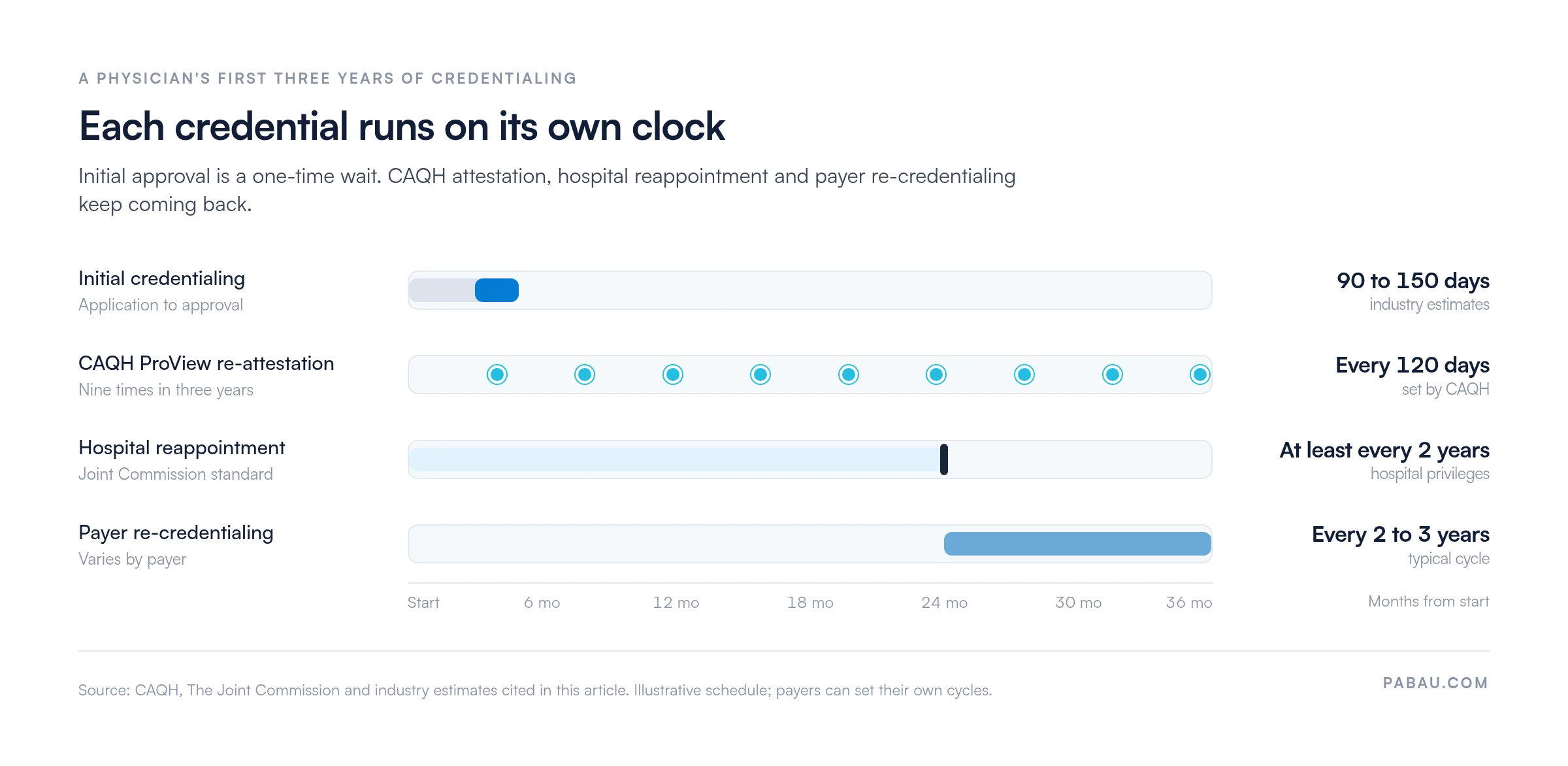
Re-verify the license, DEA, board status, malpractice coverage, and NPDB history. Update the work history to cover the period since the last cycle. Keep every expiry date in one tracker, so a lapsing license or policy gets caught before its renewal deadline passes.
Keep one working file per physician and work through it in the order below. That way, each verification result sits next to the document it relates to.
Spreadsheet trackers hold up until one expiry date is missed. Dedicated credentialing platforms such as Modio Health and Medallion offer payer-specific application tracking and CAQH sync, which reduces re-entry during attestation. They suit teams running large payer enrollments across many physicians.
Credentialing gets a physician approved. After that, the practice still has to put them on the calendar, set up their forms and notes, and bill for their visits. In many practices, each of those jobs lives in a different tool.
Pabau, the all-in-one practice management system we build, brings scheduling, online booking, patient records, and invoicing into one place. It’s software for physician practices that would rather run one system than seven. Once a physician’s payer approvals land, you add their schedule and open their slots to online booking.
CAQH sync isn’t part of Pabau, so ProView attestation stays with your credentialing coordinator or dedicated tool. The change comes after approval. A new physician’s appointments, notes, and invoices sit in one record from the first visit, so your team isn’t copying data between systems.

Pabau puts scheduling, online booking, patient records, and invoicing in one place, so a newly credentialed physician starts on a joined-up setup. Book a demo to see how it fits your practice.

A credentialing file usually stalls on small items: a missing malpractice certificate, an unexplained break in work history, or a CAQH profile nobody re-attested. Start the payer applications the day the offer is signed, and verify each item at its source as it arrives.
After approval, the job turns into calendar management. Put every renewal date, from the 120-day CAQH cycle to the two-year hospital reappointment, in one tracker that one person owns. Book a demo to see how Pabau keeps a newly credentialed physician’s schedule, records, and billing in one system.

Bringing a new physician on board? Physician onboarding checklist gives you a phased plan and a sign-off form for the weeks around their start date.
Planning hires a year ahead? Healthcare workforce planning shows how to forecast staffing needs so credentialing timelines fit the plan.
Onboarding support staff as well? Onboarding checklist template for healthcare practices gives you a reusable list for every new hire.
Hiring nurse practitioners too? Can a nurse practitioner be a medical director? explains where state rules draw the line on supervision.
Want credentialed physicians to stay? How to retain employees in healthcare covers the strategies that keep clinical staff in post.
A physician credentialing checklist lists the licenses, certificates, verifications, and enrollment documents a physician needs before a practice, hospital, or payer approves them. It helps teams avoid restarting an application over one missing item.
Timelines vary widely, and industry estimates often range from about 90 to 150 days. The payer, specialty, and completeness of the application all affect the result.
No. DEA registration is required only for physicians who prescribe, dispense, or administer controlled substances. Other physicians can omit it from their file unless a specific payer or facility asks for it.
CAQH ProView must be re-attested every 120 days. Individual payers can apply their own requirements, so confirm each payer’s rules before relying on the standard cycle.