Punch excision aftercare instructions template
Punch excision is a minor procedure that removes a small cylinder of skin with a...

2
Last Updated: Oct 15, 2026

Pabau is a multi-industry clinic management platform covering aesthetic, wellness, medical, and multi-specialty practices with unified CRM, scheduling, and clinical documentation.
Portrait Care is a US-based platform combining practice management software with bundled business services — including medical director access, compliance support, supply savings, and business coaching — built for independent medspa entrepreneurs.
Pabau offers verified multi-location support, automated appointment reminders, deposit collection, and a broader integration ecosystem natively built in.
Portrait Care’s pricing is not publicly confirmed; contact them directly for current figures before making a buying decision.
Neither platform has identical positioning – your clinic’s size, clinical complexity, and operational scope should drive the final choice.
Choosing between Pabau vs Portrait Care is a genuinely consequential decision for any aesthetic clinic or medical spa operator. Both platforms target the aesthetics segment, but they approach practice management from meaningfully different angles – and the wrong choice can create friction across every patient touchpoint from first booking to post-treatment follow-up.
Pabau is an all-in-one clinic management platform built for aesthetic, medical, wellness, and multi-specialty practices. It combines CRM, online booking, clinical documentation, digital consent forms, invoicing, staff management, and marketing automation within a single system.
Portrait Care is a US-based practice management platform built for independent medspa entrepreneurs. It combines EHR, scheduling, payments, and CRM with bundled services — medical director access, compliance support, coaching, and supply savings.
This comparison evaluates both platforms across core features, pricing transparency, integration depth, user experience, and suitability for UK and international healthcare providers. The goal is to give clinic owners and practice managers a clear, factual basis for their evaluation – not a sales pitch.
| Feature | Portrait Care | Pabau |
|---|---|---|
| Online Booking | ✅ | ✅ |
| Deposit Collection | ⚠️ Not confirmed | ✅ |
| Automated Appointment Reminders | ✅ | ✅ |
| Digital Consent Forms | ✅ | ✅ |
| Before and After Photo Management | ✅ | ✅ |
| Injection Plotting | ⚠️ Not confirmed | ✅ |
| Multi-Location Management | ⚠️ Not confirmed | ✅ |
| CRM and Client Management | ✅ | ✅ |
| Invoicing and Payment Processing | ✅ | ✅ |
| Inventory Management | ✅ | ✅ |
| Marketing Automation | ✅ | ✅ |
| Staff Management and Commissions | ⚠️ Not confirmed | ✅ |
| Third-Party Integrations | ⚠️ Not confirmed | ✅ |
| AI-Assisted Documentation | ⚠️ Not confirmed | ✅ Pabau Scribe |
| Verified Third-Party Reviews | ❌ None found | ✅ 600+ on Capterra |
The most important question for any practice management platform is whether it handles the full operational journey – from the moment a patient searches online to the moment they return for their next appointment. That journey involves booking, consultation, documentation, treatment recording, payment, and follow-up. Gaps at any point create manual workarounds and increase clinical risk.
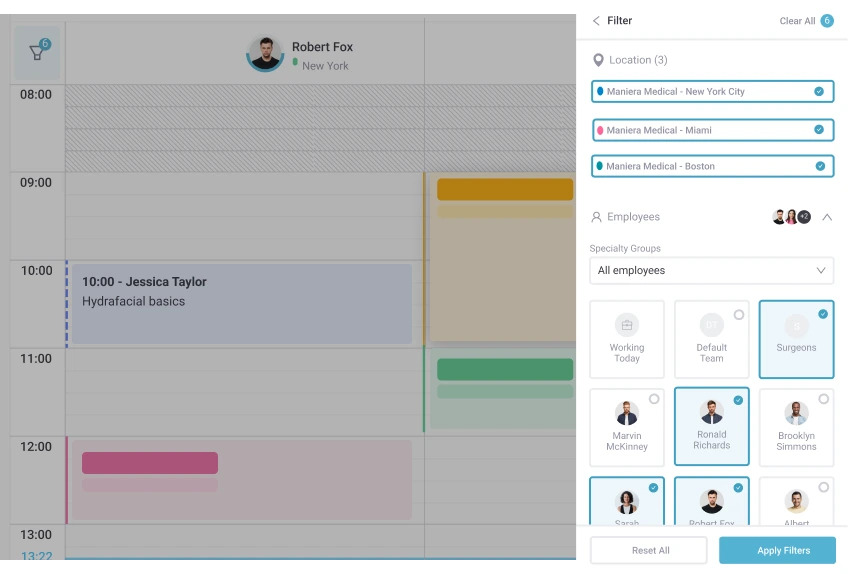
Pabau’s online booking system is natively integrated with its CRM, consent workflow, and treatment record system. Clients book directly from a clinic’s website or the Pabau client portal, with automated confirmation emails, pre-appointment reminders, and deposit collection handled without manual intervention. Multi-location scheduling is supported within the same interface, which matters for clinic groups managing staff rotas across sites.
Portrait Care includes appointment scheduling and online booking as part of its integrated platform. Patient intake forms auto-attach to records on booking, inventory updates after every session, and medical oversight workflows like Good Faith Exams trigger automatically. Clinics outside the US should verify local compatibility directly with the vendor.
In the UK, CQC-registered clinics and practitioners working under the Joint Council for Cosmetic Practitioners (JCCP) framework have specific documentation obligations. Consent must be demonstrably informed, treatment records must be comprehensive, and patient data must be handled in accordance with GDPR and ICO guidance. Software that handles these workflows within a single audit trail reduces compliance risk considerably.
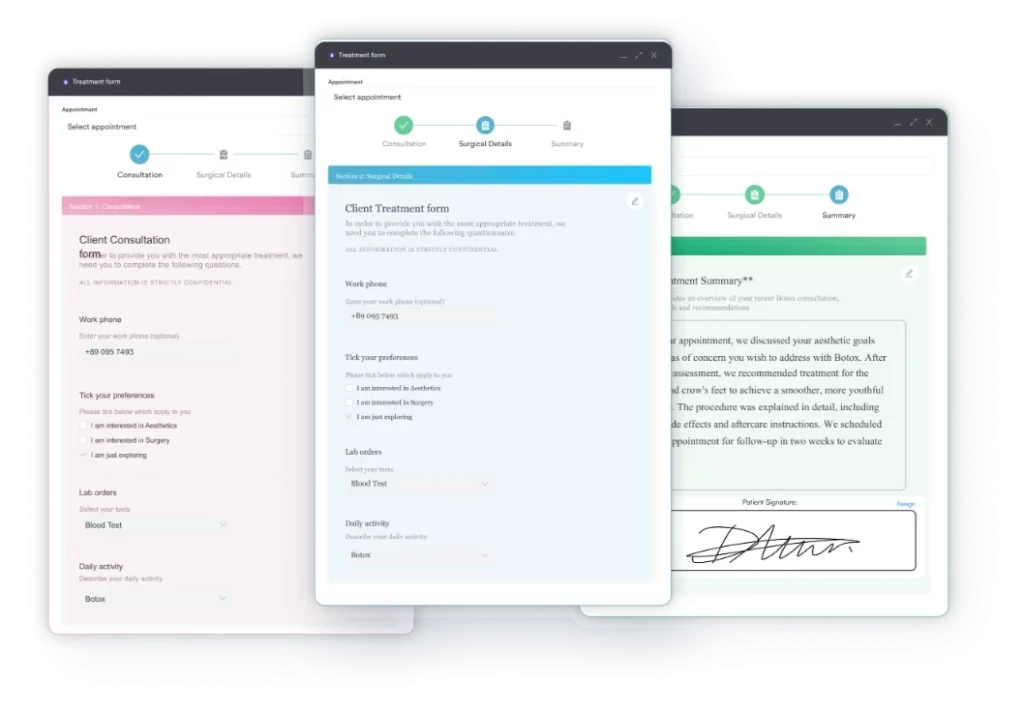
Pabau’s digital forms module covers consent documents, intake questionnaires, and post-treatment notes – all linked to the patient record. Its injection plotting tool is particularly relevant for botulinum toxin and filler practitioners who need to document treatment placement precisely. The platform also offers a before and after photo management feature, meaning visual documentation sits alongside the clinical record rather than in a separate system.
Portrait Care includes EHR and digital intake forms as part of its integrated platform. Its compliance support services — including medical director oversight — are structured around US regulatory frameworks (HIPAA, CPOM). UK clinics should request clarification on how Portrait’s compliance tools map to CQC and GDPR requirements before committing.
Pabau’s client management layer connects the patient record to automated communication workflows. This includes recall messaging for repeat treatments – particularly relevant for botulinum toxin clinics where 12-16 week recall cycles directly affect revenue – as well as post-treatment care instructions and email and SMS campaigns for promotions and re-engagement.
Portrait Care includes CRM, marketing automation, and email and SMS tools as part of its platform. Marketing support extends beyond software too — business coaching and done-for-you marketing services are part of the bundle.
Portrait Care has built its platform around the aesthetics segment, which means its feature design reflects the specific clinical and commercial needs of aesthetic practitioners. For solo practitioners or small aesthetic practices, a focused aesthetic platform may offer a more streamlined experience than a broader clinic management system.
Portrait Care also includes billing, payment features, and appointment scheduling designed for aesthetic businesses. These are core requirements for any practice management tool, and a platform built exclusively around aesthetics may have designed these workflows with sector-specific nuance.
Its bundled services — medical director access, compliance support, business coaching, and supply savings — give independent medspa entrepreneurs additional infrastructure that most standalone software vendors don’t provide.
Portrait Care does not appear on Capterra, Trustpilot, or G2 at the time of writing – meaning there is no independent verified review base available for prospective buyers to reference. This limits the ability to assess user satisfaction, support quality, or common implementation challenges from third-party data. For clinics that rely on peer validation before purchasing software, this is a notable gap.
Pricing information for Portrait Care is not publicly available or independently confirmed. Clinics should request a direct quote and compare total cost of ownership carefully against alternatives, accounting for any per-user, per-location, or feature-tier pricing that may apply.
For practices that operate across multiple locations, require complex staff management workflows, or need integration with accounting, marketing automation, or third-party payment providers, Portrait Care’s suitability for these use cases is unconfirmed. It’s worth raising directly with their team before committing.
To see how Portrait Care fares against another aesthetics-focused rival, read our Portrait Care vs PatientNow comparison.
Pabau’s strongest differentiator in a Pabau vs Portrait Care evaluation is the breadth of its operational coverage. Rather than serving one segment of the clinic workflow, Pabau handles the full client lifecycle: from online booking and automated deposits through to clinical documentation, invoicing, staff commission tracking, and post-treatment recall. For practices where manual handoffs between systems introduce errors – or where team members spend time duplicating data – a unified platform has measurable operational value.

Multi-location management is documented on Pabau’s platform. Clinic groups that operate across multiple sites can manage schedules, staff, inventory, and reporting from a centralized interface – without requiring separate software instances per location. This is particularly relevant for aesthetic group practices scaling beyond a single site.
According to Capterra reviewers, Pabau holds a rating of 4.6 out of 5 based on over 600 verified reviews. Positive themes include comprehensive platform coverage, strong booking and appointment management, and customizable consent and intake forms – all directly relevant to aesthetic clinic operations. The Pabau Scribe documentation tool provides AI-assisted note generation, reducing administrative time per consultation.
Pabau supports aesthetic, wellness, medical, and multi-specialty practices with a unified system, which means a clinic that diversifies its service menu – from injectable treatments into skin health, IV therapy, or private GP services – can do so without outgrowing its practice management software.
The breadth of Pabau’s feature set means the onboarding process has a steeper learning curve than a more narrowly scoped tool. Reviewers on Capterra note that new users sometimes require time to configure the system to their specific workflows. Pabau offers onboarding support and a help centre to address this, but practices with limited administrative capacity should factor setup time into their evaluation.
Some users have also noted occasional software performance issues, and a subset of reviewers have requested more advanced reporting customization. For most aesthetic clinics, the available reporting functionality covers core KPIs – revenue, retention, staff performance, treatment mix – but practices with highly specific analytics requirements may find some constraints.
Pricing transparency varies significantly between these two platforms – and that difference is itself informative.
Pabau operates on a subscription model priced by team size, not by features. Current pricing details are available on Pabau’s pricing page. The tiered structure means smaller clinics can start with a core plan and expand as their operational needs grow, which is useful for practices that are scaling or diversifying their service menu.
Portrait Care pricing is not publicly confirmed through any independent source. No verified pricing data was available at the time of writing. Practices evaluating Portrait Care should request a direct quote from their sales team and compare the total cost of ownership – including any per-user fees, per-location charges, and implementation costs – against the verified figures from alternatives. It is also worth asking about contract length and exit provisions.
When comparing practice management software costs, the headline subscription price rarely reflects the full picture. Training time, data migration support, ongoing customer success access, and integration costs all affect what a clinic actually pays over a 12-24 month period. Both platforms should be evaluated on total operational cost, not just the monthly fee.
Before committing to any practice management platform, request a full cost breakdown that covers the subscription fee, onboarding and training costs, data migration support, any per-user or per-location charges, and the cost of integrating with your existing payment provider or accounting software. A platform with a lower headline price can cost significantly more once implementation is accounted for.

From online booking and consent forms to treatment notes, invoicing, and automated recall – Pabau manages the full client journey in one platform. Book a personalised demo to see how it fits your aesthetic or medical practice.

Integration capability is one of the clearest differentiators in this Pabau vs Portrait Care evaluation. Most aesthetic clinics already use tools outside their practice management software – whether that is Xero or QuickBooks for accounts, Stripe or Square for payments, Mailchimp or equivalent for marketing, or third-party review collection platforms. A practice management system that cannot connect to these tools creates duplicate data entry and reduces the operational benefit of going digital.
Pabau’s integration ecosystem includes connections to accounting software, payment providers, and marketing platforms. These integrations are documented on the Pabau website and reduce the need for manual data transfer between systems. For a clinic running Xero for accounting alongside Pabau for operations, for example, financial data flows without requiring manual export and import between platforms.
For UK clinics with CQC obligations or those operating under GDPR and ICO data protection requirements, the question of where patient data is stored and how it is protected is also relevant. Pabau’s GDPR compliance information and security documentation are available on the Pabau website.
Portrait Care’s compliance framework is built around US requirements — UK clinics should request specific data storage and compliance documentation directly from Portrait Care before any migration begins.
Support quality for both platforms is best assessed through recent user reviews rather than vendor marketing materials. Pabau’s support centre and onboarding resources are accessible online. Portrait Care’s support offering should be evaluated during any trial or demonstration period – specifically the response time for technical issues and the availability of a dedicated account manager for growing clinics.
Pabau has an established public review presence across multiple platforms. According to Capterra reviewers, Pabau holds a 4.6 out of 5 rating based on over 600 verified reviews – a substantial base for a specialist healthcare software product. Reviewers consistently highlight the comprehensive nature of the platform, specifically citing appointment management, client communication tools, and the flexibility of the consent form and documentation system as standout features.
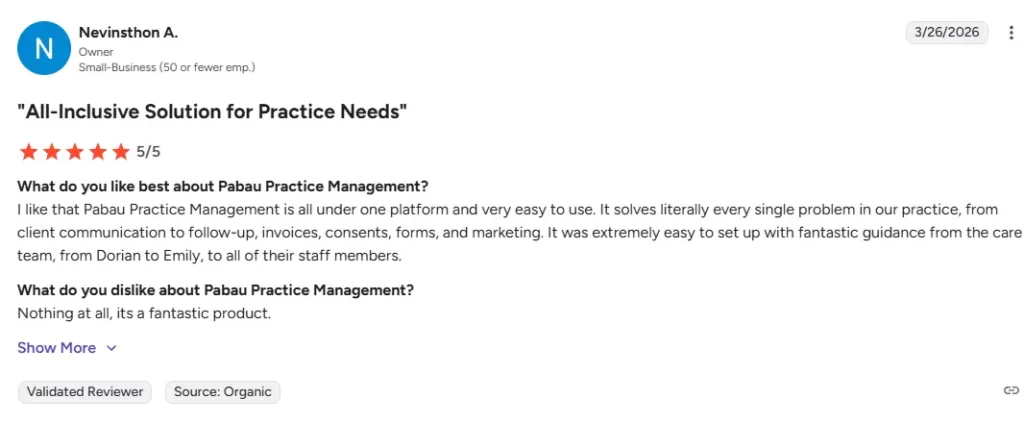
According to G2 reviewers, Pabau also carries a 4.7 rating. The themes across both platforms align: users appreciate having booking, clinical records, and billing within a single system, and the onboarding team receives positive mentions in multiple reviews. The most frequent constructive feedback relates to the learning curve during initial setup and occasional performance issues – both common characteristics of feature-rich platforms.
Trustpilot shows a 4.1 rating, though the review count there is lower than Capterra. The Capterra dataset is the most reliable basis for comparison given its verification process and volume.
Portrait Care does not have a public profile on Capterra, G2, or Trustpilot at the time of writing. No independently verified user reviews were available through these platforms. This means prospective buyers cannot draw on third-party data to assess user satisfaction, support responsiveness, or typical implementation experience.
For clinics that rely on peer validation as part of their software evaluation process, this is a meaningful gap. When evaluating Portrait Care, ask the vendor for direct reference contacts at practices of a similar size and service mix to your own. A reference call with an existing user provides qualitative data that compensates for the absence of a public review profile.
The right answer depends on what your clinic actually needs from a practice management system – including where you’re based and whether you want software alone or software plus a surrounding services infrastructure.
Choose Pabau if your clinic requires a unified operational platform covering booking, clinical documentation, consent, invoicing, staff management, and marketing automation. It is particularly suited to practices operating across multiple locations, practices that are scaling and diversifying their service mix beyond aesthetics, and any clinic where integration with accounting, payment, or marketing tools is a current or near-term requirement. The verified review base, documented multi-location support, and alignment with UK regulatory frameworks make it the default choice for any clinic operating outside the US.
Choose Portrait Care if you are a US-based aesthetic entrepreneur launching or scaling an independent medspa, and you want a platform that combines operational software with compliance infrastructure, medical director access, supply savings, and business coaching in one place. However, given the absence of public third-party reviews, request a full demonstration and speak to reference users before committing. UK-based clinics should approach with caution and verify compliance coverage carefully.
In either case, run both platforms through a structured evaluation using your own clinic’s specific workflows – not a generic feature checklist. The platform that handles your most frequent daily tasks with the least friction is almost always the right choice, regardless of how the marketing materials compare.
Different clinic configurations benefit from different platforms. These scenarios reflect the Pabau vs Portrait Care decision as it plays out in real practice contexts.
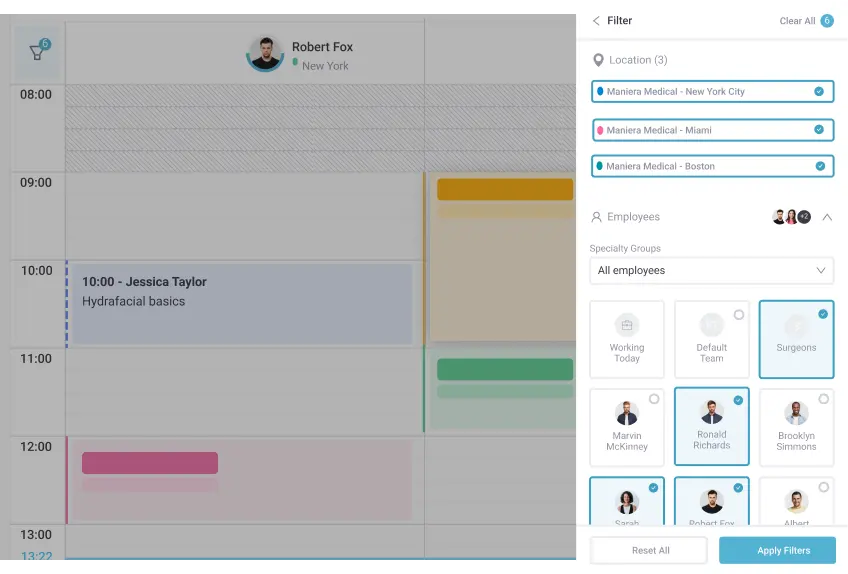
Multi-practitioner aesthetic clinic, two locations: A clinic running 8-10 practitioners across two sites, offering injectables, skin treatments, and laser services, needs centralized scheduling, per-practitioner commission tracking, consolidated reporting, and a clinical documentation system that travels with the patient record regardless of which site they visit. Pabau’s multi-location management and staff management tools are designed for this configuration. Portrait Care’s suitability for this use case is unconfirmed.
Solo injector, primarily injectables and skin consultations: A solo practitioner seeing 15-20 clients per week needs reliable appointment management, digital consent, injection mapping, and recall messaging. Pabau covers all of this. Portrait Care may suit practitioners who value the bundled services model — but the absence of verified reviews makes a trial advisable before committing.
Clinic diversifying into medical aesthetics and private GP: A practice adding private GP consultations, wellness assessments, or IV therapy alongside its aesthetic services will outgrow a purely aesthetics-focused platform relatively quickly. Pabau supports aesthetic, medical, wellness, and allied health practices within the same system – so expanding the service menu does not require changing the software. This adaptability is a concrete operational advantage for practices with growth ambitions beyond a single treatment category. See Pabau for medical spas and skin clinic software for further detail on supported industries.

Comparing scheduling software for a multi-location practice? Pabau vs SimplePractice compares scheduling, reminders, and client portals across both platforms.
Comparing options for a South African practice? Pabau vs Healthbridge compares features, pricing, reviews, and compliance for South African practices.
Running a dental practice and comparing software? dental practice management software compares cloud platforms and clinical workflow features for US dental practices.
Curious what Zanda costs per month? Zanda pricing breaks down every plan cost and how it compares to Pabau.
The Pabau vs Portrait Care decision comes down to operational scope and geography. Portrait Care suits independent US medspa entrepreneurs who want software and business services in one place — though the absence of verified pricing and third-party reviews means due diligence is essential before committing.
Pabau is the broader platform, built for aesthetic, medical, wellness, and multi-specialty practices needing the full operational stack. With over 600 verified reviews on Capterra, multi-location support, and Pabau Scribe, it is the lower-risk choice for complex or growing practices — and the default for any clinic outside the US.
If Pabau sounds like the right fit for your practice, book a personalised demo to see how it handles your specific workflows.
Portrait Care is a US-based practice management platform designed for independent medspa entrepreneurs. It combines EHR, scheduling, CRM, payments, and inventory management with bundled business services including medical director access, compliance support, and supply savings. Specific capabilities should be verified directly with Portrait Care, as independent documentation is limited.
Pabau is a broader platform covering the full clinic workflow — booking, digital consent, injection plotting, invoicing, staff management, and marketing automation. Portrait Care combines practice management software with bundled business services for independent US medspa entrepreneurs. Pabau suits practices needing multi-location support or broader operational depth; Portrait Care suits US-based practitioners who want software and business infrastructure in one place.
Portrait Care includes appointment scheduling and online booking capabilities. Whether it supports deposit collection natively has not been independently confirmed at the time of writing. Pabau’s deposit collection feature is documented and integrated with its online booking system. Verify Portrait Care’s deposit functionality directly with their team before evaluating it for your clinic.
Both platforms include before-and-after photo management. Pabau links images directly to the patient record alongside treatment notes and consent forms. For UK practitioners, having photographic records within the clinical record supports GDPR compliance by reducing fragmented data storage.
Yes. Pabau integrates with third-party payment providers and accounting software including Xero. Its integration ecosystem is documented on pabau.com/integrations. This allows financial data to flow between Pabau and accounting tools without manual export, which is relevant for clinics managing revenue across multiple practitioners or locations.
Portrait Care’s dashboard tracks KPIs in real time. The specific metrics, customization options, and export capabilities are not independently documented at the time of writing. Pabau provides detailed analytics covering revenue, staff performance, client retention, and treatment outcomes, with multi-location consolidation available for clinic groups.