Health appraisal form
A health appraisal form is a record a licensed provider signs to document someon...

2
Last Updated: Oct 13, 2026

NextGen healthcare pricing is not published anywhere. Every practice gets a custom quote shaped by provider count, specialty, and module mix.
Third-party platforms report NextGen Office at roughly $299 to $549 per provider per month, and Enterprise pricing is fully custom.
Implementation, training, migration, and premium support are usually quoted separately, so year-one cost runs well above the subscription line.
Three platforms on a typical NextGen shortlist do publish a rate: eClinicalWorks, AdvancedMD, and Pabau.
Pabau, practice management software for aesthetic and wellness practices, publishes pricing from $65 per month.
NextGen Healthcare publishes no pricing. There is no rate card and no published tier comparison, so every figure circulating online is a third-party estimate rather than a confirmed rate. The range most often quoted for NextGen Office is $299 to $549 per provider per month.
Quote-based pricing is normal in enterprise EHR software. It also means a smaller specialty practice cannot compare vendors without sitting through several sales processes. Your quote moves with your specialty, your provider count, and the modules you bundle.
This guide covers what practices report paying and which line items sit outside the subscription. It also shows how NextGen compares with the vendors that do publish a rate. Use it to walk into a sales call with a number already in mind.
NextGen healthcare pricing is not published on its website. There is no pricing page and no rate card, so every quote comes out of a sales conversation and reflects your specific setup. Third-party review platforms report $299 to $549 per provider per month for the Office (cloud) edition. NextGen has not confirmed those figures, and they may not reflect current rates.
Four factors move a quote up or down. The number of providers in your practice and the specialty you serve both matter. So does your module mix, meaning EHR only against EHR plus practice management. Data migration from a legacy system is the fourth. A solo dermatologist and a 12-provider orthopedic group will get very different quotes for the same edition.
Important caveat: these figures come from third-party review sites and may not match the quote you receive. Treat them as a budgeting benchmark, not a confirmed price.
NextGen Office is the cloud-hosted line built for smaller specialty practices. It bills per provider, per month, and the rate scales with your specialty and your selected modules. Third-party sources consistently report the $299 to $549 band. Practices that bundle practice management alongside the EHR tend to land near the top of it.
The Office edition typically covers clinical documentation, e-prescribing, a patient portal, and scheduling. The practice management module is often priced as an add-on rather than a default inclusion. Ask your sales contact which modules your quote bundles and which are billed separately.
NextGen Enterprise is built for larger, more complex practices and health systems. It deploys on-premise or in a hosted environment, and pricing is fully custom with no published starting point. Budget for total cost of ownership here, not just the software license.
Enterprise implementations are typically led by NextGen’s professional services team. Implementation fees are a significant line item, often running into tens of thousands of dollars depending on practice size and data complexity. Enterprise’s case usually rests on connecting to existing hospital or health system infrastructure, so price the integration work that connection takes.
The subscription fee is only part of what practices pay. Both editions leave several cost categories out of the initial quote. Practices that budget around the base subscription alone routinely meet unplanned expenses in year one.
Treat the base subscription and the implementation as two separate budget lines. Some practices also buy a patient engagement or CRM tool to supplement NextGen, which adds another layer to total spend. Reputation platforms sit in the same category, and Birdeye pricing per location comes by quote rather than a published rate.
Ask your NextGen sales rep for an all-in year-one cost estimate in writing, including implementation, training, and data migration. Comparing subscription fees alone will understate NextGen’s total cost against platforms with inclusive onboarding.
NextGen scores 3.7 out of 5 on Capterra (280 reviews) and 3.8 out of 5 on G2 (190 reviews). Scores in this range are typical for enterprise EHR products. Implementation complexity and support response times weigh on satisfaction even when the clinical features are well regarded.
NextGen works well for practices with an established billing team, dedicated IT resources, and time to invest in a longer implementation cycle. It is not designed for a practice that needs to be operational within weeks. Direct primary care and other lean models generally need something simpler and faster to deploy.
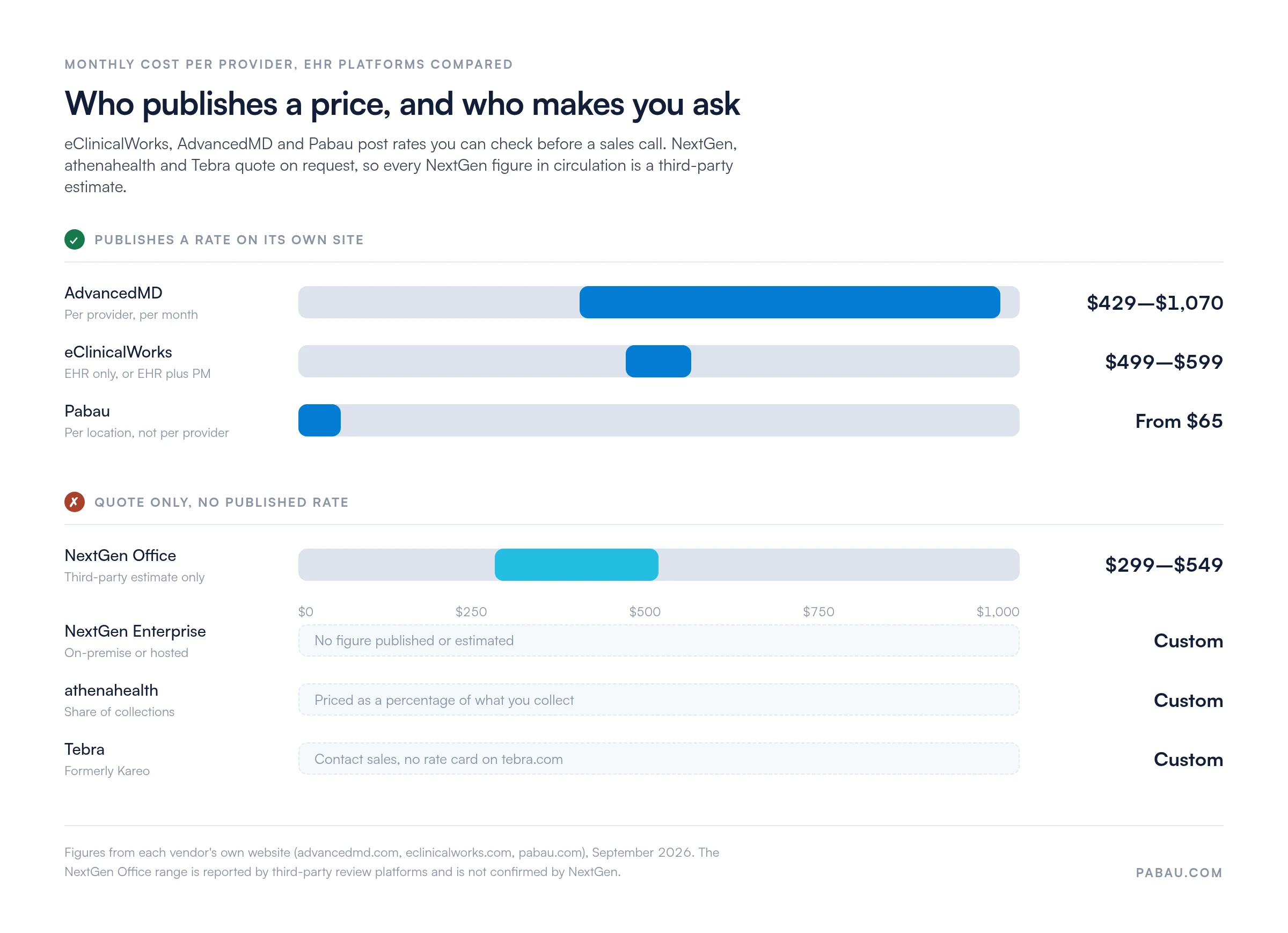
NextGen sits in the mid-to-upper range of specialty EHR pricing, though only some of its rivals let you check that without a call. The table below mixes vendor-published rates with third-party estimates, and each row says which it is. Request quotes from at least three vendors using the same practice parameters before you decide.
Rows marked as published come from the vendor’s own website. NextGen’s range is a third-party estimate that NextGen has not confirmed. Request a formal quote before you budget.
The split matters as much as the numbers. Three of these platforms let a practice check a rate before booking a call, and three do not.
Our breakdown of Nextech pricing applies the same method to another specialty EHR, if that vendor is also on your shortlist.
Tebra sits at the affordable end of this list, but it publishes no rate card. Our guide to Tebra pricing explains what that means when you request a quote.
Veradigm, formerly Allscripts, quotes the same way. Our breakdown of what Veradigm costs sets out the implementation estimates in circulation.
Practices look elsewhere for three reasons. NextGen’s pricing is opaque, its implementations run long, and it fits non-traditional specialties like aesthetics, wellness, and IV therapy poorly. The options below come up most often on a NextGen shortlist.
Pricing across that group varies more than the feature sets do. Our drchrono pricing breakdown covers the mobile-first option in detail. Our index of Pabau alternatives and competitors sets each of these platforms next to Pabau, feature by feature.
NextGen healthcare pricing makes most sense for a practice that can use the platform’s specialty depth in full. A 10-provider orthopedic group with a dedicated billing team and a three-month implementation window will get its money’s worth. Even at the top of the reported range, the per-provider subscription is competitive for that scope.
Under five providers, the economics shift. Implementation and training costs that a larger group absorbs comfortably become proportionally heavy at small scale. Solo practitioners and two-to-three-provider practices consistently report better value from simpler, faster platforms.
The same holds for any practice outside NextGen’s core specialties. Say your workflows center on aesthetic treatments, hormone therapy, or functional medicine. NextGen then needs more configuration than a platform built for those verticals from the start. Weigh total year-one cost rather than the subscription line before you commit.
A practice running aesthetic or wellness treatments on a general-purpose EHR usually ends up assembling its own workflows. Consent forms live in a separate signing tool, before-and-after photos sit in a phone gallery or a shared drive, and follow-ups get chased by hand. That configuration work is a large part of what pushes an enterprise EHR quote up.
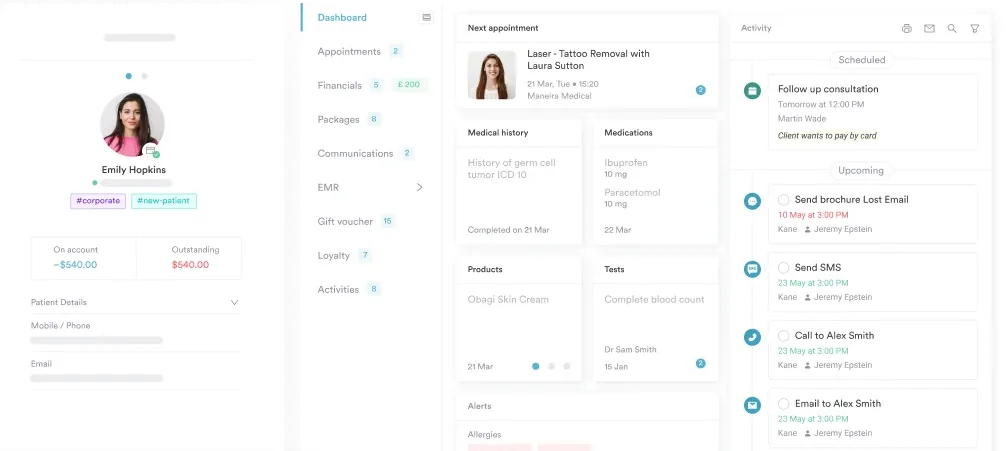
Pabau, practice management software built for aesthetic medicine, medspas, and private specialty practices, ships those workflows as standard. Treatment records, consent forms, before-and-after photo management, and automated patient follow-ups are all included. Because it is purpose-built as medical spa software, the workflows already match how these practices operate.
Pricing is published from $65 per month, tied to location and user count rather than an opaque per-provider quote. Every subscription includes every feature, so switching one on does not change what you pay. Onboarding is structured and led by our team, which is how a practice gets running in weeks rather than months.
On Capterra, Pabau scores 4.6 out of 5 from 566 reviews. Reviewers most often name easy onboarding and responsive support as the strengths.

Pabau bundles treatment records, consents, photo management, bookings, and billing into one subscription with published pricing. You get a specialty-ready setup without paying to have it built.

NextGen healthcare pricing is opaque by design, and that suits the product it sells. NextGen is a feature-rich EHR for practices with complex billing environments and the resources to run a structured implementation. For those practices, the cost is usually justified.
For a smaller or non-traditional specialty practice, the same qualities read as friction. Opaque pricing, long go-lives, and add-on fees turn a reasonable subscription into poor value. The honest test is whether you will use the specialty depth you are paying for.
If the answer is no, price the platforms that publish a rate before you book a NextGen call. Book a demo to see how Pabau covers records, bookings, billing, and follow-ups for an aesthetic or wellness practice without an IT team.

Comparing another specialty EHR on price? Nextech pricing breaks down what specialty practices report paying, using the same year-one cost method.
Shortlisting replacements for a quote-only vendor? Tebra alternatives compares the platforms small specialty practices move to, and what each one costs to run.
Weighing a mobile-first EHR instead? drchrono alternatives covers the cloud options that suit small practices better than an enterprise deployment.
Replacing a Kareo-era setup? Best Kareo alternatives reviews the platforms medical practices move to after Tebra, and what each costs.
NextGen Healthcare pricing is not publicly disclosed. It is a quote-based model where cost depends on your edition, Office or Enterprise, plus provider count, specialty, and selected modules. Third-party sources estimate the Office edition at $299 to $549 per provider per month. Official rates require a sales conversation.
Based on third-party estimates, NextGen Office costs roughly $299 to $549 per provider per month. Enterprise pricing is entirely custom and typically higher. Total year-one cost sits well above the base subscription once implementation and training are counted.
NextGen Office is the cloud edition, billed per provider per month and reported in the $299 to $549 range. NextGen Enterprise is the on-premise or hosted version for larger practices. Its pricing is fully custom, and it adds implementation and infrastructure costs on top of the software license.
eClinicalWorks, AdvancedMD, and Pabau publish rates on their own websites. NextGen, athenahealth, and Tebra quote on request. That means you can benchmark half of a typical shortlist before taking a single sales call.
NextGen does not offer a self-serve free trial. A guided demo is available by request through its sales team. Expect a discovery call and a needs assessment before any product demonstration is scheduled.
The best alternative depends on your practice type. Tebra, formerly Kareo, works well for smaller specialty practices. Pabau is the strongest option for aesthetic, wellness, and medspa practices. It publishes pricing from $65 per month and ships those specialty workflows as standard.
No. NextGen does not publish pricing on its website. Every quote comes through direct contact with its sales team. Costs vary widely with practice configuration, module selection, and provider count.