Health appraisal form
A health appraisal form is a record a licensed provider signs to document someon...

2
Last Updated: Oct 13, 2026
Birdeye lists no public pricing. Third-party estimates land around $299–$349 per location per month, which makes them benchmarks rather than quotes. Smaller practices reviewing Birdeye on G2 frequently flag that opacity, though the platform still averages 4.7/5.
Opacity costs healthcare businesses more than it costs retail or hospitality. A med spa owner comparing review management software has to know the total cost of ownership, not the headline monthly figure. Add-ons, per-location fees, and contract length can push the annual spend well above the starting rate.
This guide breaks down what Birdeye costs across its three plans and where the extra fees sit. It also covers how the per-location model lands on a multi-site practice, and which alternatives are worth a look.

Birdeye publishes no pricing, and third-party breakdowns put the entry tiers at roughly $299 to $349 per location each month.
Three plans are on offer, Starter, Growth and Dominate, and the per-location rate falls as you add sites.
Onboarding charges, add-on modules and 12-month contracts can lift the total well above the headline monthly fee.
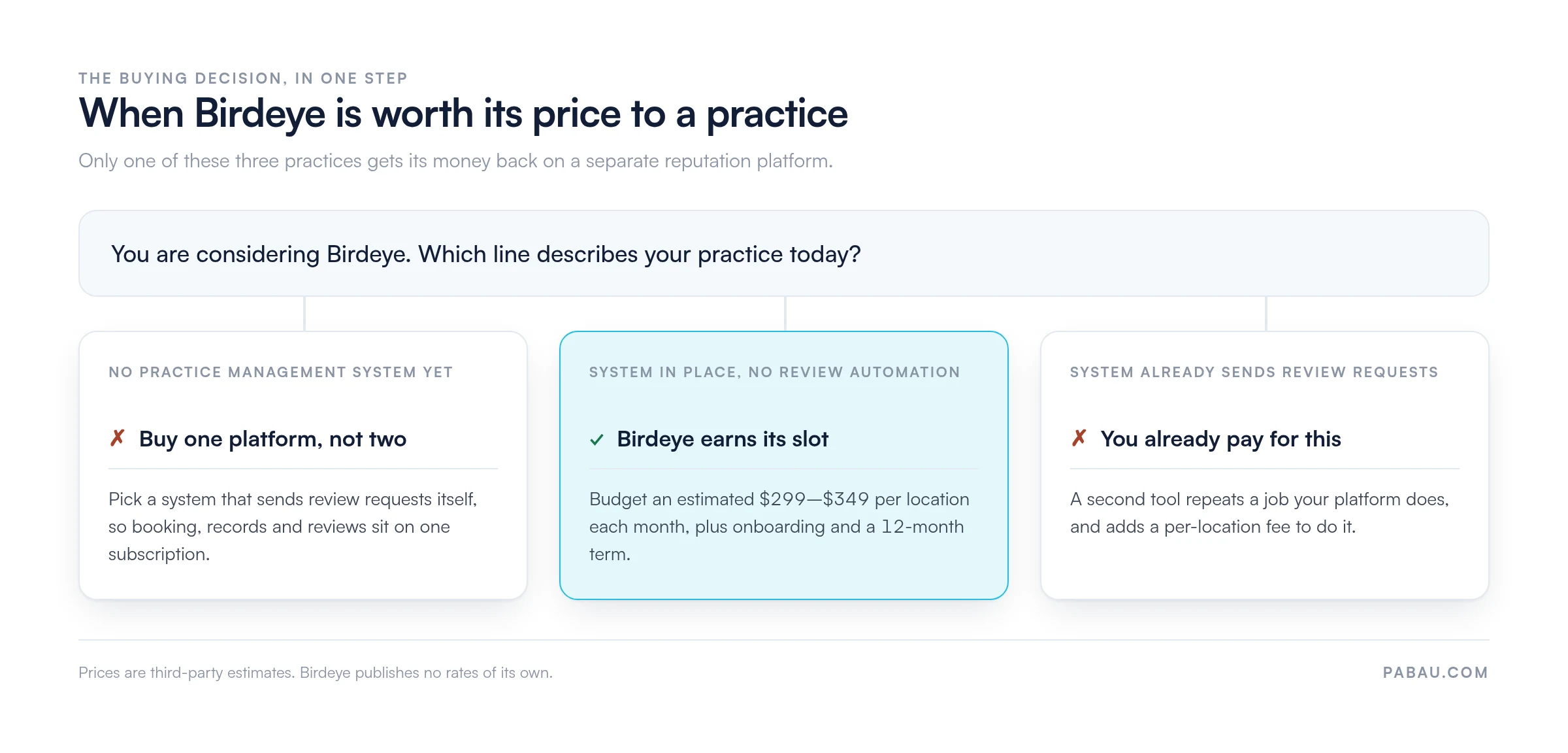
Birdeye covers reviews only, so a practice still pays separately for booking, clinical records and billing.
A practice choosing a system from scratch can get review requests built into practice management software like Pabau instead, alongside booking and clinical records.
Birdeye is a cloud-based reputation management and customer experience platform. It helps businesses generate reviews, monitor their online presence, and message customers across several channels.
It serves dentistry, aesthetics, retail, hospitality and legal services, which makes it a horizontal tool rather than a healthcare-specific one.
Core capabilities include review generation by SMS and email, Google Business Profile integration, social media monitoring, webchat, and a unified messaging inbox.
Its AI features draft review responses and surface sentiment trends across locations. For a multi-location dental group or a national med spa franchise, those features cut hours of manual review chasing every week.
Birdeye leaves the clinical side out entirely. There is no appointment booking, no clinical documentation, no treatment records and no billing. A practice that adds Birdeye has to connect it to a separate practice management system, which costs money and adds moving parts.
Birdeye does not publish pricing on its website. To get a quote, you have to book a demo with its sales team. Independent breakdowns from software review sites and industry blogs point to three named tiers: Starter, Growth and Dominate.
Every figure above comes from third-party review sites and may not match current Birdeye rates. Birdeye has confirmed that it does not publish official pricing, so treat these as benchmarks. Contact Birdeye directly for a number that applies to your practice.
The Starter plan covers the fundamentals. You get automated review requests by SMS and email, review monitoring across Google and Facebook, and the option to publish reviews on your website. For a single-location practice building its review profile, that is enough to start.
At roughly $299 per month, it is not cheap for a solo practitioner or a small practice with tight margins. The value case rests on how many reviews you generate, and whether those reviews turn into booked appointments.
The Growth plan adds webchat, business listings management and social media tools to the review core. A practice that wants one inbox for web inquiries, review responses and social comments gets it at this tier. At an estimated $349 per location, a two-site practice pays around $700 a month before add-ons.
The Dominate plan is priced on request and aims squarely at multi-location businesses. It carries Birdeye’s AI tools for automated review responses, sentiment analysis, competitive benchmarking and API access. For a national aesthetic chain or a dental group running 10 or more sites, the range on offer starts to justify the cost.
Below roughly five locations, the return at Dominate pricing is hard to argue for without a detailed needs assessment.
If you’re also comparing practice management systems, review requests don’t have to be a separate line item. Practice management software like Pabau sends the request from inside the same record that holds the booking and the treatment note.
That’s a different job than Birdeye’s. Birdeye is built to run reputation management across many locations and many review sites at once, and it goes deeper on that one job than a bundled feature does. Pabau’s version covers the core loop, mark a treatment complete and the request goes out, without a second subscription to manage.
Pabau pricing starts at $104 a month in the US, and every plan includes every feature. For a practice weighing a dedicated reputation platform against a bundled one, that’s the trade worth running the numbers on.
The monthly plan fee is rarely the full picture. Several categories of extra spend show up consistently in user reviews and in third-party breakdowns of what Birdeye costs over a year.
None of this makes Birdeye a poor choice. It does make the total harder to predict, which matters when you are deciding whether the platform fits one practice’s budget.
Before you sign, ask Birdeye’s sales team for three numbers in writing. Those are the total onboarding fee, the add-ons your chosen tier does not include, and the minimum contract length. Get them before the demo call ends.
Birdeye’s per-location model suits multi-location businesses in theory, because volume discounts cut the rate as you add sites. In practice, healthcare groups should run the numbers before the demo call.
Take a med spa group with five locations. At the Growth plan’s estimated $349 per location, the base cost is $1,745 a month. That sits before add-ons, before integration work and before any onboarding fee, and it buys no clinical workflow at all.
Volume discounts exist at higher location counts, but Birdeye does not quantify them publicly. If you are running a growing group, add the cost of whichever practice management system you run alongside Birdeye, because the two do not overlap.
Birdeye is a mature, well-reviewed product in its category. It has real strengths, and real limitations worth weighing before you sign a 12-month contract.
Birdeye’s own strengths point to a specific kind of buyer. Here’s where it earns its price, and where the case is weaker.
Ten or more sites, brand consistency to protect, and enough review volume that AI-assisted responses save real time. This is where Birdeye’s per-location model and its depth of monitoring pay for themselves.
A team that can act on Birdeye’s sentiment reporting and competitive benchmarking gets more from the platform than one that logs in once a month. The reporting is built for someone whose job includes reading it.
Solo practitioners and small practices, where $299 to $349 a month is a meaningful budget line, will feel the cost more than the benefit. And any healthcare practice still needs booking, clinical notes and patient records from somewhere else. Birdeye doesn’t touch that side of the business.
Birdeye holds a 4.7/5 rating on both G2 and Capterra, across thousands of verified reviews. The picture looks different on Trustpilot, where reviews aren’t vendor-solicited and the rating sits closer to 3.4/5.
Reviewers on G2 and Capterra praise the automated review request system for producing a steady flow of authentic feedback, and consistently call out the support team’s responsiveness during setup. The reporting comes up often as genuinely useful for spotting sentiment trends across locations, not a dashboard nobody opens.
The recurring theme in less favorable reviews is billing, not the product itself. Reviewers describe 12-month contracts that auto-renew, and cancellation that’s harder to arrange than the sign-up was. The Better Business Bureau has logged over 100 complaints in the past three years, most about renewal and billing rather than the software’s features.
A smaller group of reviewers flag a cumbersome initial setup. One limitation comes up more than once: Birdeye syncs with Google but not Yelp, which matters for a business that leans on Yelp for local discovery.
Birdeye and Pabau aren’t really solving the same problem. Birdeye is a dedicated reputation management tool, and it goes deeper on that single job than most bundled alternatives do.
It doesn’t book appointments, store treatment notes, manage consent forms or handle billing, so a practice using it runs a separate practice management system alongside it.
Practice management software built for aesthetic and healthcare practices, such as Pabau, carries automated review requests inside the core patient communication workflow. Mark a treatment complete and the request goes out by SMS or email, with no second tool and no integration to maintain. The same platform handles booking, clinical records and billing.
A practice paying for Birdeye and a separate management system is funding two platforms where one could cover both jobs. For medical spa software buyers, that sum is worth doing before any contract is signed.
Pabau’s email and SMS campaigns handle post-treatment follow-up and review requests inside the workflow that already manages bookings and records.
If Birdeye pricing sits outside your budget, or the feature set does not match what you need, three alternatives cover different parts of the problem.
The evaluation framework is short. If you already run a practice management system you like and it has no review automation, Birdeye or Podium can cover that one job. Some practices on enterprise health record software take that route, because NextGen healthcare pricing often leaves patient engagement tools out of the base quote.
If you are choosing a platform from scratch, pick one that includes review requests in the same subscription. That keeps a second vendor off your invoice. Our comparisons for practice owners line the main platforms up side by side. Our breakdown of Zenoti pricing runs the same sums for an all-in-one med spa system.
Most practices still chase reviews by hand. A receptionist remembers to ask at checkout, or someone exports last week’s appointments and pastes the list into a separate review tool. The request goes out days late, once the treatment is no longer fresh in the patient’s mind.
Pabau is practice management software for aesthetic and healthcare practices, and review requests run off the appointment itself. When a treatment is marked complete, the message goes out by SMS or email on the timing you set. The booking, the clinical note and the request share one patient record, so nobody re-keys a list or pays for a connector.
You get a steadier flow of reviews without a second subscription, and one monthly fee covering booking, records, consent, payments and communications. Every Pabau subscription includes every feature, so review automation is not a tier you have to climb to.

Pabau combines automated review requests with appointment scheduling, patient records and clinical workflows. One platform, one monthly fee, no integration costs.

Birdeye earns its price for multi-location businesses with the budget and the marketing resource to run a dedicated reputation platform, and its monitoring depth backs that up. For a solo practice or a small group, the case is harder. The monthly cost, the 12-month term and the missing clinical features all count against it.
The trade-off worth remembering is the second subscription. Review automation bought on its own will always cost more than review automation that arrives with the system you already run.
So price the whole stack rather than the single tool. Ask what your current software already does before you add another vendor. Book a demo to see how Pabau sends review requests automatically after every appointment, alongside booking and clinical records.

Weighing Pabau against the other platforms on your shortlist? Pabau competitors and alternatives sets out where each one fits and who it suits.
Comparing all-in-one systems built for aesthetic practices? PatientNow pricing breaks down the plans and the costs that land after signing.
Looking at salon and med spa platforms on price? Boulevard pricing covers the tiers, the per-user fees and what each plan includes.
Birdeye pricing is quote-based, with no rates published on its website. Third-party breakdowns put the entry and mid tiers at roughly $299 to $349 per location each month. Enterprise pricing for multi-location businesses is available on request. You have to contact Birdeye’s sales team to get a figure for your own practice.
No. Birdeye does not offer a free plan, and every plan needs a paid subscription. Contracts are typically annual. Birdeye lists no free trial option on its website.
Yes, in practice. Beyond the monthly plan fee, users commonly report separate onboarding charges and extra costs for modules outside the base plan. Annual lock-in periods also make early cancellation expensive. Ask for a full cost breakdown in writing before you sign.
Both use quote-based, non-public pricing at similar starting points. Podium is the leaner product, focused on text-based review requests and payments. Birdeye covers more ground, including AI tools and multi-platform monitoring. Neither publishes a rate card, so both need a sales conversation before you can compare.
The strongest alternative for a healthcare practice is management software with review management built in, such as Pabau. It sends review requests after each appointment, inside the platform that already handles booking and clinical records. For standalone reputation management, Podium is the closest competitor to Birdeye.
Birdeye rates 4.7/5 on both G2 and Capterra, with reviewers praising the automated review system, support quality and sentiment reporting. Trustpilot tells a different story at closer to 3.4/5, and the Better Business Bureau has logged over 100 complaints in the past three years, mostly about 12-month contracts and renewal billing rather than the product itself.