Health appraisal form
A health appraisal form is a record a licensed provider signs to document someon...

2
Last Updated: Oct 13, 2026
Veradigm pricing is not published anywhere on the vendor’s website, so every figure comes from a custom quote.
Third-party analyst estimates put implementation between $5,000 for a small practice and $50,000 or more for a larger multi-provider group. The recurring subscription is charged per provider, and no starting rate is public at all.
This guide sets out what is known about each Veradigm cost component and what pushes a quote higher. It also lists six questions that turn a vague proposal into a number you can compare.

Veradigm publishes no pricing, so every cost comes from a custom quote through a sales representative.
Implementation costs range from roughly $5,000 for a small practice to $50,000 or more for a larger group, per third-party estimates.
ePrescribe is sold standalone or bundled with the EHR, and EPCS support is a separate cost driver.
Pabau publishes its subscription tiers from $104/month, so you can compare cost before you engage any sales team.
Veradigm pricing follows an enterprise custom-quote model. The company does not publish a pricing page, a starting tier, or a per-provider rate on its website. Every cost figure in circulation comes from third-party analyst estimates or from practices that have been through the sales process.
Veradigm, formerly Allscripts, is a clinical EHR and data analytics platform for ambulatory medical practices. Its lineup covers the Veradigm EHR, the standalone ePrescribe module, and data services such as RxTruePrice. What a practice pays depends on the modules selected, the provider count, and the level of implementation support.
The table below collects the publicly available cost signals for each component.
Every dollar figure above is a directional estimate from third-party research such as ITQlick, not a confirmed Veradigm rate. Treat them as opening benchmarks for a sales conversation rather than binding quotes. Software buyers outside the EHR market hit the same wall, which is why Birdeye pricing also has to be pieced together from third-party estimates.
The Veradigm EHR, formerly Allscripts Professional EHR, is the platform’s core product. It targets ambulatory medical practices in primary care and multi-specialty settings. That market is why its quotes read like enterprise software quotes.
Several factors decide what a practice actually pays for the EHR component:
Integration costs sit on top of that. A practice that needs Veradigm to connect with an external billing clearinghouse will usually pay an integration fee. The same applies to a specific lab system or patient portal.
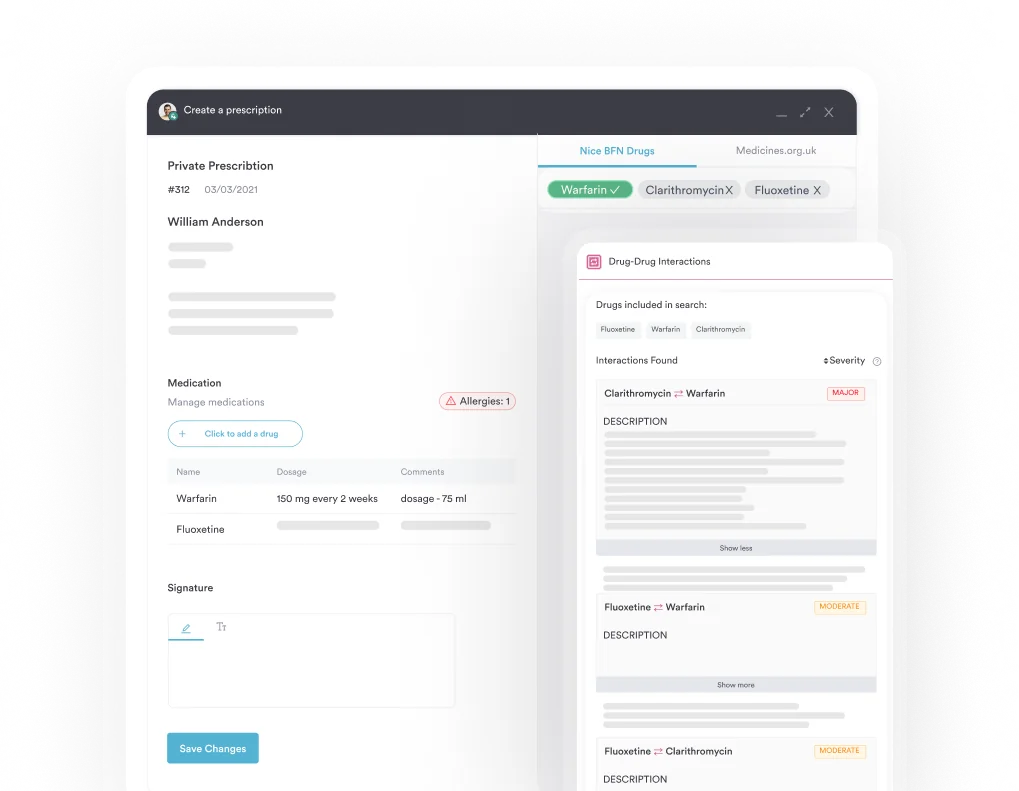
Veradigm ePrescribe is a dedicated electronic prescribing module with full EPCS support, as confirmed on the official Veradigm ePrescribe page. EPCS stands for Electronic Prescribing for Controlled Substances. A practice can license it standalone or take it as part of the broader Veradigm EHR suite.
Key cost considerations for ePrescribe:
A practice that does not need EPCS, and only wants standard e-prescribing, often finds the standalone module cheaper than the full EHR. It is worth benchmarking that module against all-in-one platforms where prescription management tools ship inside the base package.
Implementation is the most variable line in any Veradigm quote. Two practices of the same size can receive estimates that differ by a factor of three.
The main drivers are:
Ask your Veradigm sales contact to itemize implementation: data migration, training delivery, third-party integrations, and go-live support. A single implementation fee makes it impossible to compare quotes across vendors. Insist on the detailed version before you sign.
Laid out side by side, the published and quote-only lines show why budgeting for Veradigm is so awkward.
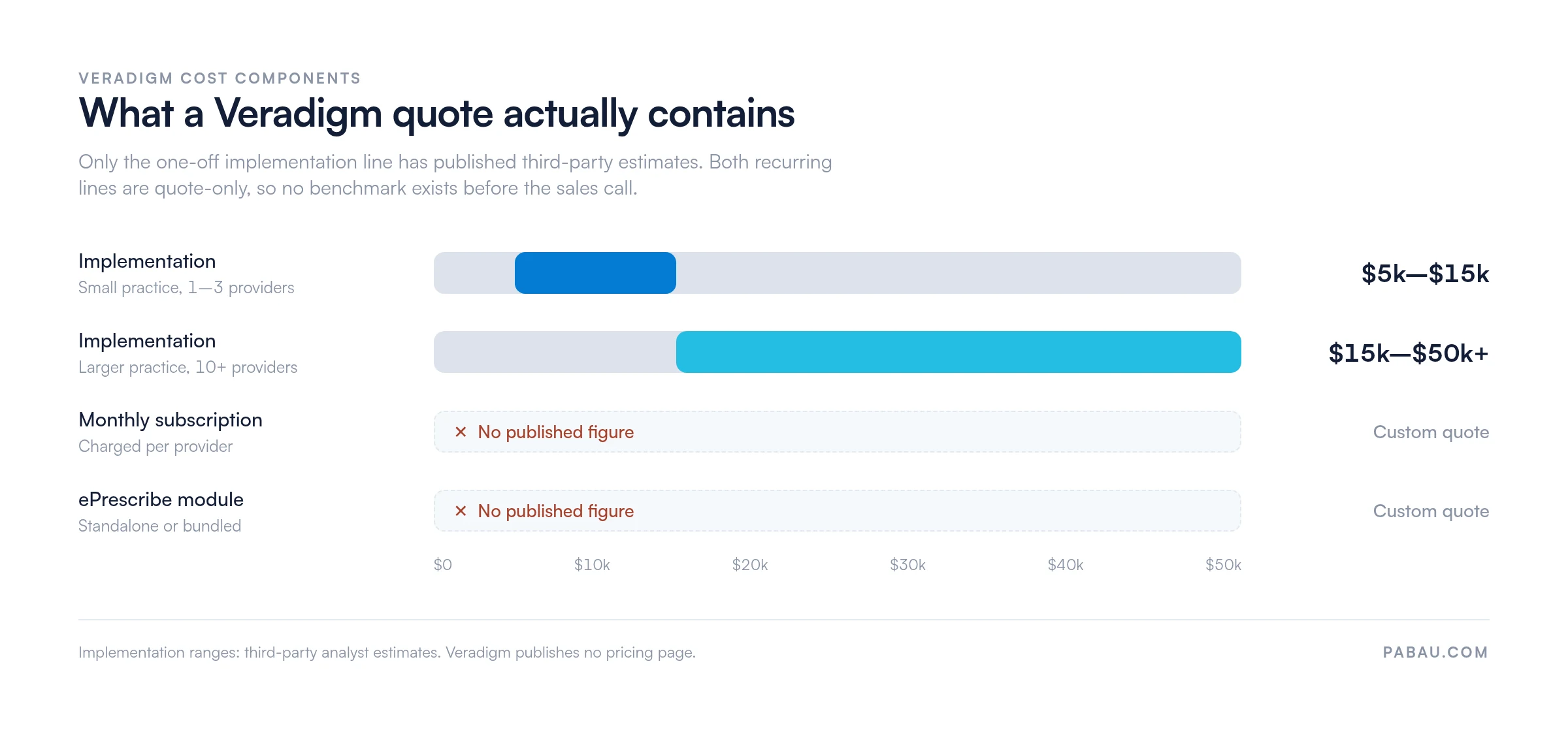
Small practices usually sit at the lower end of the implementation range. The per-provider subscription can still feel steep for a solo or two-provider setup, where there is no volume discount to earn. Large practices negotiate per-provider rates and spread the implementation cost across more users.
Solo practitioners and small independent practices often find the cost structure hard to justify. Veradigm was built for ambulatory medical groups with complex workflows. Much of its depth only pays off from about five providers upward. A lighter practice management platform may cover the same day-to-day work for less.
Veradigm does not publish pricing, so every practice runs the same process. Request a demo, sit through a discovery call, then wait weeks for a custom proposal. What you ask during that call decides whether the proposal is comparable to anyone else’s.
Six questions to ask in a Veradigm sales call:
A practice that has already decided what it needs walks into that call in a stronger position. Knowing which features matter, and which integrations are non-negotiable, makes it easier to push back on a padded implementation quote.
For an established multi-provider ambulatory group the answer is usually yes. For a solo or small independent practice it usually is not. Veradigm holds a 3.5/5 rating on Capterra from 66 reviews, a thin sample for a platform this established.
Where Veradigm tends to deliver value:
Where reviewers report friction:
Veradigm’s feature set is broad. If staff cannot move through the interface quickly, or cannot reach support when something breaks, that breadth stops paying for itself.
Practices that find the quote process opaque, the implementation cost prohibitive, or the platform too enterprise-focused have several options. They differ sharply in pricing model, practice size fit, and clinical depth.
Two of those five publish a starting rate. DrChrono’s three tiers are now quote-only, so a DrChrono alternatives roundup is the faster route to comparable figures.
One option sits inside Veradigm’s own lineup. Practice Fusion is its cloud EHR for small independent practices, and it carries a lighter commitment than the flagship EHR. Its pricing is quote-only too. You can compare Pabau against each of these platforms on price and feature depth.
For practices in aesthetics, wellness, or multi-location settings, practice management software like Pabau is built for that operational context. Veradigm targets ambulatory medical practices with deep clinical EHR requirements.
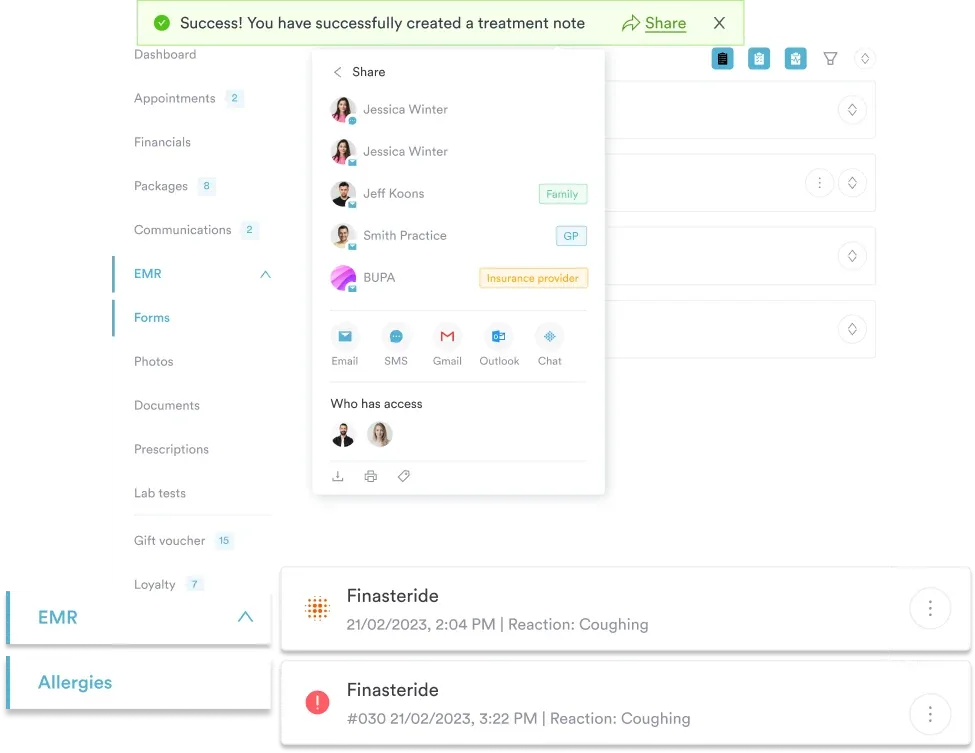
Pabau covers scheduling, clinical record management, prescribing, billing, and patient communication in one platform. Its subscription tiers are published online, so there is no quote cycle to sit through just to get a number.
Veradigm is a clinical EHR for ambulatory medical providers. Pabau is a practice management platform for aesthetic and wellness practices, and the pricing model reflects that difference. If you are shortlisting other quote-only vendors, the Nextech pricing breakdown follows the same structure for a specialty EHR.
Pabau holds a 4.6/5 rating on Capterra from 550+ reviews, and ease of use for aesthetic workflows is the recurring theme.
On the patient marketing side, every Pabau subscription includes full marketing, loyalty, and retention functionality, with no gating by tier. Marketing Plus is a separate paid monthly add-on for practices that want to do more in that area.
A practice evaluating Veradigm cannot budget until a proposal arrives. That usually means a demo, a discovery call, and several weeks of waiting, with nothing comparable to hold the figures against.
Pabau works the other way round. Subscription pricing is published and scales with location count and user count, starting at $62/month for one user. Every subscription includes every feature. There is no tier to upgrade into, and no module to add for prescribing, clinical records, or reporting.
Getting started runs as a structured onboarding process rather than a separately scoped implementation project. The onboarding team handles data migration, and each new practice gets a dedicated Client Coordinator plus the Pabau Portal for setup guidance.
So the comparison is not quote against quote. It is a published monthly figure you can budget from today against a proposal that arrives in three weeks.

Pabau publishes its subscription tiers online. No sales call required to get a number. See how Pabau handles scheduling, clinical records, prescribing workflows, and billing in one platform.

Veradigm pricing is not a number you look up. It is a negotiation that starts with a sales call and ends with a multi-line proposal. Provider count, specialty, implementation scope, and contract term all shape the figure.
For a larger ambulatory medical group with complex clinical workflows, that investment can pay for itself. For a smaller or independent practice, the ratio of cost to value is harder to make work. Either way, go into the call with the six questions above and an itemized breakdown as a condition.
If published pricing matters to how you evaluate software, Pabau lists its tiers from $104/month, so the recurring cost is knowable on day one. Book a demo to see how it maps to your workflow before you commit to any vendor’s sales process.

Comparing another quote-only medical EHR? Nextech pricing breaks down the same cost components for a specialty-focused platform.
Shortlisting Kareo or Tebra for a medical practice? Best Kareo alternatives for medical practices compares the platforms independent practices look at most.
Put off by DrChrono’s quote-only tiers? DrChrono alternatives lists the platforms that publish a rate before the sales call.
Weighing Pabau against the rest of the market? Pabau competitors and alternatives sets out where each platform fits and who it suits.
Veradigm pricing is a custom-quote model with no publicly published tiers. Costs come from a sales representative after a discovery call. They vary by provider count, modules selected, and implementation scope. Third-party estimates place implementation between $5,000 and $50,000+ depending on practice size.
Small practices of one to three providers typically see implementation estimates of $5,000 to $15,000, based on third-party analyst research. Monthly subscription costs are not published and require a sales quote. Solo practitioners often find the per-provider rate disproportionately high without volume discounts.
Veradigm does not publicly offer a free trial. Prospects access the platform through a guided sales demo arranged via a sales representative. There is no self-service trial or sandbox environment listed on the Veradigm website.
Veradigm subscription pricing is per provider. Each additional prescribing or clinical provider on the system adds to the monthly fee. Larger practices often negotiate volume-based rates that lower the per-provider cost once a certain threshold is reached.
Implementation is the most variable line in a Veradigm quote. Third-party estimates suggest $5,000 to $15,000 for smaller practices. Larger groups see $15,000 to $50,000 or more. Data migration, specialty workflow configuration, training delivery method, and third-party integrations all add to the final figure.
Comparison is difficult before a sales process, because Veradigm publishes nothing to compare against. AdvancedMD publishes a starting rate of $130 per provider per month, while DrChrono’s tiers are quote-only. Pabau, which serves aesthetic and wellness practices rather than ambulatory medical groups, publishes tiers from $62/month.