GLP-1 diet plan
A GLP-1 diet plan is a structured eating framework for patients taking semagluti...

2
Last Updated: Oct 13, 2026
The lateral hop test is a single-leg functional test in which the patient hops sideways between two markers set 40 cm apart, for 30 seconds. The score is the number of clean hops completed on each leg.
Dividing the involved limb’s count by the uninvolved limb’s count gives the limb symmetry index. A value of 90% or above is the passing mark most return-to-sport protocols use. It is one criterion among several rather than a clearance on its own.
Sports medicine and physical therapy teams run the test after ACL reconstruction, inside a battery rather than alone. This guide covers the setup, the scoring, the normative ranges, the errors that inflate results, and where the number sits in a clearance decision.

The lateral hop test measures single-leg neuromuscular control and limb symmetry, primarily in ACL rehabilitation and return-to-sport decision-making.
The side hop belongs to Gustavsson’s three-test battery from 2006, not to the older four-test Noyes battery that practices often run alongside it.
The standard adult protocol places the two markers 40 cm apart and runs for 30 seconds, with 30 cm reserved for younger athletes.
A limb symmetry index of 90% or above is the widely cited passing threshold, but strength, psychological readiness, and time since surgery matter too.
Reliability is excellent, yet one 2023 study found hop counts did not separate reconstructed knees from knee-healthy ones.
Pabau helps sports medicine and physical therapy practices record hop test data and track LSI trends across rehab phases.
The lateral hop test is a functional performance assessment in which the patient hops sideways over a set distance on one leg. Performance is measured by the number of hops completed in a set time, or by the distance covered. It belongs to the family of hop tests used to quantify lower-limb functional capacity.
What it isolates is the ability to generate and absorb force on one limb while staying stable. Strength tests run on an isokinetic dynamometer cannot show that. Hop tests capture integrated neuromuscular function in a movement pattern that resembles sport-specific demands.
The test is most commonly administered to patients who have undergone ACL reconstruction (ACLR). It is also used in other knee rehabilitation contexts, such as meniscal repair and patellofemoral rehabilitation, and in pre-season musculoskeletal screening.
The result is expressed either as a raw repetition count or a distance. That figure is then compared between limbs to calculate the limb symmetry index (LSI).
No single hop test tells the full story, and the lateral hop test has a specific provenance that is often reported incorrectly. It comes from the three-test battery published by Gustavsson and colleagues in 2006.
That battery pairs the side hop with a one-leg vertical jump and a one-leg hop for distance. Those authors picked that combination so the battery would capture maximal single efforts and performance under fatigue in the same session.
The well-known four-test hop battery is older and belongs to a different group. Noyes, Barber and Mangine published it in 1991. Its four members are the single-leg hop for distance, the triple hop for distance, the crossover hop for distance, and a timed 6-meter hop.
The side hop is not one of the four. Many practices run it alongside them, because it loads the frontal plane and adds the fatigue element those four tests leave out.
Running a battery rather than one test gives a more reliable picture of functional capacity. A patient may score well on the single-leg hop for distance and poorly on the side hop.
That pattern points to adequate sagittal-plane power and insufficient frontal-plane stability. That combination is the deficit most closely linked to re-injury risk in cutting sports.
In most of the published literature, “side hop test” and “lateral hop test” refer to the same assessment. Descriptions of the Gustavsson battery and most clinical rehabilitation databases treat the two names as one test.
The underlying movement is identical. The patient stands on one leg and hops sideways between two markers, repeating as many times as possible within a set time window.
Physiotutors is the exception worth knowing about. Its page on the Gustavsson hop test cluster uses the name side hop test only.
It also runs a separate page for a lateral hop test, also called the ZigZag hop test, which screens for femoral stress fracture. That is a different test with a different purpose, so check which one a colleague means before you compare scores.
Elsewhere, diverging terminology usually reflects the protocol variant rather than a different test. The 30-second side hop test specifies a timed format and a 40 cm distance between markers.
Some authors use “lateral hop” when describing a single maximal-distance variant. Confirm which protocol your outcome measure database or institutional standard requires before testing, then document the variant you used.
The protocol is straightforward, but small errors in setup compound into large measurement inconsistencies across sessions. Follow these steps to administer it consistently.
The 30-second side hop test is the most widely reported variant in ACL rehabilitation research. The 30-second window captures both power and local muscular endurance. That matters clinically, because re-injury in sport typically happens in fatigued conditions rather than during the first movement of a session.
Setup specifics: markers placed 40 cm apart, patient hops sideways between them, uninvolved leg tested first. Record the total hop count for each limb across two trials.
The key addition in the timed protocol is that the clinician also observes landing quality throughout. Watch for progressive knee valgus collapse, trunk sway, or deceleration in the final 10 seconds. Each one points to neuromuscular fatigue the count alone will not show.
The limb symmetry index (LSI) is the standard way to express lateral hop test results in clinical practice. It compares the involved limb’s performance to the uninvolved limb and expresses the result as a percentage.
One important nuance: always test the uninvolved limb first and use it as the denominator. If the patient has bilateral pathology or a history of contralateral injury, normative reference values matter more than LSI alone. The healthy limb may itself sit below population norms.
A limb symmetry index of 90% or above is the threshold most commonly cited in the ACL return-to-sport literature. The figure appears across multiple peer-reviewed studies and clinical guidelines. Clinicians apply it to the side hop test and to the four Noyes hop tests alike. A patient who clears 90% on one test has not cleared the battery.
Normative data for the 30-second side hop test varies by age and sex. Broadly, healthy young adult males complete 50-70 side hops in 30 seconds, and healthy young adult females complete 40-60. Values decline with age and vary by sport background.
When citing normative data to a patient or in documentation, note the source population. A norm derived from competitive soccer players does not apply to a recreational tennis player returning after ACLR.
Passing the lateral hop test at 90% LSI means the patient meets one criterion in a multifactorial return-to-sport framework. It does not mean they are cleared to return. Evidence-based frameworks also require strength criteria, usually quadriceps and hamstring symmetry assessed isokinetically.
They require psychological readiness, measured with the ACL-RSI or a similar scale. They also apply a time-based criterion of roughly nine months after ACLR before contact sport. The four sit side by side, and a patient can clear one while failing another.
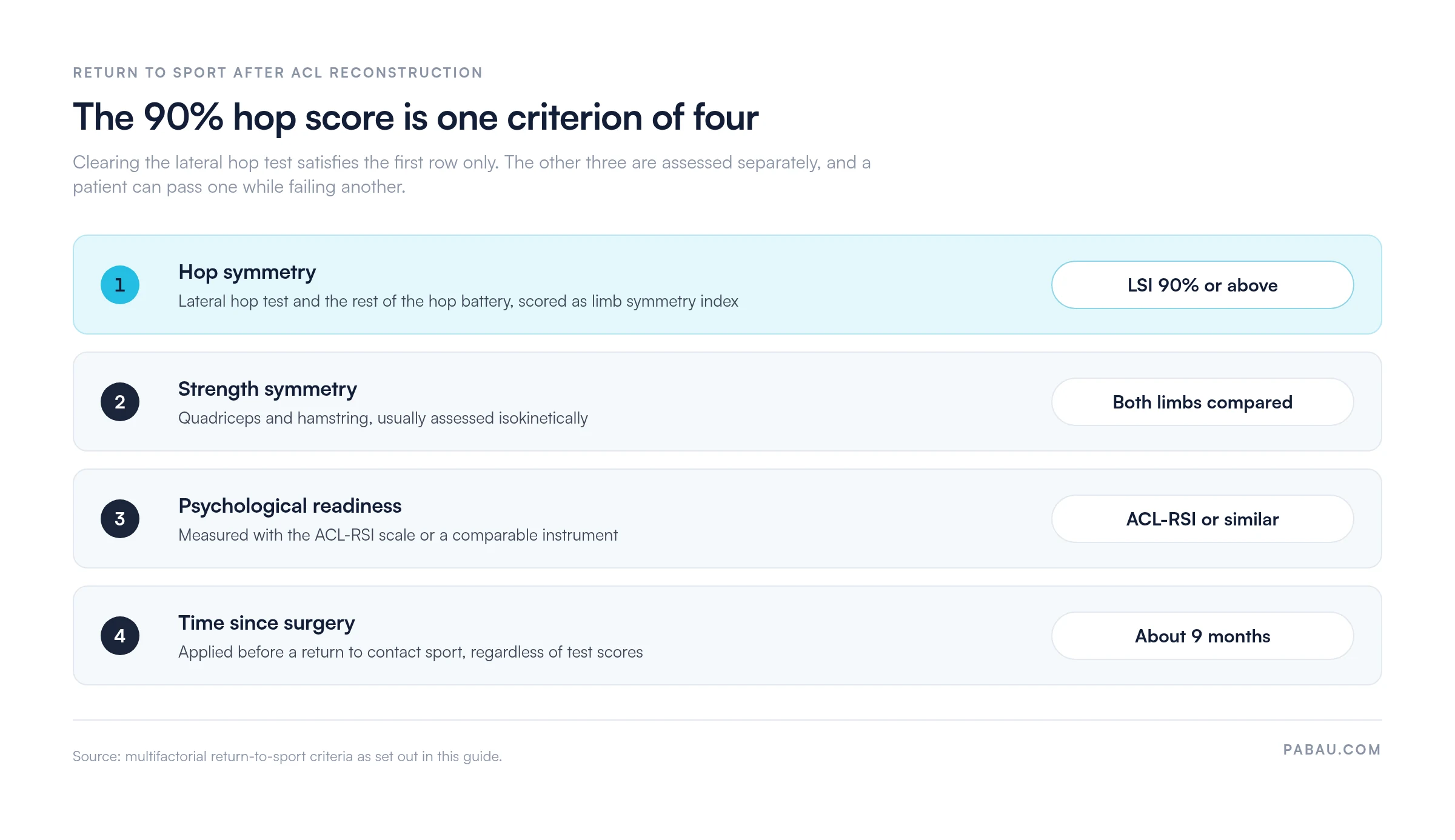
Hop test performance on its own does not predict re-injury risk closely enough to carry a clearance decision. Some physical therapy EMR systems track several outcome domains at once. Clinicians can then flag a patient who meets hop criteria but not strength or psychological criteria, which heads off a premature return.
The lateral hop test belongs in the later stages of ACL rehabilitation, not as an early assessment tool. Administering it too early risks exposing healing tissue to inappropriate loading, and it produces misleading scores that do not reflect functional capacity.
Sports physical therapists who combine hop testing with a return-to-running protocol get a more complete picture of readiness. A patient might pass hop criteria and still show load intolerance during progressive running tasks. That warrants more conditioning before any return to contact sport.
The lateral hop test demonstrates good to excellent test-retest reliability in post-ACLR populations. A 2024 PMC study reported ICC values above 0.80 for temporal parameters during the side hop test in reconstructed knees.
That sits with the broader hop-test reliability literature. Reliability does depend on standardization. The same evaluator, the same surface, the same marker spacing, and the same protocol across sessions produce far more defensible data than variable conditions.
Measurement properties were examined separately in a side hop test study in soccer players published in Physical Therapy in Sport. Fältström and colleagues assessed the test across sex, age, and ACL reconstruction status in 2023.
Reliability and validity were excellent, with ICC values between 0.92 and 1.0. Hop counts did not separate reconstructed knees from knee-healthy knees in that sample of female players. Only the quality aspects of the movement, the flaws the raters scored, differed by sex and age.
Read that as a limit on what the count alone can tell you. The test measures lateral control and endurance dependably. A score inside the normal band still does not confirm that a reconstructed knee behaves like an uninjured one. Score landing quality alongside the count, and treat the number as one input to the battery rather than a verdict on the graft.
Setup and counting errors are what cost hop test data its value. The six below are the ones that most often invalidate a trial or inflate an LSI score.
Each hop test stresses a different movement pattern, whichever battery it came from. Choosing the right mix depends on the demands of the patient’s sport and on the specific deficits you are targeting.
For athletes returning to cutting sports such as soccer, basketball, and lacrosse, prioritize the lateral hop test and the crossover hop. Run them alongside the single-leg hop for distance. For runners and cyclists, the single-leg hop and the triple hop are more sport-specific. Using only one hop test is always a compromise, so run a battery wherever clinical time allows.
A patient may pass the single-leg hop for distance and still fall below 90% LSI on the lateral hop test. Do not discharge them from hop testing. The discrepancy signals a frontal-plane deficit that sagittal-plane tests miss entirely. Add targeted lateral plyometric training and retest in 4 weeks.
Hop test results that are not documented systematically lose their clinical value once the session ends. A raw hop count written on a notepad tells you very little six weeks later. You also need the leg tested first, the protocol variant and marker spacing, the rest period between trials, and each trial score.
At minimum, record the same set of fields for both limbs at every session:
That produces a trackable data series rather than a one-off snapshot.
The compliance dimension matters too. Clinicians working in regulated rehabilitation settings must retain outcome measure data as part of the clinical record. The physical therapy compliance requirements cover record retention periods and the standards that apply to functional assessment data.
Whether that record holds up depends partly on the system it sits in. Teams comparing platforms for this work can start with our roundup of sports medicine software. It weighs outcome tracking against the rest of the clinical workflow.
Hop test results usually land in a free-text session note or a side spreadsheet. That holds up for a single session. It falls apart when a clinician has to show how a patient’s LSI moved between month four and month eight. By then the protocol variant behind each figure has usually gone missing.
Practice management software like Pabau handles this differently. You build the hop test fields into a reusable assessment template using outcome tracking software. Every clinician on the team then captures protocol variant, trial scores, LSI, and landing quality in the same format. The data sits on the patient record rather than in a separate file, so no one has to reconcile two sources later.
The result is a trackable series instead of a pile of snapshots. You can see at a glance whether a patient reached the 90% threshold and when. The landing quality recorded at the time sits next to it. That trail supports the clearance decision itself and the clinical governance requirements that follow it.

Pabau helps sports medicine and physical therapy practices record functional performance data, track limb symmetry trends, and document return-to-sport decisions in structured patient records. See how it works in your practice.

Run the lateral hop test late, run it the same way every time, and write down the variant you used. Those three habits decide whether the score is comparable at the next session. Scoring a 40 cm setup against a 30 cm setup compares two different tests.
Hold the 90% threshold lightly. The 2023 soccer player data explains why. Reliability was excellent, and hop counts still showed no separation between reconstructed and knee-healthy limbs.
What the number gives you is a dependable measure of lateral control under fatigue, next to strength, psychological readiness, and time since surgery. What it will not give you is permission to clear someone.
Pabau records hop counts, LSI, and landing quality on the patient’s own chart, so the trend survives a change of clinician. Book a demo to see how that documentation trail comes together for a sports medicine or physical therapy practice.

Looking for another single-leg test to run alongside it? Star excursion balance test measures dynamic postural control across reach directions, which complements the frontal-plane demand of the side hop.
Looking at what sports medicine practices need from their software? Sports medicine software covers the features that support outcome tracking, appointment management, and return-to-sport documentation in one place.
The lateral hop test assesses single-leg neuromuscular control, dynamic lateral stability, and limb symmetry after knee injury, most commonly ACL reconstruction. It is a component of return-to-sport functional testing batteries. It is also used in pre-season musculoskeletal screening for athletes in cutting and pivoting sports.
Record the best trial hop count for each limb, then calculate the limb symmetry index (LSI). Divide the involved limb score by the uninvolved limb score and multiply by 100. An LSI of 90% or above is the threshold most commonly cited in return-to-sport literature. Treat it as one criterion among several, not as a standalone clearance.
Yes. The side hop, also called the lateral hop test, is one of three tests in the battery Gustavsson and colleagues published in 2006. The other two are a one-leg vertical jump and a one-leg hop for distance. It is not part of the older four-test battery from Noyes, Barber and Mangine. That battery combines the single-leg hop for distance, the triple hop, the crossover hop, and a timed 6-meter hop.
The standard adult protocol places the two markers, cones or tape strips, 40 cm apart, and the patient hops sideways across them for 30 seconds. A reduced 30 cm spacing is used with younger or developmental athletes. Record which spacing you used, because scores taken at different spacings are not comparable across sessions.
The lateral hop test involves repetitive side-to-side hops between two fixed markers on one leg, stressing frontal-plane stability and neuromuscular endurance. The crossover hop test requires three consecutive hops across a center line, combining frontal and sagittal demands, and it is scored on total distance. The two come from different batteries, but many practices run both, because each exposes a deficit the other misses.
Reliability is excellent. Test-retest work in post-ACLR populations reports ICC values above 0.80, and a 2023 study of female soccer players reported ICC values between 0.92 and 1.0. That same study found hop counts did not separate reconstructed knees from knee-healthy knees. Reliability is highest when the same evaluator uses the same protocol, marker spacing, and rest intervals across sessions.
The lateral hop test suits an initial baseline assessment from 4-6 months post-ACLR. It is repeated at 8-9 months as part of the return-to-sport battery. Administering it before 4 months risks loading healing tissue inappropriately and produces scores that do not reflect functional capacity. Serial testing every 4-6 weeks during the return-to-sport phase lets clinicians monitor LSI progression.
The limb symmetry index (LSI) is a percentage comparing the involved limb’s hop performance to the uninvolved limb: (involved score / uninvolved score) x 100. A score of 100% indicates perfect symmetry. In ACL return-to-sport testing, 90% or above is the accepted minimum across the hop tests in common use. The uninvolved limb must itself sit at or near population norms for the comparison to carry clinical meaning.