GLP-1 diet plan
A GLP-1 diet plan is a structured eating framework for patients taking semagluti...

2
Last Updated: Oct 13, 2026
The Brudzinski sign test is a bedside neurological maneuver used to detect meningeal irritation. The examiner flexes a supine patient’s neck and watches for involuntary hip and knee flexion. A positive result points hard at meningeal irritation, most urgently bacterial meningitis. A negative result excludes nothing.
A diagnostic accuracy appraisal in the Annals of Indian Academy of Neurology reported sensitivity as low as 5% in culture-proven cases. Specificity ran above 95%. This guide covers how to elicit the sign, how to read the result, and when to escalate.

The Brudzinski sign test is positive when passive neck flexion causes involuntary hip and knee flexion in a supine patient.
Specificity runs above 95%, but sensitivity has been reported as low as 5%, so a negative result excludes nothing.
The sign is read alongside Kernig’s sign, nuchal rigidity, and the patient’s whole presentation.
A positive finding with fever, headache, or altered consciousness warrants immediate escalation and empirical treatment.
Practice management software like Pabau can capture meningeal sign results directly in the patient record.
The Brudzinski sign test is a clinical examination maneuver that screens for meningeal irritation. It works by eliciting an involuntary lower-limb reflex in response to passive neck flexion. Józef Brudziński, a Polish physician, first described it in 1909.
The sign belongs to a family of classical meningeal irritation signs used at the bedside in suspected meningitis. Clinicians use it as part of a broader meningeal examination, never in isolation. It sits alongside nuchal rigidity and Kernig’s sign in the classic triad.
The test is performed with the patient lying supine and relaxed. The examiner lifts the head off the bed, flexing the neck forward toward the chest. A positive result occurs when the patient involuntarily draws up the hips and knees. The patient cannot suppress that reflex, which is what gives the finding its clinical weight.
The meninges (dura mater, arachnoid mater, and pia mater) encase the central nervous system from the skull down through the spinal canal. When they are inflamed, the structures they enclose become taut and sensitized.
Passive neck flexion elongates the spinal cord and its surrounding meningeal sheaths. In a healthy patient that stretch causes no discomfort and no lower-limb movement. With meningeal inflammation present, the same stretch produces pain and mechanical tension along the cord.
The body responds by reflexively flexing at the hips and knees. That movement shortens the spinal canal and relieves the stretch. It is the physiological basis of Brudzinski’s sign.
Correct patient positioning and a smooth, controlled maneuver are what keep the result trustworthy. Rushed flexion produces both false positives and false negatives.
A patient who cries out during neck flexion without moving the lower limbs may have nuchal rigidity alone. Both findings matter, and both warrant further investigation.
A positive Brudzinski sign indicates meningeal irritation. On its own it confirms no specific diagnosis. The common causes are bacterial meningitis, viral meningitis, and subarachnoid hemorrhage (SAH). Each one inflames or irritates the meningeal layers, which triggers the same reflex response to neck flexion.
Bacterial meningitis is the most clinically urgent cause. Treat a positive sign as an emergency in any patient with fever, severe headache, photophobia, or altered consciousness. Viral meningitis usually runs a milder course, though the sign can be positive in both.
Subarachnoid hemorrhage irritates the meninges through blood in the subarachnoid space, which triggers the same reflex pathway. Clinical context helps separate it from infectious causes. A thunderclap headache onset and the absence of fever both point toward SAH. Imaging and lumbar puncture are still required to confirm it.
Several conditions beyond meningitis and SAH produce a positive Brudzinski sign. Work through the full differential before you commit to an interpretation.
Read the finding alongside the whole clinical picture. That means vital signs, headache characteristics, rash distribution, cerebrospinal fluid analysis, neuroimaging, immune status, and travel history.
Two findings dominate the evidence. When Brudzinski’s sign is present, it is highly specific for meningeal irritation. When it is absent, the diagnosis stays open.
The Mehndiratta appraisal found sensitivity of roughly 5% in culture-proven bacterial meningitis. The BMJ Education in Practice review reports a range of 27% to 97% across study populations. That spread reflects differences in disease severity, patient age, and immune status.
Those figures change what each bedside outcome is worth, and the panel below sets out all three.
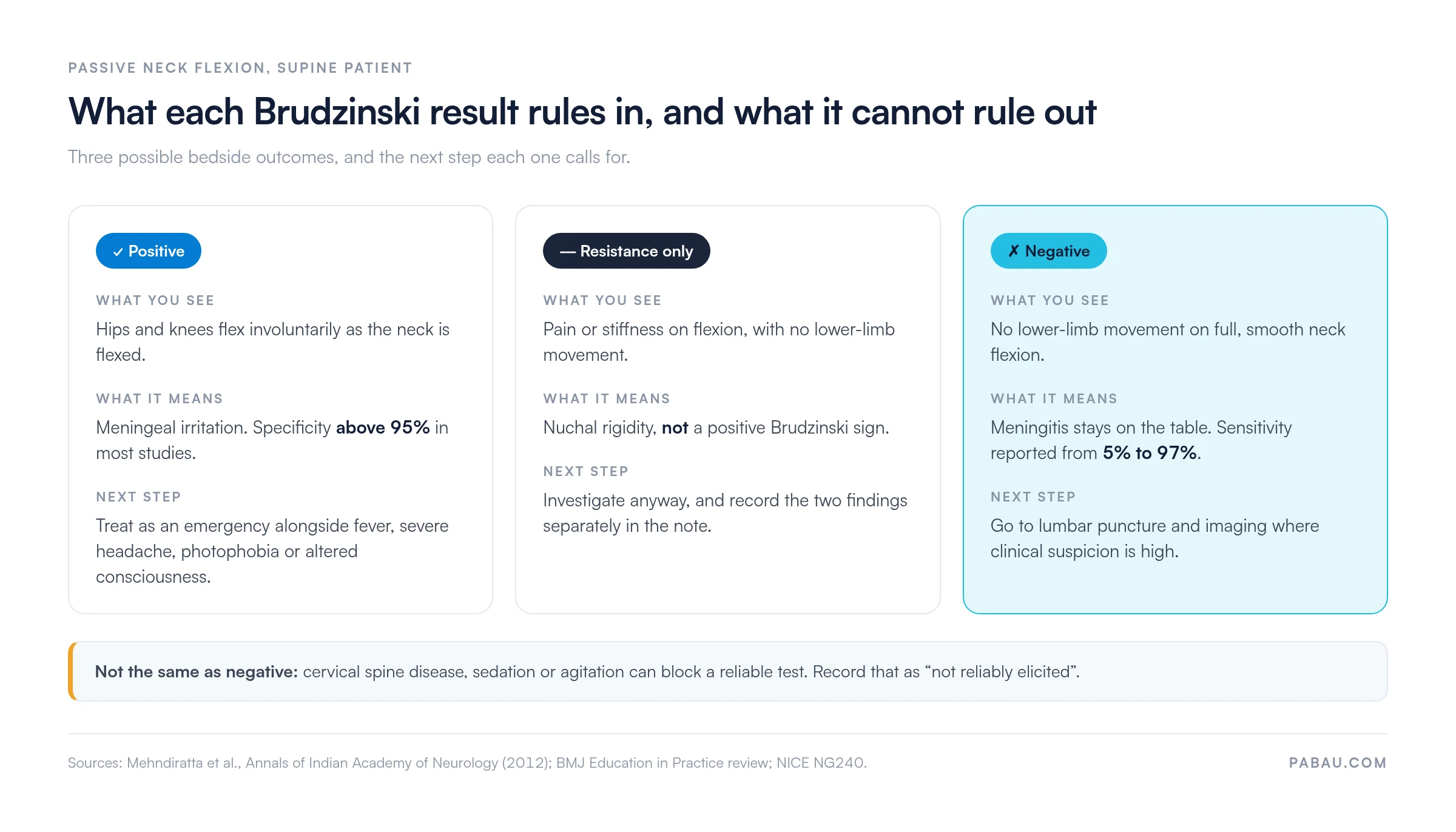
Record the Brudzinski sign test result alongside any confounding factors. Pre-existing cervical spine disease, patient agitation and sedation all belong in the note. A sign you could not elicit reliably is not a negative finding, so write it up as unobtainable.
Kernig’s sign is the other classic meningeal irritation test, and the two are assessed together. Their elicitation techniques differ. Both detect the same underlying phenomenon, because meningeal inflammation makes stretching of the cord and nerve roots painful.
Neither sign alone confirms or excludes meningeal disease. Two positives together raise clinical confidence in a meningeal process considerably. Two negatives still leave lumbar puncture and neuroimaging on the table where the history points that way. Our guide to the Kernig’s sign test covers the technique and its own accuracy data.
In practice the test is one of three bedside assessments combined in suspected meningitis. Knowing all three helps you build a fuller picture before confirmatory testing.
Nuchal rigidity is resistance to passive neck flexion, felt by the examiner as stiffness. It produces no lower-limb movement. The same neck flexion maneuver elicits it, and it can coexist with Brudzinski’s sign. On its own it has low specificity in older adults.
Jolt accentuation of headache is tested by asking the patient to rotate the head horizontally at about two cycles per second. A positive result is a worsening of an existing headache. The BMJ Education in Practice review reports sensitivity above 90% in some populations, with lower specificity.
Use all three together, alongside the patient’s full presentation. Record every meningeal sign you performed and its result, including the negative ones.
Low sensitivity is the most significant limitation, and it bites where the test matters most. Among prospectively studied patients with confirmed bacterial meningitis, the sign may be absent in over 95% of cases.
Several patient groups are particularly likely to test negative while meningeal disease is present.
The BMJ review states plainly that the absence of meningeal signs cannot exclude meningitis. So record a negative finding with the same care as a positive one. Note anything that stopped you eliciting the sign reliably.
A positive Brudzinski sign test in a symptomatic patient is a medical emergency until proven otherwise. Speed of treatment in bacterial meningitis is directly linked to outcome. Do not wait for lumbar puncture results when clinical probability is high.
Escalate immediately when a positive or suspected positive sign occurs alongside any of the following:
Current guidance from NICE guideline NG240 recommends empirical antibiotic therapy before lumbar puncture in suspected bacterial meningitis. That applies where the patient is deteriorating, or where immediate lumbar puncture is contraindicated. The CDC publishes parallel guidance on meningitis diagnosis and management for US practitioners.
Documentation is where a bedside finding becomes part of the patient’s history. A thin note costs the next clinician the handover detail they need, and it weakens the record if the patient presents again.
A best-practice note on the test covers the following:
Structured templates inside an EMR make this faster and harder to skip. A neurological exam checklist prompts for each sign, its result, and any confounder, so nothing is left to memory. Our guide to safer clinical notes makes the same case for writing negative findings down explicitly.

Primary care meets most of these presentations first. GP clinic software with structured examination templates keeps the finding in the patient record, where the next clinician will find it.
Most practices record a meningeal examination as free text, when they record it at all. The maneuver takes thirty seconds and the note takes longer, so the detail gets compressed into “neuro exam NAD”. The next clinician cannot tell whether Brudzinski’s sign was negative or never attempted.
Practice management software like Pabau lets you build the examination into the note itself. A neurological template prompts for each meningeal sign, its result, and the confounders that limited it. Those answers are stored as structured fields in the patient record, so they stay searchable.
Pabau Scribe, our AI medical scribe, writes the consultation up from the conversation and files the findings in the same record. Clinicians spend less time typing after a high-acuity assessment. The note still shows what was tested, what was found, and what happened next.
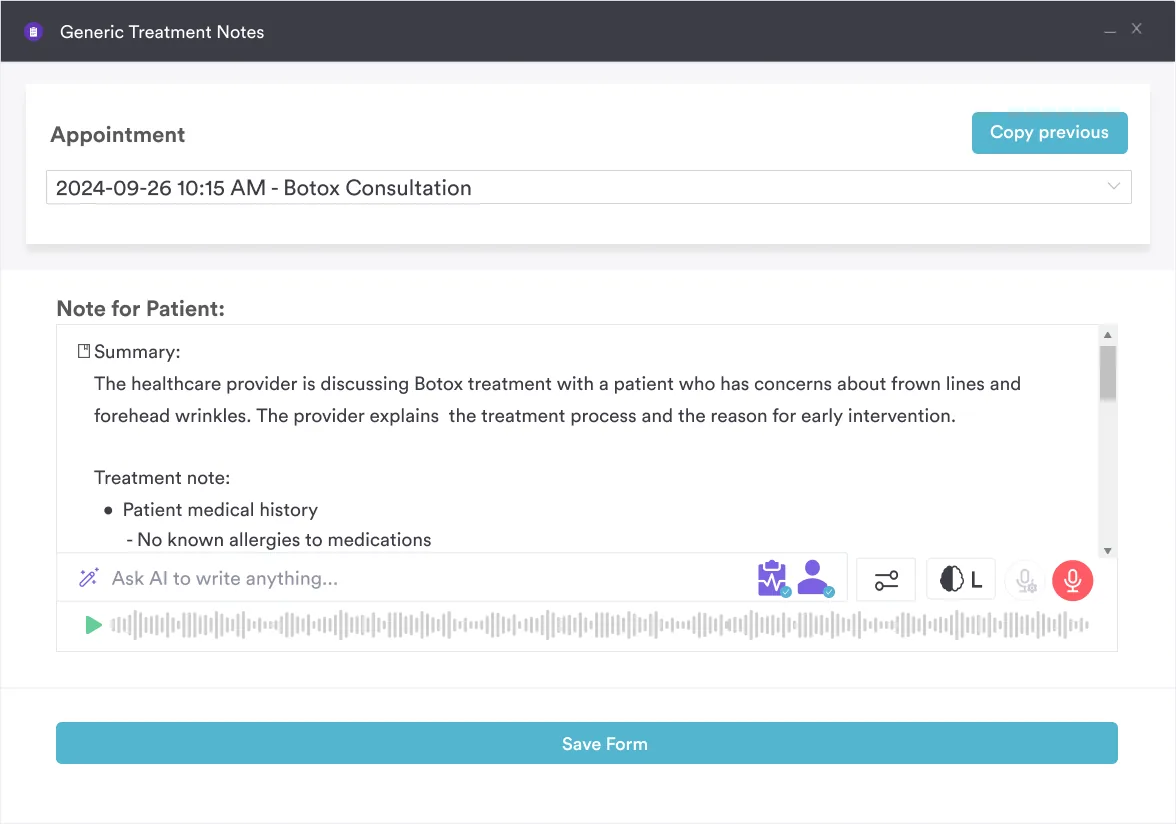

Pabau Scribe, our AI scribe, captures examination findings and clinical reasoning in structured records. Clinicians spend less time typing and more time with patients.

The Brudzinski sign test earns its place at the bedside because a positive finding forces action. Specificity above 95% makes it meaningful when present. Sensitivity as low as 5% makes it unsafe to lean on when absent.
Perform it as one part of a meningeal examination, record what you found, and record what stopped you finding it. Book a demo to see how Pabau keeps neurological examination findings structured and searchable in the patient record.

Assessing the other classic meningeal sign? Kernig’s sign test covers the technique, the positive finding, and how the two signs are read together.
Need a structured neurological examination record? Neurological exam checklist gives you a printable prompt for each sign and its result.
Grading consciousness alongside the meningeal signs? Glasgow Coma Scale template sets out the eye, verbal, and motor scores with their scoring rules.
Planning care once meningitis is confirmed? Meningitis nursing care plan template sets out the diagnoses, goals, and interventions to document.
Working up the headache that brought the patient in? Headache physical exam walks through the wider examination that surrounds these meningeal signs.
Brudzinski’s sign is a finding of meningeal irritation. Passive flexion of a supine patient’s neck causes involuntary flexion of the hips and knees. It screens at the bedside for bacterial meningitis, viral meningitis, and subarachnoid hemorrhage. Clinicians assess it alongside Kernig’s sign and nuchal rigidity.
A positive Brudzinski’s sign indicates meningeal irritation. The most urgent cause is bacterial meningitis, but a positive result can also occur in viral meningitis, subarachnoid hemorrhage, tuberculous meningitis, and carcinomatous meningitis. The finding requires clinical correlation with the patient’s full presentation.
Kernig’s sign is elicited by flexing the hip to 90 degrees, then attempting to extend the knee. A positive result is resistance or pain at the knee. Brudzinski’s sign is elicited by passive neck flexion, and a positive result is involuntary hip and knee flexion. Both detect meningeal irritation through different reflex pathways, and they are typically assessed together.
Specificity exceeds 95% in most studies, so a positive sign strongly suggests meningeal disease. Sensitivity ranges from as low as 5% to 97%, depending on the study population and disease stage. A negative finding therefore does not rule out bacterial meningitis. Clinicians should never use absence of the sign to exclude the diagnosis.
Perform the Brudzinski sign test whenever bacterial meningitis or subarachnoid hemorrhage is in the differential diagnosis. That includes new severe headache, fever, photophobia, neck stiffness, altered consciousness, or a non-blanching rash. It belongs in the routine neurological examination for any suspected central nervous system infection.