What state has the most plastic surgery per capita? America’s cosmetic map in 20 numbers
What state has the most plastic surgery per capita? Florida is America’s p...

Last Updated: Oct 16, 2026
Opening a cosmetic surgery clinic takes eight steps, from choosing an ownership structure to launch marketing, and usually 12 months or more.
Startup costs run from $200,000–$500,000 for a small clinic to over $1 million for larger operations, according to Vellis. Nextech puts plastic surgery startups as high as $3 million.
The order of the steps matters more than the checklist, and we call that order the surgery clinic critical path. Payer credentialing alone takes 9–12 months, so it starts first, alongside accreditation. Work backward from those two and you get a realistic opening date.
This guide covers how to open a plastic surgery clinic in the US, for surgeons and business partners starting a plastic surgery practice. If you only plan non-surgical treatments, our guide on how to start an aesthetics business is the better fit.

Settle ownership first, because corporate practice of medicine rules in many states reserve ownership for physicians, with non-doctors joining through an MSO.
The deepest anesthesia you plan to use sets your facility class, which decides whether you accredit through Quad A, AAAHC, or The Joint Commission.
Payer credentialing takes 9–12 months, so the surgery clinic critical path starts there and works backward to a realistic opening date.
Reported startup costs range from $200,000 for a small clinic to $3 million for a larger plastic surgery build, and most surgeons finance the launch.
Set up practice management software before launch marketing starts, six to eight weeks out, so patients are booked for day one.
Opening a cosmetic surgery clinic takes eight steps, from ownership structure to launch marketing, and the order matters because credentialing and accreditation take longest.
Steps one, two, four, and five apply to any new medical practice. Steps three, six, and seven add the surgical layer.
The list follows the order you make decisions in. The timeline below shows when each task has to start on the calendar.
Plan on 12 months or more to open a cosmetic surgery clinic, because payer credentialing alone takes 9–12 months to complete.
The surgery clinic critical path starts with the two long-lead items, credentialing and accreditation. Every other task fits inside their lead time, so the date you start them sets the date you open.
Dr. Andrew Rosenthal, writing for ModMed, advises starting insurance credentialing 9–12 months ahead so you can bill from day one. His other lead times, plus Nextech’s marketing window, make up the table below.
| Task | Typical lead time | When to start | Source |
|---|---|---|---|
| Payer credentialing | 9–12 months | 9–12 months before opening, before any other task | ModMed |
| Securing a location | About 6 months | 6 months before opening, since many forms need a physical address | ModMed |
| Medical licensing and regulations | 3–4 months, and up to a year for a Florida medical license | 3–4 months before opening, or earlier in slow-licensing states | ModMed |
| Facility accreditation | Varies by accreditor and state | Alongside the buildout, once your facility class is fixed | No published standard |
| Launch marketing | 6–8 weeks | 6–8 weeks before opening | Nextech |
| Hiring staff | About 6 weeks | 6 weeks before opening | ModMed |
Laid out against opening day, the chart shows why credentialing, not the lease, sets the date.
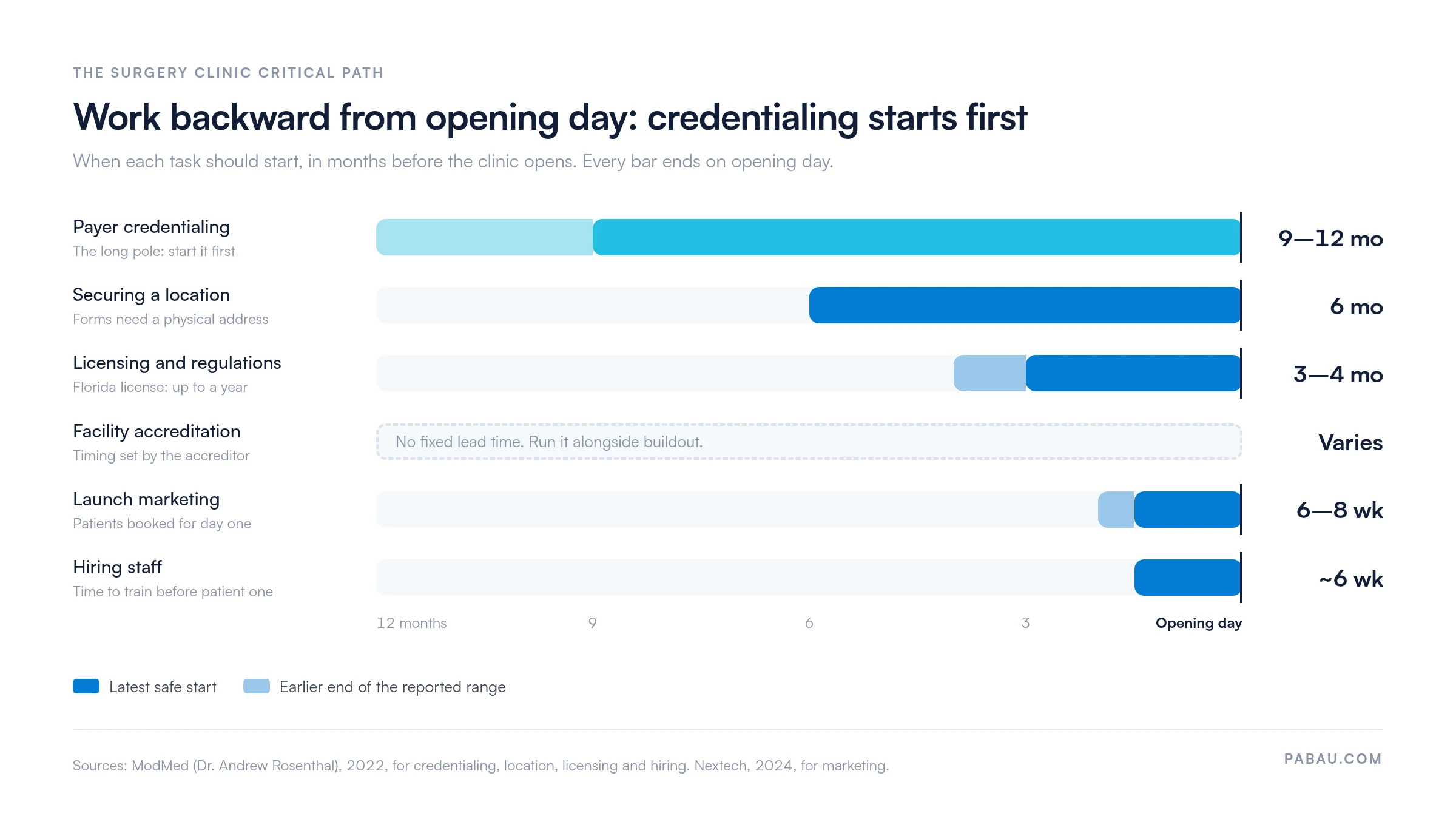
Accreditation has no single published lead time. Ask your chosen accreditor early what it needs to see on survey day, because the answer shapes the buildout.
When a new surgical practice asks us how soon it can open, our first question is when credentialing started. If it hasn’t, the opening date is at least nine months away.
Most cosmetic surgery clinics are physician-owned through a professional corporation or PLLC, because state law often bars non-physicians from owning a medical practice.
The structure decides who can sign the lease, hold the licenses, and employ the surgeons. Lawyers and lenders will ask for it first, so settle it before anything else.
In many states, corporate practice of medicine rules stop non-physicians from owning a medical practice or employing physicians, so non-doctors usually partner through an MSO.
The American Medical Association notes that the corporate practice of medicine doctrine varies widely by state. The doctrine can bar a lay corporation from employing physicians, or bar non-physicians from holding an ownership stake in a practice.
A management services organization, or MSO, is the usual workaround. The physician owns the professional corporation that treats patients. The non-physician partner owns the MSO, which provides space, equipment, staff, and administration for a management fee.
How that fee is set, and how much control the MSO holds, differs from state to state. Have a health-law attorney in your state review the structure before you sign a lease.
| Structure | Who can own it | Liability protection | Typical use in a surgery practice |
|---|---|---|---|
| Professional corporation (PC) | Licensed physicians only, in most states | Shields owners from business debts, but not from their own malpractice | The default for a surgeon-owned practice |
| Professional LLC (PLLC) | Licensed professionals only, where the state offers it | Similar to a PC, with simpler management rules | Solo surgeons or small surgeon partnerships |
| LLC | Anyone, but many states bar a standard LLC from practicing medicine | Limited liability for owners | Holding the building or equipment, or the practice itself where the state allows it |
| Physician-owned PC plus an MSO | The physician owns the PC, and the non-physician partner owns the MSO | Each entity protects its own owners | A surgeon partnering with a business owner or investor |
An S corporation is a tax election rather than a separate entity. A PC or PLLC can often elect S-corp status to change how owners are taxed, so raise it with your accountant once the entity exists.
The surgeon needs a state medical license, DEA registration, and an NPI, while the clinic needs business and facility licenses plus insurance.
Expect to file most of these in parallel. The registrations every new surgical practice should plan for:
Requirements vary by state, so confirm the full list with your state medical board and health department.
A surgical practice needs malpractice coverage for each surgeon, plus business policies for the premises, equipment, staff, and patient data.
Bind malpractice cover before credentialing applications go out, because payers ask for the certificate with the application.
HIPAA, the federal health privacy law, applies from your first patient record, so build it into your systems before opening. The steps to complete before day one:
Whether you operate an in-office surgical suite or a licensed ambulatory surgery center decides which accreditation and certification you need.
An office-based suite sits inside your practice. An ambulatory surgery center, or ASC, is a separate entity that exists only to provide outpatient surgery. To bill Medicare, an ASC also needs an agreement with CMS.
Most cosmetic procedures are self-pay, so many cosmetic surgeons start with an accredited office suite. An ASC makes more sense if you also plan reconstructive cases billed to Medicare.
Office-based surgery accreditation is tiered by the deepest anesthesia you use, so fix your procedure list before you choose a facility class.
Quad A defines three classes for US facilities in its anesthesia class requirements. Each class must also meet every standard of the classes below it. A fourth class, C-M, applies only to international facilities.
| Facility class | Anesthesia level | Typical cosmetic procedures | Accreditation route |
|---|---|---|---|
| Class A | Local or topical anesthesia, minimal sedation, or nitrous oxide. No moderate sedation, propofol, or general anesthesia. | Minor excisions, scar revisions, and liposuction capped at 500cc of aspirate | Quad A Class A. Often voluntary, since ASPS exempts local anesthesia and mild oral sedation. |
| Class B | IV sedation, regional anesthesia, or dissociative drugs to moderate sedation. No propofol, airway device, or general anesthesia. | Eyelid surgery and smaller facial or body procedures under IV sedation | Quad A Class B, or an AAAHC or Joint Commission office-based surgery program |
| Class C | IV propofol, spinal or epidural, and general anesthesia, given by an anesthesiologist or CRNA | Breast augmentation, tummy tucks, full facelifts, and rhinoplasty | Quad A Class C, AAAHC, or The Joint Commission, plus Medicare ASC certification if you bill Medicare as an ASC |
The procedure examples show where cases typically fall. The class is set by the anesthesia used for each case, not by the procedure name.
Quad A accreditation, formerly AAAASF accreditation, was built for office-based plastic surgery, while AAAHC and The Joint Commission cover a wider range of ambulatory settings.
AAAASF rebranded as Quad A in 2022. The group began in 1980 as an accreditor for plastic surgery facilities, so its office-based standards map directly onto the anesthesia classes above.
The Accreditation Association for Ambulatory Health Care (AAAHC) and The Joint Commission both run office-based and ASC programs. For ambulatory surgery center accreditation, all three can survey an ASC for Medicare certification.
Professional bodies set a floor too. The American Society of Plastic Surgeons requires members to operate in accredited, Medicare-certified, or state-licensed facilities for procedures beyond local anesthesia and mild oral sedation.
Many states add their own rules for office surgery above minimal sedation. Florida, for example, requires offices performing higher levels of surgery to register with its Board of Medicine.
Pick an accreditor your state recognizes for your facility class. Then ask each one for its survey timeline before you finalize the buildout.
Opening a cosmetic surgery clinic costs $200,000–$500,000 for a small clinic and over $1 million for larger operations. Some plastic surgery startups reach $3 million.
Vellis reports the first two ranges, covering equipment, staffing, and facility costs. Nextech puts plastic surgery startup costs as high as $3 million, which is why most surgeons need financing.
Lenders and partners read the business plan first, so it should cover:
The published figures are totals, so no source prices each category for you. The table shows what drives each cost and who gives you the quote.
| Cost category | What drives the cost | Who quotes it |
|---|---|---|
| Facility lease and buildout | Square footage, local rents, and operating room ventilation, power, and medical gas | Landlord, plus a contractor with surgical suite experience |
| Surgical and anesthesia equipment | Your facility class, since general anesthesia needs an anesthesia machine and full monitoring | Equipment vendors, who often offer leasing |
| Licensing and accreditation | State fees, plus the accreditor’s application and survey fees | Your state boards and chosen accreditor |
| Staffing before revenue | Salaries during training weeks and the months before cases fill the schedule | Your own payroll model |
| Technology and software | Practice management, EMR, imaging, and phone systems | Software vendors, usually per user or per location |
| Marketing launch | Website, photography, paid ads, and local search | Agencies or in-house staff |
| Working capital | Rent and payroll while case volume builds | Your lender. ModMed suggests having two years of funds available. |
| Total startup cost | Practice size, facility class, and location | $200,000–$500,000 for a small clinic and over $1 million for larger ones (Vellis). Up to $3 million (Nextech). |
Most surgeons combine two or more funding sources:
Open with procedures that match your facility class and your credentialed payers. Many surgical practices also offer non-invasive treatments such as Botox and fillers, which fill the schedule between surgeries and bring patients back.
Review the most common cosmetic procedures to see where demand sits before you set the menu.
Profit takes time. Dr. Rosenthal warns that full capacity could take five years, and advises skipping a personal salary for a while. Nextech tells new owners to expect losses for the first year or two.
Choose a location about six months before opening, because many licensing forms need a physical address and a surgical suite limits which buildings qualify.
Leasing preserves working capital in the first years, which is why Nextech advises leasing space rather than buying it at the start.
Hire your core team about six weeks before opening day, which gives staff time to train on your protocols and systems before the first patient.
ModMed gives that six-week window, and Dr. Rosenthal recommends starting with essential staff only while the patient base builds. The core surgical roles are:
Staff credentials need the same care as the surgeon’s. Accreditors check licenses, life support certifications, and training records on survey, so keep a file for every clinician.
Write standard operating procedures before day one, covering intake, pre-op checks, sterilization, emergency hospital transfer, and discharge. Then run a mock surgery day with the full team to test them.
Equipment follows your facility class, and software follows your patient journey. Order both early enough to train on them during the six-week hiring window.
Plastic surgery practice management software runs the patient journey from first inquiry to final follow-up, so set it up before marketing goes live. One system should handle:
Practice management software like Pabau covers all five in one system, so your team isn’t copying data between tools. Compare the options in our roundup of the best plastic surgery software.
We recommend building consent forms and photo protocols before booking pages, because every surgical procedure depends on them.
Start plastic surgery marketing six to eight weeks before opening, so consultations are already booked for your first day.
Nextech recommends that window for a new practice’s launch campaigns. Keep the pre-launch work focused on the channels that book consultations:
For channel-by-channel tactics once you are open, see our plastic surgery marketing strategies.
A new surgical practice often opens with separate tools for booking, forms, photos, and payments. The front desk then spends its day moving data between them.
Pabau is an all-in-one practice management system that puts those workflows in one place from the first consultation. Patients book consultations through online booking and pay deposits up front.
Before surgery day, Pabau sends digital consent forms that patients sign at home, and each form lands in the patient record. Before-and-after photos, treatment notes, and payments sit in the same record.
Every Pabau subscription includes every feature, from the built-in marketing suite to reporting. The same platform also works as software for med spas if you add injectables. Structured onboarding sets up your forms and booking rules before launch.
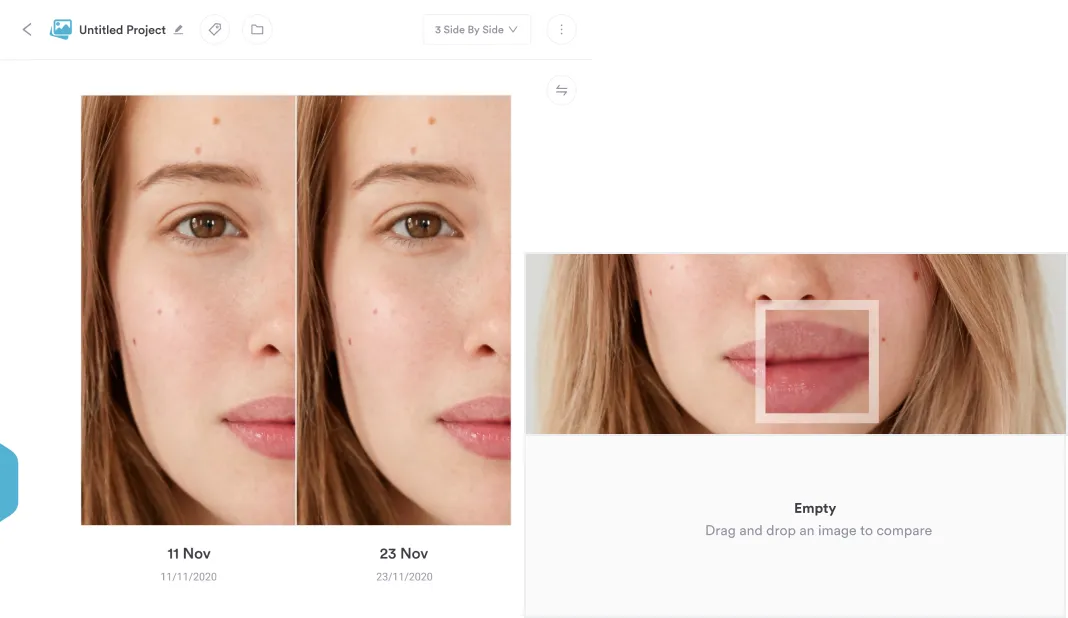

Pabau brings online booking, digital consent forms, before-and-after photos, and payments together, so your team is ready for surgery patients from day one.

Opening dates slip when the long-lead items start late. Start payer credentialing and your accreditation plan first, and settle ownership before you sign a lease or loan, because both depend on it.
Follow the surgery clinic critical path and every later step, from hiring to launch marketing, lands in a window you already planned. The trade-off is cash, since you pay for those lead times before revenue arrives.
Book a demo to see how Pabau sets up booking, consent, and photo workflows before your first surgery patient arrives.

Choosing a surgical EMR? Plastic surgery practice EMR software compares the systems built for surgical documentation and photos.
Want consults to turn into surgeries? Converting consultations into surgical bookings covers the follow-up that turns interest into a booked date.
Need a consent form for launch? Cosmetic surgery consent form gives you a template to adapt for your procedures.
Preparing your first consultations? How to prepare for a cosmetic consultation walks through what to cover before and during the visit.
In many states you can’t own a medical practice outright, because corporate practice of medicine rules reserve ownership for licensed physicians. The usual route is owning a management services organization that runs the business side for a physician-owned practice. Rules vary by state, so check with a health-law attorney first.
Startup costs for a cosmetic surgery clinic run from $200,000–$500,000 for a small clinic to over $1 million for larger operations, according to Vellis. Nextech reports plastic surgery startups reaching $3 million, and ModMed advises keeping two years of funds available.
A plastic surgery practice can be profitable, but not quickly. Nextech tells new owners to expect losses for the first year or two, and ModMed’s Dr. Rosenthal says full capacity could take five years.
Start payer credentialing 9–12 months before opening, as ModMed recommends, so you can bill insurers from day one. Credentialing is the longest item on the surgery clinic critical path.
Usually yes, once you go beyond local anesthesia and mild oral sedation. ASPS requires members to use accredited, Medicare-certified, or state-licensed facilities at that level, and many states set their own rules.