Medicare charting cheat sheet
A Medicare charting cheat sheet is a one-page reference that lists what Medicare...

6
Last Updated: Oct 21, 2026

Cliniko pricing runs from $45 a month for one practitioner to $395 a month for 26 to 200 practitioners. Every tier includes the full feature set.
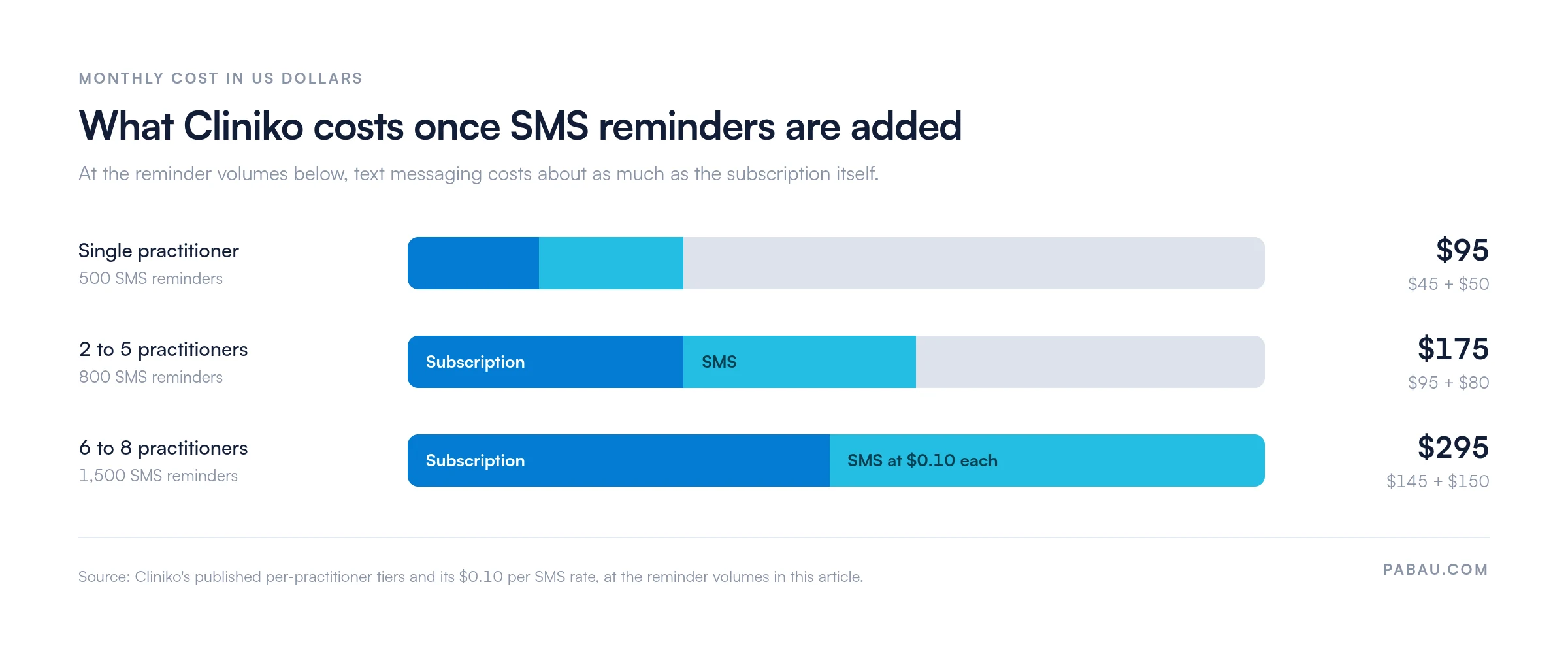
SMS appointment reminders cost about $0.10 each and sit outside the subscription. At 800 reminders a month, that adds roughly $80 to the bill.
Cliniko runs a 30-day free trial with no credit card required, though telehealth and bulk email need a card to activate.
Cliniko has no dedicated mobile app, so practitioners work in the browser and pin the site to a phone home screen.
On Capterra, Cliniko earns 4.7 out of 5 from 23 verified reviews. Support responsiveness and pricing transparency are the recurring praise.
Cliniko pricing runs from $45 a month for a single practitioner to $395 a month for a practice with 26 to 200 practitioners. Every bracket gets the same features, so the bill tracks head count alone. The headline number is not the whole cost, though. Once SMS reminders and your team’s onboarding time are counted, a reminder-heavy solo practice can pay close to double the subscription.
This guide breaks down what each tier includes, how the per-practitioner model works day to day, and what verified Capterra and G2 reviewers report. Our Cliniko review covers the product itself in more depth.
Cliniko’s pricing model has one unusual feature for the category. There are no feature tiers. Every practitioner-count bracket gives you the same full feature set, and the bill simply grows as your team grows.
| Plan / Tier | Price | Details |
|---|---|---|
| Single Practitioner | $45/month | Per practitioner; annual pay = 1 month free/year; SMS add-on 10c/msg |
| 2-5 Practitioners | $95/month | Per tier (2-5 practitioners) |
| 6-8 Practitioners | $145/month | Per tier |
| 9-12 Practitioners | $195/month | Per tier |
| 13-25 Practitioners | $295/month | Per tier |
| 26-200 Practitioners | $395/month | Per tier |
Vendors update their tiers periodically, so check the current figures on Cliniko’s own site before you buy. The flat-feature design has a practical consequence. A solo practitioner on the $45 plan and a 200-practitioner group on the $395 plan run the same product. There is no “Pro” or “Enterprise” upsell layered on top.
Because there are no feature tiers, the included feature set is the same whether you pay $45 or $395 a month. Knowing what sits in the box matters more than picking the right plan, since the only variable is practitioner head count.
The biggest difference between Cliniko’s headline price and its monthly bill is SMS. Text reminders sit outside the base subscription and cost roughly $0.10 USD per message. For a busy practice, that compounds quickly:
Line those volumes up against the matching subscription tier and the pattern is hard to miss. At the reminder rates above, texting costs about as much as the software.
SMS volume follows appointment volume, reminder cadence, and how heavily you text about reschedules and follow-ups. Practices that treat text as their primary reminder channel should run this calculation before signing up. Email reminders are included at no cost and work well for many practices, which can shrink the SMS line or remove it.
Run a total-cost-of-ownership calculation before committing. Add the base Cliniko subscription and your projected SMS volume at $0.10 per message. Then add any third-party tools you already pay for, plus your team’s onboarding time. The headline figure is honest, but it is not the full picture for high-SMS-volume or multi-location operations.
The Cliniko free trial runs for 30 days and needs no credit card to start. Nearly every feature is available during it, which is unusually generous for the category. Most practice management vendors either gate features during a trial or ask for a card upfront. Telehealth is the exception here, and activating video consultations or bulk email does require card details.
Use the 30 days on work you actually do. Run a full new-patient intake through online booking, write the clinical note, raise the invoice, and take the payment. Then run a representative billing scenario for your payer mix. The strengths and limits of any platform show up in that sequence rather than in the demo data.
Cliniko earns 4.7/5 from 23 verified reviews on Capterra and a similar rating distribution on G2. The Capterra sample is small, but the distribution is consistent. Scores cluster at four and five stars, with a short tail of three-star reviews naming specific limits rather than systemic complaints. The cards below quote the themes those platforms publish.
Those ratings sit at the high end of the solo allied health category. A comparable budget platform built for the same practitioners scores 4.4/5, as Carepatron review on Capterra and G2 show.
Quotes are paraphrased from themes published on Capterra and G2. Open both source pages to read the original reviews and check the rating distributions yourself.
Allied health workflows. Cliniko is purpose-built for physiotherapists, chiropractors, osteopaths, psychologists, and occupational therapists. Its documentation model maps to how those clinicians work, through SOAP notes, treatment records, and customizable templates. Setting up a new physiotherapy practice on Cliniko is low friction precisely because the note structure already fits the discipline.
Transparent, predictable pricing. The flat-feature, per-practitioner model is easy to budget around. No feature is gated to push you toward a more expensive tier, and there are no enterprise upsells. Capterra reviewers name pricing transparency as a differentiator more than once.
Customer support availability. Cliniko runs as a fully remote company, with support coverage that stretches across time zones and most weekends. Capterra and G2 reviewers raise responsiveness more often than any other strength, and several report replies arriving within hours.
30-day trial with nearly full access. No credit card is needed to start, and only telehealth and bulk email require one. That is uncommon in this market, and it lowers the risk of a first platform decision.
Mature integration ecosystem for allied health. Xero, Stripe, Mailchimp, telehealth platforms, and a range of allied-health-specific tools connect reliably. The API documentation is clear, and the developer community around Cliniko is active given its niche.
Critical reviews are measured rather than hostile, and they cluster around a short list of specific limits. These are the patterns the four-star and three-star reviews surface most often.
SMS as an add-on cost. This is the largest line item beyond the subscription. A practice sending 500 to 1,500 reminders a month adds $50 to $150 to the monthly bill. If text is your primary reminder channel, price it into the evaluation rather than treating it as a footnote.
Reporting depth. Built-in reporting is functional but shallow for practices that want revenue analysis by practitioner, service type, or location. G2 reviewers describe this as the friction that grows with the practice. Multi-location operators tend to export to spreadsheets or layer a separate BI tool on top.
Aesthetic and medical workflows. Cliniko is not designed for aesthetics, dermatology, or other procedure-heavy specialties. Injection plotting, before-and-after photo management, prescription management, batch consent forms, and procedure-specific clinical libraries are absent. Practices that started on Cliniko for general clinical work and later added aesthetic services tend to outgrow it. That is usually the point at which owners start weighing Cliniko alternatives. Med spas that need clinical documentation face a different choice than beauty professionals wanting simple bookings, as Aesthetic Record vs GlossGenius explains.
Built-in marketing automation is limited. Email campaigns, recall sequences, loyalty programs, and review collection all need third-party tools. Practices that want marketing in the same platform as scheduling and clinical records end up assembling a stack instead.
Multi-location support is light. Cliniko handles multi-practitioner scheduling well, but its multi-location architecture is thinner than platforms built for site groups. Location-level reporting, central admin controls, and room and resource management across sites all fall short of what those groups need.
Cliniko suits a practice whose day is scheduling, notes, and invoicing for a settled team of practitioners. The 4.7/5 Capterra rating reflects that experience: a clean interface, quick onboarding, predictable billing, and support that answers. The 30-day trial is long enough to test the fit properly against your own workflows.
The limits show up when scope widens rather than when head count grows. Aesthetic services, deep revenue reporting, and multi-site administration all sit outside what Cliniko does. A practice heading that way is better off comparing platforms early. Our hub to compare clinic software puts Pabau side by side with the tools allied health buyers shortlist. Scheduling-only tools and full practice management software solve different problems, as our Acuity Scheduling vs SimplePractice comparison shows.
All-in-one practice management software like Pabau prices differently. Instead of charging per practitioner, Pabau charges per user and per location, and every plan includes every feature. That structure is built for a different kind of practice: aesthetic, medical, and multi-discipline clinics that need more than scheduling and notes. The useful question is what each price actually buys.
| Cliniko | Pabau | |
|---|---|---|
| Pricing model | Per practitioner | Per user and per location |
| Entry price | $45/month (1 practitioner) | From around $62/month (single user) |
| Feature tiers | None — every tier gets every feature | None — every plan gets every feature |
| SMS | Add-on at ~$0.10 per message | Credit-based (SMS, telehealth, and AI notes) |
| Video consultations | Included | Credit-based (pay-as-you-go) |
| Marketing and patient communication | Third-party tools required | Built into the core subscription |
| Free trial | 30 days, no card required | No trial — demo and structured onboarding |
| Best fit | Allied health (physio, chiro, psychology, osteopathy) | Aesthetic, medical, and multi-location practices |
Cliniko keeps one flat feature set for allied health. Pabau bundles clinical documentation, referral marketing, patient communication, and multi-location reporting into the core subscription. Published pricing starts at around $62 a month for a single user and scales with your team and locations. A growing practice pays for more users rather than unlocking features tier by tier.
Marketing Plus and Care Plus, two optional add-ons, sit on top for practices that want to go further in one area. They are additional rather than a switch for core functionality, since every subscription already includes a full marketing, patient care, and reporting suite. Pabau also runs no free trial. Setup happens through a demo and structured onboarding, so the platform is configured around your workflows before you go live.

Pabau prices per user and per location, with every feature included and SMS, telehealth, and AI notes drawn from credits. A demo shows what your practice would pay at your exact user count and number of locations.

For an allied health practice shaped like Cliniko’s ideal customer, the per-practitioner price is hard to beat. Budget the SMS line before you sign. At 800 reminders a month it costs almost as much as a two-practitioner subscription.
The decision gets harder as your services outgrow scheduling and notes. Aesthetic work, heavier reporting, and a second location each add a tool Cliniko expects you to buy elsewhere. At that point the cheaper subscription often becomes the more expensive stack.
Pabau earns 4.7/5 from 600+ verified Capterra reviews, and most of those practices arrived after outgrowing a single-purpose tool. Book a demo to see what your user count and locations would cost, with marketing and reporting already included.

Ready to shortlist replacements? Cliniko Alternatives compares the platforms practices move to when clinical scope outgrows Cliniko.
Comparing Cliniko against allied health alternatives? Jane App Pricing walks through one of the most common like-for-like alternatives in the same category.
Looking at the wider allied health software market? Jane App Alternatives covers the broader shortlist for physiotherapy, chiropractic, and psychology practices.
Weighing another budget platform for solo practitioners? Carepatron Pricing breaks down a per-user model aimed at the same allied health buyer.
Torn between Acuity and a full practice platform? Acuity Scheduling vs SimplePractice lines up what each one is actually built to do.
Cliniko pricing starts at $45/month for a single practitioner and scales up to $395/month for practices with 26 to 200 practitioners. Every tier includes the same full feature set, with no feature-tier upsells. SMS reminders are charged separately at approximately $0.10 USD per message, which is the main add-on cost to factor in for high-volume practices.
Yes. Cliniko offers a 30-day free trial with no credit card required to start, and nearly all features are available during the trial. Telehealth is the exception. Activating video consultations or bulk email requires card details during the trial. This still allows practices to test most real workflows before committing to a subscription.
Cliniko explicitly states there are no hidden fees on its official FAQ page. The subscription cost is based solely on practitioner count. The main additional expense is SMS messaging, charged at approximately $0.10 USD per message. It is an optional add-on for appointment reminders and patient communication. Email reminders are included at no extra cost.
Cliniko is designed primarily for allied health professionals (physiotherapy, chiropractic, psychology, osteopathy, occupational therapy). It does not offer injection plotting, before-and-after photo management, prescription management, or batch consent workflows. Aesthetic practices that need these capabilities are better served by a platform built for medical or aesthetic work, such as Pabau.
Cliniko’s $45/month entry tier is among the lowest headline figures in the allied health practice management market. What each platform includes matters more than the entry figure. Mangomint pricing, for example, starts at $120 a month per location plus $10 per user. Its marketing and phone tools, including SMS, are separate paid add-ons on top of that base. Platforms that do bundle SMS, marketing, and multi-location reporting look more expensive on paper. They can still cost less overall for a practice that needs those tools. For allied health practices that do not, Cliniko’s per-practitioner model is hard to beat on simplicity.
Capterra and G2 reviewers flag multi-location support as a limitation. Cliniko handles multi-practitioner scheduling well, but native location-level reporting, central admin controls, and shared room and resource scheduling across sites are limited. Practices running two or more locations tend to build workarounds or evaluate platforms built for multi-site groups.