Patient financing: How to offer it and stay compliant
Patient financing lets patients spread the cost of treatment over weeks or month...

Last Updated: Oct 7, 2026
Bookkeeping for medical practices is the day-to-day recording of every payer remittance, patient payment, adjustment and expense, so the books match the bank. Medical practice accounting then turns those records into financial statements, tax filings and decisions about pricing, hiring and cash.
The payer mix is what makes it harder than ordinary small-business bookkeeping. One visit can produce an insurance payment, a patient copay and a contractual write-off, and each one posts to a different account.
This guide covers the recurring tasks, a healthcare chart of accounts, cash vs accrual, specialty differences and the KPIs worth tracking. It also gives you the Month-End Handoff Pack, seven reports to send your bookkeeper every month. With it, the close runs from source data instead of follow-up emails.

Bookkeeping records a practice’s payments, adjustments and expenses, while medical practice accounting turns those records into statements, tax filings and decisions.
Accounts receivable is the riskiest area of the books, so work the aging report weekly and give every claim past 45 days a named owner.
Post contractual adjustments and bad debt to separate accounts, or your collection performance will look worse than it is.
On accrual books, prepaid packages, memberships and surgery deposits sit as deferred revenue until the service is delivered.
The Month-End Handoff Pack is seven reports your bookkeeper gets every month, from daily takings to the stock report.
Any vendor or bookkeeping firm handling financial records that contain PHI must sign a Business Associate Agreement. Intuit does not sign one for QuickBooks Online.
Medical practice bookkeeping is different because one appointment can generate several payments, adjustments and payers, and the records that carry them fall under HIPAA.
Standard bookkeeping tracks income and expenses. Bookkeeping for health practices does that too, then adds a payer mix on top. One visit can produce a primary insurance claim, a secondary payer submission, a patient copay and a contractual write-off. Each needs its own accounting entry.
Three factors make medical bookkeeping harder than running the books for a retail shop or a law firm.
Bookkeeping records the practice’s transactions, controllership checks and closes them each month, and accounting interprets them for taxes, planning and financial statements.
Small practices often get all three from one outsourced firm, so it helps to know which job you are paying for.
Bookkeeping for healthcare practices rests on four recurring tasks: recording every transaction, reconciling the bank monthly, working AR aging weekly and running payroll accurately.
Skip any one of them and the errors compound downstream, whatever the practice’s size or specialty.
Every charge, payment, adjustment and refund has to be recorded accurately and promptly. That covers insurance payments received by ERA (Electronic Remittance Advice), patient copays taken at the front desk, and vendor payments for supplies or equipment. Your chart of accounts decides how each one is categorized.
Reconciling the practice bank account against the general ledger every month catches errors, duplicate payments and unauthorized charges before they compound. This is a consensus best practice in healthcare accounting rather than a statutory requirement. Practices that skip it tend to find the discrepancies at year-end, when they are harder and more expensive to unpick.
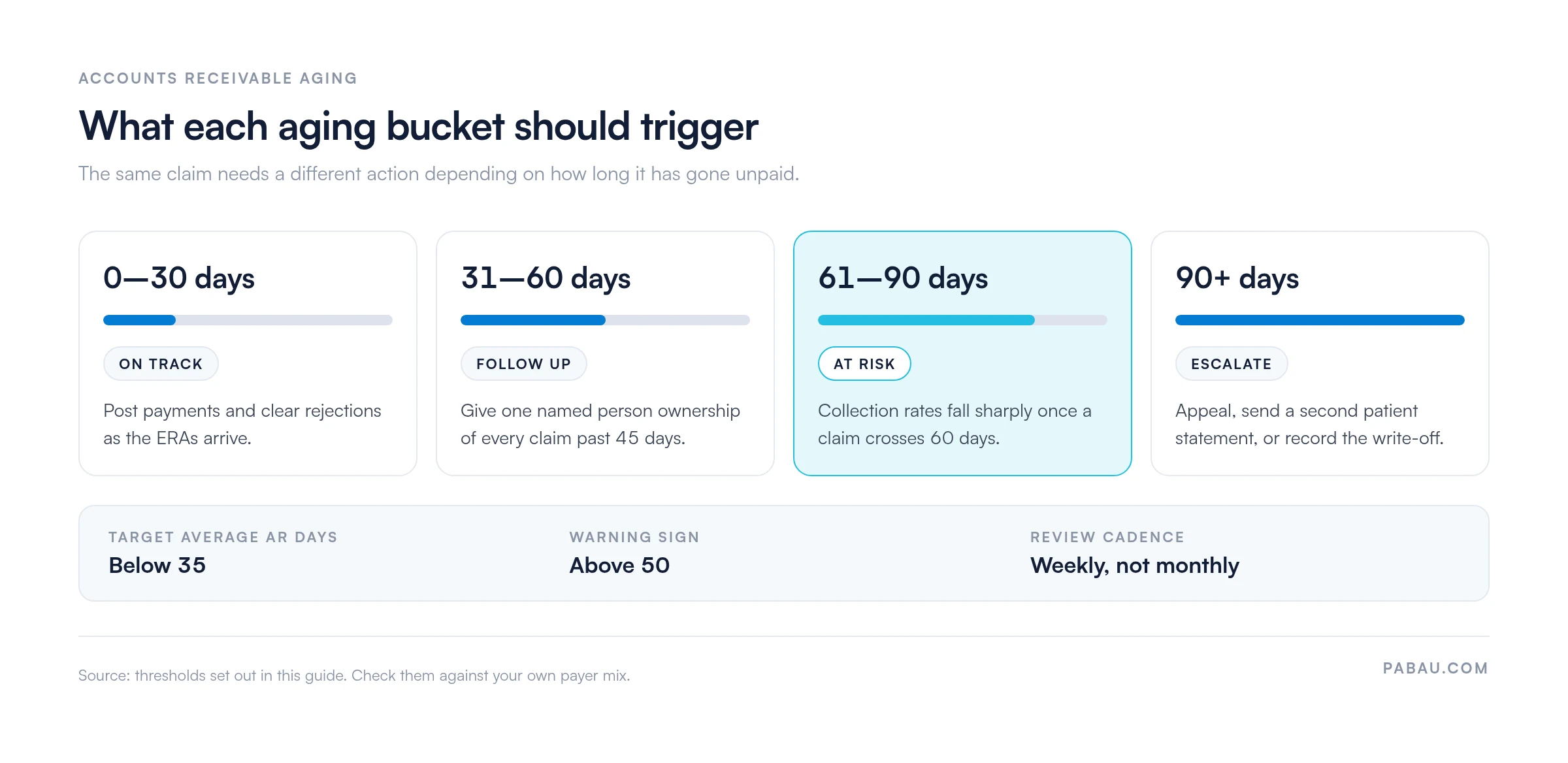
Accounts receivable aging reports group outstanding claims by how long they have gone unpaid: 0-30 days, 31-60, 61-90 and 90+. Claims sitting past 90 days have much lower collection rates. Work the aging report weekly rather than monthly, and give each overdue claim a named owner.
Each bucket calls for a different response, and the escalation below is what a weekly review is for.
Medical practices employ a mix of clinical and administrative staff, often on different pay structures, overtime rules and benefit setups. Payroll software that tracks provider commission, separates contractors from employees and withholds tax automatically cuts the compliance risk of running payroll by hand.
The Fair Labor Standards Act (FLSA) governs overtime and minimum wage for non-exempt staff. Licensed physicians and some other salaried professionals are exempt. State wage laws layer on top of that.
For non-exempt staff, the FLSA also requires a record of daily and weekly hours worked. A free timesheet template keeps that record in one consistent format.
Managing accounts receivable means submitting clean claims, posting every insurer payment, collecting the patient balance and documenting each write-off, so billed revenue turns into cash.
What matters is the distance between what you bill and what you collect, plus how long the money takes to arrive. That decides whether payroll clears and equipment leases get paid on time. Revenue goes missing between those four steps rather than inside them.
Three leaks account for most of the money that goes missing:
Automated reconciliation matches ERA files to claims, flags unposted payments and surfaces the patient balances that need chasing. Without it, a front-desk team handling 200 or more claims a month cross-references every payment by hand.
Write-offs come in two kinds that tell different stories. A contractual adjustment is the difference between your billed rate and the insurer’s contracted allowed amount. A contractual adjustment is expected and does not signal a collection failure.
A bad debt write-off is a balance you could not collect from a patient. Treating the two identically misrepresents how well you collect, so separate them in your chart of accounts.
A healthcare chart of accounts splits revenue by payer type, records adjustments as contra revenue, and gives deposits, packages and memberships their own liability account.
A generic small-business chart of accounts lumps all of this into “sales”. That hides the payer mix and makes your collection rate impossible to read. The structure below lists each account and exactly what should post to it. Rename accounts to suit your specialty, but keep the separations.
Two separations do most of the work. Splitting AR by insurance and patient shows which side is slowing down. Recording card processing fees gross, rather than banking the net payout as revenue, keeps your income figure honest and your fees visible.
Manage cash flow between payer cycles by cutting AR days, timing vendor payments to match incoming receipts and holding a 60-90 day operating reserve.
Fixed overhead like rent, salaries and equipment leases doesn’t pause while a claim sits with the payer. Start by projecting expected insurance receipts by payer from your historical payment cycles, then layer in what patients are likely to pay. Treat it as a weekly discipline instead of a monthly check-in.
Collecting more at the point of care shortens the cycle at the other end. A signed credit card authorization form lets you charge an agreed balance once the insurer has paid its share. The residual never turns into a statement chase.
Run your AR aging report every Monday morning, not monthly. Claims that cross the 60-day mark without follow-up have a substantially lower collection rate regardless of payer. Assign one staff member specific ownership of every claim over 45 days.
Bookkeeping for dermatology, plastic surgery and ENT practices differs by payer mix: cash-pay work creates deferred revenue, while insurance-billed work makes AR the priority.
The same core rules apply to bookkeeping for medical services of every kind. What changes is which accounts carry the weight, and which report your bookkeeper needs most.
Bookkeeping for dermatology practices usually runs two revenue streams: insurance-billed medical dermatology and cash-pay cosmetic treatments. Keep them in separate income accounts so the P&L shows how revenue splits between insured and cash-pay work.
Retail skincare adds product sales, stock to count and, in many states, sales tax collected at the counter. If the practice pays an outside lab for pathology, give those fees their own expense line.
Bookkeeping for plastic surgery practices is dominated by cash-pay procedures paid in advance. A deposit taken at consultation is not earned until the surgery happens, so accrual books hold it as deferred revenue.
Cancellations then become refunds or forfeited deposits, depending on your policy, and each needs its own entry. Patient financing companies usually deduct a merchant fee from the payout. Book the full procedure fee as revenue and the financing charge as an expense.
Bookkeeping for ENT practices looks most like primary care. Most revenue arrives through insurance, so AR aging, denial tracking and contractual adjustments matter most.
Two lines often need their own accounts. Hearing aid sales, where the practice runs audiology, are product revenue with stock attached. Allergy testing and immunotherapy add serum and supply costs, which should be tracked against the revenue they produce.
Medical practices that bill insurance or sell prepaid packages should generally use accrual accounting, while small cash-pay practices can often run on cash basis.
Your method of accounting for medical practices decides when revenue and expenses get recorded. That affects the timing of your tax liability and how useful your books are for decisions. The last three rows below are the ones most comparisons skip.
Practices billing insurance should generally use accrual accounting. Cash basis reports only what you collected, so it leaves out what you are owed. A practice that bills $400,000 in a quarter and collects $280,000 looks weaker on a cash basis statement than it is.
Packages cut the other way. A cash-basis practice that sells a block of prepaid sessions in December looks flush that month, then delivers the treatments in a quiet first quarter. Tax treatment of advance payments follows its own IRS rules, so check with your CPA before you change methods.
A medical practice month-end close matches takings to the bank, reviews balances and write-offs, updates deferred revenue and stock, then sends the bookkeeper fixed reports.
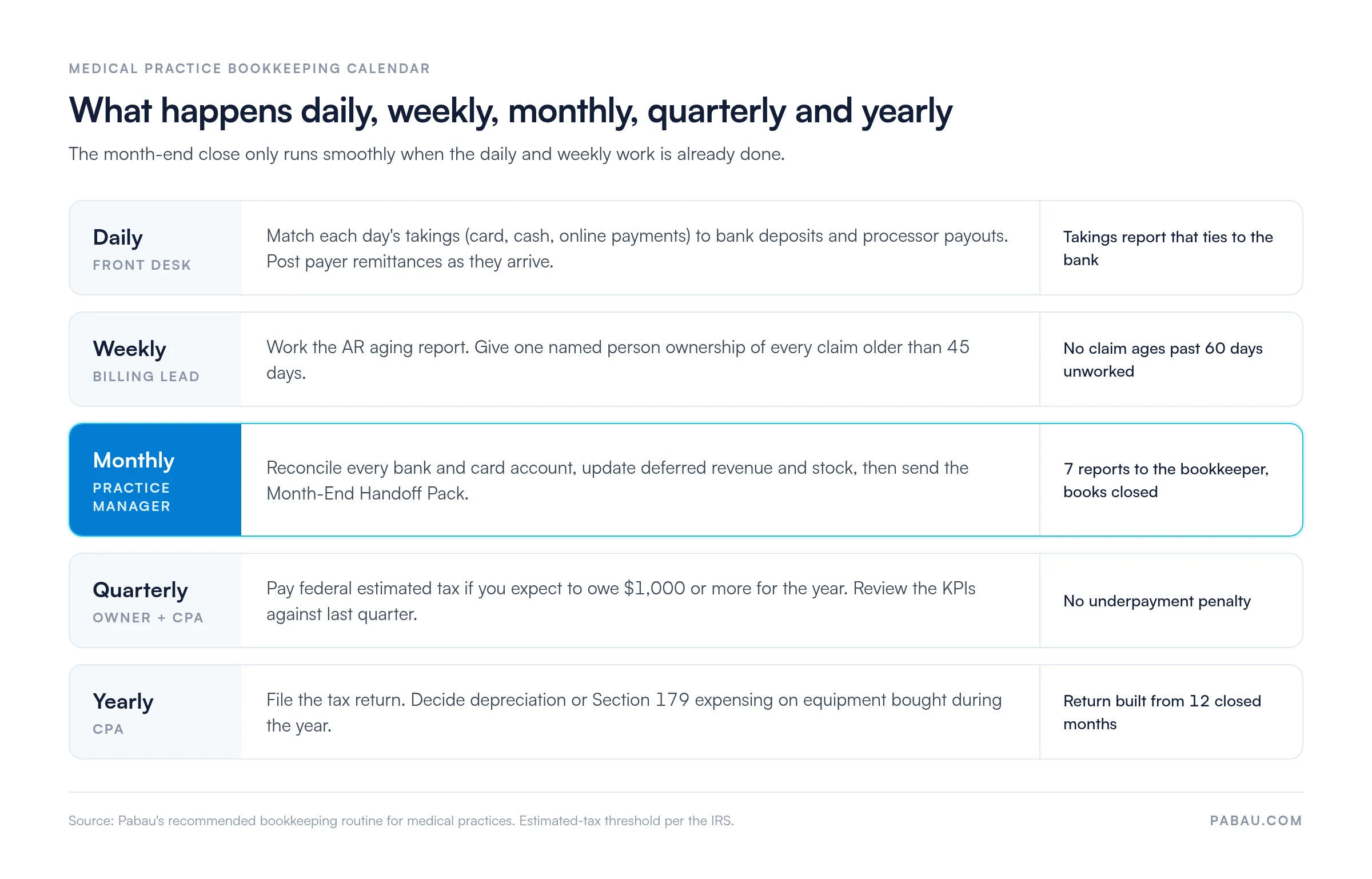
In medical practice accounting, the close only runs smoothly when the daily and weekly work is already done. The calendar below shows where each task sits across the year.
Work through these eight steps in order in the first week of the new month:
The Month-End Handoff Pack is seven reports your bookkeeper receives on the same day each month, pulled straight from your practice management or billing system.
A practice’s payments can arrive from three places at once: a card terminal, online booking deposits and bank transfers. The pack is what ties those back to the ledger without a round of follow-up emails.
Send minimum-necessary versions wherever the bookkeeper does not need patient detail. A patient ID and a total is usually enough, but it is still PHI, so the BAA still applies.
Medical practices can deduct equipment, malpractice premiums, continuing education and payroll, but only year-round bookkeeping captures them without a tax-time scramble.
Talk to a licensed CPA with healthcare experience. Your tax position depends on business structure, state and specialty mix. Key deductions available to most medical practices, subject to IRS rules:
Quarterly estimated tax payments are required for most practice owners who expect to owe $1,000 or more in federal tax for the year. For a C corporation, the threshold is $500. Missing them creates underpayment penalties on top of the year-end bill.
HIPAA governs clinical records, and it governs financial records that carry patient identifiers too. EOBs almost always carry them. An EOB ties a patient name, date of service, procedure code and diagnosis to a payment amount. That combination meets HIPAA’s definition of protected health information at 45 CFR §160.103.
Two compliance requirements land directly on bookkeeping operations.
The practical workaround is to keep as little PHI as possible in the accounting ledger. Invoices exported to your accounting software can carry a patient ID and a total, with no diagnosis or procedure detail. That limits what you have to protect, but an identifier is still PHI, so use a BAA-covered system for anything patient-identifiable.
The four KPIs worth tracking are days in AR, net collection rate, denial rate and overhead ratio, all calculated from figures your close already produces.
Track the trend month to month rather than chasing a published benchmark. Your payer mix and specialty move these numbers more than any industry average.
The best medical bookkeeping software setup pairs a general ledger, such as QuickBooks Online or Xero, with a practice management system that handles patient billing.
Most practices run general accounting software alongside a connected practice management platform. The question worth asking is how cleanly the two hand data to each other. When you evaluate the options, these criteria matter most:
For the ledger, most practices shortlist QuickBooks Online or Xero. Because Intuit does not sign a BAA for QuickBooks Online, keep patient detail out of it. Pabau, the practice management system we build, passes invoices and payments to Xero through a native integration.
Bookkeeping failures in a practice usually start as small, repeated errors. Over months, they compound into a discrepancy nobody can explain.
Outsourced bookkeeping usually suits solo practitioners and practices under five providers, while larger groups with complex payer mixes tend to justify an in-house bookkeeper.
Physician bookkeeping at a solo practice is a few hours a week, which rarely justifies a salary. Many firms sell doctor bookkeeping as a fixed monthly package, often bundled with medical accounting services from a CPA.
Volume usually settles it. Below about five providers, an outsourced firm with healthcare experience costs less than a capable hire and brings payer knowledge with it. Above that, the daily coordination between bookkeeping and billing starts to justify someone in the building. Either way, the Handoff Pack gives whoever does the books the same starting point every month.
A common source of bookkeeping errors is the distance between the clinical record and the financial record. When appointments live in one system and invoices in another, reconciliation means cross-referencing by hand.
Pabau keeps both sides in one platform. When a practitioner completes a treatment, the invoice is generated from the clinical record, so the financial data reflects the service delivered. Notes get finished sooner too, because Pabau Scribe, our time-saving AI scribe, drafts them from the consultation.
Integrated payment processing records the transaction at the point of care and feeds it straight through to your reports. That covers much of the Month-End Handoff Pack.
Pabau’s payments and invoicing produce the daily takings summary and the outstanding invoices report. Inventory and stock management produces the stock report. Reporting and analytics break revenue down by service, provider and location, which feeds the commission check.
Reporting comes with every Pabau subscription, so the reports are there from day one. Your ledger still lives in your accounting software, and the Xero integration passes invoice and payment data across so nobody re-keys it. Payer remittances still come from your billing service or clearinghouse.

Pabau builds your daily takings, outstanding invoices and stock reports from the treatment record, so your bookkeeper starts the close with clean figures.

Bookkeeping for a medical practice fails quietly. AR ages, write-offs get miscategorized, and package sales flatter a month that was tight. Nobody notices until the year-end reconciliation or the tax bill lands.
If you change one habit this month, make the handoff fixed. Pick a date, send the same seven reports every time, and give one named person the weekly AR review. Clean books follow from routine far more often than from software.
The trade-off worth remembering is that the routine costs staff time. Software only pays that back where it removes re-keying instead of adding another screen to check. Book a demo to see how Pabau produces your month-end reports from the treatment record, so your bookkeeper works from one set of numbers.

Paying more in card fees than you expected? Medical credit card processing explains how card payments and their fees work for practices.
Still reconciling stock from a spreadsheet? Automated inventory management sets out how automation keeps your stock report accurate.
Comparing billing platforms for an insurance-heavy practice? Best CareCloud alternatives compares practice management and billing software for medical practices.
Adding AI tools that handle patient data? HIPAA compliant AI tools covers what makes an AI tool safe to use with PHI.
Bookkeeping is the day-to-day recording of financial transactions: posting payments, reconciling bank accounts, tracking AR, and processing payroll. Accounting uses those records to produce financial statements, tax returns, and strategic analysis. A bookkeeper manages the data, and an accountant interprets it. Most practices need both, though a healthcare-experienced CPA can often supervise bookkeeping at a smaller practice.
Practices that bill insurance should generally use accrual accounting. Accrual records revenue when services are delivered rather than when payment arrives, so you can see what the practice is owed. Cash basis understates receivables and can make a practice with large outstanding claims look less healthy than it is. Verify current IRS eligibility thresholds and switching rules with your CPA.
The best accounting software for a medical practice is usually a general ledger, such as QuickBooks Online or Xero, connected to your practice management system. Intuit does not sign Business Associate Agreements for QuickBooks Online, so keep patient-identifiable records out of it. Judge any accounting platform on BAA availability, integration with your practice software and support for multi-payer payment posting.
A medical accountant prepares a practice’s financial statements and tax returns, plans its taxes and advises on entity structure and growth decisions. Good accounting for doctors also covers payer mix, deferred revenue from packages and HIPAA rules on financial records. Most medical accounting services build on the monthly books a bookkeeper closes.
Outsourcing works well for solo practitioners and practices under five providers, where the volume doesn’t justify a full-time hire. In-house bookkeeping suits larger groups with complex payer mixes that need daily attention and close coordination with billing staff. Whichever you choose, confirm that anyone touching PHI-containing financial records has signed or operates under a BAA.
HIPAA applies to financial records that contain patient identifiers, including EOBs, invoices carrying diagnosis codes, and payment histories tied to a named patient. Those records need secure storage and access controls, and any third-party vendor who sees them must sign a Business Associate Agreement. HIPAA’s minimum necessary standard then limits who may view financial PHI and for what purpose.
Four mistakes cause the most damage. The first two are ignoring AR aging past 60 days and mixing personal money with practice money. The other two are using cash basis accounting while billing insurance, and lumping contractual write-offs in with bad debt. Claims get significantly harder to collect once they pass the 60-day mark. Each mistake produces compounding errors that are expensive and slow to unwind at year-end.
The manual bookkeeping system for patient accounting is the pegboard system, also called the write-it-once system. Carbon-backed forms on a pegboard record each transaction on the day sheet, the patient ledger card and the receipt in one stroke. Most practices have since replaced it with practice management software.