Health appraisal form
A health appraisal form is a record a licensed provider signs to document someon...

2
Last Updated: Oct 13, 2026
Athenahealth EMR cost starts at an estimated $140 per provider per month for the base EHR license. On top of that sits a revenue cycle management fee of roughly 4% to 7% of monthly collections.
For a three-provider practice collecting $50,000 a month, that works out to around $2,400 to $3,900 per month. Implementation charges and optional modules push the first-year figure higher still.
Athenahealth publishes no fixed pricing. Every contract is quoted around practice size, specialty, and the modules selected. This guide breaks down each fee layer, so you know what to ask before you sign anything.

Athenahealth EMR cost starts at an estimated $140 per provider per month for the base license, per third-party review sources rather than athenahealth.
A revenue cycle management fee of roughly 4% to 7% of monthly collections sits on top of that base fee.
The percentage fee decides the bill. Three providers collecting $50,000 a month pay roughly $2,400 to $3,900.
Implementation, data migration, and add-on modules add one-time and recurring costs that rarely appear in the first quote.
Pabau publishes flat-rate pricing from $104 a month, with no percentage-of-collections fee, so the bill does not grow with revenue.
Athenahealth pricing is performance-based rather than flat-rate. A base per-provider license fee is combined with a percentage of the practice’s monthly collections. That second component pays for their revenue cycle management (RCM) service, and it carries most of the total cost.
The model ties athenahealth’s revenue to the practice’s billing outcomes. In theory that keeps them motivated to submit clean claims and chase denials. In practice, the software bill climbs every time revenue climbs, which works against a scaling practice.
None of these figures appear on athenahealth’s own site. Their cost and value page calls the model “aligned with your success” and points visitors to a demo request. Every number in this guide comes from third-party review sites and buyer reports.
Third-party review sources consistently cite $140 per provider per month as the starting point for the base EHR license. Athenahealth has never confirmed that figure, but it turns up across several independent review platforms and buyer reports.
Quotes vary with specialty, negotiated terms, and the version of athenaOne a practice selects.
These are illustrative calculations built on the $140 per-provider estimate. They exclude the RCM percentage fee, implementation costs, and any add-on modules.
The revenue cycle management fee is the largest variable in athenahealth’s total cost. Estimates from review platforms and buyer communities put it at 4% to 7% of monthly collections. A practice collecting $50,000 a month therefore pays $2,000 to $3,500 in RCM fees alone.
Set that against the base license for the same practice and the balance becomes obvious.
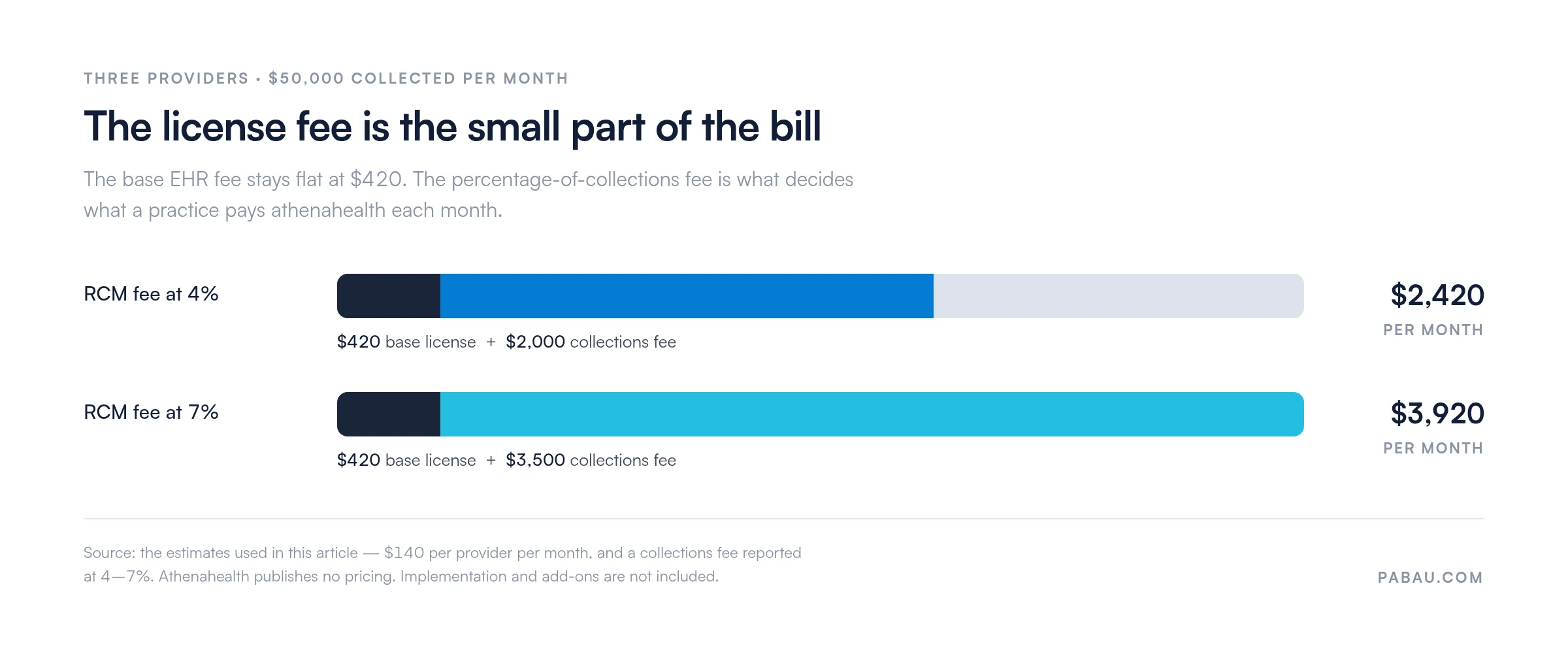
The percentage-of-collections model is athenahealth’s differentiator. Some practice managers value the aligned incentives. Others decide that handing over a share of revenue indefinitely stops paying off once billing runs smoothly.
Implementation is the first cost buyers tend to leave out of the budget. These are one-time charges for onboarding, data migration from legacy systems, interface configuration, and staff training.
Third-party buyer reports put implementation anywhere from a few thousand dollars for a small practice to $10,000 or more for multi-provider groups with complex migrations.
Practices moving off paper records or a simple scheduling tool tend to face the heaviest setup. Switching from another EHR with years of patient history brings a different kind of migration work than opening a brand-new practice.
Athenahealth hidden fees come up repeatedly in buyer reviews on Capterra and G2. On Capterra the platform holds a 3.8/5 rating from 912 reviews. Negative reviews cluster on one theme. The monthly invoice lands well above the quoted base price.
Athenahealth charges separately for capabilities that other platforms fold into one subscription. That makes the add-on list worth a line-by-line read before you sign.
Small practices carry a heavier per-provider burden than large groups. Solo and two-provider practices pay the same base rate per provider, but absorb the full implementation cost without volume discounts. They also get less from the RCM service, because their denial volume is lower and their billing is simpler.
These figures are estimates drawn from third-party buyer reports and community discussions. Athenahealth publishes no verified pricing tier for any practice size.
Contract length and renewal terms shape what an athenahealth deal costs over three years. Contracts are commonly reported as multi-year commitments of one to three years. Auto-renewal clauses can lock a practice in unless notice arrives well before the renewal date.
Put three questions to Athenahealth in writing before you sign. What is the notice period for non-renewal? Are there exit fees? And what happens to patient data once the contract ends?
Ask for the contract renewal notice period in writing before signing. Many practices discover they needed to notify athenahealth 90 days before renewal to avoid another full term. Add a calendar reminder 120 days before your contract expiry the day you sign.
Comparing athenahealth with alternatives means translating different pricing models into the same terms. Flat-rate per-provider tools are straightforward to budget. Percentage-of-collections models are much harder to project a year out.
Epic and DrChrono figures are reported starting rates rather than published list prices. Tebra and Pabau publish theirs. Every athenahealth figure here remains a third-party estimate.
Athenahealth earns its price at practices that bill heavily through insurance. Their RCM service can stand in for a dedicated billing hire, which is the point at which the percentage fee starts to look reasonable.
The trade-off is predictability. A practice collecting $80,000 a month on a 5% RCM fee spends $4,000 a month on that component alone. That is $48,000 a year, before the base license, implementation, or add-ons.
Practices that find athenahealth EMR cost too unpredictable usually build a shortlist. The right substitute depends on specialty, billing model, and practice size. Common options include DrChrono, Tebra, AdvancedMD, SimplePractice, and Jane App.
Two of those are worth a closer look if the pricing model is your sticking point. Our round-ups of Tebra alternatives and DrChrono alternatives set each one against the platforms practices switch to most often.
Pabau may be on your shortlist as well. Our list of Pabau alternatives and competitors shows which platforms buyers weigh it against, and what separates them.
If your practice bills heavily through insurance and wants an outsourced RCM partner, athenahealth may still be the better fit. For a cash-pay or mixed-model practice, the percentage-of-collections fee costs more than a flat subscription over time.
A useful Athenahealth quote takes preparation. Without clear context on practice size and specialty, their sales process tends to produce a broad range rather than a binding number.
The uncertainty above traces back to one design choice. The bill moves with revenue, so the better a practice bills, the more the software costs.
Practice management software like Pabau prices on locations and users instead. The subscription is published, flat, and starts at $62 a month for one user. Every subscription includes every feature, so there is no higher tier to buy into later.
That covers the whole patient journey in one system. Online booking, digital consent, treatment notes, payments, and automated follow-up all sit against the same patient record. Integrated billing and invoicing is part of the core subscription, so the software cost holds steady as collections grow.
Pabau is built for aesthetic, wellness, and multi-specialty practices. Those practices run a mix of cash-pay treatments, clinical services, and membership programs rather than high-volume insurance billing.


Pabau’s pricing is published and flat, based on locations and users rather than your collections. Every subscription includes every feature. Book a demo to see the platform set up for your specialty.

Athenahealth EMR cost resists a single number, because the model is quoted case by case and the company publishes nothing. The third-party estimates land around $140 per provider per month, plus a 4% to 7% fee on collections.
For a three-provider practice collecting $50,000 a month, that is roughly $2,400 to $3,900 before implementation or add-ons. Run the same math against your own collections before the first sales call, and the quote that comes back is far easier to judge.
Insurance-heavy practices with strong billing volume can make the percentage fee pay for itself. Cash-pay and mixed-model practices usually cannot. Predictability may matter more to you than an outsourced billing team. If so, book a demo to see the full practice workflow at a published price.

Weighing Pabau against the wider market? Pabau competitors and alternatives walks through the platforms buyers shortlist alongside us and where each one fits.
Still considering Kareo, now Tebra? Best Kareo alternatives for medical practices compares the options practices move to and what each one costs.
Looking at SimplePractice too? SimplePractice competitors covers the platforms that handle clinical documentation and billing in one place.
Athenahealth EMR cost is estimated at around $140 per provider per month for the base EHR license, according to multiple third-party review sources. This figure is not confirmed by athenahealth, which does not publish pricing on its website. Actual costs depend on specialty, practice size, and negotiated contract terms.
Yes, athenahealth charges a revenue cycle management fee as a percentage of monthly collections, commonly estimated at 4-7% based on buyer reports and community forums. This fee is in addition to the base per-provider license and can significantly increase total monthly costs for practices with strong revenue.
The most common hidden fees are implementation and data migration costs, plus add-on module fees for telehealth and patient engagement tools. Premium support tiers and annual price escalation clauses in multi-year contracts add more. Buyers on Capterra report that the monthly bill exceeds the quoted base rate once these charges land.
Athenahealth is generally better value for mid-to-large insurance-heavy practices than for solo or small ones. Small practices carry the same per-provider base rate and implementation burden without any volume discount. For a low-volume practice, the RCM percentage fee can also exceed the cost of billing in-house.
Epic is substantially more expensive. Third-party estimates place its starting cost at $1,200 or more per provider per month, against athenahealth’s estimated $140. Epic is designed for large health systems and hospital networks, while athenahealth targets independent and multi-specialty ambulatory practices. Both require custom quotes and do not publish public pricing.
No, athenahealth does not offer a free trial. Access is through a paid contract following a sales demo process. Practices evaluating the platform should request a structured demo first. Ask for a fully loaded quote covering implementation, RCM fees, and any add-on costs before committing.