Nitrates medication list
A nitrates medication list is a point-of-care reference that sets out the main c...

Last Updated: Oct 6, 2026

An ANA blood test looks for antinuclear antibodies, proteins the immune system aims at the nuclei of the body’s own cells.
A positive ANA does not diagnose a disease on its own. The titer and the staining pattern decide what happens next.
Roughly 31.7% of healthy people test positive at a 1:40 dilution, so a low titer alone rarely justifies a workup.
Practice management software like Pabau tracks ANA orders, flags the results that need follow-up, and sends the patient message.
Most patients who get a positive ANA blood test do not have an autoimmune disease. For a rheumatologist, though, that result is often where a months-long workup starts. The ANA test is one of the most commonly ordered screens in clinical immunology, and one of the most misread.
This guide covers what the test measures, how the titer and the pattern change the reading, and which tests follow a positive result. It also puts numbers on the false positives, because those numbers decide whether a workup is worth starting.
An ANA blood test detects antinuclear antibodies circulating in the bloodstream. These are proteins the immune system produces. In autoimmune disease they attack proteins found inside the nucleus of the body’s own cells.
Normally the immune system builds antibodies to fight bacteria and viruses. In autoimmune conditions that response turns inward. The test shows whether these self-targeting antibodies are present, at what concentration, and with what staining pattern.
The test is also called the antinuclear antibody test, the FANA test (fluorescent antinuclear antibody), or the ANA panel. According to MedlinePlus (U.S. National Library of Medicine), a positive result means antinuclear antibodies were found, which may be a sign of an autoimmune disorder.
The test does not diagnose a specific disease. It screens for autoantibodies that appear across a range of autoimmune conditions. A rheumatologist reads the result alongside the physical exam and the patient’s history.
The conditions most commonly associated with a positive ANA include:
Rheumatoid arthritis is the outlier on that list. ANA positivity is common in RA but never confirms it, so a rheumatoid arthritis test panel adds rheumatoid factor and anti-CCP antibodies to the picture.
A rheumatologist or primary care physician orders the test when a patient presents with unexplained symptoms that suggest autoimmune activity. These are the most common clinical triggers:
Several of those signs come and go. Rashes fade and Raynaud’s discoloration lasts minutes. Dated before and after photos in the record give the rheumatologist evidence the patient cannot describe from memory.
The test is rarely ordered as a routine screen for patients with no symptoms. The American College of Rheumatology is clear on when it earns its place. It is most useful when symptoms or exam findings already raise the pre-test probability of autoimmune disease.
The test itself is a standard blood draw. A healthcare professional takes a venous sample, usually from the inner elbow. No fasting is required, and the risk beyond minor bruising is minimal.
Recording the medication list at intake matters more here than it does for most panels. Several commonly prescribed drugs push an ANA positive, so the requisition should name them before the sample reaches the lab.

The sample is then analyzed by one of two main methods:
Results usually take one to three business days. The report gives the titer, and with IIF it gives the staining pattern as well.
An ANA result has three parts. The lab reports positive or negative, the titer, and the staining pattern. Reading one part in isolation is a common clinical mistake. The Mayo Clinic notes that all three, read with the patient’s clinical picture, decide whether further workup is warranted.
A positive result means antinuclear antibodies were detected above the laboratory’s threshold. It does not confirm a diagnosis. Higher titers carry more clinical weight, and low titers in healthy people are a well-recognized finding. The staining pattern points toward which disease group to consider.
A negative result largely rules out lupus. Roughly 97% of lupus patients test ANA positive, so a negative result is strong evidence against that diagnosis. Seronegative lupus exists but is rare. A negative ANA does not rule out every autoimmune condition, particularly those driven by antibodies against non-nuclear antigens.
The titer is how far a sample can be diluted before ANA are no longer detectable. A titer of 1:160 means antibodies were still present after a 160-fold dilution. A higher ratio means a higher antibody concentration.
The first row is the one that trips up interpretation. Positivity in a healthy population drops sharply with every doubling of the dilution, and the shape of that drop-off is what makes a titer readable.
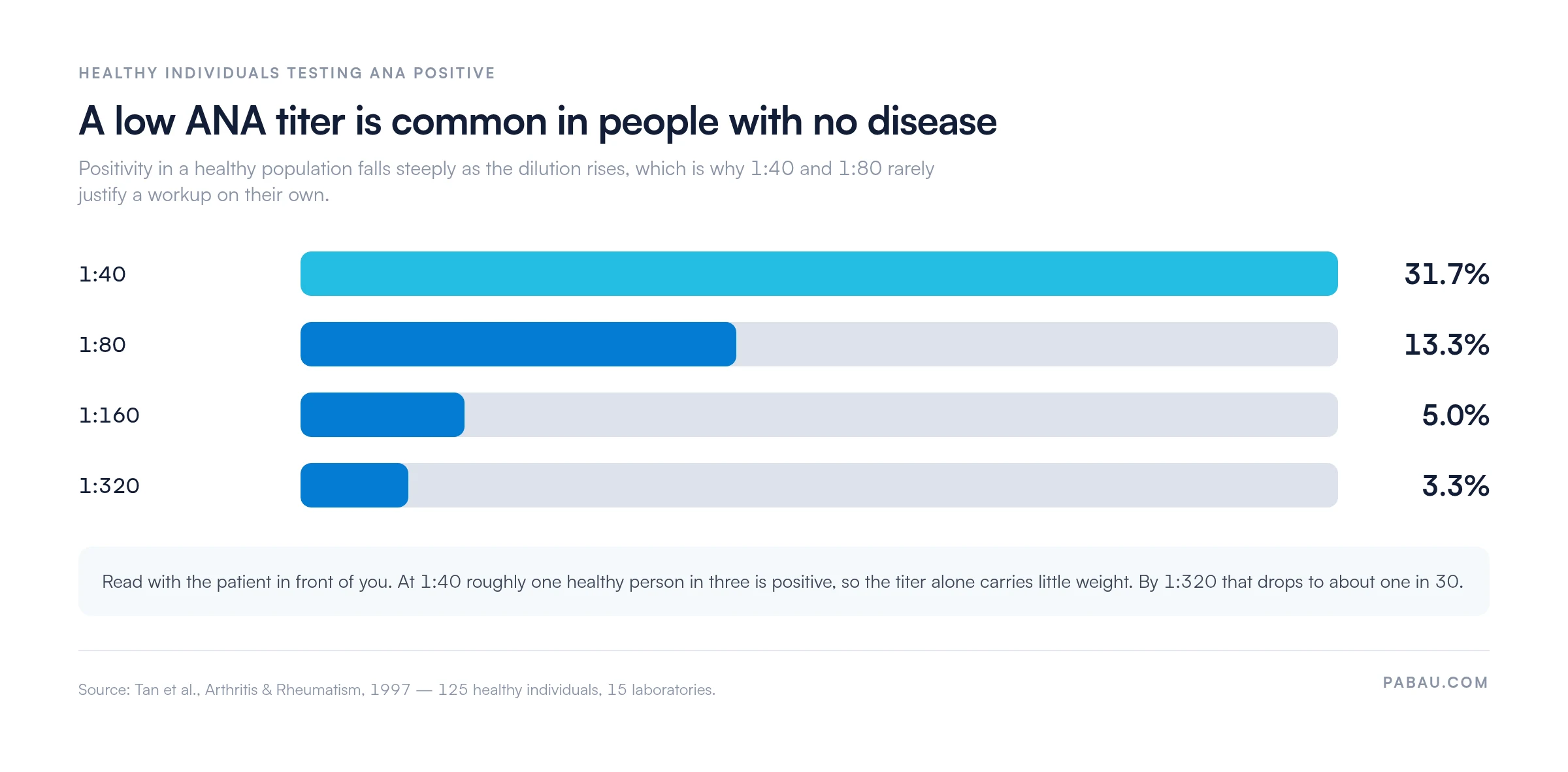
These ranges are a general clinical guide. UNC Rheumatology and the Mayo Clinic both treat 1:40 to 1:80 as often clinically insignificant. Neither supports an extensive workup in an asymptomatic patient, and the threshold for action varies by laboratory.
Titers also move over time. Logging each result on an ANA levels chart shows whether a patient is climbing through the dilutions or holding steady. A single result cannot show that.
When IIF testing is used, the lab also reports a staining pattern. Different patterns reflect which nuclear structures the antibodies are targeting, and each carries distinct disease associations.
Pattern interpretation is not diagnostic on its own. A rheumatologist weighs the pattern alongside the titer, the symptom history, and specific antibody sub-tests before drawing conclusions.
Yes, and this is the most clinically important point about ANA testing. A widely cited 1997 study of healthy individuals found 31.7% positive at 1:40 and 13.3% at 1:80. Positivity is higher in older adults and in women.
Certain medications also produce a positive ANA without autoimmune disease. According to the Mayo Clinic, hydralazine, procainamide, and isoniazid are among the confirmed examples. This is drug-induced lupus, and stopping the drug usually clears the result.
A low-titer positive ANA in a healthy, asymptomatic patient generally needs no further investigation. What prompts a workup is a high-titer positive alongside symptoms that fit an autoimmune picture.
Document the patient’s complete medication list before ordering an ANA blood test. Several commonly prescribed drugs produce false-positive ANA results, and knowing this upfront prevents unnecessary specialist referrals and patient anxiety. Flag any recent medication changes in the lab requisition notes.
A positive ANA narrows the diagnostic field but rarely ends the investigation. Rheumatologists order specific antibody sub-tests to find which nuclear antigens are being targeted.
The most commonly ordered follow-up tests after a positive ANA include:
Anti-dsDNA and anti-Sm antibodies are more specific to lupus than ANA alone, per the American College of Rheumatology. In a symptomatic patient, either one at a significant level carries serious diagnostic weight.
Complement levels are the one row used for monitoring rather than diagnosis. The C4 complement blood test explains how falling C3 and C4 track active disease. Most patients with a high-titer positive ANA are referred to a rheumatologist at this stage.
A positive ANA is rarely one appointment’s work. The order goes out, the result lands days later, the patient needs a call, and a referral often follows. Practices running rheumatology, integrative medicine, or functional medicine services repeat that loop for months per patient.
Practice management software like Pabau holds the order, the result, and the follow-up task on one patient record. Our lab management software flags a result that needs action, so a positive ANA does not sit unread in an inbox.
When a result calls for a rheumatology referral, staff log the referral, set the follow-up task, and send the patient message from the same screen. Nobody switches systems, and the next person to open the record can see what already happened.

For patients monitored over years, that record becomes the trend line. Titers, complement levels, medication changes, and referral dates sit in one timeline, so a rising titer is visible rather than buried.

Pabau keeps ANA orders, results, and referrals on the patient record, and flags the results that need action. Your team stops chasing paperwork between systems.

The judgment call in ANA testing usually sits in the titer rather than in the positive or negative. A 1:40 positive in a patient with vague fatigue is a reason to wait and watch. A 1:320 positive with a butterfly rash is a reason to refer.
So order the test only when the symptoms already point somewhere. Read the titer and the pattern together, and document the medication list before the sample goes out. That sequence heads off most of the unnecessary referrals a positive ANA can trigger.
The other half of the job is administrative. A result only helps if it reaches someone who acts on it. Book a demo to see how Pabau keeps ANA orders, results, and follow-up tasks on one patient record.

Tracking a patient’s titer across visits? ANA levels chart template gives you a printable log for each result, its titer and its pattern.
Ruling rheumatoid arthritis in or out after a positive ANA? Rheumatoid arthritis test covers rheumatoid factor, anti-CCP and what each result tells you.
Monitoring lupus activity rather than diagnosing it? C4 complement blood test explains how complement levels rise and fall with disease activity.
Standardizing how orders reach the lab? Blood test lab request form is a ready-made requisition covering patient details, tests requested and clinical notes.
An ANA blood test screens for antinuclear antibodies in the bloodstream. Their presence can point to an autoimmune disease such as lupus, scleroderma, Sjögren’s syndrome, or mixed connective tissue disease. It is usually ordered when a patient has unexplained joint pain, fatigue, rashes, or other symptoms that suggest autoimmune activity.
A positive ANA blood test means antinuclear antibodies were detected above the laboratory’s threshold. It does not confirm any specific diagnosis. Clinical significance depends on the titer, the staining pattern, and whether the patient has symptoms consistent with autoimmune disease. Low titers in asymptomatic patients are often incidental findings.
A negative ANA test result makes lupus unlikely, since roughly 97% of people with lupus test ANA positive. It does not rule out every autoimmune condition, particularly those driven by antibodies targeting non-nuclear antigens. Rare cases of seronegative lupus exist.
Yes. A widely cited 1997 study of healthy individuals found 31.7% positive at a 1:40 dilution and 13.3% at 1:80. A positive ANA can also come from other autoimmune conditions, certain medications, viral infections, or aging. It does not diagnose lupus on its own.
A negative result is considered normal. Titers of 1:40 to 1:80 are often clinically insignificant and appear in healthy individuals, particularly older adults and women. Titers of 1:160 and above are more likely to reflect autoimmune activity, and they usually prompt further investigation alongside the patient’s symptoms.
Common follow-up tests include anti-dsDNA and anti-Sm, which are specific for lupus. Anti-Ro/SSA and anti-La/SSB point to Sjögren’s syndrome, anti-Scl-70 to scleroderma, and anti-Jo-1 to polymyositis or dermatomyositis. Complement levels (C3 and C4) are used to assess disease activity. A rheumatologist guides this phase of the evaluation.
Yes. Roughly 31.7% of healthy individuals test positive at the 1:40 dilution, and 13.3% at 1:80. Positivity is more common in older adults and in women. That is why a positive ANA is read alongside the patient’s symptoms, history, titer, and staining pattern rather than on its own.