









Tummy tuck revision consultation checklist
A revision tummy tuck corrects scars, belly button position, and muscle repair. ...

Last Updated: August 6, 2026


Aesthetic Record pricing starts at $15 per user per month for Essentials and $19 per user per month for Accelerator, both with a one-time $399 startup and onboarding fee.
There is no permanently free plan. Aesthetic Record offers a 14-day risk-free trial, and Enterprise pricing is custom.
The per-user headline is only part of the cost. Paid add-ons like e-prescribing, ChartSmart AI, and LeadAR, plus per-user storage, SMS, and email caps, push the total higher.
Some users report a $1,120 charge to export their patient data, so ask about data portability before you sign a contract.
Pabau, an all-in-one practice management platform, starts at $62 per month with every feature included and no reported data export fees.
Aesthetic Record costs $15 per user per month on the Essentials plan and $19 per user per month on Accelerator, each with a one-time $399 startup and onboarding fee, while Enterprise pricing is custom. That is the headline number.
The fuller picture, once you add training, paid add-ons, per-user caps, and a widely reported data export fee, is what lands on your first-year invoice. This guide breaks down every Aesthetic Record plan, what each tier includes, the costs that sit outside the subscription, and how the total stacks up against an all-in-one practice management platform like Pabau.
Aesthetic Record costs $15 per user per month for Essentials and $19 per user per month for Accelerator, each with a one-time $399 startup and onboarding fee. Enterprise pricing is custom and quoted per practice. Because billing is per user, your monthly cost climbs with every provider or front-desk user you add.
Older third-party listings still show $12 and $16 per user. Those figures are from 2022 and are out of date. Always confirm current rates on Aesthetic Record’s official pricing page before you budget.
Aesthetic Record does not offer a permanently free plan. New practices can test the platform on a 14-day risk-free trial before committing, and can also book a live demo.
Every Aesthetic Record EMR plan bundles charting, scheduling, point of sale, inventory, photo management, and patient communication into one subscription. The difference between tiers is mostly integrations, reporting depth, and per-user limits rather than core clinical features. For a broader look at the category, see our guide to aesthetic EMR software.
Essentials is the entry tier and covers the day-to-day basics an aesthetic practice needs to open its doors.
Accelerator adds the integrations and reporting that busier practices tend to outgrow Essentials for.
Enterprise is built for multi-location and franchise groups and is quoted per organization. It layers on an enterprise management portal, franchise and multi-location dashboards, branded onboarding, a strategic account manager, and account cloning across locations, on top of everything in Essentials and Accelerator.
Several tools most aesthetic practices expect to use are billed on top of the core subscription, so they belong in any honest cost estimate.
Two-way texting isn’t a separate line item here. It’s bundled into the Accelerator tier already, though it runs through a third-party integration rather than a native Aesthetic Record tool.
None of these are unusual features for a med spa to want. The point is that the $15 or $19 per-user figure rarely reflects the full stack a working practice ends up running.
Every new Aesthetic Record account pays a one-time $399 startup and onboarding investment, and it applies to both Essentials and Accelerator. It is a separate line from the monthly subscription, so factor it into your first-year budget rather than your ongoing run rate.
The fee covers a 90-day guided onboarding with a specialist, CORE4 training and workshops, live system audit calls, access to the AR Learning Lab knowledge base, and live chat support seven days a week.
For a solo provider, that is a modest one-off. For a practice onboarding a full team, it is a first-year cost the headline price does not show.
The cost that comes up most often in Aesthetic Record pricing discussions is a reported $1,120 fee to export patient data. Reviewers on Capterra and Software Advice describe the charge appearing after roughly two years of use.
Aesthetic Record has not addressed this figure on its official pricing page, so treat it as user-reported rather than confirmed policy. If you are evaluating the platform, ask your sales contact directly whether data portability carries any fee before you sign.
Exit costs like this shape how freely you can switch systems later, and they never appear on a headline pricing sheet.
Before you sign any EMR contract, ask the vendor in writing what it costs to export your full patient database and photos if you leave. Get the number, the format, and the timeline in the agreement. Data portability is cheap to promise during a sales call and expensive to discover two years in.
The single biggest driver of your Aesthetic Record cost is the per-user model, because every provider, injector, and front-desk login adds another $15 to $19 a month. Here is what a realistic first year looks like for a three-provider med spa on Essentials, before any add-ons.
That is before e-prescribing, LeadAR, 2-way texting, or a possible data export fee down the line. A few things reliably push the number up:
Aesthetic Record holds a 3.5 out of 5 rating on Capterra and has built genuine traction among solo and small aesthetic practices. Reviewers praise its aesthetic-specific feature depth. The recurring criticisms are reliability and cost transparency.

Aesthetic Record is the best fit for a solo provider or small single-location practice that wants an aesthetic-focused EMR and can work within per-user pricing. Its low entry price and strong photo and membership tools suit a lean team getting started.
It is a weaker fit for practices planning to add providers or locations, where per-user billing and higher-tier gating raise the total quickly.
Aesthetic practices comparing options often also look at AestheticsPro, Mangomint, and Pabau, which sit at different price and rating points. Weight-loss clinics and injectables-focused med spas weighing similar EMR options face many of the same trade-offs. For a wider view of the category, see our guide to the best medical software.
Pabau, an all-in-one practice management platform for aesthetic, wellness, and medical practices, starts at $62 per month and takes a different approach to pricing than Aesthetic Record. Instead of charging per user for a base plan and gating features behind higher tiers, every Pabau subscription includes every feature, with pricing that scales by users and locations.
That structure changes the total cost picture in three ways:
Ageless Enhancements, a two-location med spa, relies on that multi-location support to keep bookings and records synced across both sites. You can see current tiers on the Pabau pricing page.
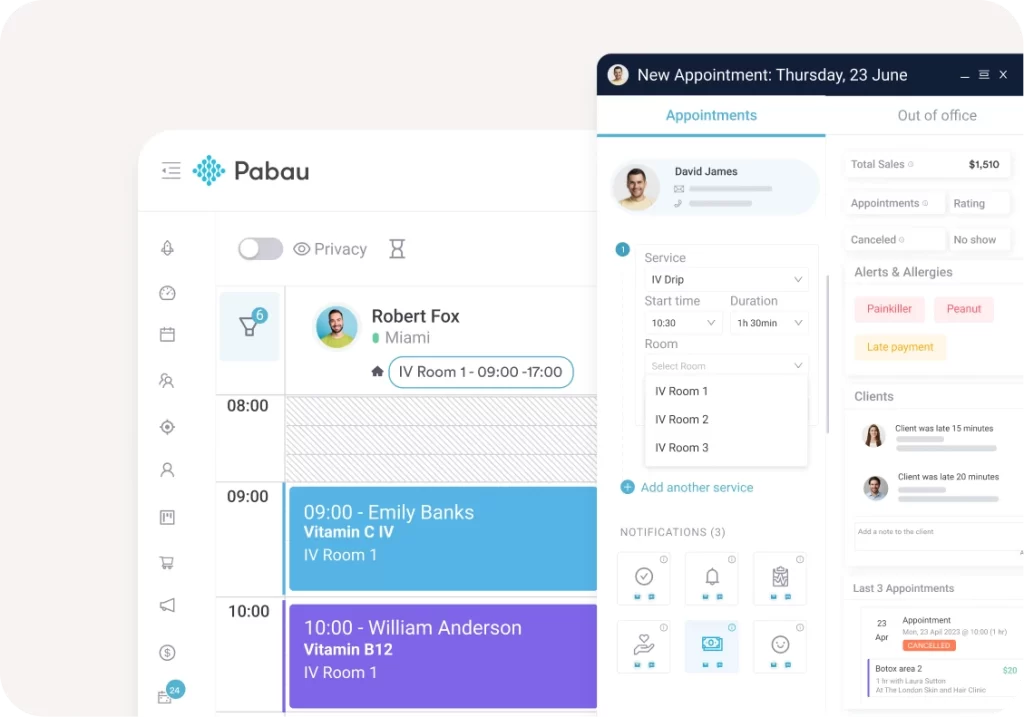
For a solo provider testing the water, Aesthetic Record’s low per-user entry can win on first-year price. For a practice planning to add providers, run more than one location, or avoid exit-fee risk, Pabau’s flat, all-inclusive model tends to give a more predictable total cost of ownership as you grow.

From booking and charting to billing, memberships, and automated follow-ups, Pabau gives aesthetic and wellness practices a single platform with every feature included. No onboarding fee. No data export fees.

Aesthetic Record’s headline rate of $15 per user per month looks approachable, but the number you actually pay depends on your team size and the extras you switch on.
Add the $399 onboarding fee, paid tools like e-prescribing and ChartSmart AI, and the data export charge users have reported, and the total can climb well past the sticker price as you grow into more providers or a second location.
The most reliable way to judge value is to map your full first-year total against how you actually plan to scale, rather than comparing entry-tier rates alone.
Book a demo with Pabau to see how an all-inclusive plan, with onboarding built in and no reported export fees, compares for your practice.

Want the full platform comparison, not just price? Pabau vs Aesthetic Record breaks down the two platforms feature by feature.
Curious how Pabau handles the med spa workflow? Pabau for medical spas covers the tools built for aesthetic and wellness practices.
Comparing the wider market first? Best medical software benchmarks the leading options so you can weigh cost against fit.
Aesthetic Record costs $15 per user per month for Essentials and $19 per user per month for Accelerator, each with a one-time $399 startup and onboarding fee. Enterprise pricing is custom. Older third-party figures of $12 and $16 per user are from 2022 and out of date, so confirm current rates on the vendor’s pricing page.
Aesthetic Record does not offer a permanently free plan. It provides a 14-day risk-free trial and a live demo so new practices can evaluate the platform before committing to a paid subscription.
Beyond the per-user subscription, budget for the $399 onboarding fee and paid add-ons such as e-prescribing, ChartSmart AI, LeadAR, and AR Pay. Multiple reviewers also report a $1,120 charge to export patient data after about two years, which the vendor has not confirmed. Ask about data portability and add-on pricing before signing.
Yes. Several aesthetic-focused EHR and practice management systems compete at different price points, from Aesthetic Record’s $15-per-user entry tier to flat-rate platforms like Pabau from $62 per month. The most affordable option depends on your user count and which add-ons you need, so compare total first-year cost rather than the headline monthly rate.
Aesthetic Record has a lower per-user entry price, while Pabau uses a flat subscription from $62 per month with every feature included, onboarding built in, and no reported export fees. For a solo provider, Aesthetic Record can be cheaper up front. For a growing or multi-location practice, Pabau often gives a lower total cost of ownership.