Health appraisal form
A health appraisal form is a record a licensed provider signs to document someon...

2
Last Updated: Oct 13, 2026

Mangomint sells a single plan: $120 per month for the base subscription, plus $10 per month per user.
Mangomint’s website headlines the plan at $130 per month, which is the base fee plus a single user.
Phone, marketing, and payroll are paid add-ons, so your real bill depends on which ones you switch on.
Mangomint is built for salon and spa teams, not clinical environments that need medical records or prescribing.
Pabau is the alternative for med spas that need consent forms and treatment records alongside booking and payments.
Most salon software pricing pages hide the real cost behind per-user fees, add-on modules, and processing fine print. Mangomint is more upfront than most. There is one plan, priced at $120 a month plus $10 for every user, with no contracts and no setup fees. Whether that reads as cheap or expensive depends on your headcount.
This guide breaks down what the plan costs as your team grows, which tools cost extra, and what Mangomint Pay charges. It also flags where the platform falls short for practices that need clinical-grade tools. If you’re comparing options before committing, a Pabau vs Mangomint comparison is worth reading alongside this breakdown.
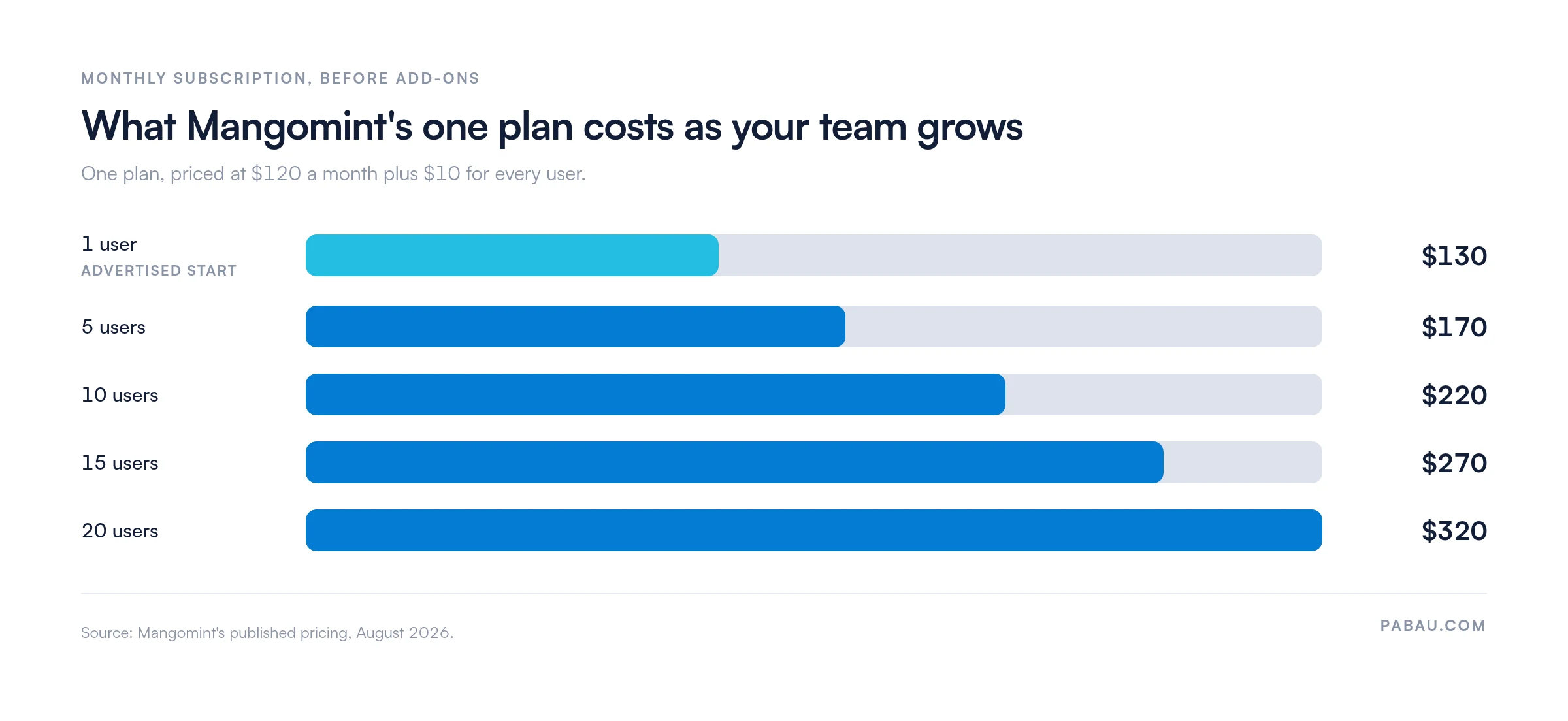
Mangomint no longer sells tiered plans. Its website lists one plan: $120 per month for the base subscription, plus $10 per month for each user.
Mangomint headlines that as starting at $130 per month, which is the base fee plus one user. Every location after the first adds another $120 per month.
| What you pay for | Price | What it covers |
|---|---|---|
| Base subscription | $120 / month | The platform itself, at one location |
| Each user | $10 / month | Every team member with a login |
| Advertised starting price | $130 / month | The base fee plus one user |
| Each extra location | $120 / month | Charged per location beyond the first |
| Add-on | Price | What it covers |
|---|---|---|
| Phone | $70 / month per line | In-app calls and texting |
| Marketing | From $30 / month | Mangomint’s marketing tools |
| Payroll | $50 / month plus $8 per worker | Payroll runs for your team |
Those figures come from Mangomint’s website, checked in August 2026. Mangomint also offers a free trial, free onboarding, and free data transfer. There are no contracts, so you can cancel at any time.
The base fee stays flat whatever your headcount, so the per-user charge is the part that moves your bill.
Every user on the plan gets the same platform. There is no higher tier to buy, so core scheduling and checkout tools are not held back for bigger accounts.
Three things sit outside that subscription. Marketing starts at $30 a month, payroll runs $50 a month plus $8 per worker, and a phone line costs $70 a month. Switching on all three adds at least $150 a month, before the per-worker payroll fee.
Because the plan charges per person, your software cost tracks your headcount directly. A team of 10 pays $220 a month. Hire five more people and the subscription moves to $270.
Mangomint is built for salons, spas, barbershops, and beauty studios. It does not include clinical documentation, medical history tracking, prescription management, or treatment record storage. Practitioners offering injectables, laser treatments, or any procedure needing informed consent for medical liability will find those limitations significant. That is not a weakness for its target market. It is simply a different product category.
Mangomint Pay is the platform’s integrated payment processing system. According to Mangomint’s own documentation, it offers transparent rates with no hidden fees, which reviewers consistently praise. Understanding integrated payment processing for spas helps put these rates in context.
Mangomint Pay supports card-present transactions (chip and tap), card-not-present payments, and online deposits. The platform markets itself on fee transparency, positioning processing as a straightforward cost rather than a variable with unexpected surcharges.
Mangomint publishes its processing rates directly: 2.45% + 15¢ per in-person (card-present) transaction and 2.90% + 30¢ per virtual (card-not-present) transaction. Both rates are flat and posted up front, so there are no surprise surcharges to negotiate.
Before signing with any salon or spa software, work out your monthly card volume and multiply it by the processing rate. On $30,000 a month, a 0.5% difference in rates costs $150. That is what 15 users add to a Mangomint subscription. Get processing rates in writing, not just in a sales conversation.
Mangomint reviews are consistently strong. The recurring thread across positive feedback is that the platform’s feature breadth and design quality justify the premium over cheaper alternatives.
One Reddit user who switched from Vagaro to Mangomint reported paying several times more each month. They also dropped the extra software subscriptions Vagaro needed for the same functionality. The net cost gap was smaller than the headline price difference suggested.
The consistent criticism: Solo practitioners find Mangomint hard to justify. A single-chair stylist pays $130 a month for a system designed around shared calendars and team management. Compared with options like the GlossGenius pricing breakdown, that is a lot of capacity nobody is using. Mangomint is transparent about this, and its own positioning targets teams rather than independents.
Reviewers echo this: The platform offers strong value when the features are actually used. A smaller team that never touches memberships or reporting is paying for capability it doesn’t need yet.
Mangomint’s own messaging is unusually honest about fit. The platform is not for solo practitioners, and that clarity helps buyers self-qualify quickly.
Solo practitioners should look at how Booksy prices its plans or evaluate GlossGenius for lower entry costs. Mangomint’s $130 floor only makes financial sense once several people are logging in.
Direct price comparisons are tricky because platforms bundle features differently. Here’s how Mangomint’s single plan sits relative to its main competitors:
Vagaro’s base price looks cheaper, but both platforms charge separately for some modules. If your team needs marketing and payroll, add those line items to each quote before you compare. For a detailed look at one competitor’s cost structure, see our Mindbody pricing tiers breakdown.
Med spas sit in an awkward category. They need booking, POS, and staff scheduling like any spa, but they also operate under clinical compliance requirements that pure beauty software doesn’t address. Mangomint handles the first set well. It doesn’t handle the second at all.
Practitioners offering neurotoxins, dermal fillers, laser treatments, or IV therapy need more than a booking system. They need digital consent forms with medical-grade audit trails, treatment record storage linked to client history, and prescription management for regulated substances. None of that exists in Mangomint’s feature set, on the plan or in any of its add-ons.
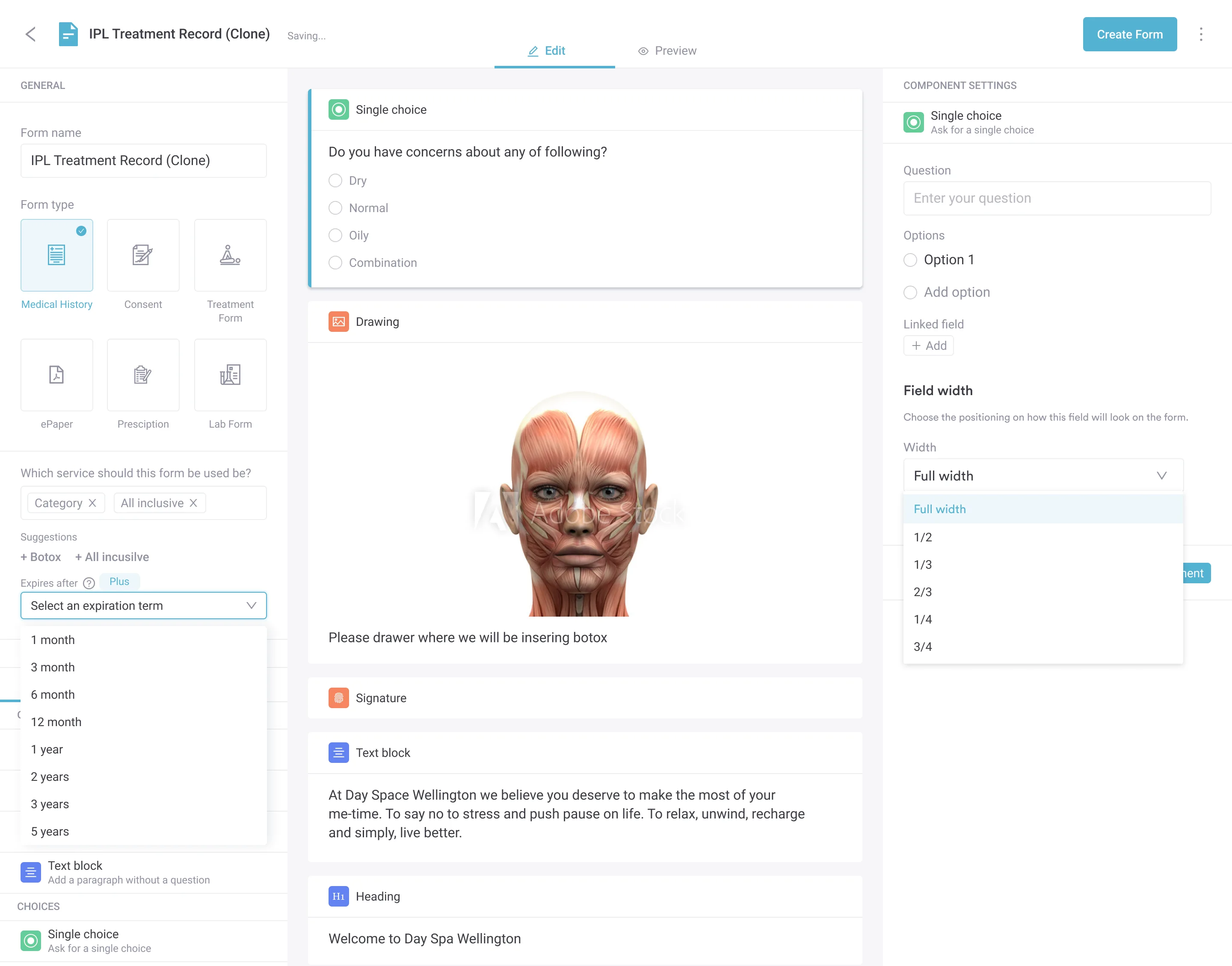
This isn’t a criticism of Mangomint’s design decisions, because the platform is excellent at what it’s built for. But a med spa evaluating Mangomint would still need clinical software running alongside it, which changes the total cost equation significantly.
Run a feature audit before comparing prices. List the tools your practice actually uses today: Booking, POS, consent forms, treatment notes, prescriptions, photo records. If more than two of those need separate software, add up the total. An all-in-one clinical platform usually costs less than a beauty tool plus clinical add-ons.
Pabau is practice management software for aesthetic practices, built as medical spa software rather than salon software. It combines the booking, POS, and team management Mangomint does well with the clinical layer med spas need. That means electronic medical records, consent form workflows, before-and-after photo documentation, and prescription tracking.
The practical difference shows up in the daily routine. A practice running salon software keeps consent forms and treatment notes somewhere else, then copies details between systems. In Pabau, the consent form, the injection record, and the invoice all attach to the same client file.
Pabau is well reviewed for its clinical and booking features, which users cite as the main value driver. Pricing starts from $65/month, scaling with location and user count. For practices reviewing their options, our roundup of top-rated med spa platforms covers how Pabau compares across the full competitive landscape.

Pabau is built for med spas and aesthetic practices that need consent forms, treatment records, and prescription management alongside booking and payments.

Mangomint pricing is easy to model now. One plan at $120 a month, $10 for every user, and a short list of add-ons you either need or you don’t. For salon and spa teams, that structure is simple to budget, and the cost per head falls as you hire.
The trade-off is worth remembering. Mangomint is not built for clinical environments, so med spas that need consent management, treatment records, and prescribing will need software built for that job. Pabau’s clinical-grade feature set covers exactly those requirements. To see how it handles the workflows Mangomint can’t, book a demo and we’ll walk through your setup.

Evaluating Mangomint against clinical platforms? Pabau vs Mangomint breaks down how the two platforms differ on clinical features, pricing, and target market.
Wondering how other spa platforms price their plans? Phorest pricing breakdown gives a comparable look at another premium salon software price structure.
Mangomint sells one plan: $120 per month for the base subscription, plus $10 per month per user. That works out at $130 a month for a single user, which is the figure Mangomint advertises. There are no setup fees and no contracts.
Yes. Mangomint offers a free trial, and it includes free onboarding and free data transfer. There are no contracts, so you can cancel at any time.
Mangomint Pay charges 2.45% + 15¢ per in-person transaction and 2.90% + 30¢ per online (card-not-present) payment. The rates are flat and posted up front, so there are no surprise surcharges to negotiate.
Mangomint positions itself for teams rather than solo operators. A single user pays $130 a month, which buys a system designed around shared calendars and team management. Solo stylists usually find lower-cost options like GlossGenius a better financial fit.
Pabau is the primary alternative for med spas and aesthetic practices. Unlike Mangomint, Pabau includes clinical documentation, consent form workflows, treatment records, and prescription management alongside standard booking and POS. Vagaro and Boulevard are alternatives for businesses that remain within the salon and spa category.
A team of 15 users pays $270 a month: the $120 base fee plus $10 for each user. Add-ons are charged on top, so payroll costs $50 a month plus $8 per worker and a phone line costs $70.
Phone, marketing, and payroll are paid add-ons. Phone is $70 a month per line, marketing starts at $30 a month, and payroll is $50 a month plus $8 per worker. Each location after the first adds $120 a month.