Waist-to-hip ratio chart: Risk bands for women & men (free PDF)
A waist-to-hip ratio chart sorts a patient’s waist-to-hip ratio (WHR) into...

3
Last Updated: Oct 14, 2026

A vegetarian weight loss meal plan builds a calorie deficit from plant foods while keeping protein, vitamin B12, iron and calcium adequate.
Build the week around legumes, tofu, whole grains, dairy and eggs rather than processed meat substitutes, which are often high in calories and sodium.
Aim for 25 to 30 grams of protein per meal to protect lean muscle and keep patients full between meals.
The template lays Monday out in full and leaves the rest of the week open, with one printed sample day as the model.
Practice management software like Pabau stores the completed plan in the client record and automates the check-ins that follow it.
A printable two-page form with patient information fields, a medical considerations box, and a fully fielded Monday for breakfast, lunch, dinner, snack and notes. Tuesday through Sunday stay open, and a printed sample day shows the shape each one should take.
Download templateA vegetarian weight loss meal plan builds a calorie deficit out of plant foods, without leaving the patient hungry or short on nutrients. Legumes, whole grains and steady plant protein do the work that portion cuts alone cannot.
Plans rarely fail on day one. They fail on a Tuesday evening, when the patient never decided the meal in advance and reaches for bread and cheese.
Writing the week down in the appointment removes that decision, and protein is the number to get right. Aim for 25 to 30 grams a meal. Below you get the template, a 7-day sample week, a grocery list and the nutrient checks that go with them.
A vegetarian weight loss meal plan is a structured dietary guide that leaves out meat and holds a calorie deficit. It centers on whole plant foods such as legumes, tofu, tempeh, whole grains, nuts, seeds, vegetables and fruit. Most vegetarians add dairy and eggs.
Weight loss should not cost the patient nutrient adequacy. The NHS Eatwell Guide and the Academy of Nutrition and Dietetics both support plant-based eating for weight management. That support depends on meeting protein, vitamin B12, iron, calcium and omega-3 needs.
That condition matters, because vegetarians are more exposed on three fronts. Vitamin B12 appears only in animal products and fortified foods. Non-heme iron from plants absorbs less readily than heme iron from meat, and long-chain omega-3 intake tends to run low.
The deficit that drives weight loss works the same way on any diet. Roughly 500 to 1,000 kcal below daily expenditure yields 0.5 to 1 kg of loss per week. A vegetarian plan reaches that deficit with foods lower in calorie density and higher in fiber, so patients feel full sooner.
Each step below fits inside a standard consultation, and none of them needs a second visit to complete.
The download is a working document rather than a finished menu. Page one collects the patient’s name, goal weight and any medical conditions worth noting.
Monday then arrives with a full set of boxes for breakfast, lunch, dinner, snack and notes. Tuesday to Sunday follow as open days you fill in the same way. The sample day at the end shows the shape each day should take.
The form stays blank until you fill it in. That means one file covers lacto-ovo, lacto vegetarian and vegan patients, with no editing on your side.
Metabolic and nutritional needs shift with sex, age and reproductive stage. The table below breaks the 1,200 to 1,500 kcal a day baseline down by age and activity level.
Where a patient’s target lands at the floor of that band, the 1200 calorie diet plan gives you a day already portioned to it. A target below 1,200 kcal needs medical supervision.
Iron: The RDA for menstruating women is 18 mg a day, against 8 mg for men. The NIH Office of Dietary Supplements advises vegetarians to aim for about 1.8 times the RDA, roughly 32 mg a day. Non-heme iron absorbs poorly, and that multiplier accounts for it. Pair iron-rich meals such as lentils, spinach and fortified cereal with vitamin C from citrus, peppers or tomatoes. Consider ferritin testing if the patient reports fatigue.
Calcium and bone health: Women aged 50 and over need 1,200 mg of calcium a day to offset menopause-related bone loss. Fortified plant milks, Greek yogurt and leafy greens are the main vegetarian sources, though oxalate in some greens limits absorption. Supplements may be needed, so raise it with the patient’s physician.
Hormonal factors: Restriction below 1,200 kcal a day can disrupt menstrual cycles and thyroid function. Moderate deficits, adequate protein and one or two maintenance days a week protect hormonal health during weight loss.
Day 1 is the sample day printed in the download. Days 2 to 7 follow the same shape. Write them under the open day headings, or swap in equivalents the patient prefers. Portion each day to the calorie target you set in step one.
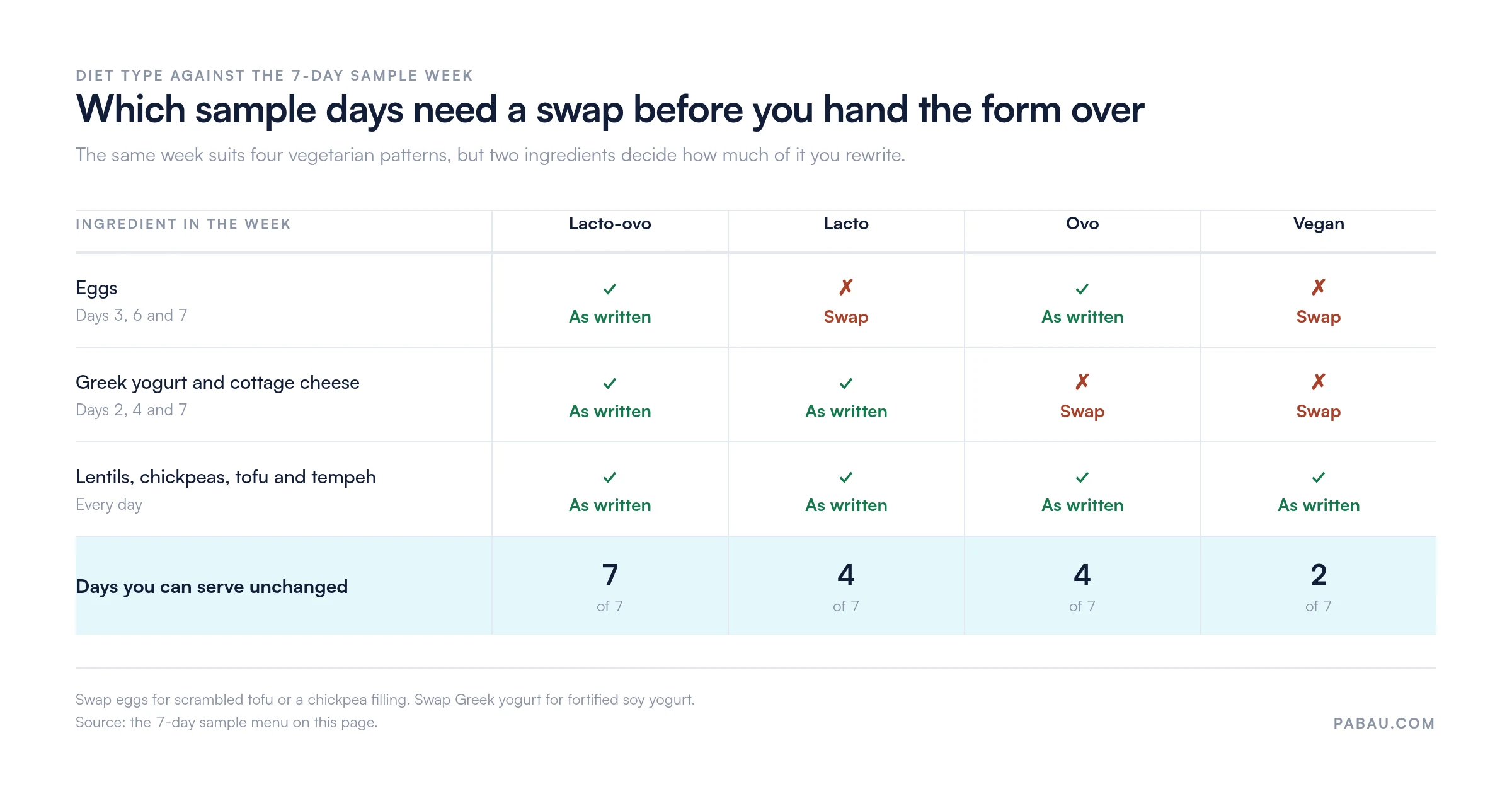
Days 3, 6 and 7 use eggs, and days 2, 4 and 7 use Greek yogurt or cottage cheese. Swap in scrambled tofu or a chickpea filling for lacto vegetarian and vegan patients. Where the week calls for dairy, use fortified soy yogurt. For a patient who is already fully plant-based, the vegan meal plan is a cleaner starting point.
The matrix below counts how much of the week each pattern keeps.
Repeat the days a patient liked rather than forcing seven different dinners. Adherence improves when the week asks for fewer decisions, and a repeated day makes the grocery list shorter and cheaper.
This list covers the seven days above. Print it, or copy the items into the notes field on the template, so the patient shops once instead of three times.
Prep on Sunday. Chop the salad, roast the root vegetables, and cook the grains and legumes in bulk. Stored in glass containers, most of the week then assembles in under ten minutes a meal.
Two minutes of checks at the end of the appointment save a phone call later. Run through this list while the patient is still in the room.
Three mistakes come up more than the rest. Practitioners plan seven different dinners, which the patient abandons by Wednesday. Some write the plan without asking who cooks at home. Others set the deficit from a chart rather than the patient’s current intake.
The form is written for practitioners who handle nutrition across several specialties:
The form itself is gender-neutral, and the calorie and iron adjustments above cover the female-specific considerations. Note the ones that apply in the medical considerations box before you hand it over.
Practices that run weight management as an ongoing program keep these forms inside software built for weight loss. Each review then starts where the last one ended.
Structured accountability: A written week removes the daily guesswork. Patients know what the next meal is, which cuts decision fatigue and the impulse buys that come with it.
Nutritional completeness: A plan built by a dietitian keeps weight loss from costing the patient nutrients. Legumes and whole grains supply fiber and B vitamins, and fortified plant milks or a supplement cover B12. The completed plan then sits in the patient portal, where the patient can reread it whenever they need to.
Better adherence: A written plan beats verbal advice, because the patient has something to check against when the fridge is open. The form becomes a reference document rather than a memory test.
Shorter appointments: Starting from a template means less time designing a week from scratch. That time goes into the barriers to adherence and the follow-up instead.
A record of what you advised: The form captures the patient’s medical considerations, your name, license number and signature. That leaves you a dated record showing the advice was personalized.
Track fiber alongside calories. Most vegetarians take in 25 to 35 g of fiber a day from whole grains and legumes. That promotes fullness and lowers total calorie intake. Warn patients that pushing above 35 g a day without a gradual ramp-up causes bloating and discomfort. Build up over two weeks instead.
A printed plan stops being visible to the practice the moment the patient walks out. Practice management software like Pabau keeps it inside the record instead. Digital forms collect weight, medical considerations and food preferences before the appointment, so you fill the week in from what the patient reported.
The completed plan then goes out through the patient portal, so there is one current version instead of four printouts. Weigh-ins, adherence notes and consultation notes sit in the same client record. When a patient stalls in week three, you can see the week the logging stopped.
Automated reminders prompt patients to log meals and book the next review, with no one at the front desk chasing them. Those touchpoints run on a schedule you set once. Every Pabau subscription includes the forms, the portal, the records and the reminders, and structured onboarding sets the workflow up for you.

Pabau’s digital forms, patient portal and automated reminders send the plan out and record how each patient responds. Weights and adherence notes stay in one client record, so no one waits on a printout coming back.

The arithmetic of a calorie deficit is the easy part of vegetarian weight loss. What decides whether a patient is still on plan in month three is simpler. Was the week written down, and did anyone follow up on it?
So set the calorie target, then fill the template in with the patient rather than for them. Agree how the next review happens before they leave. Record what changes each week. That record tells you whether to adjust portions or rethink the approach.
Book a demo to see how Pabau sends the plan out, chases the weekly log, and keeps every weigh-in in one client record.

Patient already fully plant-based? Vegan meal plan for weight loss drops the dairy and egg days without rebuilding the week.
Planning a longer block than one week? 30-day meal plan for weight loss carries the same weekly structure across a full month.
Want a broader plant-forward option? 30-day plant-based diet plan gives you a month of plant-based days to draw from.
Need the intake side of the appointment? New patient weight loss intake form captures the history before you set a calorie target.
Managing inflammation alongside weight? Anti-inflammatory meal plan template gives you a second dietary angle for the same patient.
Usually the calories crept up rather than the plan failing. Cheese, nuts, oils, avocado and processed meat substitutes are calorie-dense, and portions grow quietly. Ask for three days of logged meals with portion sizes. Then compare what the patient ate against the week you wrote.
At a 500 to 1,000 kcal daily deficit, expect 0.5 to 1 kg a week. Most patients notice the change by week three. Weight moves unevenly, so review the four-week trend rather than a single weigh-in.
Neither wins on its own. Both work through the same calorie deficit, and adherence decides the outcome. A vegan plan removes calorie-dense dairy, but it also makes B12, iron and calcium harder to cover. Match the plan to what the patient will keep eating.
Yes, with one adjustment. GLP-1 medications blunt appetite, so total intake often drops below the target you set. Serve protein first at every meal, and use smaller portions more often. Check protein intake and lean mass at each review.