Monika Lazarevska
Nursing care plan for aggressive behavior
A nursing care plan for aggressive behavior is a structured clinical document fo...

3
Last Updated: Oct 26, 2026
Free PDF 2 pages, print-ready Clinician-reviewed
A vegetarian diet plan works only when the numbers behind it are written down. Cut meat, poultry, and fish, and a patient’s day often tips toward refined carbs. Protein, iron, and vitamin B12 are usually the first to fall short.
One decision belongs in every consultation. No unfortified plant food supplies vitamin B12 reliably, so the supplement question goes on the form each time.
The template here covers a single day, not a week. You get six meal slots, boxes for restrictions and medical conditions, and a totals row. Below are the calorie and macro targets and the nutrients to plan for. A worked example day follows, plus how the numbers shift for weight loss, Mediterranean, or keto eating.
A fillable form for a single day of vegetarian eating. It has patient detail fields, restriction and medical condition boxes, and six meal slots. Each slot records the meal, portion size, calories, protein, carbs, fat, and fiber, and a totals row adds up the day.
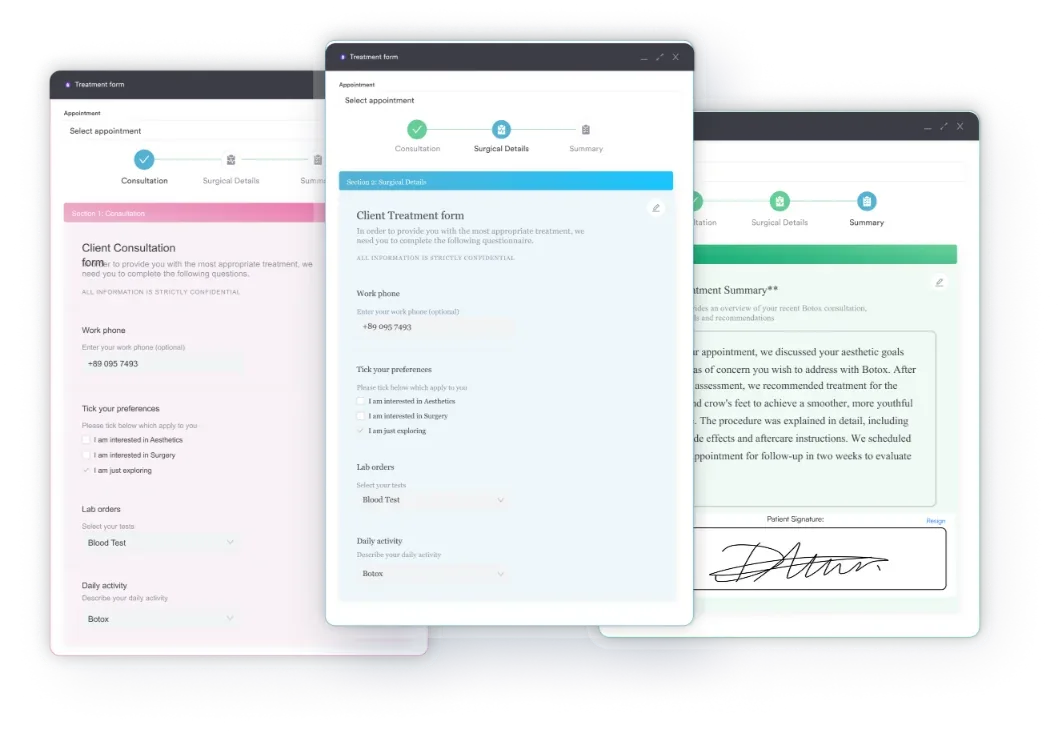
Upload this PDF, or any form you already use, and Pabau's AI Form rebuilds it with tick boxes, text fields and a signature. Attach it to the treatment once, and every patient gets it on time.
AI Form rebuilds the consent, history and aftercare forms you already use. You review each one, then publish.
Patients complete forms on their phone before they arrive, so the front desk stops retyping paper.
Every signed form is versioned and attached to the treatment record, ready when you need it.
Set how long a consent stays valid. Returning patients skip forms they have already signed.
Supports HIPAA and GDPR compliance AES-256 encryption 4.8 on G2 4.7 on Capterra Trusted by 4,000+ practices worldwide

A vegetarian diet plan structures plant-based eating to meet macronutrient and micronutrient needs without meat, poultry, or fish.
Vegetarians need an active plan for vitamin B12, iron, calcium, vitamin D, zinc, and omega-3 fatty acids, through food sources or supplementation.
The downloadable template is a single-day form with six meal slots, so you log one day’s meals, portions, calories, macros, and fiber per patient.
Weight loss, Mediterranean, and ketogenic vegetarian patterns change the numbers you write into that form, not the form itself.
Practice management software like Pabau stores the completed form in the patient record and automates follow-up reminders between visits.
A vegetarian diet plan is a written eating pattern that excludes meat, poultry, and fish. It builds meals from legumes, whole grains, vegetables, nuts, seeds, and, in most versions, dairy and eggs.
The plan sets a calorie target, splits it across macronutrients, and confirms the nutrients that plant foods deliver poorly are still covered.
Pescatarian and flexitarian eating often get grouped with these three, but neither is vegetarian. Pescatarians eat fish, and flexitarians eat meat occasionally. A patient who follows either needs a pescatarian meal plan or a flexitarian diet plan rather than this form.
Each variation needs a different nutrition strategy. The single-day form suits all three, because you write the patient’s own foods into the meal slots. What changes is which nutrients you watch, and that gets tighter as more animal products come out.
Removing meat, poultry, and fish removes the most reliable food source of several nutrients, each with its own metabolic health implications.
Track these six when you write the plan, and record any supplement you agree in the notes area on the form.
B12 is the one to settle first. Iron comes next, and pairing it with vitamin C at the same meal lifts absorption from plant sources.
Work through five steps before you fill in the form. Collect the weight, height, activity level, and food preferences ahead of the appointment, so step one is quick.
Run those five checks and you avoid the usual result, which is a vegetarian day built on refined carbs and processed meat substitutes.
This example fills every row on the form, so you can see how a day adds up. Adjust the portions to the calorie target you calculated, then swap foods for the patient’s preferences.
That day lands at 2,065 calories with 94g of protein. For a 70 kg patient that is 1.3 g/kg, inside the target from step two.
Fiber totals 56g, well above the 25 to 30g most adults get. Move a patient there over two or three weeks, not overnight, or they will report bloating and give up on the plan.
Weight loss on a vegetarian diet comes from a calorie deficit that keeps satiety and nutrient density intact. The form itself stays the same. You lower the number in the calorie field and rewrite the portion sizes.
A weight-loss vegetarian day usually sits at 1,500 to 1,800 calories for most adults. Pair it with a review date, because sustainable weight management depends more on the follow-up than on the first plan.
Both patterns fill the same form. What changes is the macro balance you aim for across the six slots, and the foods that get you there.
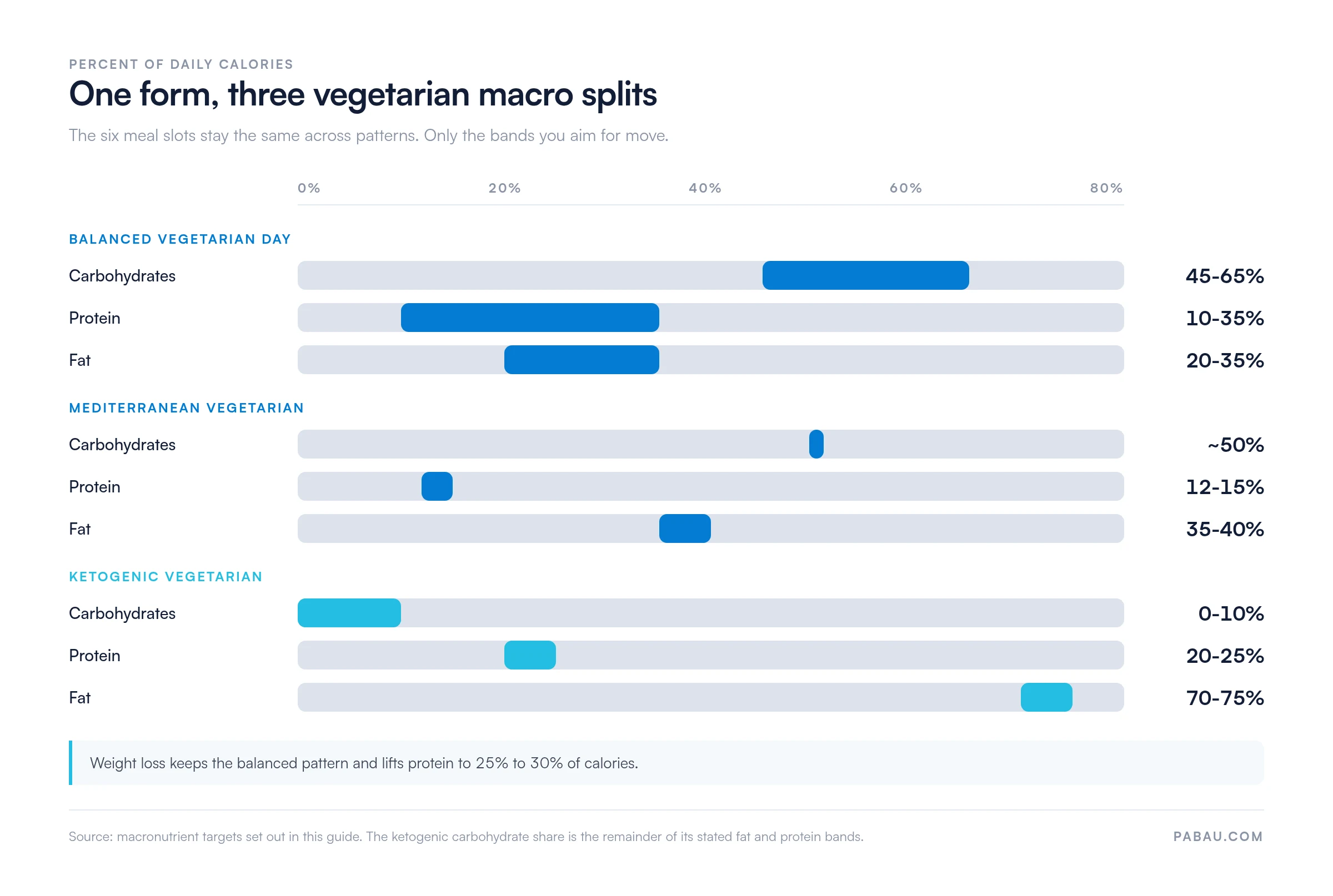
Mediterranean vegetarian leans on olive oil, nuts, seeds, whole grains, legumes, and a large volume of vegetables. Aim for roughly 50 percent of calories from carbohydrates, 12 to 15 percent from protein, and 35 to 40 percent from fat. The pattern supports cardiovascular health and is linked to longevity in aging populations.
Ketogenic vegetarian holds carbohydrates under 50g a day. Fat takes 70 to 75 percent of calories, and protein takes 20 to 25 percent. The slots fill with leafy greens, zucchini, cauliflower, nuts, seeds, avocado, eggs, and full-fat dairy where tolerated.
Grains and most legumes drop out at that carb ceiling, which removes the main vegetarian protein sources. Plan the supplement list carefully and review adherence more often than you would on the other two patterns. If the patient commits to keto beyond a trial, switch them to a ketogenic diet plan built for that split.
The same six slots serve very different caseloads. Three adjustments come up most often, and each one changes the food choices rather than the form.
The form is one document you complete with the patient, or hand over as a take-home sheet. Work down it in this order.
Those two restriction boxes are what stop a generic plan reaching the wrong patient. Because the form covers one day, reissue it whenever the plan changes. Dating and filing each copy gives you a record of how the patient’s intake moved between visits.
On paper, the plan leaves the room with the patient and the record stays behind. The signed copy sits in a folder, the swaps you agreed live in someone’s memory, and follow-up depends on the front desk making calls.
Practice management software like Pabau keeps the completed diet plan, the consultation note, and the next review date on one patient record. Digital forms let patients enter their details and restrictions before they arrive, so consultation time goes on the meal slots instead of paperwork.
Automated SMS and email reminders go out ahead of each review without anyone chasing them. When the patient comes back, you can open the last plan and see what was agreed. The next one starts from a known baseline.

Pabau’s digital forms and automated reminders store each patient’s completed diet plan alongside their notes and review dates. Follow-up stops depending on a paper copy.

Write the numbers down and the plan stops being advice. A dated form with portions and macros gives you something to compare against at the next visit.
The trade-off is scope. One day is all the file covers, so the micronutrient calls and the week-to-week pattern stay with you. Reissue the form whenever the plan changes, and keep the dated copies.
Once a plan is agreed, tracking it should not rely on paper and memory. Book a demo to see how Pabau stores each patient’s diet plan and schedules the follow-up.

Building a plan with no dairy or eggs? Vegan meal plan for weight loss covers the substitutions and the extra nutrients to watch when animal products come out entirely.
Patient wants more plants without the label? 30-day plant-based diet plan runs the same slot logic across a full month of eating.
Protein the sticking point? High-protein diet plan sets per-meal protein targets you can carry straight into the six slots.
Counting grams rather than percentages? Macro diet plan converts calorie targets into carb, protein, and fat grams for each meal.
No. Vegetarians avoid meat, poultry, and fish, but many eat dairy and eggs. Vegans avoid all animal products, including honey and animal-derived supplements. Those eggs and dairy make protein and calcium planning much easier.
No. Your body pools amino acids across the day, so pairing at every meal is not required. Aim for variety over 24 hours instead. Pairing still helps in the snack slots, where portions are small.
Yes, with adjustments. Growth raises calorie, protein, calcium, and iron needs, so the header targets go up rather than down. Menstruating teenagers need close attention to iron. Refer to a pediatric dietitian if growth or weight stalls.
Start with weight, adherence to the six slots, and any bloating from the fiber jump. Order ferritin, vitamin B12, and vitamin D if the patient has been vegetarian for a year without supplements.
Often not, unless the fortified foods are consistent. Two servings of fortified plant milk or cereal a day can cover B12. Consistency is the hard part, so a low-dose daily supplement is the safer default.