CRM for chiropractors: how to manage patients, bookings and marketing
A CRM for chiropractors is a patient relationship management system built around...

Last Updated: Oct 13, 2026
A senior blood pressure chart sets out the reading ranges and treatment targets that apply to adults aged 60 and over.
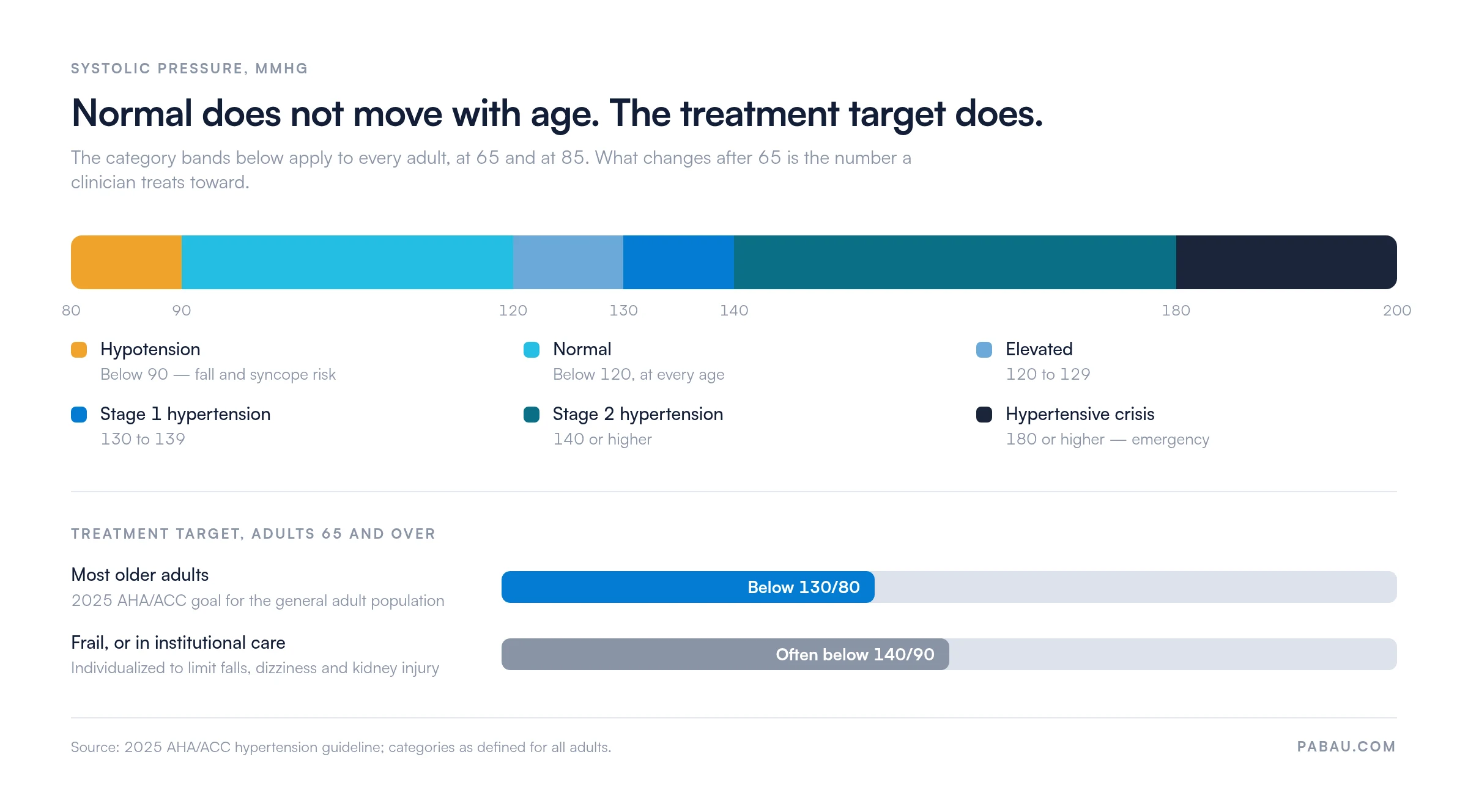
Normal is the same at every adult age: systolic below 120 mmHg and diastolic below 80 mmHg. What shifts after 65 is the number a clinician treats toward, not the definition of normal.
The 2025 AHA/ACC hypertension guideline sets a target of below 130/80 mmHg for adults, including those over 65. For frail older patients, and for anyone in institutional care, that target is individualized to avoid falls, dizziness and kidney injury. The American Heart Association (AHA) also encourages readings below 120/80 mmHg where treatment is well tolerated.
This guide gives you the age-banded ranges, explains what each category means for an older patient, and includes a printable chart with a tracking log.
An age-banded reference chart for adults 60 and over, covering normal ranges, hypertension thresholds and hypotension warning levels. It includes a daily and weekly log for recording readings, medication changes and symptoms.
Download template
Normal blood pressure is below 120/80 mmHg at every adult age, including 80 and over.
The 2025 AHA/ACC guideline sets a treatment target of below 130/80 mmHg for most adults 65 and over.
Isolated systolic hypertension — a high systolic with a normal diastolic — is the most common pattern after 65.
Orthostatic hypotension raises fall and syncope risk, so record standing and seated readings at every visit.
The printable chart gives a senior a structured log, so the practice reviews weeks of readings instead of one measurement.
A senior blood pressure chart is a reference table showing normal, elevated and high reading ranges for adults aged 60 and over. It is usually split into 60-69, 70-79 and 80+ bands. The bands exist because arterial stiffening, polypharmacy and frailty change what a given reading means for that patient. They do not mean normal itself moves with age.
The chart does two jobs. It tells a patient and their family what a reading means at their age, and it gives the practice one place to collect home measurements. Most versions carry a tracking log, with dated rows for daily or weekly readings, so self-monitoring and clinical follow-up draw on one record.
Dated blood pressure records in the patient file are standard of care for any senior on antihypertensive medication. A printable chart with a log cuts how much home data staff have to key in by hand. It also leaves a clear trail behind every treatment decision.
Blood pressure is written as two numbers, both measured in millimeters of mercury (mmHg). Systolic is the top number and diastolic is the bottom one.
In older adults the systolic number carries more weight. It rises more steeply with age, and isolated systolic hypertension is the dominant pattern after 65. A reading of 130/85 mmHg means a systolic of 130 and a diastolic of 85. Both feed cardiovascular risk, but systolic is usually what a clinician treats toward.
Record both numbers every time. Accurate clinical notes are what let the next clinician read a trend rather than a single measurement.
The American Heart Association and American College of Cardiology define five blood pressure categories that apply to all adults. What differs for an older patient is the clinical response each one calls for.
A systolic of 130 to 139 mmHg is Stage 1 on the chart. Treating a frail 85-year-old down below 120 mmHg, though, can bring on falls, dizziness and acute kidney injury. This is why CDC guidance asks clinicians to set the target per patient rather than per threshold.
Age-banded ranges let a clinician see quickly whether a reading is typical for the patient’s cohort. The table below keeps the normal range, which does not change with age, separate from the treatment target, which does.
*Targets follow the 2025 AHA/ACC hypertension guideline. A frail patient, or one in institutional care, is treated to an individualized target that often sits nearer 140/90 mmHg.
Put the categories and the targets on one scale and the distinction is easier to hold on to.
Isolated systolic hypertension (ISH) means a systolic of 140 mmHg or above with a diastolic under 90 mmHg. It is the most common form of hypertension in adults 65 and older. It develops as elastic fibers in the artery wall break down and collagen replaces them, which leaves the vessel less able to flex.
ISH carries substantial risk of stroke, coronary events and heart failure even when the diastolic number looks fine. Treating it hard can pull the diastolic down too far, which raises ischemic stroke risk in some older patients. Finding the individual target is a matter of measuring often enough to see what the patient tolerates.
Low blood pressure gets less attention than high, and it is just as dangerous in older adults. A systolic below 90 mmHg or a diastolic below 60 mmHg counts as hypotension. It brings dizziness, falls, syncope and acute kidney injury with it.
Orthostatic hypotension is a drop of 20 mmHg systolic or 10 mmHg diastolic on standing. It is common in seniors taking antihypertensives, and it is a direct fall risk. ACE inhibitors, diuretics, beta-blockers and calcium-channel blockers can all overshoot in a vulnerable patient. Take standing and seated readings at every visit.
The 2025 AHA/ACC hypertension guideline replaced the 2017 version and is the current US standard. It keeps a single target of below 130/80 mmHg for adults, and encourages below 120/80 mmHg where treatment is tolerated. There is no separate, looser number for people over 65.
The guideline does carve out exceptions, and older patients are where most of them land. Anyone in institutional care, or with a limited life expectancy, is given an individualized target instead of the standard one. In practice that often means treating toward something nearer 140/90 mmHg, to hold medication burden and fall risk down.
The 2017 guideline is where the old 140/90 figure for seniors came from, and it still turns up in printed patient material. Check any chart you hand out against the 2025 version before you copy it.
SPRINT, the Systolic Blood Pressure Intervention Trial, is the evidence behind the tighter number. It found fewer cardiovascular events in older adults treated below 120 mmHg systolic, alongside more acute kidney injury, syncope and electrolyte disturbance. That trade-off is why the guideline asks for a judgment per patient.
First-line antihypertensives for older adults are ACE inhibitors, angiotensin-receptor blockers (ARBs), thiazide and thiazide-like diuretics, and calcium-channel blockers. Beta-blockers are held back for patients with a prior MI or heart failure. All of them need closer monitoring in a senior, because of polypharmacy, reduced kidney function and greater sensitivity to side effects.
Dose titration works only when the reading and the medication change sit in the same record. Digital patient records keep medication history beside blood pressure response, so an overshoot shows up at the next review.
Non-drug measures stay first-line at every age, and they are where treatment for an older patient usually starts.
Together these typically bring systolic pressure down by 5 to 15 mmHg, depending on the starting point and how consistently the patient sticks with them. Education, family involvement and a written record of progress all lift adherence. That is why the log column on the chart matters as much as the reference table.
Home blood pressure monitoring shows how a patient responds to treatment across ordinary days. It also catches white-coat hypertension, where readings are high only in the practice. Technique decides whether the numbers are usable.
Two or three readings a week is the floor. Daily readings are better for anyone newly started on medication, or running unstable. A reading at or above 180/120 mmHg, or below 90/60 mmHg with symptoms, means contacting the practice the same day.
Four situations need same-day or emergency care.
Make sure the patient knows which number to call and what counts as an emergency. Printing that escalation line at the top of the chart is the simplest way to do it.
The chart is built for the consulting room and for the patient’s kitchen table. Five steps put it to work.
Any practice treating older adults with hypertension can use it. It earns its place fastest in five settings.
Four things change once readings are collected the same way every time.
Each entry should carry the date, the time, the device used, both numbers, the patient’s position and any medication or symptom worth noting. That level of detail is what makes the record usable by a second clinician. It is also what makes it defensible in an audit or a complaint.
Paper logs belong in the locked patient file. If you keep the log digitally instead, check three things. The platform should encrypt data in transit and at rest, restrict access by role and log every view. Most GP clinic software covers all three. Confirm it against the rules you work under, whether that is HIPAA, GDPR or a provincial privacy law.
Most practices collect home readings on paper and then lose time transcribing them. Either a staff member keys a month of rows into the record, or the log gets filed unread. The next review then runs on one consulting-room measurement.
Practice management software like Pabau keeps the reading, the medication change and the follow-up task on the same patient record. Custom forms capture systolic, diastolic, position and symptoms as structured fields rather than free text. A clinician opens the record and sees the trend, what was prescribed and when, and what was agreed last visit.
That structure is what makes a target reviewable. You can see whether a patient over 65 is running below 130/80 mmHg. You can also see whether a dose change moved them or tipped them into orthostatic symptoms.

Record blood pressure as structured fields, track medication changes beside it, and share the log with patients through the Client Portal. The whole log stays on one patient record.

The number worth remembering is that normal does not move. Below 120/80 mmHg is normal at 62 and at 92. A chart that says otherwise has read a treatment target as though it were a reference range.
What does move is what you treat toward, and how hard. For most patients over 65 that is below 130/80 mmHg. For a frail patient, or one in residential care, it is whatever number gives the cardiovascular benefit without the falls.
Print the chart and set the target with the patient in front of you. Then review weeks of readings rather than the one taken in your room. Book a demo to see how Pabau keeps those readings, and the medication changes beside them, on one record.

Need the ranges for adults of any age? Normal blood pressure chart sets out the same five categories without the age bands, for patients under 60.
Want more rows than the chart holds? The blood pressure log is a standalone printable sheet for patients recording twice a day over several weeks.
Setting up home monitoring for a whole patient list? Blood pressure monitoring covers device validation, measurement technique and how to get readings back into the record.
Building out the senior annual review? The annual physical exam checklist covers the rest of the assessment that sits around the blood pressure reading.
Normal blood pressure for a 70-year-old is below 120/80 mmHg, the same as for any other adult. The treatment target is a separate number: the 2025 AHA/ACC guideline sets it at below 130/80 mmHg when medication is needed. A healthy, active 70-year-old may tolerate and benefit from a tighter target. A frail or multimorbid patient of the same age is treated to an individualized one. That often sits nearer 140/90 mmHg, to limit side effects and fall risk.
A systolic of 180 mmHg or higher, or a diastolic of 120 mmHg or higher, counts as a hypertensive crisis and needs emergency assessment. Call 911 straight away if the reading comes with chest pain, shortness of breath, severe headache, vision changes or neurological symptoms.
A reading of 130/80 mmHg is Stage 1 hypertension, not normal, at any adult age. It is, however, the treatment target the 2025 AHA/ACC guideline sets for most adults. A patient who reaches it from a higher reading is where their clinician wants them. Whether it is the right number for a specific older patient depends on frailty, cardiovascular history and how well they tolerate medication.
The ideal reading for a 65-year-old woman without cardiovascular disease is below 120/80 mmHg. Where treatment is indicated, the target is below 130/80 mmHg. Postmenopausal women often see a steeper rise in systolic pressure as estrogen’s protective effect on the vessel wall falls away. Regular monitoring is worth the effort here.
Blood pressure does rise with age as the arteries stiffen. The evidence does not support accepting a higher reading simply because the patient is older. The 2025 AHA/ACC guideline applies the same below 130/80 mmHg target across adult ages. What changes is the room for judgment. A frail patient, or one in institutional care, gets an individualized target weighing falls and medication burden against cardiovascular benefit.
Low blood pressure in an older adult means a systolic below 90 mmHg or a diastolic below 60 mmHg, particularly alongside dizziness, weakness or fainting. Orthostatic hypotension — a drop of 20 mmHg systolic on standing — is a specific concern for seniors on antihypertensives, and it raises fall and syncope risk. Contact the practice if low readings persist or symptoms appear.
The 2025 AHA/ACC hypertension guideline recommends below 130/80 mmHg for adults, including those over 65, and encourages below 120/80 mmHg where treatment is well tolerated. That applies to older adults in reasonable general health. Patients who are frail, in institutional care or of limited life expectancy are treated to an individualized target instead, often nearer 140/90 mmHg.