Maja Popovska

Emotional intelligence scale: Free PDF and how to score it
Download your free emotional intelligence scale A three-page questionnaire with ...

1
Last Updated: Nov 2, 2026
Free PDF 3 pages, print-ready Clinician-reviewed
The South Oaks Gambling Screen (SOGS) is a 20-item questionnaire that screens adults for problem gambling and probable pathological gambling, now called gambling disorder. Henry Lesieur and Sheila Blume published it in 1987, and a total of 5 or more flags a probable pathological gambler.
Because it is a screen, a positive result leads to a clinical interview rather than a diagnosis. Practices can also run it through digital intake forms so the score lands in the patient record instead of a paper file. What follows covers scoring, the adolescent version, false positives and the steps after a positive screen.
A print-ready South Oaks Gambling Screen with all 16 questions, from gambling types and borrowing sources to chasing losses. It ends with a score sheet, the interpretation bands, and space for clinician notes.
Start from scratch, or upload this PDF or any form you already use, and Pabau's AI Form rebuilds it with tick boxes, text fields and a signature. Attach it to the treatment once, and every patient gets it on time.
AI Form rebuilds the consent, history and aftercare forms you already use. You review each one, then publish.
Patients complete forms on their phone before they arrive, so the front desk stops retyping paper.
Every signed form is versioned and attached to the treatment record, ready when you need it.
Set how long a consent stays valid. Returning patients skip forms they have already signed.
Supports HIPAA and GDPR compliance AES-256 encryption 4.8 on G2 4.7 on Capterra Trusted by 4,000+ practices worldwide

The South Oaks Gambling Screen is a 20-item screen for problem gambling, published by Lesieur and Blume in 1987.
Each “at risk” answer scores one point, so totals run from 0 to 20.
A total of 5 or more flags probable pathological gambling, and 1 to 4 flags some problems with gambling.
The screen overestimates pathological gambling in the general population, so confirm every positive result with a clinical interview.
Pabau, the practice software we build, can file the score and your next step in the patient’s record.
The South Oaks Gambling Screen is a 20-item questionnaire based on the DSM-III criteria for pathological gambling. Patients can complete it on their own, or a professional or nonprofessional interviewer can ask the questions.
Henry Lesieur and Sheila Blume built it at South Oaks Hospital, a private psychiatric hospital on Long Island, New York. Blume ran the hospital’s adult addiction services, and Lesieur was a research consultant to the South Oaks Foundation.
Their 1987 paper in the American Journal of Psychiatry drew on 1,616 people. The sample covered 867 patients treated for substance abuse or pathological gambling, 213 Gamblers Anonymous members, 384 university students and 152 hospital employees.
Family members and counselors independently validated the results, and the authors reported internal consistency and test-retest reliability. They pitched the screen for clinical populations of people with alcohol or drug problems, and for the general population.
The South Oaks Gambling Screen uses 20 scored items. They cover chasing losses, borrowing money to gamble, hiding gambling from family, and the time or money spent on it. Each item asks about a specific behavior rather than a general feeling, which keeps answers concrete.
The form also opens with unscored questions. They cover the types of gambling the patient has tried, the largest amount gambled in one day, and relatives with a gambling problem. Those answers give you context without moving the total.
Items also ask whether people have criticized the patient’s gambling, which often surfaces family strain early. Most items ask whether something has ever happened, so the screen measures lifetime behavior unless your version sets a shorter timeframe.
The American Psychological Association lists the instrument in its PsycTests record. Check the permissions terms there before you reuse the wording outside your practice.
The South Oaks Gambling Screen scores one point for each answer that shows risk, and the total falls between 0 and 20. The standard score sheet sets out which answers count.
Those rules give 20 scored items in total. Add the points, then match the total to the band below.
A South Oaks Gambling Screen total of 5 or more marks a probable pathological gambler. A total of 1 to 4 shows some problems, and 0 shows none. The bands come from the standard score sheet and match the template’s own score sheet.
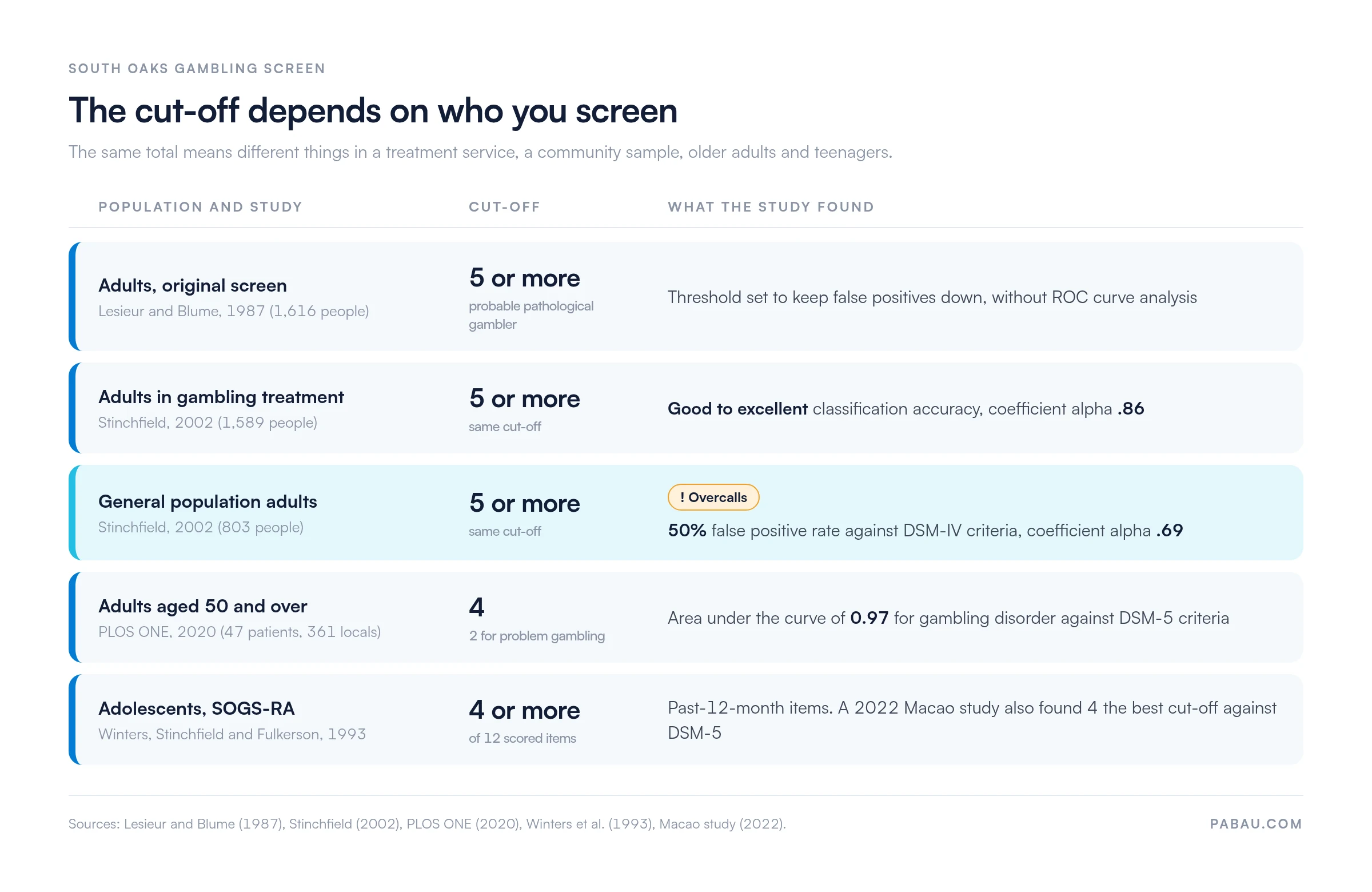
The cut-off of 5 comes from Lesieur and Blume’s original work. A 2020 PLOS ONE study notes that the threshold was set to keep false positives down, without ROC curve analysis.
The DSM-5 now diagnoses gambling disorder at 4 or more of 9 criteria, down from 5 under the DSM-IV-TR. Treat the band as a prompt for the interview, and record your reading of it next to the number.
Store the total and the answers in the patient record so the next clinician sees the same score.
The South Oaks Gambling Screen performs well in treatment settings but overestimates pathological gambling in the general population. That finding comes from a 2002 study by Stinchfield in Addictive Behaviors.
Stinchfield gave both the SOGS and the DSM-IV criteria to 803 people from the general population and 1,589 people in gambling treatment. Coefficient alpha was .69 in the general population sample and .86 in the treatment sample.
Classification accuracy was good to excellent among people in treatment. In the general population sample, the screen had a 50% false positive rate against the DSM-IV criteria.
The practical lesson is about setting. In a gambling or addiction service, a high score is usually a sound signal. In primary care or a community survey, expect more people to screen positive who would not meet diagnostic criteria. The cut-off shifts with the population as well.
Other limitations follow from the format. Answers depend on what the patient remembers and is willing to admit, and lifetime wording can flag someone whose gambling problem ended years ago.
The original screen was built for adults. Two adaptations and one study of older adults cover most other settings you’ll meet.
The South Oaks Gambling Screen Revised for Adolescents was published by Winters, Stinchfield and Fulkerson in 1993. It uses 12 scored items that ask about the past 12 months.
A score of 4 or more marks problem gambling on the SOGS-RA. A 2022 study of adolescent gamblers in Macao tested it against the DSM-5 criteria and also found 4 to be the best cut-off.
In 1993, Lesieur and Blume published a paper on revising the screen for different cultures and settings. Versions labeled SOGS-R vary in wording and timeframe, so confirm the exact text in the copy you hold.
Pick the version that matches your protocol and the time frame your service needs. Never compare totals across versions without checking that the items match.
The South Oaks Gambling Screen also works with older adults, according to the 2020 PLOS ONE study of people aged 50 and over. It compared 47 patients in a gambling outpatient unit with 361 people from the same area.
Against DSM-5 criteria, the screen identified gambling disorder with an area under the curve of 0.97. The best cut-off for gambling disorder in that group was 4, and 2 for problem gambling.
Before you adapt any wording, compare the item text with the NLM Common Data Elements repository, which hosts item data for the instrument. If a patient’s situation differs from the study population, document why you chose the tool.
Administer the screen as a self-report questionnaire, score it straight away, and file the result with your clinical notes. It suits intake visits in mental health and addiction services, and any visit where gambling, debt or money arguments come up.
Lesieur and Blume designed it for people treated for alcohol or drug problems, so run it alongside substance use screens such as the CAGE-AID questionnaire.
Clinicians who want faster write-ups can pair the record with AI-powered clinical documentation to draft the note, then check it before signing.
Clinicians in mental health, psychiatry, psychology and therapy practices are the natural users of the South Oaks Gambling Screen. Addiction services and primary care teams use it too.
Practices running a mental health EMR can keep these screens beside other assessments in one record.
After a positive South Oaks Gambling Screen, the next step is a clinical interview against the DSM-5 criteria for gambling disorder. The score tells you who needs that conversation, not what the diagnosis is.
Good SOGS documentation lets the next clinician see what was asked, what the patient scored, and what you decided. Record these points every time:
Map the screen’s path before you launch it. Decide who asks the questions, who scores them, and where the total is filed, so the result never depends on one person’s memory.
A standard screen gives every clinician the same starting point, which makes results easier to compare across patients and over time.
A dated score in the record also shows what you asked and what you did next. That trail supports clinical governance and makes case reviews far easier.
Other validated tools include the Problem Gambling Severity Index (PGSI), the Brief Biosocial Gambling Screen (BBGS), and the NODS.
Compare items, cut-offs, and the time each tool requires before you switch. The right choice depends on your setting, appointment length, and the population you see. In a general population setting, weigh the SOGS false positive rate when you choose.
On paper, a SOGS total often ends up in a scanned file nobody opens before the next appointment. The clinician who sees the patient next then starts the conversation from scratch.
With Pabau’s intake forms and EMR, patients complete the screen before or during the visit. The total, the answers and your next step then sit in the same record as the rest of the visit.
Repeat screens stay in one timeline, so you can see whether a score has dropped since the referral. To see that workflow end to end, book a demo with our team.

Pabau’s digital forms and patient records keep each SOGS score, answer and follow-up step in one timeline per patient.

The South Oaks Gambling Screen earns its place as a fast, structured first question about gambling. Its weakness is overcalling in low-risk groups, so the score should open a clinical conversation rather than close one.
Use it where gambling harm is likely, score it the same way every time, and confirm each positive result against the DSM-5 criteria. The record you keep matters as much as the total. Book a demo to see how Pabau files every screen and follow-up in the patient record.

Screening for alcohol too? AUDIT alcohol screening test gives you a structured alcohol screen to run alongside the SOGS.
Need a full substance use workup? Drug and alcohol evaluation form structures the assessment that can follow a positive screen.
Assessing impulsivity as well? Impulse control disorder test screens for impulse control problems alongside gambling harm.
Seeing other behavioral addictions? Internet addiction test scores problematic internet use with a structured questionnaire.
Working with more than one addiction? Cross addiction worksheet helps patients spot one compulsive behavior replacing another.
The South Oaks Gambling Screen is a 20-item self-report questionnaire that screens for problem gambling and probable gambling disorder. Lesieur and Blume developed it in 1987. Clinicians in mental health and psychology settings use it as a first check, not a standalone diagnosis.
Give one point for each “at risk” answer across the 20 scored items, then add them up. Questions 1 to 3, question 12, and questions 16j and 16k are not counted. Totals run from 0 to 20.
A score of 5 or more indicates probable pathological gambling under Lesieur and Blume’s criteria. Treat it as a screening result, and confirm it with a full clinical interview before you make a diagnosis or a treatment decision.
No. It is a screening tool, and a 2002 study found a 50% false positive rate in a general population sample. Confirm a positive screen against the DSM-5 criteria for gambling disorder.
The SOGS-RA is the adolescent version, published by Winters, Stinchfield and Fulkerson in 1993. It has 12 scored items about the past 12 months, and a score of 4 or more marks problem gambling.
SOGS-R refers to revised versions of the screen, which Lesieur and Blume discussed adapting for different settings in 1993. Wording and timeframes vary, so check your copy before you compare scores across the two.
Yes. A 2020 study of adults aged 50 and over found the screen identified gambling disorder accurately, with a best cut-off of 4. Review the study that matches your population before you rely on its cut-offs.
Yes. You can download a free, print-ready South Oaks Gambling Screen from this page, with the score sheet and space for clinician notes. Check the permissions terms in the APA PsycTests record before you republish the wording.