Mental health color chart
A mental health color chart is a reference guide that maps colors to mental heal...

Last Updated: Oct 5, 2026

Each case note covers a single contact and names the presenting issue, your observations, your assessment, the intervention, and the next step.
SOAP, DAP, BIRP, and GIRP are the four common formats, and your agency or your setting usually decides which one you use.
Write the note within 24 hours and in objective language, because late notes are vaguer and far harder to defend.
The template on this page follows a case management framework, with background, goals, progress, collateral contacts, barriers, reassessment, reflections, and future plans.
Practice management software like Pabau keeps forms, notes, and client history in one record, so case notes stop living in a separate folder.
A social work case note is the written record of a single contact with a client. It captures what you observed, what you did, and what happens next. It is also the file a supervisor, an auditor, or a judge reads when you are not in the room.
Most notes run 250 to 500 words and follow a set structure, usually SOAP or DAP. Pick the right structure and the note takes ten minutes. Skip it and you spend Friday evening rebuilding Tuesday’s session from memory.
What follows is the field list, the four formats, two worked examples, a pre-filing check, and a template you can download and use today.
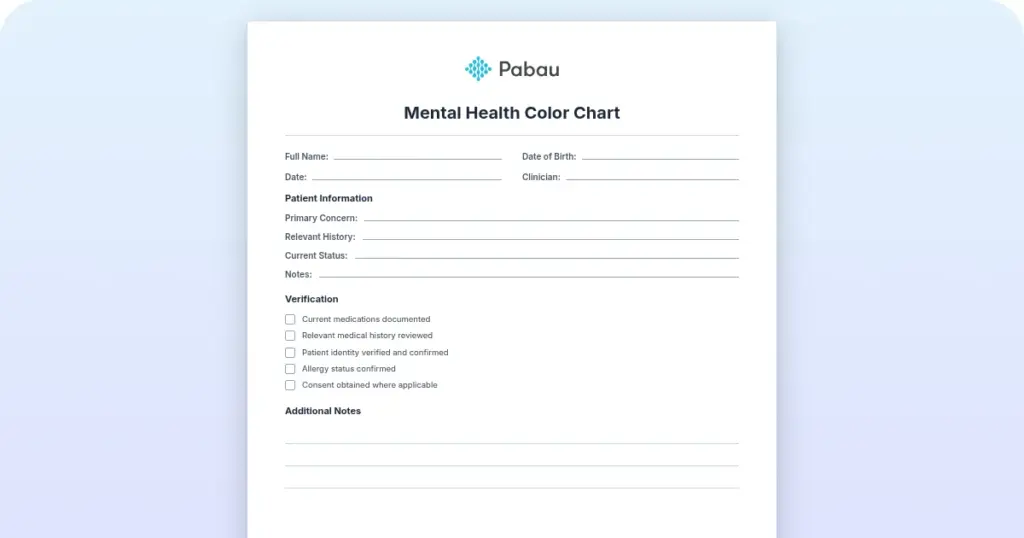
A printable form with fields for presenting issues, background information, assessment, goals, interventions, progress, collateral contacts, barriers and challenges, reassessment, reflections, and future plans. It closes with a confidentiality notice and a dated signature line.
Download templateA case note records one contact with a client, and nothing beyond it. It says what the client brought to the session, what you observed, what you made of it, and what happens next. Anything wider than that belongs in an assessment or a treatment plan.
A case note differs from a treatment summary or a progress letter in two ways. You write it close to the session, and you write it from what you witnessed yourself. A summary comes later, assembled from the file.
That single-encounter scope is what gives the note its three jobs:
Thin documentation is one of the most common weaknesses found in malpractice and licensing cases. Your note is the evidence that you assessed the risk, acted on it, and followed agency protocol. Two years later, memory will not do that job.
Well-kept client records cut that exposure. It is one reason software for therapy practices keeps consent forms, notes, and case history in a single file.
Continuity is the everyday payoff. When a colleague covers your caseload, your notes should tell them where the case stands. They should see what has been tried, what worked, and what is booked next.
Every case note carries the same nine elements, whatever format sits on top of them. The labels change and the order changes. The information does not.
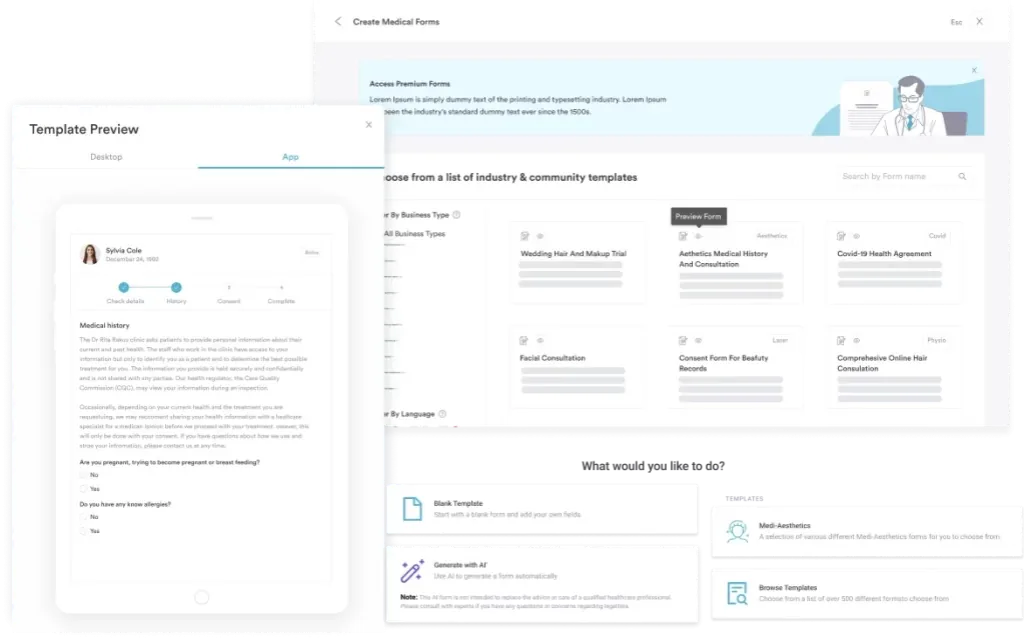
Digital intake forms help here. A blank text box lets you forget the plan. A prompted field asks for it before the note will save.
Use the format your agency requires. Where the choice is yours, let the setting decide. Therapy work suits SOAP, non-medical casework suits DAP, and behavior-led programs suit BIRP or GIRP.
The four differ less than their acronyms suggest, as the breakdown below shows.
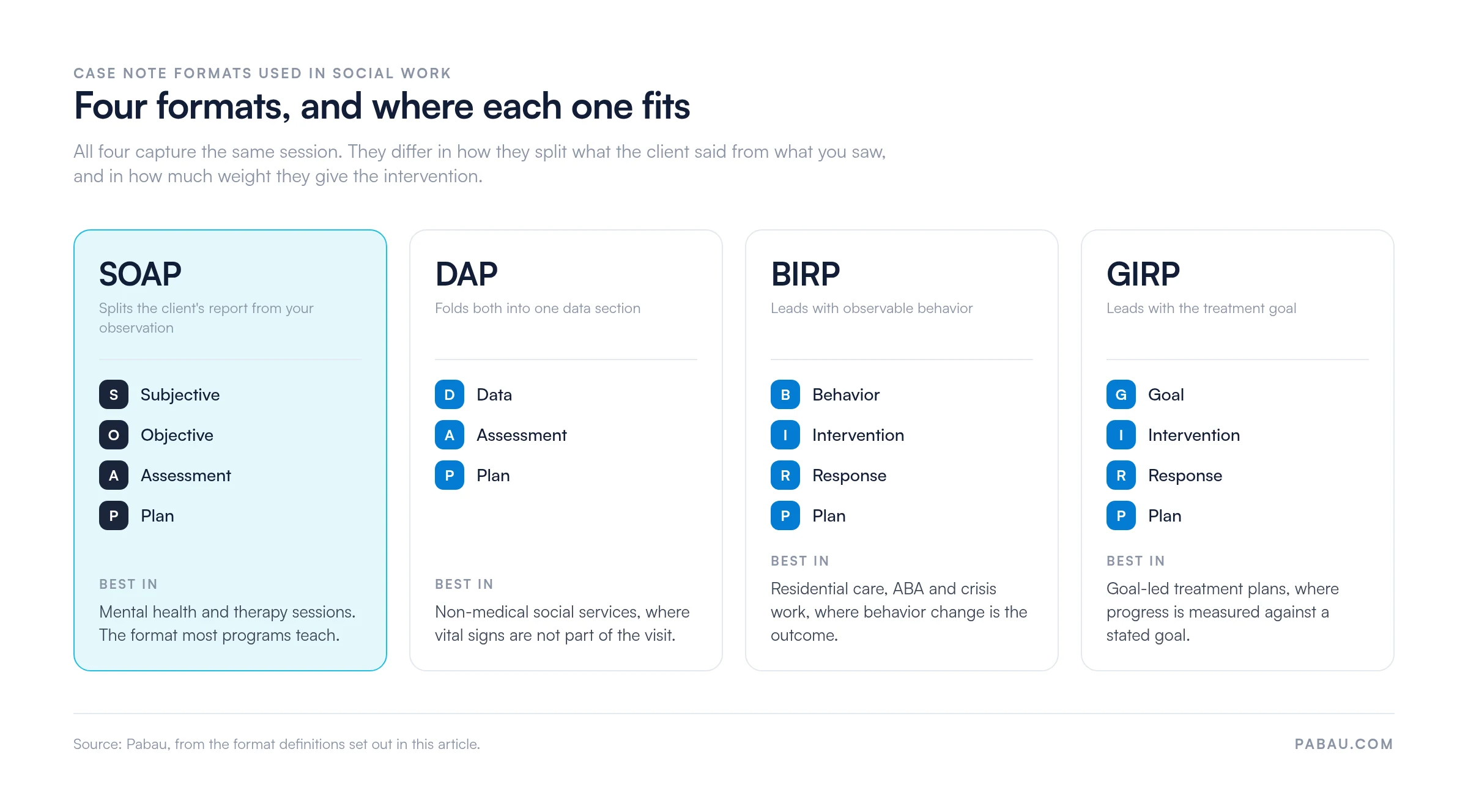
SOAP is the format most social work programs teach, and the one insurance reviewers know best. Each letter has a narrow job.
The hardest part is keeping opinion out of the objective line. Our guide to social work SOAP notes works through that line by line.
DAP merges subjective and objective into a single Data section. That suits settings where vital signs and test results play no part in the visit, such as non-medical social services.
Switching from SOAP takes a session or two to feel normal. A filled DAP note template is the fastest way to see where the content moves.
Both formats foreground what you did and how the client responded to it. BIRP starts from observable behavior. GIRP starts from the treatment goal.
The template on this page uses a case management framework rather than four lettered sections. That is deliberate. Casework carries background, collateral contacts, and barriers that a four-line format has nowhere to put.
Folding it into SOAP takes one pass. Here is how the fields line up.
Print it as it stands for case management work. If your agency wants SOAP or DAP, use it as a prompt sheet and copy the content across.
Reading a finished note teaches more than any rule about objectivity. Both examples below use SOAP, and both are short on purpose.
Setting: follow-up home visit for an open child protective services case.
S (Subjective): Mother reports ongoing conflict with her teenager over curfew and phone use. States the teen is “out of control” but denies hitting or verbal abuse. Teen not present. Mother cooperative and willing to discuss structured routines.
O (Objective): Home clean and safe. No sign of substance use, weapons, or hazards. Mother alert and appropriately dressed. Two school-aged children present, supervised, and without visible injury.
A (Assessment): Family stable, with no acute safety concern today. Parent-adolescent conflict is developmentally typical but worsened by inconsistent limit-setting. Mother able to apply behavioral strategies with coaching. Case tracking toward the reunification goals in the court-approved safety plan.
P (Plan): Referred mother to a parenting skills group and gave contact details. Next home visit booked in two weeks. Will request school attendance records at that visit. Worker: Sarah Johnson, MSW, license #4521.
Setting: weekly outpatient therapy session, 50 minutes.
S: Client reports a week of elevated anxiety after a work performance review. Denies suicidal or self-harm ideation. Sleep disrupted three nights, appetite normal. Engaged throughout, speech clear and organized.
O: Client visibly tense in the shoulders and jaw on arrival. Fidgeted with hands for the first ten minutes, then settled. No tremor, sweating, or panic symptoms observed. Shoulders dropped and speech slowed after a guided breathing exercise.
A: Situational anxiety consistent with the existing diagnosis, triggered by the evaluation. Client shows good insight and motivation. Breathing and cognitive reframing both worked in session. No safety risk identified.
P: Continue weekly therapy. Homework is five minutes of daily breathing practice and a thought record on two triggering situations. Client declined a medication referral for now. Next appointment Thursday, 10:00 AM. Worker: Dr. Chen, LCP license #8834.
Speed comes from habit and structure, not from writing less. These six habits do most of the work.
Experienced clinicians still make the same handful of documentation errors. Each one is easy to avoid once you have seen it named.
Before the note leaves your screen, read it once against these five questions. It takes about a minute.
A note that clears all five is a note you can defend. If one answer is no, fix it now rather than in two years.
Case notes are legal documents. They can be subpoenaed, read by a licensing board, and used to support or undermine your account of the work.
Most social work teams write notes in one place and store them in another. The form is a Word document, the file sits on a shared drive, and the appointment lives in a separate calendar. Details get retyped, and some of them get lost.
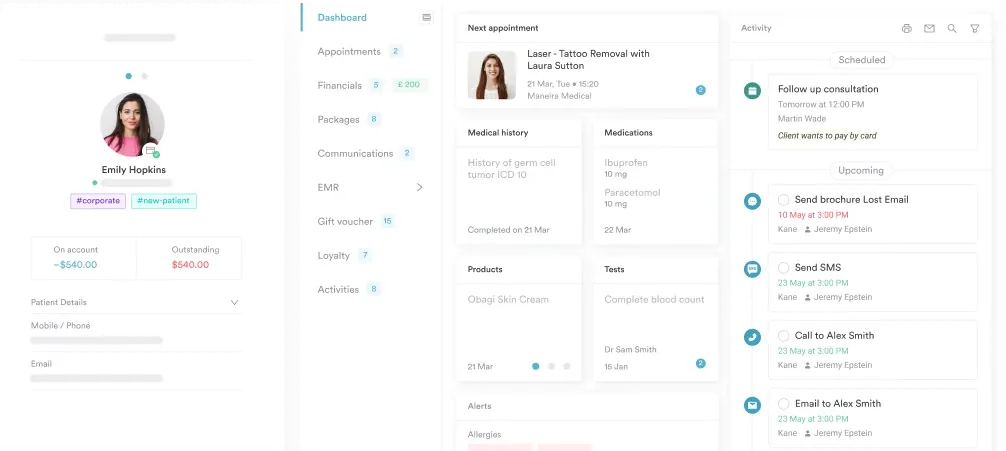
Practice management software like Pabau closes that loop. Your case note template becomes a digital form attached to the client record. The note then saves against the right client and the right appointment on its own, with a timestamp and a user against every edit.
Pabau Scribe, our AI scribe, can draft the note from the session, so you edit rather than type. Notes, consent forms, and treatment history then sit on one timeline. When a colleague picks up the case, the history is already in front of them.

Pabau turns your case note template into a digital form that saves straight into the client record, with a timestamped audit trail on every edit. Your team stops retyping notes between systems and stops hunting for the last one.

Format matters far less than habit. A plain, dated, objective note written within 24 hours protects you better than a polished SOAP note filed three days later.
So pick one structure and stay with it. Download the template, keep it open during the session, and fill it as you go. The note stops being the thing you dread at 6pm.
If your case notes still live outside your client records, that is the part worth fixing first. Book a demo to see how Pabau keeps forms, notes, and client history in one record.

Want SOAP explained line by line? SOAP notes for social work works through each section with full worked examples.
Prefer a shorter note structure? DAP note template lays out the data, assessment and plan format as a printable form.
Working in residential or behavioral care? BIRP note template covers behavior, intervention, response and plan on a single sheet.
Mapping a client’s support network? Ecomap social work template charts the relationships and resources around a case.
Need a structured intake before the first session? Case management intake form captures history, risk and consent at the start of a case.
In most agencies, yes. Both name the record of a single client contact. “Case note” is more common in child welfare and case management, and “progress note” in clinical therapy settings. Your agency policy will use one term consistently, so follow that.
Psychotherapy notes are a therapist’s private process notes, kept separate from the client file. HIPAA gives them extra protection, and clients have no automatic right to request them. A case note is part of the record, and it is disclosable.
Yes. Log the date, the missed appointment, and any outreach you attempted afterwards. That record shows the effort you made, which matters in court-involved and child welfare cases.
A client can request an amendment to their record under HIPAA. You do not have to agree. If you decline, respond in writing and keep the client’s statement of disagreement filed with the note.