Questionnaire privacy statement: Free healthcare practice template
A questionnaire privacy statement tells the person filling in your form how thei...

12
Last Updated: Sep 18, 2026

A short term memory loss test screens how well a patient takes in, holds, and recalls new information over seconds to minutes.
The MoCA and MMSE are the two most widely used tools, and scores below 26 and 24 respectively call for further evaluation.
Causes run from sleep loss, stress, and medication side effects through to thyroid disease, sleep apnea, and neurological decline.
Rapid decline over weeks, safety incidents at home, and new neurological symptoms warrant an urgent specialist referral.
Practice management software like Pabau sends the form, files the score in the patient record, and books the follow-up.
A printable screening form for short-term memory function, with step-by-step administration instructions and a scoring key. Interpretation benchmarks sit next to the score, so the result can go straight into the patient record.
Download templateA short term memory loss test screens how well a patient encodes, stores, and retrieves information over a few seconds or minutes. It is a screening instrument rather than a diagnostic one. A low score tells you to look further, not what the patient has.
This guide covers the validated tools clinicians use daily and how to administer them without inflating the score. It also covers what each band means and when a referral is warranted. It also shows why the same raw number reads three different ways across the three most common tests.
Screening only pays off when the score can be found again six months later. A therapy practice management system keeps the form, the score, and the referral together in one patient record.
Short-term memory, also called working memory or immediate recall, is the capacity to hold and manipulate a small amount of information for seconds to minutes. Most adults hold five to nine items at once. The test measures that capacity through structured tasks such as word recall, digit span, or visual-spatial sequencing.
These tests differ from long-term memory assessment. Long-term memory stores information over hours, days, or years. Short-term assessments screen for acute or progressive trouble in immediate processing, and they break the task into three parts.
Clinicians use these tests to catch early cognitive decline, to monitor progression in a known neurological condition, or to separate delirium from dementia. Delirium comes on acutely and fluctuates. Dementia declines gradually. A psychiatric evaluation template keeps the surrounding history consistent from one encounter to the next.
Memory trouble runs from normal aging to pathological decline. The cause decides whether a low score is a red flag or an expected result for this patient’s age and health.
Read the score against that list before you read it against the cutoff. A medication review and a set of bloods resolve a fair share of low scores without any specialist involvement at all.
Standardized tests give you reliability and normative comparisons. These five are the ones used most in primary care, neurology, geriatrics, and mental health.
Each tool suits a different situation. The MoCA is the most sensitive to mild cognitive impairment. The MMSE carries decades of normative data but misses subtle decline. The SAGE can be handed out in the waiting room, and the AD8 captures what the caregiver has noticed. The Clock Drawing Test takes about a minute.
The MoCA is a 30-point screening tool developed by Dr. Ziad Nasreddine in 1996 in Montreal, at the Université de Sherbrooke.
It was first validated and published in 2005. It covers eight cognitive domains and takes 10 to 15 minutes to administer. Scores of 26 to 30 are normal, 18 to 25 suggest mild cognitive impairment, and below 18 points to moderate-to-severe decline.
The test includes word recall, visuospatial drawing, naming, digit span, verbal fluency, abstraction, and orientation. One point is added when the patient has fewer than 12 years of education, which offsets socioeconomic disparities in performance. Our guide to the Montreal Cognitive Assessment walks through each subtest in order.
Patients often arrive convinced that any slip is the start of dementia. The CDC’s guidance that dementia is not a normal part of aging is a useful handout for that conversation.
The MMSE is a 30-point test published in 1975, with 50 years of validation behind it. Scores of 24 to 30 are normal, 18 to 23 suggest mild cognitive impairment, and below 18 may indicate dementia. It weights orientation and memory over executive function, which makes it good at advanced dementia and weaker at mild impairment.
Administration requires clinician training. The test is copyrighted, so scoring materials have to be purchased at roughly $1 to $2 per administration. Our MMSE template sets out the item order and the scoring key.
The SAGE is a free, self-administered four-page assessment published by Ohio State University. Patients complete it on their own in the waiting room, with no clinician in the chair beside them. It takes 10 to 15 minutes and comes in several languages.
SAGE assesses memory, language, visuospatial skills, and executive function on a 22-point scale. A score of 17 to 22 is normal, 15 to 16 suggests mild cognitive impairment, and 14 or below suggests dementia. Because it costs nothing and needs no staff time, it works well as a first pass in busy primary care.
Administration decides whether the score means anything. Control the room, deliver the instructions the same way every time, and record what the patient does rather than what you think it shows.
The common errors all inflate the score: rushing, repeating an item, praising a correct answer, and letting the session be interrupted. Retesting usually happens at three to six months, depending on the clinical indication.
A raw number carries no meaning until you know which test produced it. The three tests below use different scales and different cutoffs. A 17 can be a normal result or a dementia-range one, depending on the form in your hand.
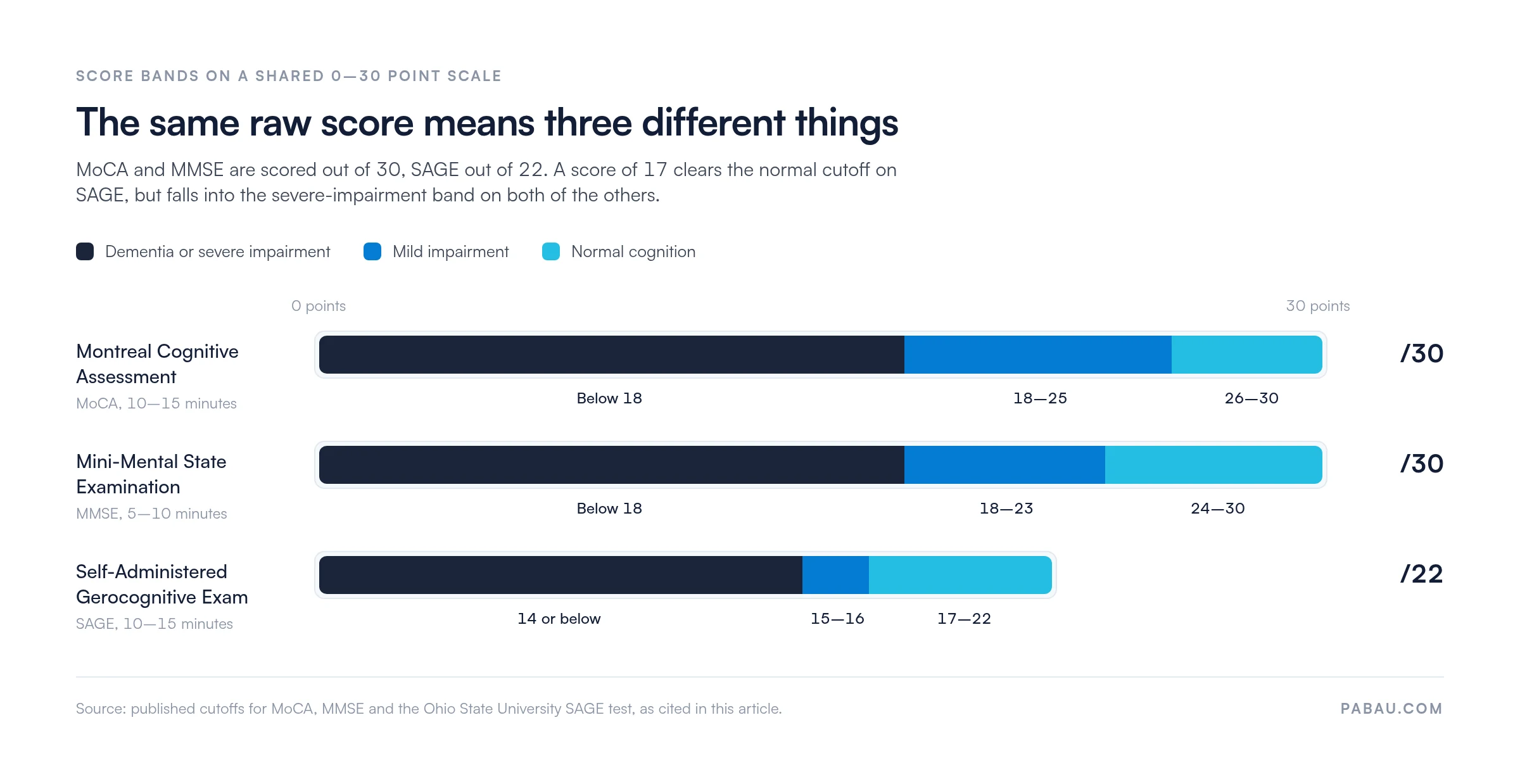
Age, education, and language background all shift where the cutoff should sit for a given patient. Write the interpretation into the chart alongside the score, so the next clinician sees your reasoning and not just a number.
Cognitive screening in older adults needs age-adjusted interpretation. Normal aging slows processing speed and trims working memory slightly, and both are expected rather than pathological.
Caregivers are partners in this assessment, not bystanders. Where the picture points toward progressive decline, a 7 stages of dementia chart helps the conversation. It shows the family what this stage looks like and what tends to come next.
A low score starts a clinical judgment, not an automatic referral. Sort what you are seeing into one of these four responses.
Whichever route you take, the referral letter carries the weight. Name the test, the score, the date, the trend against any earlier score, and the functional change the family has described.
In most practices the screening form lives in a folder, the score lives in a paper chart, and the follow-up lives in someone’s memory. Six months later nobody can say what the patient scored last time, which is the one comparison that matters in cognitive screening.
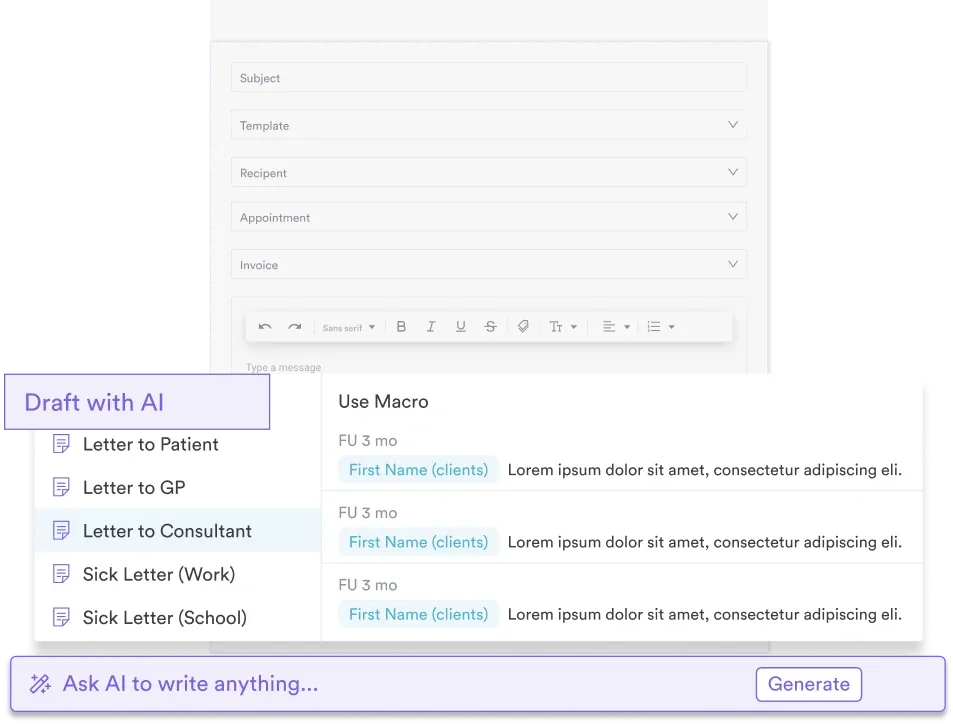
Practice management software like Pabau closes that loop. Digital forms go out before the appointment, so the patient arrives with the history and medication list already filled in. The score is filed in the client record next to every earlier one. Pabau Scribe, our AI scribe, then drafts the note and the referral letter from what you dictated in the room.
Recalls and reminders then handle the part practices lose track of. The three-month retest is booked before the patient leaves, and the record shows at a glance who is overdue.

Pabau sends the assessment before the visit, files the score in the patient’s record next to previous results, and books the retest. Trends show up on the chart, so a two-point drop is visible the moment you open the file.

The score is the easy part. The judgment sits in everything around it: the medications, the sleep, the mood, and what the family has watched happen over the past year. Run the test the same way every time, and that context is what you get to read.
One screening tells you very little. Two, taken a year apart under the same conditions, tell you the direction of travel. That is the argument for putting the form and the score somewhere they can be compared, rather than in a drawer.
Download the template above and use it at the next annual review. Book a demo to see how Pabau keeps each score, note, and referral in the patient’s record for the next clinician who opens it.

Not sure what a borderline MoCA result means? MoCA score interpretation explains how education and age shift the cutoff for an individual patient.
Need material for the patient and family? Dementia worksheets give you structured activities and orientation exercises to send home after the appointment.
Want to test planning and attention as well as recall? Executive function assessment covers the domains a memory screen alone will miss.
Collecting history before the first appointment? Mental health intake form captures medications, sleep, and mood, which is the context every memory score is read against.
A short term memory loss test is a validated screening instrument. It measures how well a patient encodes, stores, and retrieves information over seconds to minutes. Examples include the Montreal Cognitive Assessment (MoCA), the Mini-Mental State Examination (MMSE), and the SAGE test. These tools screen rather than diagnose, so a low score prompts further clinical evaluation.
Self-administered tests like SAGE can be completed at home, but the result still needs clinical interpretation. Online memory games and quizzes are not validated medical assessments. They should not replace a clinician-administered evaluation where cognitive impairment is suspected.
The MoCA is a 30-point screening tool covering eight cognitive domains: memory, visuospatial skills, executive function, language, attention, orientation, delayed recall, and abstraction. A score of 26 to 30 is normal. Below 26 may indicate mild cognitive impairment or dementia.
Book an appointment when memory problems affect daily activities, or when decline speeds up over weeks to months. Getting lost in familiar places, losing familiar names, and new tremor or gait changes also warrant evaluation. Normal aging brings a mild slowdown in processing speed, not a loss of function.
Short-term memory, or immediate recall, holds information passively for a few seconds. Working memory actively manipulates and transforms that information, which is a more complex process. Most cognitive assessments test both, though they lean toward working memory capacity.