Maja Popovska

Values exploration worksheet
Download your free values exploration worksheet A two-page printable form that o...

1
Last Updated: Nov 6, 2026
Free PDF 3 pages, print-ready Clinician-reviewed
A sample no refund policy template is a written policy a practice can adapt, sign off, and show patients before they pay. It sets which sales are final, how deposits and late cancellations are charged, and which exceptions still get a refund. Appointment time and staff hours cannot be resold once a slot passes, so clear terms protect revenue and cut front desk disputes. A policy only holds if patients see it before paying, and several US states set posting rules. This guide gives you copy-paste wording, deposit rules and a three-check process for refund requests.
Start from scratch, or upload this PDF or any form you already use, and Pabau's AI Form rebuilds it with tick boxes, text fields and a signature. Attach it to the treatment once, and every patient gets it on time.
AI Form rebuilds the consent, history and aftercare forms you already use. You review each one, then publish.
Patients complete forms on their phone before they arrive, so the front desk stops retyping paper.
Every signed form is versioned and attached to the treatment record, ready when you need it.
Set how long a consent stays valid. Returning patients skip forms they have already signed.
Supports HIPAA and GDPR compliance AES-256 encryption 4.8 on G2 4.7 on Capterra Trusted by 4,000+ practices worldwide

A no refund policy only protects you if the patient saw it before paying, so record where and when it was shown.
Several US states, including California, New York and Florida, set posting rules for refund terms on goods.
Six exceptions stay refundable under any sound policy, from faulty products to a clinical reason that stops treatment.
Deposits and cancellation charges work best as a short table with one row per scenario, including cancellations by the practice.
A signed acknowledgement stored on the patient record is your strongest evidence if a patient disputes the charge with their card issuer.
The template covers five parts of a refund policy plus a signed acknowledgement. Each part answers a question patients and staff ask at the front desk.
The header also asks for the business name, trading address, effective date and version number. Update the version whenever you change a charge or a notice period. A dispute is judged against the terms the patient signed, not the ones you use today.
Copy the wording below into section 1 and section 3 of the template. Replace each bracketed part, and delete any line that does not match how your practice trades.
Keep the wording plain. A patient who understands the policy at booking is less likely to dispute it later. Long legal phrasing tends to get skimmed, and skimmed terms are easier to challenge.
Display the policy anywhere a patient pays or commits to paying, and before the payment happens. A refund term the patient never saw is the easiest kind to challenge, so disclosure carries most of the policy’s weight.
The template lists seven disclosure points to tick:
Tick every point you use, then keep a note of where and when each patient was shown the policy. Store that note with the transaction.
Several states set posting rules for retailers that limit refunds. They mainly cover goods, which matters if you sell skincare or other retail products at the front desk.
Other states have their own rules, and the template flags that consumer and healthcare law varies by state. Have an attorney licensed in your state review the finished policy before you use it with patients.
Set one charge for each of the five scenarios in section 3, and write a short note explaining it. The charge should be proportionate to the cost of the lost appointment, and the patient should know it before booking. If you only need notice periods and late fees, our appointment cancellation policy template covers just those.
Four more fields sit under the table. Fill each one, because a blank field reads as an open question in a dispute.
Gift certificates are the one place to check federal rules before you set an expiry. Under Regulation E, electronic gift certificates, store gift cards and codes generally cannot expire within five years of issue. For a reloadable card, the five years count from the last load.
Paper-only certificates are excluded, so check state law for those. Prepaid treatment packages may fall under state rules too, which the template flags.
Practices that take deposits through their booking system can enforce these rules without staff chasing payment. Pabau, the practice management platform we build, records the deposit against the appointment. Its no-show policy software prompts your team to apply the fee from the booking record, so the outcome matches the policy the patient accepted.
Six situations stay refundable even under a final-sale policy. Naming them in the policy shows patients the terms are fair, and it makes the rest of the policy easier to defend.
The clinical reason exception matters most in medical and aesthetic practices. If a practitioner decides treatment is unsafe, keeping the patient’s money for it is hard to justify. Record the clinical decision in the treatment note, and refund or move the payment to a suitable alternative.
Add any exceptions specific to your practice in the space below the list. Common additions are bereavement, a documented medical emergency, and a patient relocating out of the area. Whether to offer refunds beyond these is a wider call, covered in our patient refund policy guide.
Every refund request can be run through the same three checks, in the same order. The flow below shows how the template’s sections fit together when a patient asks for money back.
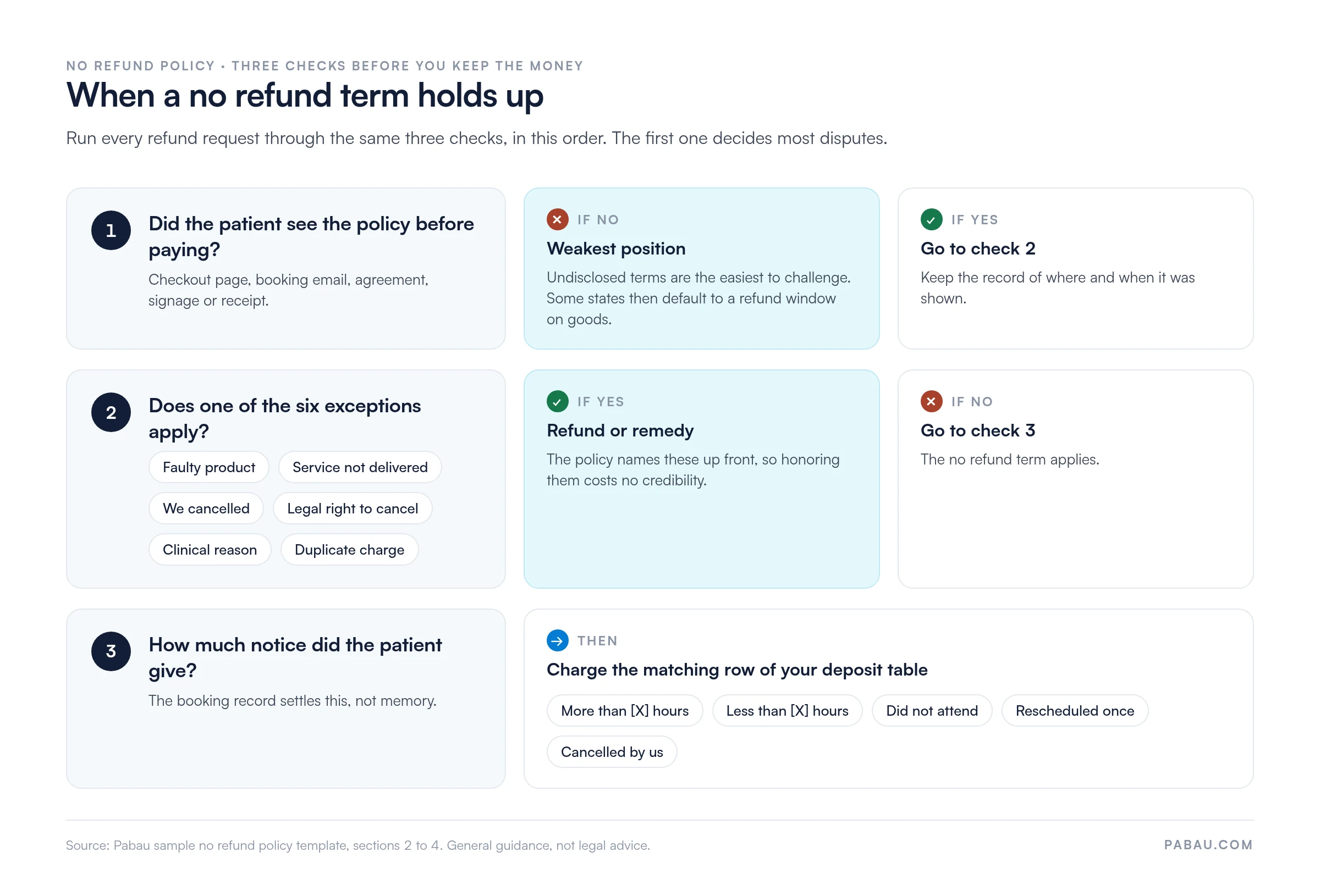
Train front desk staff to run the checks in this order every time. Starting with the deposit table skips the disclosure question, which is the one a card issuer asks first.
Section 5 of the template gives patients a four-step route to raise a concern before they go to their card issuer:
Keep the response times short. Under the federal Fair Credit Billing Act rules, a credit card holder generally has 60 days from the statement to dispute a charge. A patient who gets no reply from you may file a dispute instead of waiting.
If a dispute does arrive, the card issuer will want evidence. Pull these four records together:
The template also asks for a chargeback contact. Name one person, so disputes do not sit unanswered in a shared inbox.
A paper policy relies on staff remembering to show it, collect the signature and file it. Pabau attaches each of those steps to the booking itself.
The result is a policy that runs the same way for every patient, whoever is on the front desk. Pabau’s practice management app covers booking, forms and payments in one system, so there is no second tool to reconcile.

Pabau takes deposits through online booking and collects a signed refund policy before the visit. When a patient disputes a charge, the evidence is already on their record.

A no refund policy is only as strong as the proof that the patient saw it. Put your effort into disclosure and the signed acknowledgement first, then the deposit table. The wording matters less than the record behind it.
Expect to refund sometimes. The six exceptions protect patients, and honoring them keeps the rest of your policy credible when a dispute reaches a card issuer.
Book a demo to see how Pabau collects deposits and signed refund policies at booking, so your front desk enforces the terms without awkward conversations.

Need a separate policy for missed appointments? Appointment cancellation policy gives you a template focused on notice periods and late-cancellation fees.
Weighing whether to offer refunds at all? Patient refund policy: What clinics need to know covers how practices balance refunds with patient trust.
Want to measure the cost of missed slots? How to calculate and reduce your patient no-show rate shows how to track the figure your deposit policy is meant to bring down.
Want fewer late cancellations to charge for? Appointment reminder template gives you SMS and email scripts that let patients confirm or reschedule before the notice period ends.
Printing the policy on receipts? Receipt template for medical practices gives you a printable receipt to issue at checkout.
Yes, a no refund policy is generally legal in the US if it is disclosed before purchase. Some states, including California, New York and Florida, set posting rules. If those rules are not met, buyers of goods may be owed a refund.
A no refund policy should include a final-sale statement, where the policy is displayed, deposit and cancellation charges, exceptions, and a complaints process. It should end with a signed acknowledgement from the patient.
A practice can usually keep a deposit after a late cancellation or no-show, if the patient agreed to that term before booking. Set the notice period in the policy and apply it the same way for every patient.
Give a refund when a product is faulty, a service was not delivered, or the practice cancelled. The same applies when a legal right to cancel exists, a clinical reason stops treatment, or a charge was duplicated.
A signed refund policy does not stop a patient from filing a chargeback, but it is strong evidence in your response. Pair it with the disclosure record and the booking history showing the cancellation or no-show.