Slocum test: How to perform, interpret and record it
The Slocum test is a knee drawer test performed with the tibia rotated. It check...

2
Last Updated: Oct 21, 2026
The running readiness scale (RRS) is a five-task movement test that shows whether a patient can hold good form under running-like load. Each task lasts one minute and earns one point if form holds, for a total of 0 to 5.
A higher score means better control, and the cutoff matters. The cutoff comes from a 2025 study of collegiate track and field and cross country athletes. In that study, athletes who scored 3 or less had almost five times the odds of a lower extremity injury.
This guide covers the five tasks, how to score them, and what a failed task tells you. It also shows where the result fits in a return-to-running plan. You can download the free running readiness scale PDF below.
A printable test sheet with setup instructions and good-form criteria for all five RRS tasks. It includes a pass or fail box for each task and a final ready-to-run decision.
Download template
The running readiness scale scores five one-minute tasks in a set order. They are two-footed hopping, a plank, step-ups, single-legged squats, and a wall sit.
A task earns one point only if the patient holds good form for the full minute without a break. Totals run from 0 to 5.
In 113 collegiate track and field and cross country athletes, a score of 3 or less carried 4.8 times the odds of lower extremity injury.
The RRS checks movement control, not tissue healing, so pair it with your clinical exam before you clear a patient to run.
Pabau, the practice management platform we build, saves each RRS result to the patient record so you can compare scores across visits.
The running readiness scale is a clinical movement test that checks whether a patient can control their hips, knees, and trunk under repetitive, running-like load. It was developed by physical therapist and running researcher D.S. Blaise Williams III.
The RRS focuses on side-to-side and rotational control, such as a knee collapsing inward or a hip dropping. Those movement faults are linked to knee injury in runners. A metronome sets the pace for the dynamic tasks, so the load resembles a running cadence.
Physical therapists and certified athletic trainers use it at two points. One is screening runners before a season or a new program. The other is deciding when an injured patient can start running again.
The free running readiness scale PDF gives you a one-page structure for each test. Print it for the treatment room, or keep a digital copy in the patient file.
The running readiness scale measures whether a patient can keep good form for one minute across five tasks that mimic the demands of running. Each task targets a different part of the movement chain.
Task order, paces, and criteria follow the protocol published in the Journal of Athletic Training validation study. The PDF’s single-legged squat box lists balance and level hips only, so add knee alignment and an upright trunk from the published criteria. The scale does not diagnose an injury, so pair it with a full clinical examination.
The test runs in a standard treatment room, with no lab equipment.
Give one point for each task the patient completes for one full minute with good form and no breaks. Give zero if form breaks down or the patient stops. Add the five results for a total from 0 to 5.
Here is a worked example. A patient holds the plank, step-ups, and wall sit, but their knees drift inward during hopping and single-legged squats. That patient scores 3 out of 5. The total tells you where they sit, and the two failed tasks show you what to train.
Video helps with consistency. In the validation study, raters reached good agreement on the total score when they scored recorded tests. Filming the front view makes knee and hip faults easier to judge after the session.
A failed task points to the movement fault you need to address before the patient runs. The published research links several tasks to specific running faults or to injury risk.
The correlation figures come from the 2023 study of novice female runners, available on PubMed Central. The injury links come from the 2025 collegiate study indexed on PubMed. Use them to choose where to focus rehab, then retest the same task.
The scale is built for clinicians who make return-to-run decisions. Physical therapists, certified athletic trainers, and sports medicine physicians are the main users.
Research so far covers two groups. One is novice female runners aged 18 to 60. The other is collegiate track and field and cross country athletes of both sexes. If you use the RRS with other groups, such as older or highly trained runners, note that limit in your documentation.
The physical activity readiness questionnaire (PAR-Q) screens whether general activity is safe, while the running readiness scale tests whether a patient can control running-specific movement. The two tools answer different questions, so they work best in sequence.
The 2023 validation study followed that sequence. Participants were cleared on the PAR-Q+ before they took the RRS. Screen for medical safety first, then test movement.
Use the scale as a gate between the rehab phases of a return to running protocol, with the clinical exam alongside it. It tells you whether the patient can control load, while your exam tells you whether the injured tissue can take it.
Repeated scoring shows whether movement is trending the right way. A patient who moves from 2 to 4 has made measurable progress, even before they can pass every task.
Two peer-reviewed studies in the Journal of Athletic Training support the running readiness scale. One tested reliability and validity, and the other tested whether scores predict injury.
The evidence has clear limits worth stating in your notes:
A patient who passes all five tasks with clean form, and whose clinical exam agrees, is ready to start a graded running program. Lower scores call for a hold and targeted work on the failed tasks. The diagram below shows where the published injury cutoff sits on the 0 to 5 scale.
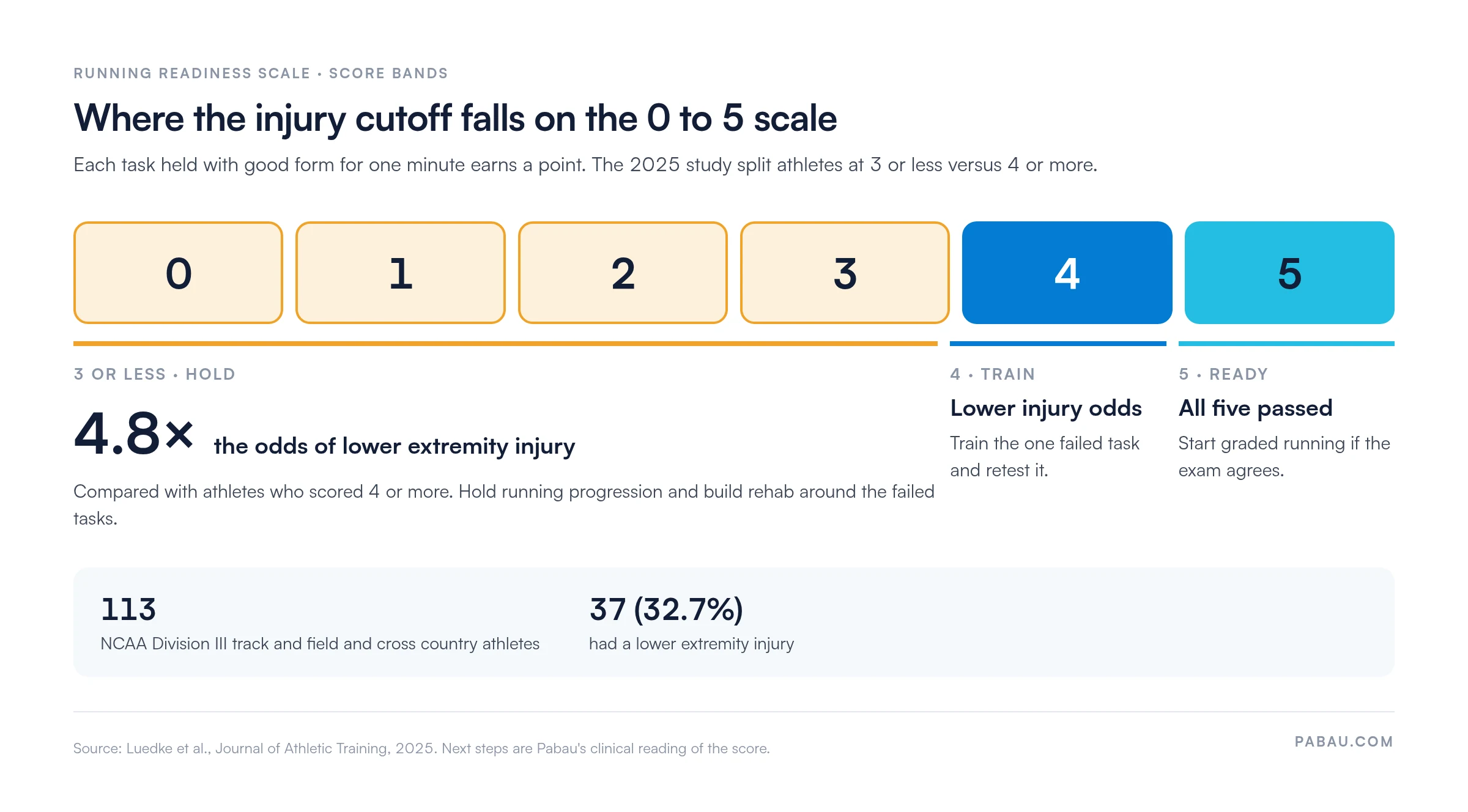
Interpretation still depends on your examination. Document the reasoning behind the decision, not only the number.
On paper, a running readiness score often ends up in a folder that nobody opens at the next visit. The baseline is hard to find when you retest, and the failed tasks get lost.
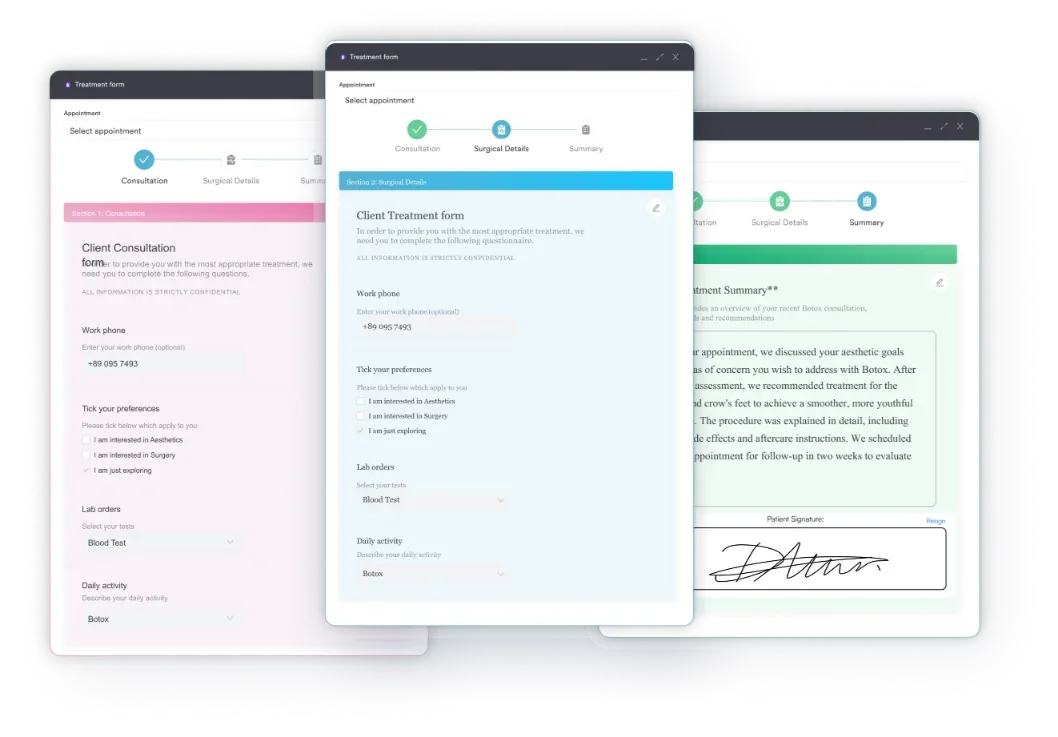
Pabau’s software for physical therapists lets you build the RRS as a digital form and fill it in on a tablet during the test. Each pass or fail lands in the patient’s Client records next to their treatment notes. Your baseline and every retest sit side by side, so progress is visible in seconds.
The same forms tool doubles as patient intake software, so the PAR-Q+ can be collected before the first visit. That way the medical screen and the movement test are done before anyone reaches for a metronome.
Record the running readiness scale score alongside the specific loading step the patient completed. A score on its own rarely explains why you progressed or held a patient, but the paired note does.

Pabau stores your running readiness scale forms, retest scores, and treatment notes in one patient record. You can see a patient’s progress at a glance before you clear them to run.

The running readiness scale earns its place because it is quick and cheap, and it answers the question injured runners ask most often. Five minutes of testing turns “Can I run yet?” into a score and a short list of faults to fix.
A single 3 out of 5 tells you little on its own. Retest at each progression point, and a move from 2 to 4 over six weeks shows the patient their progress. With the failed tasks named, it also gives you a defensible reason to progress them.
Keep its limits in view. The RRS tests movement control, and it cannot tell you whether a stress fracture or tendon has healed. Treat it as one gate in your return-to-running pathway, alongside the clinical exam, and never as the only one.
Want baseline and retest scores side by side, without digging through paper? Book a demo to see how Pabau keeps every running readiness assessment in the patient record.

Building a full return-to-run plan? Return to running protocol in physical therapy lays out the phased progression the RRS fits into.
Need a single-leg test for return to sport? Lateral hop test covers the protocol, scoring, and how it supports return-to-sport decisions.
Tracking overuse injuries across a season? OSTRC overuse injury questionnaire gives you a free template to monitor overuse problems in runners over time.
Want a broader movement screen? Functional movement screen scoring sheet scores seven movement patterns to spot faults beyond running.
Measuring lower limb function after injury? Lower Extremity Functional Scale template adds a patient-reported score to sit beside your RRS result.
The running readiness scale is a five-task movement test that shows whether a patient can hold good form under running-like load. The tasks are two-footed hopping, a plank, step-ups, single-legged squats, and a wall sit. Each one scores one point.
Each task earns one point if the patient holds good form for one full minute without a break. A form breakdown or a stop scores zero. The five results add up to a total from 0 to 5.
A score of 5 means the patient passed every task. In a 2025 study, collegiate athletes who scored 3 or less had 4.8 times the odds of lower extremity injury. That comparison was against athletes who scored 4 or more.
Yes, for the groups studied so far. A 2023 study of 56 novice female runners found good rater agreement and links to knee movement during running. A 2025 study of 113 collegiate athletes linked low scores to injury.
Yes, with some caution. The 2023 validation study included only women. The 2025 injury study included 63 male collegiate athletes, so evidence for men exists but is limited to that group.
The five tasks take one minute each, so the test itself runs about five minutes. Allow extra time to set up the metronome, box, and stability ball, and for short rests between tasks.
The PAR-Q is a self-completed questionnaire that screens whether general activity is safe. The running readiness scale is an observed test of running-specific movement control. Use the PAR-Q first, then the RRS.
You can download the free template from the download box near the top of this page. It includes setup instructions, good-form criteria, and a pass or fail box for all five tasks.