Stroke impact scale: Free PDF, scoring and MCID by domain
The stroke impact scale (SIS) is a 59-item questionnaire in which stroke survivo...

2
Last Updated: Oct 13, 2026
The OSTRC overuse injury questionnaire is a four-item weekly tool that records how an overuse problem affects an athlete. Clarsen and colleagues at the Oslo Sports Trauma Research Centre published it in 2013 and updated it as the OSTRC-O2 in 2020.
It asks about four consequences of the problem: sports participation, modified training, performance, and symptoms such as pain. Each answer carries an official weighting of 0, 8, 17 or 25 points. Add the four item scores together for a severity score of 0 to 100.
The substantial-problem label comes from the answers themselves rather than from the total. An athlete who answers moderate or major on question 2 or question 3 has a substantial problem. So does an athlete who could not take part at all.
This printable two-page checklist opens with administrative fields for the athlete’s name, date of birth, record number and completion date. Below them sit 10 statements the athlete rates from never to always about understanding, confidence, support and satisfaction with care. The four OSTRC-O2 questions and their point values appear in the tables on this page, not in this PDF.
Download template
The OSTRC overuse injury questionnaire is a four-item weekly monitoring tool from the Oslo Sports Trauma Research Centre, validated by Clarsen and colleagues.
It measures four consequences of an overuse problem: sports participation, training modification, performance, and symptoms such as pain.
Each item scores 0, 8, 17 or 25 points in the OSTRC-O2 version. The four item scores are added together, never averaged, for a severity score of 0 to 100.
A problem counts as substantial when question 2 or question 3 is answered moderate or major. An athlete who could not take part at all counts too, and no total-score cutoff applies.
Integrate the questionnaire into digital intake forms and automated athlete monitoring workflows to track weekly scores and flag rising trends early.
The questionnaire does not diagnose injury. It records functional consequences, so pair every rising score with a clinical examination.
The OSTRC overuse injury questionnaire is a brief self-report tool from the Oslo Sports Trauma Research Centre in Norway. It was developed by Ben Clarsen, Grethe Myklebust and Roald Bahr, and first published in the British Journal of Sports Medicine in 2013. It records what an overuse problem does to the athlete week by week, and a clinician supplies the diagnosis.
The four items cover one anatomical problem at a time. They ask whether the athlete took part in training and competition, and whether training was modified. The last two ask about performance and about pain or other symptoms. Answers are given for the past seven days, which keeps recall short and the weekly picture comparable.
Because it is short, repeatable and validated across several sports, the questionnaire works as an early warning system. A severity score that climbs over consecutive weeks flags a developing problem before the athlete stops training altogether.
The table below sets out the OSTRC-O2 wording and the point value attached to every answer. Each item is worth a maximum of 25 points. Replace the word “problem” with the body area you are monitoring, such as the knee or the shoulder.
In the original 2013 version, questions 2 and 3 carried a fifth option, “cannot participate at all”. Those two items were scored 0, 6, 13, 19 and 25. The 2020 update removed that option, so all four items now share the same four-point weighting.
Add the four item scores together. The sum is the severity score, and it runs from 0 to 100. There is no division and no averaging: dividing the total by four produces a number that cannot be compared with any published OSTRC data.
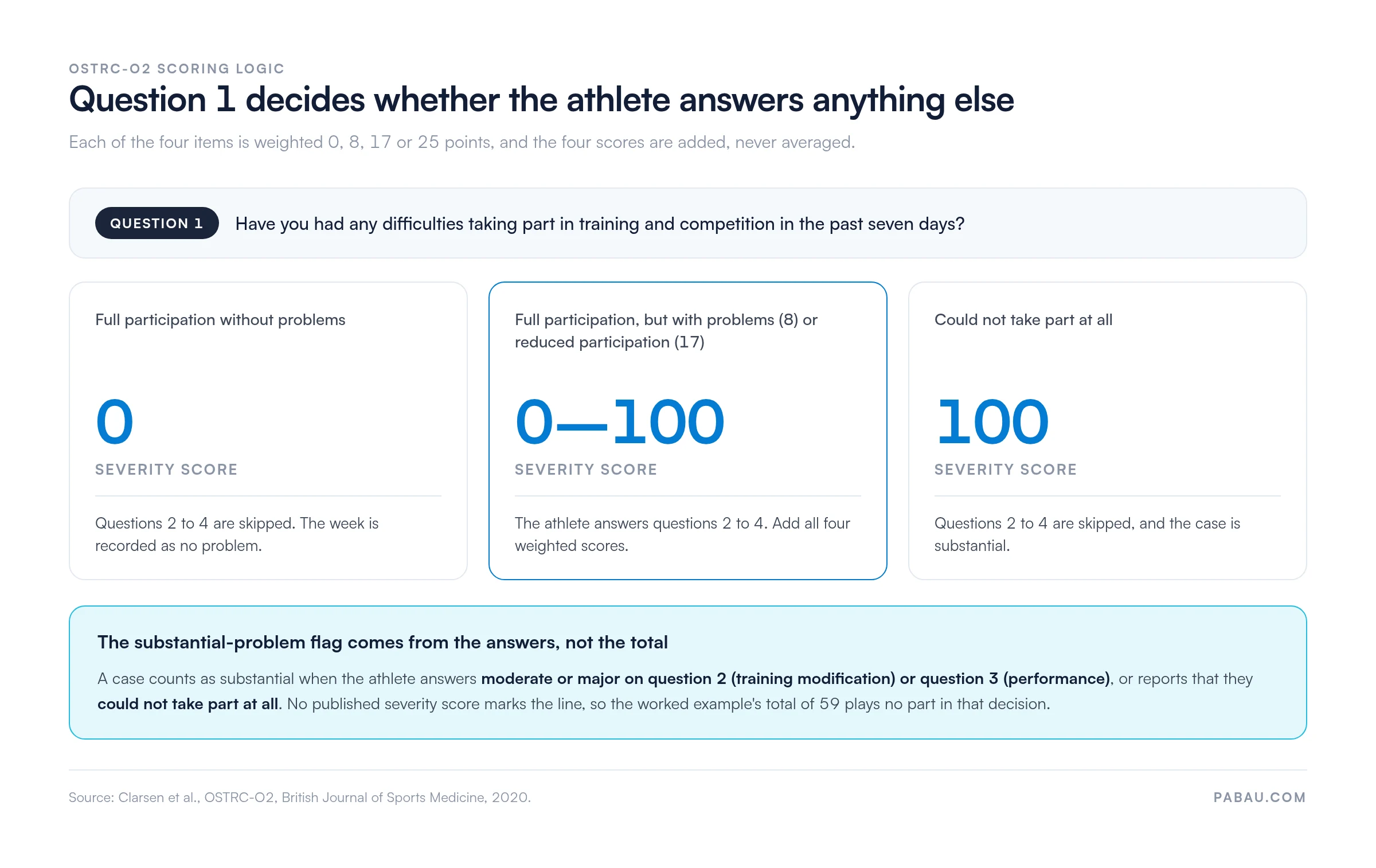
One answer short-circuits the rest. The OSTRC-O2 applies gatekeeper logic to question 1, so an athlete who reports full participation without problems scores 0 and stops there. An athlete who could not take part at all scores 100 and skips questions 2 to 4.
Here is a worked example for an athlete who trained through a shoulder problem all week.
The OSTRC authors call a case substantial when the athlete reports moderate or major effects on training modification or performance. An athlete who could not take part at all is counted as well. In the example above, question 2 and question 3 both landed on moderate, which is what makes this problem substantial. The severity score of 59 does not enter that decision, and this athlete warrants a clinical review.
Record the score every week and read the trend rather than the single figure. Clarsen and colleagues also caution that the severity score is an ordinal measure with a limited set of values. Treat it as a monitoring signal, not a continuous outcome.
The original OSTRC-O was validated in cycling, handball and other elite sports. An international review panel met in Oslo, and the update appeared in the British Journal of Sports Medicine. It kept the four domains, but changed the wording, the answer categories and the questionnaire logic.
New monitoring programs should adopt OSTRC-O2. Keep the original only where you need continuity with historical data, and record which version produced each score.
Weekly administration is the standard, and it takes two to three minutes. Hand it out on paper at a visit, or send it as a digital form from your practice management system. At a training venue, a short interview works just as well. Keeping the day and the format consistent is what makes the weekly trend reliable.
Squads that already collect a sports physical form before the season can file each week’s answers against that same athlete record. The screening form sets the baseline, and the weekly score tracks what happens to it.

The questionnaire has been tested in peer-reviewed studies across cycling, handball, swimming, running and other sports. The original 2013 British Journal of Sports Medicine paper reported that weekly self-report captured far more overuse problems than routine injury surveillance. Translated and validated versions now exist in Danish, Japanese, Spanish, Portuguese and several other languages.
Olympic and Paralympic programs in Norway, the United States, Australia, the Netherlands and Germany use the OSTRC questionnaires for athlete monitoring.
Clinical value is highest when the score is paired with examination. A rising score should trigger a physical assessment and, where appropriate, a referral for rehabilitation. Practices that keep connected physical therapy records can open the score history and the last examination note together.
The questionnaire has been used in endurance sports such as cycling, running and cross-country skiing. Team sports such as handball and football use it too, as do gymnastics and weightlifting. Its brevity suits busy practices, academy programs and solo practitioners overseeing remote athletes. Many sports medicine practices build the four items into an automated monitoring workflow. A moderate or major answer on question 2 or question 3 then alerts a clinician the same day.

The same research centre publishes the OSTRC questionnaire on health problems, updated as the OSTRC-H2 in the same 2020 paper. It uses the same four domains, but asks about any health problem, including acute injuries and illness. The overuse version stays with one problem in one body area.
Choose OSTRC-O2 when you are tracking a known overuse problem at a specific site. Choose OSTRC-H2 when you are screening a whole squad for anything that interferes with training. Record which version you used, because the two produce different case counts.
The questionnaire measures consequences, not pathology. Examination, imaging and other objective tests are still what confirm a diagnosis. The answers are self-reported, so fatigue, motivation and an athlete’s reluctance to report can all move the score.
Recall suffers when athletes complete the form days late, which is one reason the seven-day window matters. Scores are also shaped by context. Sport, competitive level and time of season all affect how athletes rate the same limitation. Clarsen and colleagues warn that data from different squads will not always be comparable.
Those caveats do not undermine weekly use. A short, cheap, repeatable measure of function still beats waiting for an athlete to report that they can no longer train.
Most sports medicine practices still collect the OSTRC questionnaire on paper, then retype the scores into a spreadsheet. Weeks get missed, the spreadsheet drifts from the clinical record, and nobody spots a rising score until the athlete reports pain at an appointment.
Pabau, our practice management software, handles this as part of the patient record. Build the four items as a digital form, then send it automatically on the same day each week through our online booking and messaging tools. Responses attach to the athlete’s file next to the clinical notes, so the person reviewing the score can see the last examination without switching systems.
From there, use reporting tools to pull scores for one athlete or a whole squad. Set an automated task for any response that flags a substantial problem. Practices running sports medicine services across several sites get one consistent monitoring record instead of a spreadsheet per location.

Pabau, our practice management software, collects weekly OSTRC responses through digital forms and stores each severity score on the patient record. Your team sees a rising trend in the same place it writes clinical notes.

The OSTRC overuse injury questionnaire earns its place by being short enough to run every week. It is also specific enough to show when an athlete is quietly losing training. Score it the published way, by adding the four weighted item scores. Treat a moderate or major answer on question 2 or question 3 as a problem a clinician needs to look at.
The value comes from the run of weekly scores, not from any single number, so the practical task is collecting it reliably. Book a demo to see how Pabau collects weekly athlete questionnaires and keeps every score on the clinical record.

Choosing software for a sports medicine practice? 7 sports medicine software platforms compares the systems that handle athlete records, scheduling and outcome tracking.
Need a pre-season screening form as well? PAR-Q template covers the readiness questions to ask before an athlete starts a training program.
Managing an athlete back to full training? Return to running protocol sets out the staged loading criteria that follow an overuse problem.
The OSTRC overuse injury questionnaire is a four-item tool that records how an overuse problem affects an athlete. It covers sports participation, training modification, performance, and symptoms, and produces a severity score from 0 to 100.
In the OSTRC-O2 version, each of the four answers scores 0, 8, 17 or 25 points. The four item scores are added together to give a severity score between 0 and 100. The total is never divided by four.
A case is substantial when the athlete answers moderate or major on question 2 or question 3. An athlete who could not take part at all also counts. The OSTRC authors set no total-score cutoff, so a summed score alone never decides it.
The 2020 OSTRC-O2 update rewrote question 2 to ask about modified training rather than reduced volume. It also removed the fifth answer option from questions 2 and 3, so all four items now score 0, 8, 17 or 25. Gatekeeper logic was added to question 1.
Weekly administration is the standard. Completion takes two to three minutes and can happen in the practice, online, or at a training venue. Consistent weekly timing is what makes the trend readable.
No. The questionnaire records functional consequences such as participation, training, performance and symptoms. A clinician still has to examine the athlete to reach a diagnosis and decide on treatment.
OSTRC-H2 is the health problems version. It captures acute injuries, illness and other health complaints that affect participation and performance, rather than the consequences of a single overuse problem.