Rotator cuff pain location diagram: Where each muscle hurts
A rotator cuff pain location diagram maps where each of the four cuff muscles se...

3
Last Updated: Oct 12, 2026

The Functional Movement Screen (FMS) grades seven movement patterns from 0 to 3, for a maximum composite score of 21.
Pain on a clearing test is the only automatic zero. A side-to-side difference means you carry the lower side into the composite.
A composite of 14 or below is commonly linked to elevated injury risk, while 15 or above suggests adequate movement quality for athletic activity.
Reported inter-rater reliability ranges widely, from 0.37 to 0.98, so scorer training and a fixed protocol matter more than the tool.
Pabau’s digital forms and client records hold each screen, total the composite, and let you compare results across sessions.
Client and team details, left and right raw scores for each of the seven movements, and a final score per pattern. There is a comments line for every test and a total out of 21.
Download templatePhysical therapists, athletic trainers, and strength coaches use the Functional Movement Screen to grade movement quality in clients who have no current pain or injury.
The screen flags dysfunction and side-to-side differences that can raise injury risk or cap performance. The sheet above gives you all seven tests, a raw score column for each side, and a composite total.
Most FMS write-ups blur two rules that behave very differently. Pain on a clearing test is the only thing that forces a zero. A side-to-side difference does something else entirely, and mixing the two up changes the composite. Below are the seven tests, the scoring rules, and how to read the total you end up with.
The Functional Movement Screen is a ranking system for seven fundamental movement patterns. Gray Cook and Lee Burton built it to grade mobility, stability, and motor control against fixed criteria. Each movement scores 0 to 3, so a composite runs from 0 to 21.
Practitioners run the FMS before an athlete returns to sport, before a strength program starts, or as part of an intake evaluation. Diagnostic tests look for pathology. The screen grades movement quality and readiness instead, which is what makes it useful for injury prevention as well as rehab screening.
Each pattern asks for coordination across several joints and planes of motion, and every test is scored on its own. Three of them carry a clearing test, and pain on that clearing test drops the score to 0.
Each movement scores 0, 1, 2, or 3 against fixed criteria. Pain on a clearing test is the one automatic zero, and it stops that pattern until the client has been evaluated. A side-to-side difference works differently. You score each side, then carry the lower of the two into the composite.
Add the seven individual movement scores to get the composite. A maximum of 21 means the client met the criteria on every pattern. A composite of 14 or below is commonly linked to elevated injury risk, and points to corrective work before any high-demand activity.
Two rules decide what a single movement gets. If a clearing test provokes pain, that movement scores 0 whatever the pattern looked like. If the two sides differ, record both raw scores and carry the lower one. The flow below runs both rules end to end.
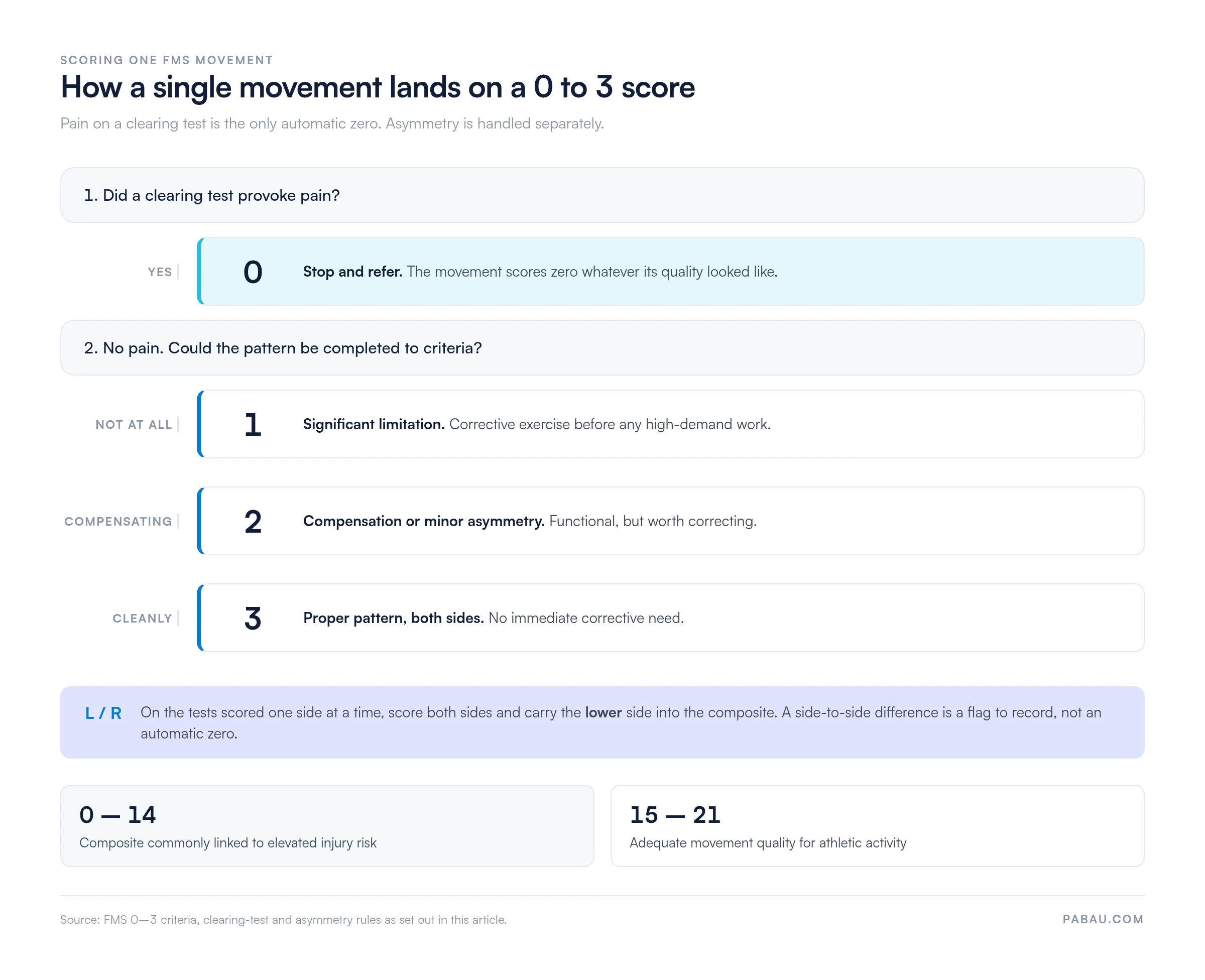
One quirk of the sheet catches people out. Its printed scoring guide covers 1 to 3 only, because a 0 is what you write in after a clearing test provokes pain. Note which movements landed below 3. That short list drives corrective exercise design, and gives you something concrete to compare at the next screen.
Set aside 10 to 15 minutes per client and a space of roughly 8 feet by 8 feet. You need a dowel or length of PVC pipe, a 2×6 board, and a hurdle set at knee height. Stand where you can watch the movement from more than one plane.
Run the tests in the same order every time. Demonstrate the movement, allow one practice repetition, then score three attempts. If compensation or a side difference shows up on any repetition, score the worst attempt you saw rather than the best.
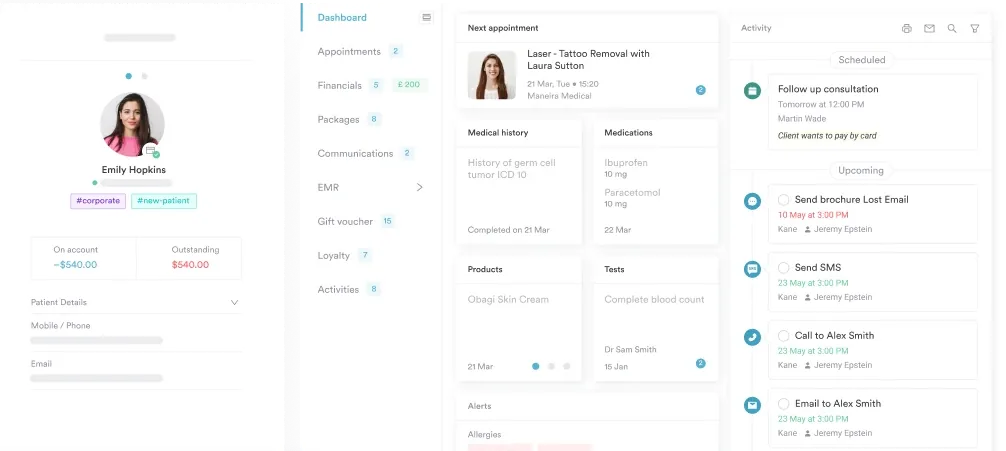
Write the scores down while the client is still in front of you. Scores entered into a physical therapy EMR stay comparable from one screen to the next. That comparability is the only thing that makes rescreening worth the time.
Keep the test order and the room set-up identical for every client, so one screen can be compared with the next. Rescreen at four to six weeks and track the composite trend rather than the single number. That trend is what justifies a return-to-sport call or a jump in training intensity.
Address the 1s and 2s with corrective work, and refer any 0 rather than training through it. Each low score points at a specific mobility, stability, or motor control deficit, so the pattern that scored badly tells you where to start.
Deep squat deficits often trace back to ankle or hip mobility. Shoulder mobility deficits call for soft-tissue work or range-of-motion drills. Trunk stability deficits point to core strengthening.
Rescreen after four to six weeks of targeted work to see whether the score actually moved. If gait is part of the picture, a functional gait assessment gives you a second scored measure to track alongside the FMS.
Many practices keep FMS scores in the client chart so they can spot trends and check them against injury history. Digital patient intake forms let you score on a tablet, total the composite automatically, and keep every screen in one record.

Reliability depends heavily on who is doing the scoring. A review indexed by the National Center for Biotechnology Information reports inter-rater reliability from 0.37 to 0.98 for total scores. It describes that spread as fair to excellent. Individual movements come out lower than the total, and less-experienced raters sit at the bottom of that range.
The practical read is that rater training and a fixed protocol matter more than the tool itself. The screen does show some predictive validity for injury risk in athletic populations, which keeps it in use for pre-season screening and return-to-sport decisions. Practices screening a whole roster tend to run it from sports medicine software, so each score sits with the athlete’s history.
One caveat is worth repeating to anyone reading a report. The FMS screens movement quality and does not diagnose anything, so an abnormal finding warrants a fuller clinical evaluation.
Most practices score the FMS on paper, then either file the sheet or retype it into a chart later. The composite gets added up by hand. Comparing a screen from March with one from May means digging out two pieces of paper and hoping both were filled in the same way.
Practice management software like Pabau replaces that with a digital form. You build the scoring sheet once, then score each movement on a tablet during the screen. The result saves straight to the client record. Every screen that client has ever had sits in the same file.
Because the sheet lives inside the record, automated workflows can prompt the four-to-six-week rescreen without anyone tracking dates on a whiteboard. Every Pabau subscription includes the forms, the client records, and the reporting, so none of this sits behind a higher tier.

Pabau’s digital forms let you score the Functional Movement Screen at the point of testing and save it straight to the client record. No retyping, no loose sheets, and every past screen ready to compare.

The FMS earns its place when the scoring is consistent, and two rules cause most of the confusion. A painful clearing test forces a zero. A side-to-side difference means you carry the lower side. Get those right and the composite means something to the next person who reads it.
The first screen is the least useful part. What changes a client’s program is the second one, four to six weeks later, run in the same order in the same room. That comparison only works if the first screen was written down properly.
Download the scoring sheet above and make it the standard for every screen you run. Book a demo to see how Pabau turns that sheet into a digital form that scores, totals, and files itself in the client record.

Screening athletes before a season starts? The sports physical form template covers the medical history and clearance side of pre-participation screening.
Need a second scored movement measure? The functional gait assessment template scores walking tasks the FMS does not look at.
Building a return-to-sport progression? The return to running protocol sets out the stages and the criteria for moving between them.
Standardizing what you collect at intake? The physical therapy intake form captures the history that gives an FMS score its context.
The Functional Movement Screen grades seven fundamental movement patterns from 0 to 3, for a maximum composite score of 21. It identifies movement limitations and side-to-side differences that may raise injury risk or hold back performance.
Each movement scores 0 for pain, 1 for a pattern the client cannot complete, or 2 for one completed with compensation. A clean pattern on both sides scores 3. Pain on a clearing test is the only automatic zero, and where the two sides differ, the lower side goes into the composite.
A composite of 15 or higher generally indicates adequate movement quality for athletic activity. A score of 14 or below is commonly linked to elevated injury risk and warrants corrective exercise before high-demand activity.
A complete screen usually takes 10 to 15 minutes per client. That covers demonstration, practice attempts, and scoring across all seven movement patterns.
Certification is not legally required in most jurisdictions, but formal training improves consistency and scoring accuracy. Many athletic trainers, physical therapists, and strength coaches take FMS Level 1 certification through Functional Movement Systems.
Rescreening after four to six weeks of corrective exercise lets you see whether the score moved. Repeat the screen before return-to-sport decisions, after an injury, or when a new training phase starts.