Trauma response test: Free template for clinicians
A trauma response test is a structured screening questionnaire that helps clinic...

3
Last Updated: Oct 15, 2026

A resentment inventory is a written Step 4 exercise that examines one resentment at a time, from the trigger to your own part.
This free template is a single-entry form. Its five prompts are I Am Resentful At, The Cause, Affects My, What Did I Do, and Where Had I Been.
Each copy of the form holds one resentment, so print a fresh page for every name on your grudge list.
Practice management software like Pabau lets therapists assign, collect, and store completed inventories alongside the client’s session notes.
A printable single-entry form with five guided prompts. They cover who you resent, the cause, what it affects, what you did, and the character defect behind it. One resentment per page, ready for individual work or clinical group sessions.
Download templateResentment festers quietly. It drives relapse, strains relationships, and keeps people circling the same shame. So Step 4 of a 12-step program answers it with a pen and a fixed set of questions.
A resentment inventory asks people to stop avoiding and start writing. Who do I resent? Why? What does it cost me? What did I do? This form walks through those questions one resentment at a time.
Below we cover what the downloadable form contains and how to answer each of its five prompts. We also include worked examples and how clinicians use it in sessions and group work.
A resentment inventory is a written tool used in Step 4 of Alcoholics Anonymous (AA), Narcotics Anonymous (NA), and other 12-step programs. It belongs to the searching and fearless moral inventory that Step 4 asks members to complete. In fact, the resentment inventory is the first and primary piece of that moral inventory.
The Big Book of Alcoholics Anonymous calls resentment the number one offender. Indeed, unprocessed anger, hurt, and grudges create emotional landmines that trigger relapse and block recovery.
Clinicians also use resentment work inside cognitive-behavioral therapy (CBT), dialectical behavior therapy (DBT), and trauma-informed practice. Treatment guidance from SAMHSA places mutual-help activities such as 12-step work alongside those clinical approaches.
The form structures this difficult emotional work into a manageable, accountable format. Rather than venting without direction or rehearsing old grievances, the writer answers set prompts in a fixed order. In other words, that is the same logic behind a psychiatric evaluation template, which fixes the order a clinician works through at intake.
Resentment is a story people tell themselves, and it is often a distorted one. They wronged me. It is all their fault. I had no part in it. Instead, the inventory punctures that narrative by asking what your own part was.
People in recovery report that an honest inventory shifts their sense of control. As a result, blame moves from the other person to their own choices and boundaries. In clinical settings, therapists use the same forms to help clients see patterns across many entries.
A client who has completed ten forms against authority figures may recognize a lifelong struggle with trust. Similarly, another who resents their own body may uncover trauma or shame that needs direct processing. Overall, the inventory becomes diagnostic and therapeutic at once.
The downloadable form covers one resentment. It carries a name and date line, then five labeled prompts with a blank writing box under each. There is no grid and there are no repeating rows.
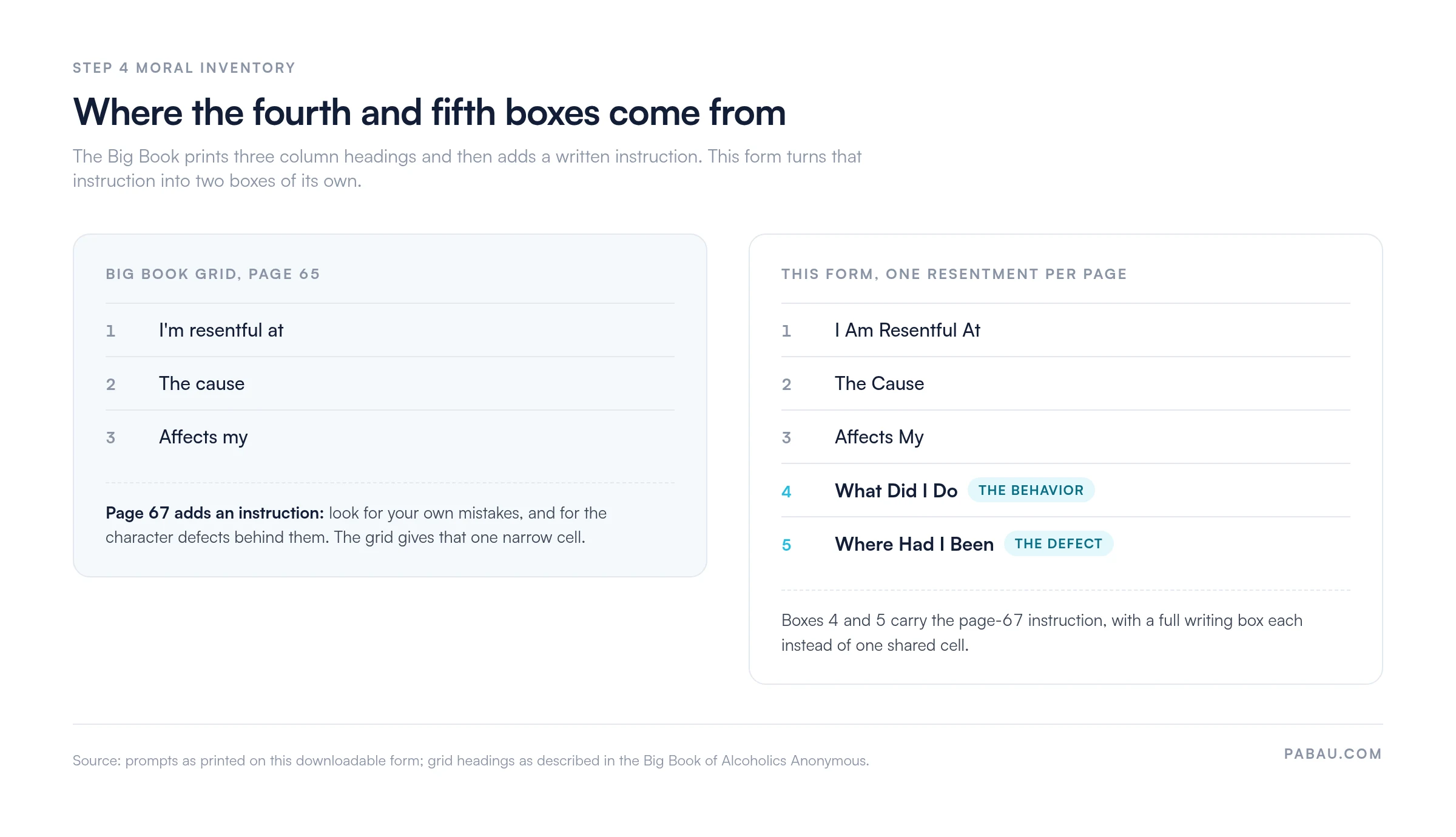
The prompts follow the Big Book’s own sequence. The grid printed on page 65 carries three headings, and page 67 adds the instruction to look for your own mistakes and character defects.
Specifically, this form gives that last instruction two separate boxes. What you did goes in one, and why you did it goes in the other.
That split is the practical difference between this form and a four-column grid. A grid gives you one narrow cell for your part. In contrast, this form gives you a full box for the behavior and another for the defect underneath it. The mapping below shows where the two extra boxes come from.
The examples below show the same five prompts answered on two separate copies of the form. Consequently, they model the honesty and specificity that make the tool effective.
Two resentments, two pages. For instance, a third might name a sibling who told the family about your drug use, and a fourth might name a church. Each one gets its own copy of the form.
Work down the page in order. Each prompt builds on the one above it, and the last two carry the weight.
Then start a fresh copy for the next name. A full Step 4 inventory usually covers many resentments, so most people work through a stack of forms over days or weeks. The process is not meant to be rushed.
The completed stack also feeds the steps that follow. For example, names that appear in your inventory often reappear on an AA Step 9 worksheet once you reach the amends stage.
In recovery communities, certain resentment targets appear repeatedly. Knowing the patterns helps people feel less alone. It also shows where trauma, boundary problems, or unmet needs cluster.
The names that come up most often usually point to the deepest wounds. A client with fifteen forms about parents and parental figures may carry early attachment trauma. Likewise, someone whose stack is mostly self-resentment may need shame work before relationship work begins.
Those patterns only stay visible if someone writes them down. For that reason, recording them in social work SOAP notes lets you compare one month’s entries against the next.
For therapists, counselors, addiction specialists, and sponsors, this form is a structured conversation tool rather than a worksheet to grade. Here is how to work it into your practice.
Assign the form as homework once you have introduced Step 4 work. Ask the client to complete a copy for each of five to ten resentments in their own time, then review the stack together.
Clients process privately first, and the most charged pages surface for deeper conversation. The same five prompts can also go out as a digital form through your client portal before the appointment.

Hand out one copy per person at the start of a group session, and keep spares for anyone who wants a second. Give the group 30 to 45 minutes to write.
Then facilitate partner sharing of a single completed page rather than the whole stack. Notably, hearing other people’s resentments normalizes the experience. One person resents a parent, three others do too, and the shame loosens.
A mental health EMR stores completed inventories securely and tracks patterns over time. Record which areas of self come up repeatedly, such as relationships, finances, or self-esteem.
Use that record to prioritize treatment focus. Resentments shift over the course of recovery, and a dated stack of forms shows that movement clearly.
Step 4 includes more than one inventory, and the fear inventory often confuses people new to the process. Both belong to the moral inventory, but they cover different emotional terrain.
Many people find the resentment inventory more immediately cathartic, because it names old hurts out loud. Conversely, the fear inventory asks clients to articulate worries they may have been avoiding. Together the two build a full picture of what is blocking recovery.
Writing a resentment inventory triggers shame, denial, and defensiveness. Here are practical ways to move through the resistance and write truthfully.
A printed form goes home with the client and comes back whenever it comes back. The completed pages end up in a folder, a scanned PDF, or the client’s own notebook. As a result, nobody can see at a glance which resentments a client has worked and which ones they keep avoiding.
Practice management software like Pabau handles that differently. You rebuild the five prompts once as a digital form, then send it to a client through the portal before their session. Each submission files straight onto the client’s record with a date on it, so the whole stack sits in one place.
The result is a therapist who opens a session already knowing what the client wrote. You spend the hour on the difficult material instead of chasing paperwork, and the record you need for supervision is already filed.

Pabau’s digital forms and client portal let therapists send the resentment inventory ahead of a session. Every completed copy files on the client record, so progress across the whole stack stays visible in one place.

The resentment inventory looks simple on the page. Five prompts, one resentment, one sheet of paper. What makes it work is the honesty demanded by the last two boxes. Underneath them both sits a single question. Where did I have power?
Print a copy for every name on your list and work them one at a time. A single completed form is worth more than a page of half-finished rows. In the end, the stack becomes the map of what your recovery still has to reach.
If you guide this work professionally, the admin around it is the part worth automating. A dedicated therapy practice management system keeps completed inventories secure, dated, and attached to the right client. Book a demo to see how Pabau keeps Step 4 paperwork out of your session time.

Want to deepen clinical assessment with more structured tools? Psychiatric evaluation templates provide a complete framework for mental health intake, assessment, and diagnosis.
Need to document group therapy sessions where resentment work happens? Group therapy consent forms and documentation guides keep session management ethical and compliant.
Looking for best practices in clinical documentation? SOAP notes for social work shows how to document therapy breakthroughs and client progress.
Working the steps beyond Step 4? AA Step 9 worksheet turns the names on your inventory into a structured amends plan.
A resentment inventory is a written Step 4 exercise used in 12-step programs (AA, NA) and in clinical therapy. It records one resentment at a time. Each copy covers who you resent, what caused it, what it damages, what you did, and the character defect behind it.
Take one resentment per copy of the form. Answer its five prompts in order: I Am Resentful At, The Cause, Affects My, What Did I Do, and Where Had I Been. Spend the most time on the last two, because that is where accountability and growth live. Then start a fresh copy for the next name.
The grid on page 65 of the Big Book carries three columns, and many sponsors add a fourth for your own part. This downloadable form turns that layout into five labeled sections, splitting your part into what you did and the character defect behind it.
One. The form is a single-entry document with one blank box per prompt, not a repeating grid. Print a fresh page for every name on your list, and keep the completed pages together as your inventory.
A resentment inventory focuses on past grievances and hurt toward other people. A fear inventory focuses on present worries and anxieties about the future. Both belong to Step 4, but they cover different emotional terrain.