Montgomery-Åsberg Depression Rating Scale (MADRS)
The Montgomery-Åsberg Depression Rating Scale (MADRS) is a clinician-administer...

Last Updated: Oct 6, 2026
A patience worksheet is a structured therapeutic tool for building emotional regulation and frustration tolerance. It guides clients through written reflection on how they define patience, what triggers impatience, and which coping strategies they will practice.
This free worksheet is used by therapists, counselors, psychiatrists, and clinical psychologists across mental health, substance abuse recovery, and behavioral health settings. It turns patience from an abstract virtue into a set of written prompts a client can answer in 15 to 20 minutes.
Patience is treated as one component of distress tolerance in cognitive behavioral therapy (CBT) and dialectical behavior therapy (DBT). Structured skills homework of this kind is a standard way for mental health practices to carry those models between sessions.
This guide covers what the worksheet contains, section by section, and how to introduce it in a session. It also shows how practice management software like Pabau helps you send the form, track completion, and file the responses.
Four guided sections covering how a client defines patience, the situations that test it, an eight-option coping-strategy checklist, and closing reflection prompts. Printer-friendly and ready to use in therapy, counseling, coaching, and recovery programs.
Download template
A patience worksheet moves clients through four written sections, from defining patience to reflecting on what changed.
Almost every prompt is free response, apart from one checklist of eight coping strategies the client ticks.
Patience work sits inside CBT and DBT distress-tolerance teaching, so it supports anxiety, impulse control, and recovery goals.
The worksheet suits adults and adolescents in therapy, counseling, coaching, and school or recovery programs.
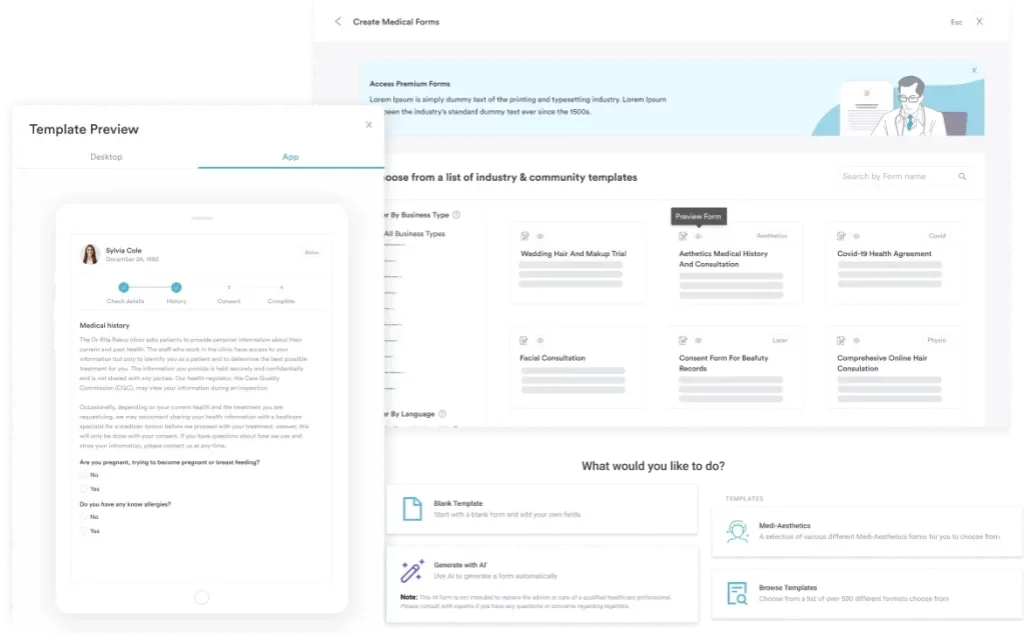
Pabau’s digital forms and client portal let you send the worksheet, track completion, and file responses with the client record.
A patience worksheet is a written self-assessment that asks a client to describe their own relationship with patience and then commit to changing it. This one runs to four numbered sections across three printable pages.
Almost every prompt is free response, so the client answers in their own words instead of picking a number on a scale. One exception sits in section III, a checklist of eight coping strategies the client ticks, plus an “Other” line.
There are no scored items, no rating scales, and no clinician-only pages. That keeps it usable as in-session work, as homework, or as a group handout. It also leaves you the client’s own wording to quote back at the next appointment.
The format puts it in the same family as other structured digital forms used in therapy. The client writes, you read, and their answers give you material to build the next session and the treatment plan around.
The worksheet opens with a short note telling the client there are no right or wrong answers. Four numbered sections follow, and each one builds on the answers above it.
Section III lists eight options and invites the client to check every one that might work for them:
Because the client picks the strategies instead of being handed them, section III doubles as clinical data. The options they ticked, and the three they committed to, tell you where to aim the next session.
Patience works as a trainable skill. It rests on emotional regulation, impulse control, and distress tolerance, and each of those responds to structured practice.
In clinical settings, patience work supports treatment for:
The American Psychological Association and DBT both treat distress tolerance as a foundation of emotional regulation. Patience sits inside that skill as its everyday form, the ability to wait without acting on the urge to escape.
Concrete skill homework gives the next session a ready agenda, which is why structured therapy leans on it so often. A completed worksheet opens the conversation before the client has to find a starting point.
Patience and emotional regulation are hard to separate in psychology practices. Emotional regulation is the ability to recognize, tolerate, and respond skillfully to difficult feelings. Patience is the tolerating part.
DBT teaches distress tolerance alongside emotion regulation because a client in crisis mode cannot reach for regulation skills. Impatience pushes people toward the fastest exit from discomfort, which is often avoidance, substance use, or aggression. A client who can wait has time to choose a different response.
The worksheet trains four related capacities:
None of this needs a long intervention. A 15 to 22 minute introduction in session is usually enough to get the worksheet completed properly and brought back.
When a client needs to work past patience alone, the emotional regulation checklist covers awareness, distress tolerance, and DBT skills in the same format.
Because the prompts are open and unscored, the worksheet travels well across clinician types and client populations.
Adults tend to fill the prompts with waiting-room delays, relationship frustration, and job stress. Adolescents answer the same questions with friendships, academic pressure, and identity. The pages do not change between the two, only the examples you offer while introducing them.
A patience worksheet works best with a short clinician-led introduction and a planned debrief. Handing it over at the door and hoping for the best is what produces blank pages. The five steps below fit into 15 to 22 minutes of session time.
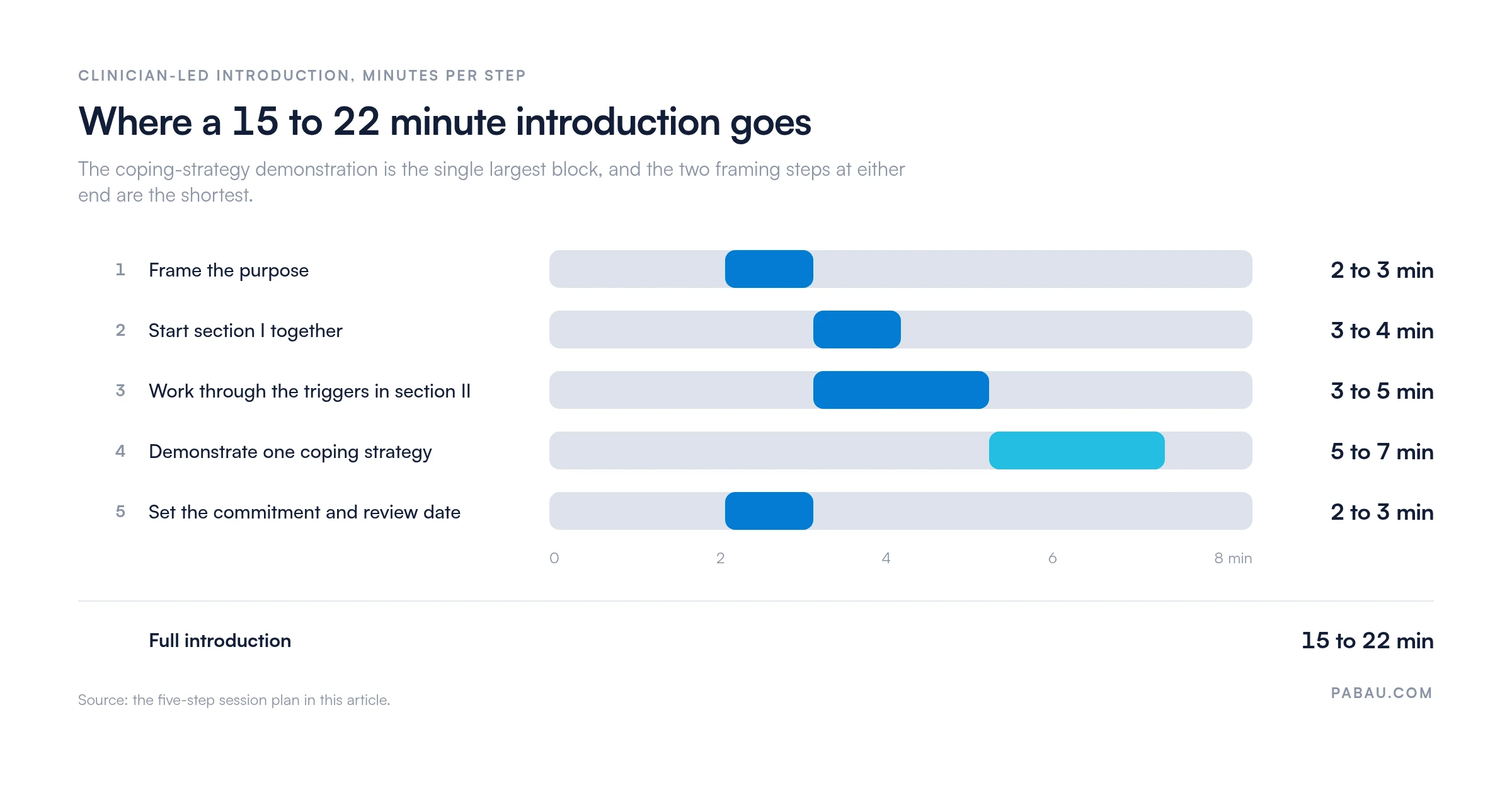
Client compliance with therapeutic homework improves when the clinician introduces the tool instead of attaching it to the end of a session. A guided introduction is the difference between a completed worksheet and a blank one.
The worksheet delivers most in a few specific clinical moments:
Engagement drops when the pages go out as end-of-session busy work. It also drops when the client has not yet accepted that impatience relates to what brought them in. Linking the worksheet to their own stated goal fixes most of that.
Digital forms also solve the lost-worksheet problem. Clients complete the pages in a secure portal, and you open their answers before the next appointment starts.
A PDF on its own gives you no record of who completed it. Pabau’s therapy practice management tools send the patience worksheet to a client and record when it comes back. The completed answers land in the client record.
The sequence is short. You attach the worksheet to a task or an appointment, and the client gets a secure link. They complete it on a phone or a laptop. Pabau logs the timestamp, and their answers wait for you next to visit notes and treatment history.
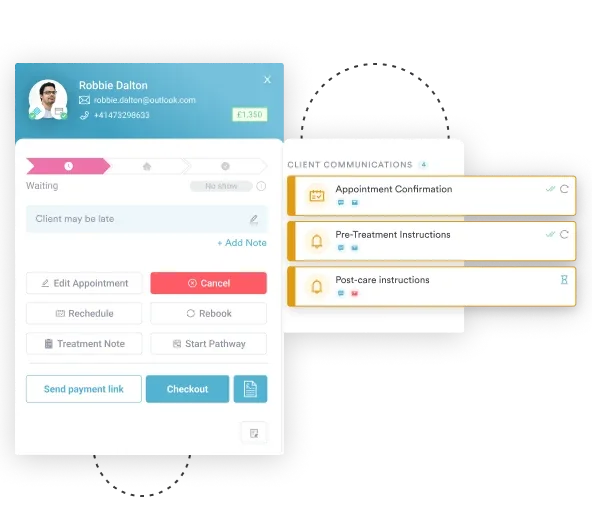
That matters most when the same worksheet goes out across a full caseload. Digital forms held in one system cut the pre-session scramble for paper. Multi-location teams can also share one approved version, so the wording stays consistent across clinicians.
The patience worksheet itself is free to download and use today. No account is needed, and the PDF is printer-friendly enough to hand across a desk.

Pabau’s digital forms and client portal send the patience worksheet to clients, record completion, and file responses with their clinical notes. You arrive at the next session already briefed.

The patience worksheet earns its place because the client does the defining. Four sections of their own writing give you material to work with, instead of a score to interpret.
Introduce it properly and pick the commitment back up at the next appointment. Done that way, one set of pages becomes a thread that runs through several sessions. Left to the end of a session, it becomes another sheet in a folder.
Book a demo to see how Pabau delivers therapy worksheets, tracks completion, and files client responses with their notes.

Working the same skills from a DBT angle? DBT therapy worksheet delivers distress tolerance and emotion regulation as a structured handout.
Want to widen the work beyond patience? Emotional intelligence worksheet covers self-awareness, empathy, and social skills alongside emotional regulation.
Ready to turn a commitment into a plan? Change plan worksheet sets goals, action steps, barriers, and a readiness scale the client scores themselves.
Carrying a full caseload of skills homework? Therapist burnout: signs, causes, and prevention covers boundaries, workload, and recovery.
A patience worksheet is a structured therapeutic tool that helps clients name their impatience triggers, choose coping strategies, and commit to practicing them. It is used in individual and group therapy to build emotional regulation, impulse control, and frustration tolerance. Those skills sit at the center of anxiety treatment, recovery work, and interpersonal conflict.
There are four numbered sections. Section I asks the client to define patience, and section II explores the triggers and barriers they face. Section III covers practicing patience, including a checklist of eight coping strategies. Section IV closes with reflection prompts, a written commitment, and a notes field.
Most clients finish it in 15 to 20 minutes on their own. Working through it with a clinician takes longer, usually 20 to 30 minutes. Section III takes the most time, because of the coping-strategy checklist and the planning questions that follow it.
This worksheet is written for adolescents aged 14 and over, and for adults. Younger children do better with activity-based patience tools such as games, movement exercises, and visual timers. For ages 10 to 13, shorten the reflection prompts and work through them together in session.
Yes. This patience worksheet is free to download as a PDF and print. You can also send it to clients through a secure client portal. They complete it on a phone or laptop, and you see who has finished without chasing anyone.
Patience is the ability to wait and delay action without distress. Frustration tolerance is the capacity to sit with uncomfortable feelings such as anger or disappointment instead of escaping them. Patience is behavioral, frustration tolerance is emotional, and this worksheet develops both.
Tie it to the problem they named. Try something like: “You mentioned rushing decisions and regretting them. These pages teach the pause before the decision.” Then run a 60-second box-breathing demo in the room. The idea lands as an experience before it becomes homework.