Maja Popovska

Can a physician assistant open a med spa? State rules explained
A physician assistant can open a med spa in many US states, but the answer depen...

Last Updated: Nov 4, 2026
Free PDF 2 pages, print-ready Clinician-reviewed
Nursing patient report sheets are one-page handover tools that capture each patient's status, plan, and pending tasks so the next nurse can take over safely. Some teams still complete them by hand, while others move the same fields into digital forms. Either way, the sheet works only when every field is filled in the same way on every shift. This guide covers what each section holds, the layouts for ward and ICU work, and how to run a handoff with the free template.
The PDF holds two printable layouts: A single-patient sheet for high-acuity care and a four-patient grid for a medical-surgical load. The single-patient sheet adds timed vitals, medication and lab trackers, and an SBAR handover box.
Start from scratch, or upload this PDF or any form you already use, and Pabau's AI Form rebuilds it with tick boxes, text fields and a signature. Attach it to the treatment once, and every patient gets it on time.
AI Form rebuilds the consent, history and aftercare forms you already use. You review each one, then publish.
Patients complete forms on their phone before they arrive, so the front desk stops retyping paper.
Every signed form is versioned and attached to the treatment record, ready when you need it.
Set how long a consent stays valid. Returning patients skip forms they have already signed.
Supports HIPAA and GDPR compliance AES-256 encryption 4.8 on G2 4.7 on Capterra Trusted by 4,000+ practices worldwide

A nursing patient report sheet is a one-page working note that tracks each patient’s status, plan, and open tasks across a shift.
Core sections cover identifiers, code status, allergies, diagnosis, vitals, a body-system assessment, medications, lines and drains, labs, and to-dos.
SBAR, I-PASS, head-to-toe, and by-system formats order the same facts, so choose one per unit and use it on every shift.
The sheet is not the medical record, so chart every clinically significant finding and shred the sheet before you leave.
Pabau, the practice software we build, keeps clinical notes, forms, and follow-up tasks in one record, so a practice handover starts from the chart.
A nursing patient report sheet is a one-page working note for tracking a shift’s patient assignment and handing it over to the next nurse. Nurses also call it a brain sheet, a report sheet, or a handoff sheet.
The sheet is used at three points in a shift. The incoming nurse fills in the top block while taking report from the outgoing nurse. Through the shift, vitals, doses, and results get written onto it as they happen. At the end of the shift, it becomes the script for the verbal handoff to the next nurse.
One rule sits above the rest: The report sheet is not the medical record. Our template prints that rule on its first page, because it decides what goes where. The sheet holds shorthand and reminders for one nurse, while the chart holds the legal record of care.
Every nursing patient report sheet records the same core facts for each patient, whatever the unit. The incoming nurse reads the sheet first, so missing fields slow the handoff and raise the risk of dropped tasks.
The table below shows what each core section should answer at handoff.
The top block names the patient and carries the facts no one can afford to miss. Record the name or initials, room, age, and attending provider. Next to them, add code status, allergies, isolation precautions, diet, mobility, and fall risk.
Put code status and allergies where the eye lands first. Our single-patient sheet places them in the opening rows for that reason. Write the reaction beside each allergy when you know it, such as a rash or anaphylaxis, and record NKDA where there are none.
Note the admitting diagnosis and the day of admission, plus the post-operative day for a surgical patient. Add only the history that changes care on this shift, such as diabetes, heart failure, or a recent fall. A full medical history belongs in the chart, not on a one-page sheet.
Log each set with its time: temperature, heart rate, respiratory rate, blood pressure, oxygen saturation, and pain score. A single reading tells the next nurse little on its own. The direction since the last set is what shows whether the patient is improving or declining. If your unit uses an early warning score, record it alongside the numbers.
The assessment block runs system by system, so the next nurse can find a finding without reading the whole page. Typical notes for each system include:
The medication tracker lists each dose by time due, with columns for given, hold reason, and initials. Note when each PRN medication was last given, so the next nurse knows when another dose is allowed. A held dose always gets its reason written beside it, or the next shift may give it twice or not at all.
Record each IV site with its gauge and insertion date, plus the fluid running and its rate. List drains with their output, and note catheters, oxygen, and any monitoring in place. These details are easy to lose at handoff and hard to rebuild from memory.
Track each lab or test from order to result. Our template gives every entry four columns: Labs due, result, whether it was critical, and which provider was notified. Write the provider’s name and the time of the call, because “provider aware” on its own cannot be checked later.
The to-do line is the part of the sheet that changes most during a shift. Add tasks as they appear, such as a dressing change, a family call, or a discharge teaching session. Strike each one through when it is done, so the open items stand out at handoff.
Three layouts cover most settings. Pick the one that matches your patient load, not the one that looks most detailed.
A single-patient sheet gives one patient a full page. It suits complex patients who need detailed assessment and medication notes.
Grid sheets fit four or six patients on one page, so a nurse can scan a whole assignment at once. They work best for stable patients, because there is less space for detail.
Our four-patient grid gives each patient one column and twelve rows, from room and code status down to the handover note. Reading across a row shows every patient’s meds due or labs pending at a glance.
ICU sheets add fields such as lines, drips, ventilator settings, and monitoring targets. A general ward template does not capture that detail, so critical care units usually need their own version, such as our ICU report sheet.
The layout decides how much space each patient gets. The format decides the order in which the facts are written and spoken. Four formats cover most units.
Our template combines two of these. The assessment block runs by system, and an SBAR box at the foot of the sheet holds the verbal handoff. That pairing gives the next nurse detail to look up and a short script to listen to. Our SBAR nursing handoff template adds worked scripts for each of the four steps.
Structure pays off without slowing the handoff. In a nine-hospital study of resident physician handoffs, the I-PASS program was associated with a 23% fall in the medical-error rate. Preventable adverse events fell by 30%, and oral handoffs stayed at about 2.4 to 2.5 minutes per patient (Starmer et al., NEJM, 2014). The study covered physicians rather than nurses, but the lesson carries over to any written handoff.
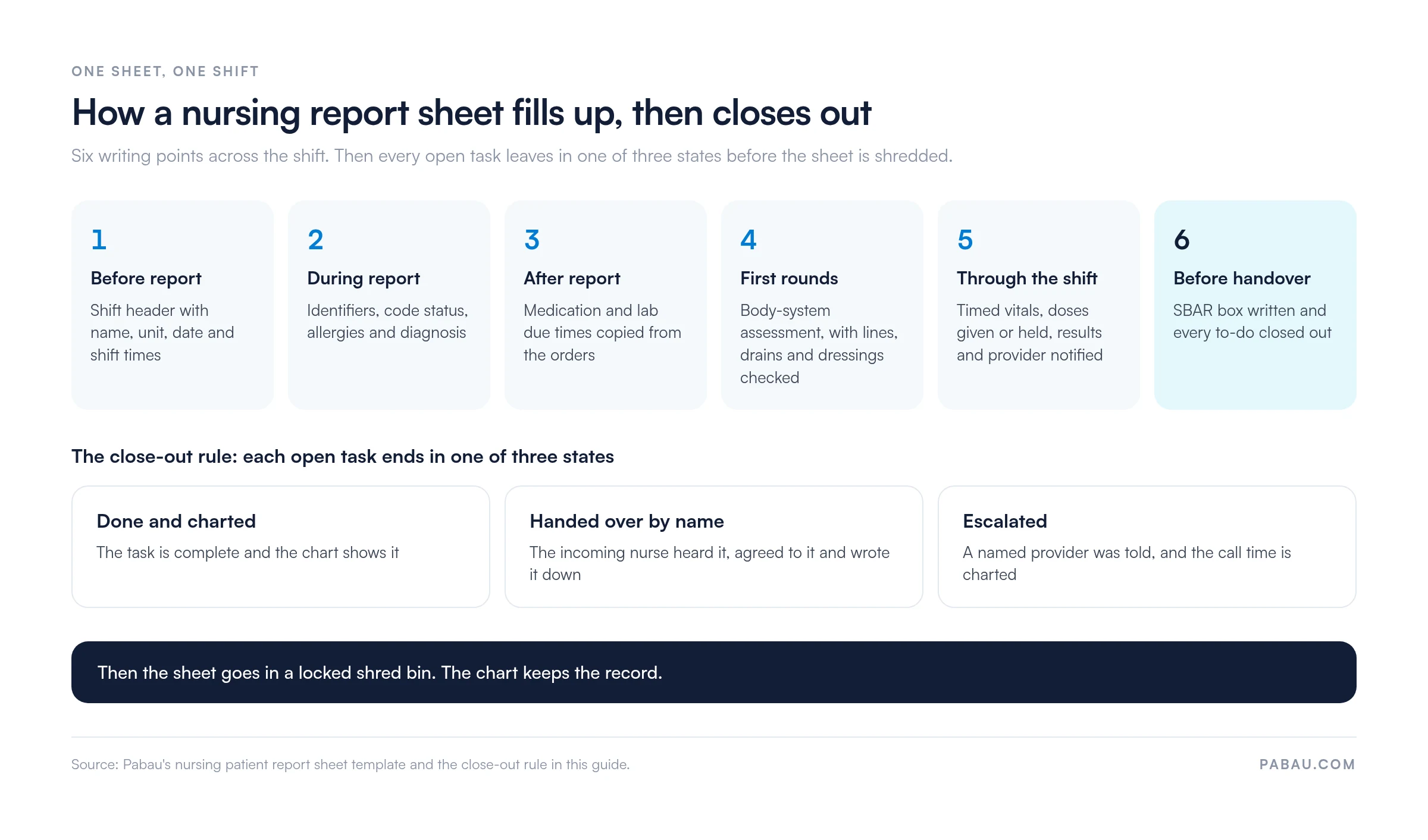
Fill the sheet in the order the shift unfolds, starting before report and finishing before handover. These steps follow the single-patient sheet in our template.
Before you hand over, every to-do should end in one of three states. Each state leaves a trace that outlives the sheet:
An item that fits none of the three is not ready to hand over. Without this check, the task stays on a sheet that goes into the shred bin an hour later. The flow below puts the six writing points and the close-out rule on one page.
Complete the sheet before handoff, then read it aloud patient by patient at the station or bedside. The steps below keep the handoff structured and short.
Where your unit allows it, finish the report at the bedside, following a bedside shift report routine. Both nurses can then check pumps, lines, and dressings together, and the patient can flag a detail that was missed. Ask the incoming nurse to read back the open tasks before you leave.
Staff nurses and charge nurses use these sheets most. Nursing students on placement often use them too, usually under supervision. Agency nurses rely on them when they join a unit partway through the week.
Outpatient and specialty settings can borrow the same structure. Any team that hands a list of patients to another clinician has the same core problem: The details must arrive right the first time.
A consistent sheet pays off at handoff in three ways.
Audit your current sheet against your unit’s handoff standard each quarter. Remove fields nobody reads, add any field that recurring incident reports point to, and confirm every field has a named owner for each shift. Small edits here often do more for handoff quality than adding another template.
A sheet is only as useful as the habits behind it. The practices below keep it readable for the next nurse, and the mistakes are the ones that cause tasks to drop at handoff.
Paper sheets that include protected health information still fall under HIPAA. HHS sets out the physical safeguards that apply, including controlled access and secure disposal.
In practice, that means keeping the sheet on your person during the shift. Never leave it at a shared workstation, and never photograph it on a personal phone. Use initials in place of full names where your unit’s policy allows.
At the end of the shift, put the sheet in a locked shred bin before you leave. HHS disposal guidance lists shredding, burning, pulping, and pulverizing as ways to make paper records unreadable.
The same HIPAA rules cover digital records, where compliance management software controls who can open a chart and logs each access.
With paper sheets and spreadsheets, the same vitals often get written twice, once in the chart and again on the sheet. Each copy is one more place for a number to fall out of date.
Pabau is built for outpatient and specialty practices, and it keeps clinical notes, digital forms, and follow-up tasks in one patient record. When one nurse hands patients to another, the next nurse opens that record instead of reading a copied sheet.
Pabau Scribe, our AI scribe, drafts AI-assisted clinical documentation in a fixed structure, so every clinician’s notes follow the same sections. Pabau’s patient intake software collects allergies, history, and consent before the visit, so those fields reach the record already filled in.
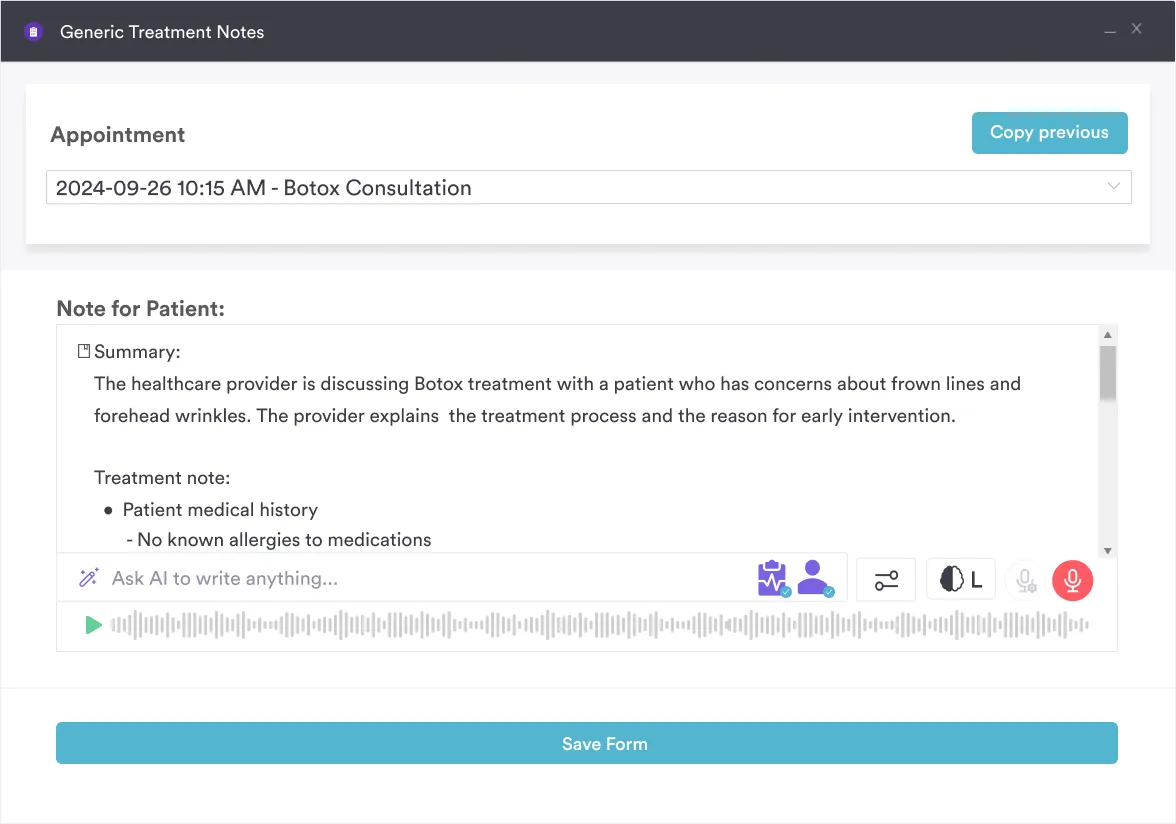
Pabau’s automated workflows can also track follow-up tasks. Open items then stay attached to the patient record rather than to a sheet that gets shredded.

Pabau keeps clinical notes, digital forms, and follow-up tasks in one patient record. The next clinician picks up from the chart instead of a copied sheet.

A report sheet earns its place when it is filled in the same order on every shift and closed out before handoff. Choose one layout for your patient load and one format for your unit, then hold every nurse to them.
The trade-off to remember is that the sheet is private and disposable. Whatever it captures has to reach the chart before the sheet reaches the shred bin. In an outpatient or specialty practice, a digital record can remove that second copy altogether. Book a demo to see how Pabau keeps notes, forms, and follow-up tasks in one record for every handover.

Want allergies and history captured before the shift starts? Digital patient intake forms shows how practices collect them before the visit.
Need a quick drug reference for med passes? Nursing pharmacology cheat sheet covers 20 common drugs by class.
Caring for a patient with a severe allergy? Anaphylaxis nursing care plan sets out the interventions and the charting that follows.
A nursing patient report sheet is a structured handoff document that records each patient’s status, plan, and pending tasks for the next shift. It keeps handoffs consistent across nurses, units, and shifts.
A nursing brain sheet is a common nickname for a nursing patient report sheet. It typically includes demographics, vitals, medications, allergies, code status, and pending tasks.
SBAR is a communication framework for handoffs. It stands for Situation, Background, Assessment, and Recommendation, and it gives the verbal report a fixed order.
Yes, but ICU versions need extra fields such as lines, drips, and monitoring targets. A general ward sheet does not cover critical care detail without adjustment.
No. A nursing report sheet is a personal working note for one shift. Chart every clinically significant finding, then shred the sheet in a secure bin before you leave the unit.
Fill in identifiers, code status, allergies, and diagnosis during the incoming report. Copy medication and lab due times from the chart, then complete the body-system assessment on first rounds. Log vitals and doses as you go, and write the SBAR box before handover.
SBAR orders a report as Situation, Background, Assessment, and Recommendation. I-PASS stands for Illness severity, Patient summary, Action list, Situation awareness and contingency planning, and Synthesis by receiver. Its last step asks the receiver to read the plan back.