Despina Petrushevska

Healthie pricing (2026): Every plan, add-on and fee in one table
Healthie pricing starts at $49.99 a month for the Essentials plan and runs to $1...

Last Updated: Nov 19, 2026
Free PDF 2 pages, print-ready Clinician-reviewed
The nonverbal pain scale (NVPS) is a behavioral pain assessment tool for adults who cannot report pain themselves. It scores five domains from 0 to 2 each, giving a total between 0 and 10.
Critical care nurses use it when patients are intubated, sedated or cognitively impaired. The scale turns what you see at the bedside into a structured record that the next shift can compare against.
Without a shared tool, a patient who grimaces during repositioning but cannot speak may be assessed once per shift, if at all. This guide covers what each domain measures, how to score and reassess, and how the scale compares with CPOT and FLACC.
An NVPS-R form with the 0 to 2 scoring criteria for all five domains and an analgesic plan box. Its observation record logs the time, each domain score, a total column and the action taken. A reassessment prompt reminds you to score again 30 minutes after an IV analgesic or 60 minutes after an oral dose.
Start from scratch, or upload this PDF or any form you already use, and Pabau's AI Form rebuilds it with tick boxes, text fields and a signature. Attach it to the treatment once, and every patient gets it on time.
AI Form rebuilds the consent, history and aftercare forms you already use. You review each one, then publish.
Patients complete forms on their phone before they arrive, so the front desk stops retyping paper.
Every signed form is versioned and attached to the treatment record, ready when you need it.
Set how long a consent stays valid. Returning patients skip forms they have already signed.
Supports HIPAA and GDPR compliance AES-256 encryption 4.8 on G2 4.7 on Capterra Trusted by 4,000+ practices worldwide

The NVPS-R scores face, activity, guarding, physiology (vital signs) and respiratory from 0 to 2 each, for a total of 0 to 10.
It was developed for critically ill adults who cannot self-report pain, not for children.
Reassess 30 minutes after an IV analgesic or 60 minutes after an oral dose, and record whether the total fell.
A total score signals a pattern to investigate, and clinical judgment still decides treatment.
In Pabau’s digital forms, each completed NVPS record is saved to the patient’s file, so earlier scores are there at handover.
The nonverbal pain scale is a clinician-rated tool for assessing pain in critically ill adults who cannot communicate it. A 2009 Critical Care Nurse study tested both versions of the scale in sedated ICU patients receiving mechanical ventilation.
Nurses at Strong Memorial Hospital in Rochester, New York, developed the original scale. It was published by Odhner and colleagues in Dimensions of Critical Care Nursing in 2003. This template follows the revised version, the NVPS-R, which Wegman described in Critical Care Nurse in 2005.
Clinicians use it with patients who are intubated, unconscious, sedated, or living with advanced cognitive impairment. Because it relies on observed behavior and physiology rather than self-report, it gives teams a common language for recording pain.
Self-report still comes first. If a patient can nod, point or squeeze a hand to a number, that answer outranks any observed score. Units that also track sedation often record a Ramsay sedation scale score alongside it.
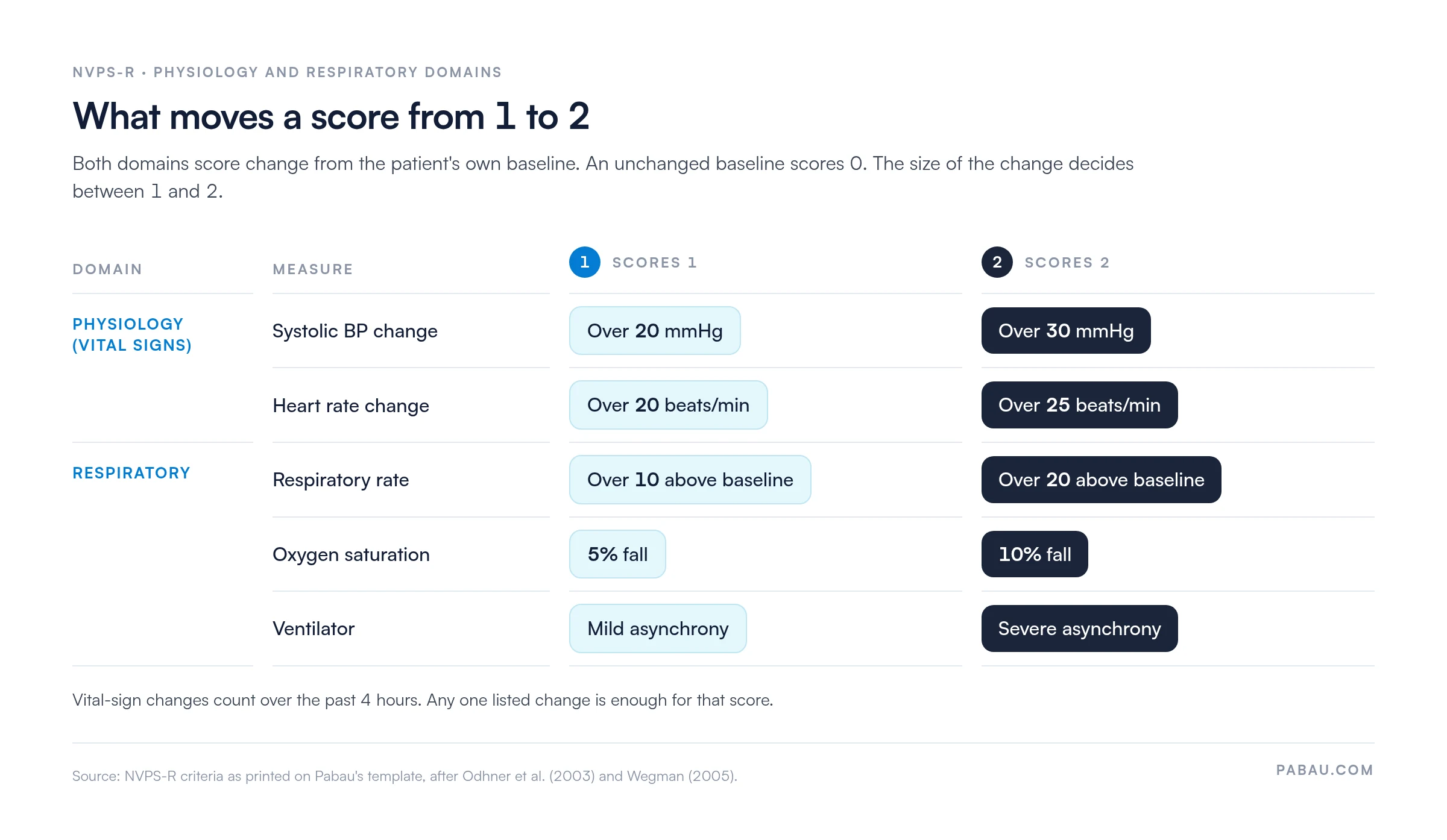
Each domain is scored 0, 1 or 2. The table shows the NVPS-R criteria as they appear on the template.
The two physiological domains score change from the patient’s own baseline, so record that baseline first, for example on a vital signs record. A change of over 20 mmHg in systolic BP or over 20 beats/min in heart rate scores 1. Over 30 mmHg or over 25 beats/min scores 2.
Respiratory works the same way. A rate more than 10 above baseline, a 5% fall in oxygen saturation or mild ventilator asynchrony scores 1. More than 20 above baseline, a 10% fall or severe asynchrony scores 2.
If your unit trained on the original 2003 scale, compare the two versions before staff switch to this form.
Work through the template in order. Each step maps to a part of the PDF.
A total score is a prompt for clinical review, not a treatment instruction. Pain management decisions remain with the clinical team.
The template suits teams that care for patients who cannot report pain themselves. It is most relevant in these settings:
A shared template makes assessments comparable between shifts and staff members. When two nurses score the same patient with the same domains, handovers carry usable information.
Structured fields also make documentation easier to evidence at review. Teams can show when pain was assessed, what was observed, and what happened next.
Assess pain at a consistent point in the care routine, such as before and after repositioning. Scores taken during a noxious procedure and scores taken at rest answer different questions, so record which one you are capturing.
The nonverbal pain scale and the FLACC scale both use observed behavior, but they serve different populations. The FLACC scale was validated for children aged 2 months to 7 years, while the NVPS was developed for critically ill adults.
Adult FLACC adaptations exist in the literature, but adults are not its primary validated population. Choose the tool that matches your patient group rather than the one your unit already uses.
Within adult critical care, the evidence leans toward two other tools. The Society of Critical Care Medicine recommends the Behavioral Pain Scale (BPS) and the CPOT pain scale. A 2014 Critical Care commentary notes both showed stronger psychometric properties than the NVPS.
That makes the NVPS a reasonable choice where your unit already trains on it. If you are choosing a tool from scratch, review BPS and CPOT against your local protocol first.
Record the total score, the individual domain scores, the time of assessment, and the action taken in the same entry. A total with no domain breakdown is hard to interpret at handover.
Our guide to nursing documentation covers how to write entries the next clinician can act on. Check your local policy on how long these records are retained.
The Joint Commission requires a documented pain assessment for all patients, and CMS Conditions of Participation include pain management documentation in hospitals. Using a template helps you evidence this process, but it does not by itself meet every requirement. Documentation standards vary by institution and jurisdiction, so confirm them with your governance team.
On paper, an NVPS sheet lives at the bedside or in a binder. The next clinician has to find it, read the earlier totals and work out whether the last analgesic helped.
Pabau, the practice management platform we build, offers digital forms for practices. You can rebuild this template as a form your team completes on a tablet or laptop. Each completed form is saved to the patient’s file.
The result is a reassessment history the whole team can read in one place. When a total doesn’t fall after two interventions, the earlier entries are already in the record for the review.

Pabau’s digital forms turn paper assessment sheets into forms your team completes at the point of care. Each one is saved to the patient’s file, so the reassessment history is there at handover.

The NVPS-R gives you a repeatable way to put a number on pain when the patient can’t. Its value comes from scoring the same five domains the same way every time, then scoring again after you act.
If your unit already uses the NVPS, this template keeps scoring and reassessment consistent across shifts. If you are picking a tool for the first time, weigh the stronger evidence behind BPS and CPOT before you commit.
Book a demo to see how Pabau keeps pain assessments and reassessment notes together on one patient record.

Assessing pain in ventilated adults? CPOT pain scale scores the four behaviors the Critical-Care Pain Observation Tool uses.
Scoring sedation as well as pain? Ramsay sedation scale gives you a six-level sedation score to record alongside the NVPS.
Need a baseline for the physiology domains? Vital signs record tracks the blood pressure, heart rate and respiratory readings the scale compares against.
Looking after patients with several symptoms? Edmonton symptom assessment scale rates pain alongside other common symptoms in palliative care.
Want entries that hold up at handover? Nursing documentation explains how to write clear, defensible nursing notes.
The nonverbal pain scale is a clinician-rated tool that scores five behavioral and physiological domains for a total of 0 to 10. It is used with adults who cannot self-report pain. It was developed for critically ill patients and is used in intensive care settings.
Yes, the scale is validated for critically ill adults, the population studied in the original 2003 publication and later validation work. Validation for dementia and other groups requires separate citation and should not be assumed.
Score thresholds vary by source, so confirm them against the published instrument and your local protocol before using them to guide action. A high total is a prompt to reassess and review, not a standalone treatment decision.
It can be used in patients with cognitive impairment, but dementia-specific validation needs separate evidence. Teams should check the current literature and their local policy before relying on it for this group.
Record each domain score, the total, the time, the care activity that preceded the assessment and the action you took. Then reassess 30 minutes after an IV analgesic or 60 minutes after an oral dose.