Journal prompts for mental health
Journal prompts for mental health are guided questions that help people process ...

2
Last Updated: Oct 13, 2026

The Mindful Attention Awareness Scale is a 15-item self-report measure of dispositional mindfulness, rated on a 6-point frequency scale.
No MAAS item is reverse-scored. All 15 describe lapses in attention, so there is no subtract-from-7 step anywhere in scoring.
The score is the plain mean of the 15 raw responses, and a higher mean indicates greater trait mindfulness.
No clinical cut-off scores exist, so read a mean against published sample means and against the client’s own baseline.
Practice management software like Pabau can send the MAAS as a digital form and file each score in the client record.
A printable response sheet with the 1 to 6 frequency scale beside every item and a total-score line. It also leaves space for the client’s reflections and an action plan. Use the item wording and the mean-score method below when you administer it.
Download templateThe Mindful Attention Awareness Scale (MAAS) measures how often a person runs on autopilot instead of noticing what is happening now. Clinicians in therapy, counseling, coaching, and mental health practices use it to put a number on trait mindfulness. It is short and free for research and clinical work, and you can score it in under a minute.
This guide gives the 15 items exactly as Kirk Warren Brown and Richard M. Ryan published them in 2003. It covers administration, the scoring method, what a score can and cannot tell you, and the scale’s documented reliability. The printable response sheet is linked above.
The Mindful Attention Awareness Scale is a 15-item self-report questionnaire that measures dispositional mindfulness. Brown and Ryan developed it at the University of Rochester and published it in 2003. Respondents rate how often they have each of 15 everyday experiences, from 1 (almost always) to 6 (almost never).
People widely search for the scale as the mindfulness attention awareness scale, but the published title uses Mindful. Both names point to the same instrument. The MAAS targets attention and present-moment awareness rather than acceptance or non-judgment, and that narrow focus is deliberate.
Brown and Ryan grounded the scale in self-determination theory. Clinicians now use it in clinical psychology, counseling, wellness coaching, and integrative medicine. Copies circulate through university repositories and training programs, which is also how several altered versions have spread.
The MAAS appeared in the Journal of Personality and Social Psychology, volume 84, issue 4, pages 822 to 848. Brown and Ryan titled the paper The Benefits of Being Present: Mindfulness and Its Role in Psychological Well-Being.
Brown and Ryan built the scale from seven samples. Five were university student groups, one was a local community sample, and one was a national mail-out survey of 239 adults. Nine experienced mindfulness practitioners rated candidate items for content validity before Brown and Ryan fixed the final 15.
One decision shaped the whole instrument. Brown and Ryan dropped statements describing high attention and awareness, because both the expert raters and the factor analysis rejected them. Brown and Ryan argued that people find it easy to claim they are attentive, so asking about lapses is more diagnostic. Later studies have replicated the single-factor structure in adult, clinical, and translated samples.
The MAAS has 15 items, each rated from 1 to 6. Every item describes a lapse in attention or awareness, so respondents are reporting how often they behave mindlessly rather than how mindful they feel.
Brown and Ryan introduced the items with a fixed instruction, and it is worth keeping. Ask respondents to indicate how frequently or infrequently they currently have each experience. Add that they should answer according to what really reflects their experience, not what they think it should be.
| Response | Frequency anchor |
|---|---|
| 1 | Almost always |
| 2 | Very frequently |
| 3 | Somewhat frequently |
| 4 | Somewhat infrequently |
| 5 | Very infrequently |
| 6 | Almost never |
These are the 15 items in the order Brown and Ryan published them.
You never reverse-score an item on the MAAS. Because all 15 run in the same direction, there is no subtract-from-7 step at any point in scoring. Scale copies from the Greater Good Science Center at UC Berkeley and from Ohio State University agree. Both carry the same 15 items, with no reverse-coded entry.
This matters because altered 15-item lists circulate widely, several of them carrying an invented reverse-coded item. If a version someone gave you asks you to flip a response, it is not the published MAAS. Check it against the list above before you score anything.
Score the MAAS by averaging the 15 raw responses. That is the whole method, and it takes well under a minute per form.
Worked example: a client’s 15 responses add up to 58. Divide 58 by 15 to get the MAAS mean, 3.87. That sits close to the student and community averages Brown and Ryan reported.
The printable response sheet has a single total-score line rather than a mean. Divide that total by 15 yourself, and read a higher mean as greater mindfulness.
There are no universally agreed clinical cut-off thresholds for the MAAS. A higher mean indicates greater trait mindfulness relative to normative samples, and that is as far as the published evidence goes. Any table of fixed low, moderate, and high bands you find online is an invention.
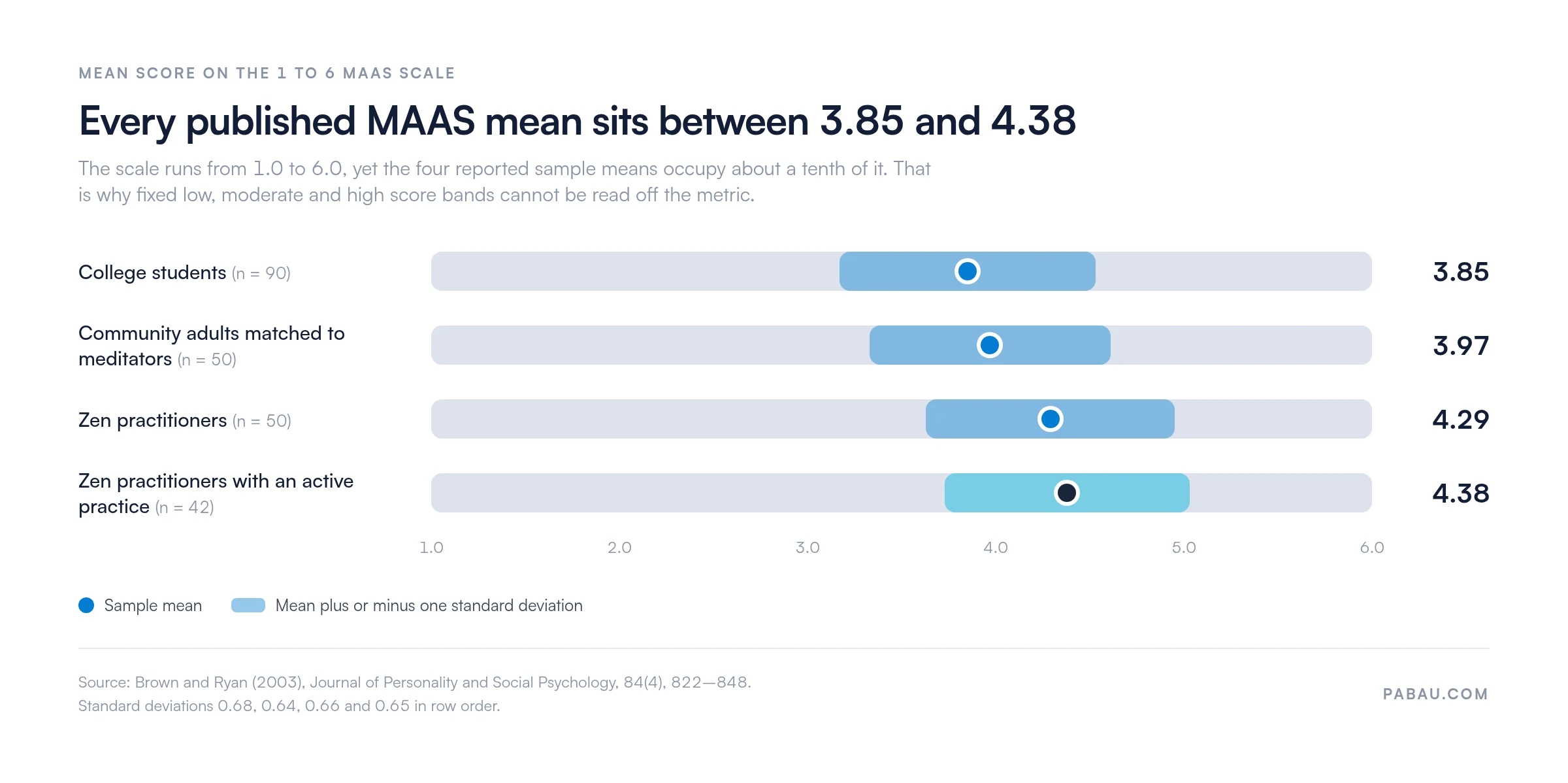
The comparisons that hold up are published sample means and the client’s own earlier score. Brown and Ryan reported the means below, all on the same 1 to 6 metric.
| Sample | n | Mean | SD |
|---|---|---|---|
| College students | 90 | 3.85 | 0.68 |
| Community adults matched to meditators | 50 | 3.97 | 0.64 |
| Zen practitioners | 50 | 4.29 | 0.66 |
| Zen practitioners with an active practice | 42 | 4.38 | 0.65 |
Note how narrow that range is. Even experienced Zen practitioners averaged 4.38, so a client scoring above 5.0 is unusual rather than exemplary. Treat very high means with the same caution you would give any self-report ceiling effect.
Plotted against the full 1 to 6 scale, the four means sit within 0.53 points of each other.
Item-level means in the original student sample of 313 ranged from 2.66 to 4.36. The lowest was preoccupation with the future or past, and the highest was driving on automatic pilot. Individual items vary a lot, which is another reason to read the mean rather than single answers.
The MAAS describes a trait, not a diagnosis. A low mean is not pathology, and one administration says nothing about change. Take the first score as a baseline and interpret every later score against it.
The MAAS has held up well across validation studies. The figures below come from the original Brown and Ryan paper. UW–Madison’s Addiction Research Center also publishes a copy of the scale with its scoring notes.
Later research has repeated these findings in clinical and non-clinical groups, in adults aged 18 to 77, and in translated versions. That breadth is why the MAAS remains one of the most used trait mindfulness measures in the literature.
Clinicians usually administer the MAAS at three points: intake, mid-treatment, and discharge. Each point answers a different question. Whether all three get collected is usually a scheduling problem, and therapy practice management software is what solves it.
Pre and post scores are where the MAAS earns its place in a treatment file. The arithmetic is easy, but the interpretation needs care.
Researchers have validated the MAAS well, and clinicians use it widely, but it has recognized limits that shape how far you can read a score.
None of this disqualifies the MAAS. It means the score belongs in a file next to clinical judgment, not in place of it.
Most practices still hand the MAAS out on paper and copy a total into a note afterward. That costs a few minutes per client. Worse, it buries the earlier score, so the comparison that gives the measure its value takes a search through the file.
Practice management software like Pabau sends the scale as a digital form before the appointment. The client completes it on a phone, and the response files itself in their record rather than in a folder. Automated reminders chase the forms that have not come back.
Because every completed form stays attached to the client record, the previous mean is on screen when you administer the scale again. Reading the change becomes a glance instead of a hunt, which is what makes repeat administration realistic across a full caseload.
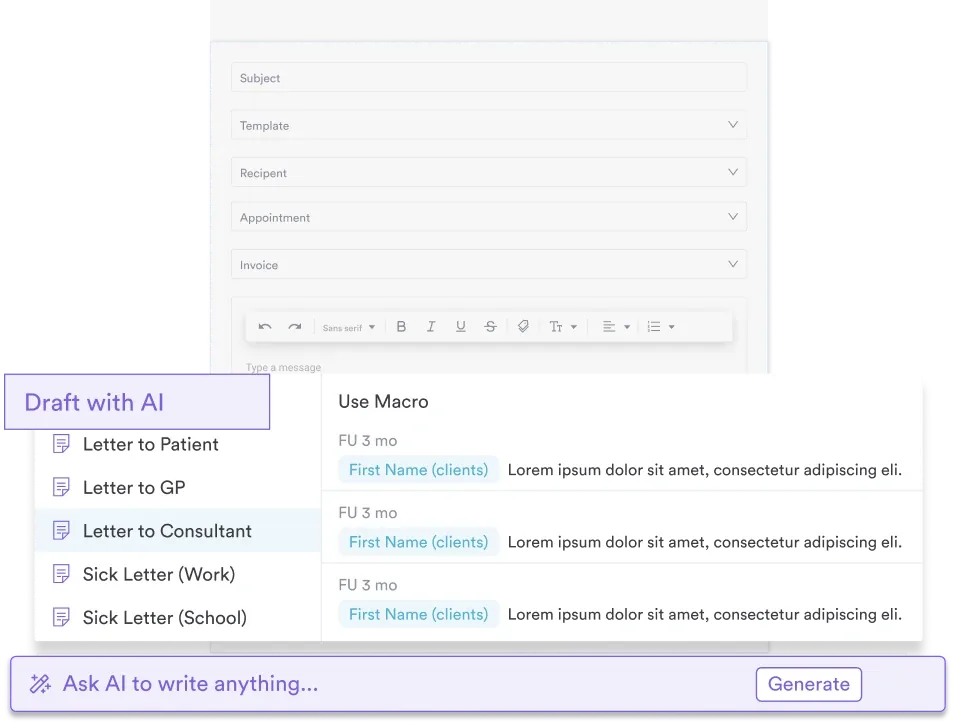

Pabau, our practice management platform, sends the MAAS as a digital form before the appointment. Each response files itself in the client record, so every score sits in one place when you review progress.

The MAAS is worth using because it is short, free, and backed by strong validation. It is worth using carefully because the version circulating online is often not the one Brown and Ryan published.
Two facts settle most of the confusion. All 15 items describe lapses in attention, and the score is the plain mean of those 15 answers. A version that asks you to subtract a response from 7, or hands you fixed interpretation bands, is not the MAAS.
Take the first mean as a baseline, compare later means against it, and keep the interval in the record. Book a demo to see how Pabau collects MAAS responses and stores every score against the client.

Fitting the MAAS into a fuller intake? Psychiatric evaluation template shows how structured assessment sections support mental health documentation.
Need to track client progress across several outcome measures? Therapy practice management software explains how to organize client records and automate outcome monitoring.
Need a measure that covers more than attention? Depression Anxiety Stress Scale (DASS-21) covers symptom severity, which the MAAS deliberately leaves out.
The MAAS is a 15-item self-report questionnaire measuring dispositional mindfulness, the stable tendency to notice present-moment experience. Respondents rate how often they have each experience from 1 (almost always) to 6 (almost never). The score is the mean of the 15 items, so it falls between 1.0 and 6.0. Kirk Warren Brown and Richard M. Ryan published it in 2003.
Add the 15 raw responses and divide by 15. No item requires reverse scoring, so nothing changes before you average. A higher mean indicates greater trait mindfulness. No clinical cut-off scores exist for the MAAS. Brown and Ryan reported means of 3.85 in a student sample and 3.97 in community adults. Compare a client score against those published samples and against their own baseline.
No. Brown and Ryan worded all 15 items to describe mindless or inattentive behavior, an approach the authors called the indirect-item approach. Brown and Ryan deliberately dropped statements about high attention and awareness during scale construction. Because every item runs in the same direction, you average the raw responses and never subtract any of them from 7.
The MAAS covers attention and awareness only, so it says nothing about acceptance, non-judgment, or body awareness. Self-report is the basis for every score, which leaves it open to bias. Clinical cut-off scores don’t exist for the scale, and its validation samples were mostly Western and English-speaking. It also measures a trait, so it will not capture the state shift after a single meditation session.