Waist-to-hip ratio chart: Risk bands for women & men (free PDF)
A waist-to-hip ratio chart sorts a patient’s waist-to-hip ratio (WHR) into...

3
Last Updated: Oct 14, 2026

A Mediterranean diet grocery list covers seven categories, and four of them are plant-based.
Fish and seafood belong on the list at least twice a week, while red meat appears only occasionally.
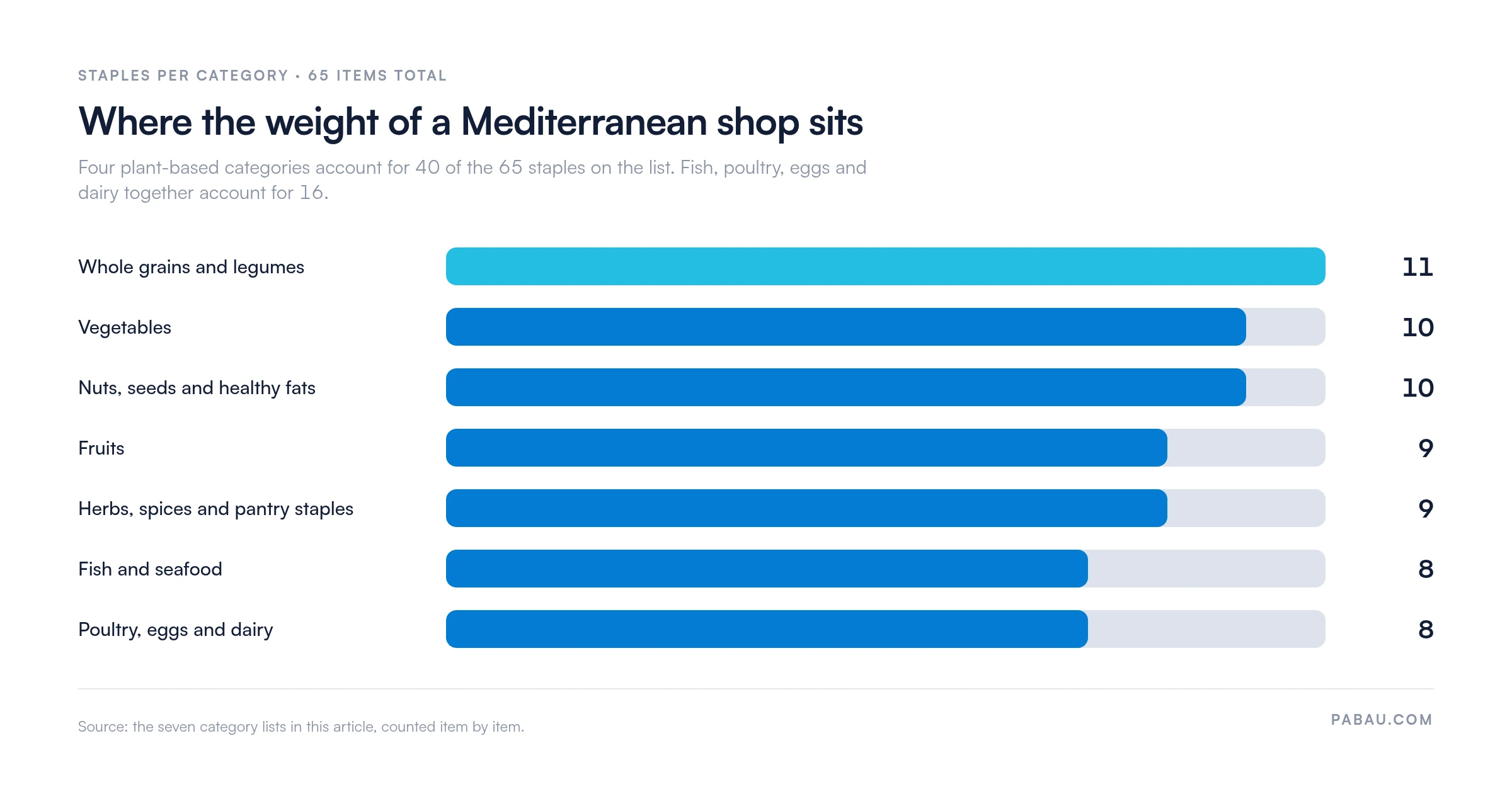
Whole grains and legumes carry more staples than any other category, at 11 of the 65 items.
The printable PDF groups every item by category, so a patient can shop one section of the store at a time.
Pabau, our practice management software, keeps the handout and the follow-up notes on the same patient record.
A Mediterranean diet grocery list sorts the weekly shop into seven categories, from vegetables and whole grains to fish, olive oil, and pantry staples.
Stock those categories and the eating pattern mostly takes care of itself. The full list below runs to 65 staples, and it downloads as a printable PDF.
This guide is written for dietitians and weight loss practices that hand the list to patients. It covers what to buy, how often each group belongs on the plate, and what to leave on the shelf. It also covers how to record adherence at the follow-up visit.
A printable list of 65 staples, grouped into seven categories from vegetables and whole grains through to pantry items. Sized to print on one page and hand to a patient at the end of a consultation.
Download templatePatients rarely abandon this diet on knowledge. They abandon it in the store, holding a list that mixes food groups with aisles. Grouping the items the way a supermarket is laid out removes most of that friction.
The Mediterranean diet draws on the traditional eating patterns of Greece, Italy, Spain, and the eastern Mediterranean. It prioritizes plant foods, extra virgin olive oil as the main fat, and fish ahead of red meat. Research from the American Heart Association links the pattern to lower cardiovascular risk, better weight management, and improved cognitive function.
Nothing is strictly banned, which is part of why adherence tends to hold. The list below is a default shop rather than a rulebook, and seasonal substitution is expected. The DASH diet food list overlaps with it heavily, so patients managing blood pressure often run both.
Each category below holds the staples worth keeping in rotation. The counts are uneven, and the shape of a first shop follows from them.
Aim for two or more servings a week of fatty fish rich in omega-3 fatty acids.
These sit in the middle of the pattern. Poultry a few times a week, eggs several times a week, and dairy daily or most days.
The pattern runs on frequency rather than portion size. This is the working guide:
Few foods are forbidden outright, but several categories undo the rest of the shop. These are the ones to skip:
Cost is the objection that ends most attempts at this diet. These tactics deal with it directly:
For a patient who is not following a named eating pattern, a general healthy grocery list is a simpler place to start.
Snacking belongs in this pattern rather than counting against it. Choose items that repeat what is already on the list.
Handing over a food list is the easy part. The list changes behavior only when it is anchored to what the patient already buys.
Start by mapping their current shop against the seven categories, one category at a time. Most patients are already strong in two or three of them, and naming those wins first makes the rest feel smaller. A nutrition assessment form captures that baseline in a comparable format.
Then agree on two substitutions rather than a full overhaul. Swapping white pasta for whole wheat and butter for olive oil covers much of the pattern’s effect. Record both swaps in the note, so the next visit reviews something specific instead of asking how the diet is going.

Transition beats conversion. Five steps get most patients to a workable version within two weeks.
The evidence behind this pattern is unusually strong for a diet. The PREDIMED trial, published in the New England Journal of Medicine, reported a 30% reduction in major cardiovascular events. Participants followed a Mediterranean diet supplemented with either extra virgin olive oil or nuts. Reported benefits also include better blood sugar control, lower inflammation markers, and improved cognitive function.
Clinically, that shows up at review rather than at the first consultation. Software built for weight loss practices keeps lipids, HbA1c, and weight next to the diet plan they belong to. Patients who want a structured week can start from a heart-healthy diet plan and adapt it to this list.
Most practices email the PDF, write a line in the note, and hope the patient raises it next time. The handout lives in an outbox, the baseline lives on a paper form, and the review starts from memory.
Pabau, our practice management software, keeps the three together. The grocery list goes out as an attachment on the appointment, and a digital intake form captures the patient’s starting pattern. Both sit on the patient record, next to the treatment note.
Automated follow-ups then check in at two weeks and six weeks without anyone remembering to send them. The outcome is a review that opens with data rather than a question. You can see what was sent, what the patient reported, and what has changed since the last visit.

Pabau sends the grocery list from the appointment, captures the patient’s baseline on a digital intake form, and schedules the follow-up automatically. Your review starts from the record rather than from memory.

The grocery list is the part of the Mediterranean diet a patient can act on the same day. Frequency guidance and trial results are useful, but the shop is where adherence is won or lost.
So hand over the printable list, agree on two swaps, and write both into the note. The trade-off worth remembering is that a shorter list beats a complete one. A patient who buys 12 of these staples every week is already following the pattern. Book a demo to see how Pabau keeps nutrition handouts, baselines, and follow-ups on one patient record.

Need a plan patients can follow for a full week? Anti-inflammatory meal plan turns the same food groups into day-by-day meals.
Working with a patient who eats fish but no meat? Pescatarian diet food list covers the seafood-forward version of this pattern.
Need to document the nutrition visit itself? Nutrition SOAP note gives you a structure for subjective, objective, assessment, and plan.
Want a starting list for a patient on no named diet? Healthy grocery list is a simpler general-purpose version of this handout.
A Mediterranean diet grocery list includes vegetables, fruits, whole grains, legumes, fish, nuts, extra virgin olive oil, and moderate amounts of poultry, eggs, and dairy. Red meat appears only occasionally, and processed foods are avoided.
Yes. The free printable template above is grouped by food category, so a patient can shop one section of the store at a time.
It supports healthy weight management through whole foods, fiber-rich legumes and grains, and healthy fats that promote satiety. Weight loss outcomes still vary by individual.
Eat fish and seafood at least twice a week, with the emphasis on fatty fish such as salmon and sardines for their omega-3 content.
Yes, it is beginner-friendly. Start by replacing refined grains with whole grains, adding more vegetables, and using olive oil as the primary fat. The printable list simplifies the transition.
Hummus with vegetables, Greek yogurt with fruit, nuts, fresh fruit, olives, whole grain crackers with cheese, and roasted chickpeas all fit the pattern.