Menopause rating scale template: scoring and visit tracker
The menopause rating scale (MRS) is an 11-item questionnaire that the patient co...

1
Last Updated: Nov 25, 2026
A GLP-1 titration log is the practice’s per-patient record of each dose given, the patient’s weight, side effects reported and the next review date. The FDA label dose steps sit beside each row for reference only, so the team records what happened against the licensed ladder.
The log is built for practice staff, not patients. It covers the 14 fields a row needs and how to fill them in at each injection visit. It also sets out the label ladders for Wegovy, Ozempic, Zepbound and Mounjaro, plus the warnings to review at every step.
A printable per-patient dose record with 14 fields per row and two blank log sheets. It also covers the label dose steps for Wegovy, Ozempic, Zepbound and Mounjaro, plus a warnings checklist.
Download template
A titration log gives each patient one dated row per dose given, with weight, side effects reported and the next review date.
Every row carries the label step number, so the minimum interval and missed-dose rule for that product sit right beside it.
The FDA labels step semaglutide and tirzepatide up at intervals of at least 4 weeks, and each label sets its own missed-dose window.
The log records doses already given, and the clinician fills in the next review date from the label rather than a pre-planned schedule.
Review the form with your medical director and legal counsel before the team starts using it.
A GLP-1 titration log needs 14 fields covering the patient, the dose given, its label step and the next review date. Each row ties to a rule in the product’s own label. Zepbound’s FDA prescribing information, for example, allows each step up only after at least 4 weeks on the current dose. That label was revised 11/2026 and checked November 25, 2026.
We call this structure the Label-step log. Each row records the step number on the licensed ladder, and the label’s minimum interval and missed-dose rule sit beside the columns. The next review date then becomes a field the clinician fills in from the label, not a date the form invents.
| Field | What to record | Why it is on the log |
|---|---|---|
| Practice and patient identifier | Practice name, patient name, date of birth and record number. | Ties every row to one patient record. |
| Visit date | The date the dose was given or the visit took place. | Every label interval counts from this date. |
| Product and presentation | Brand, strength and presentation, such as a single-dose pen, vial or KwikPen. | Each label has its own ladder, and the tirzepatide labels tie patient training to the presentation used. |
| Dose given | The dose in mg, exactly as administered. | Builds the dose history the prescriber reviews. |
| Label step number | The step on the product’s label ladder, such as step 2 of 5. | Shows where the patient sits on the licensed ladder at a glance. |
| Weeks since last dose | The interval since the previous dose, counted from the last row. | The labels set minimum intervals before a step up and windows for a missed dose. |
| Weight | Weight measured at this visit, with the units used. | Keeps the weight record next to the dose record. |
| Side effects reported | Free text in the patient’s words, plus the label-warning checklist ticked or cleared. | Escalation in each label is designed to reduce the risk of gastrointestinal adverse reactions. |
| Missed dose (Y/N) and action taken | Whether a dose was missed since the last row, and what was done under that label’s rule. | Missed-dose rules differ by product, and the Wegovy injection label changes the escalation after 2 missed doses in a row. |
| Lot number and expiry | Batch number and expiry date, where the practice dispenses from its own stock. | Lets the practice trace a dose back to the stock it came from. |
| Administered by | Name and role of the person who gave the dose. | Records who acted on the prescriber’s order. |
| Prescriber or medical director review | Initials and date of the reviewing prescriber or medical director. | Shows the row was reviewed before the next step. |
| Next review date | The date the clinician sets, read from the label’s minimum interval. | Keeps the review tied to the label rather than to a pre-planned schedule. |
| Notes | Anything the next clinician needs, such as a delayed step and its reason. | Explains any row that departs from the label ladder. |
Keep efficacy and outcome notes out of the log. Review the form with your practice’s medical director and legal counsel before the team uses it, because supervision and delegation rules vary by state.
Fill in one new row per dose, in the same order every visit, and close it with the review initials and the next review date. The eight steps below follow the row from left to right.
The order matters more than it looks. In practices we onboard, the dose column is almost always complete, while the weeks-since-last-dose and review columns are the ones left blank. Filling those two before the dose is recorded keeps the label rule in front of the person giving it.
Start the log at the first dose of any GLP-1 product. Keep the same log for the whole course, through maintenance, pauses and any change of product.
The first row records the label’s starting dose. Wegovy injection and Ozempic start at 0.25 mg weekly, and Zepbound and Mounjaro at 2.5 mg weekly. Wegovy tablets start at 1.5 mg daily. The labels and their dates are in the next section.
A restart gets its own row too. The Wegovy injection label says that after 2 or more consecutive missed doses, escalation is reinitiated at a lower dosage. Logging that as a new step 1 shows the prescriber why the ladder went backward. A change of product starts a new run of rows under the new product’s ladder.
For drug reference, the GLP-1 medication list covers each medication and its dosing. This page is the blank per-patient log that sits alongside it.
Each FDA label starts low and steps up after 4-week periods. Semaglutide injections start at 0.25 mg weekly, tirzepatide at 2.5 mg weekly and Wegovy tablets at 1.5 mg daily.
The table puts all five ladders on one page, each linked to its DailyMed label and dated. Every label was checked on November 25, 2026. Re-check the label before you print a new batch of forms, because the labels change often.
| Product | Label step ladder | Label rule on missed doses and minimum interval | Label link and dates |
|---|---|---|---|
| Wegovy injection (semaglutide), weekly | Weeks 1-4: 0.25 mg. Weeks 5-8: 0.5 mg. Weeks 9-12: 1 mg. Weeks 13-16: 1.7 mg. Week 17 on: maintenance by indication. | Next dose more than 2 days away: give the missed dose. Less than 2 days away: skip it. Two or more missed in a row: reinitiate escalation at a lower dosage. | Wegovy label on DailyMed, revised 6/2026, checked November 25, 2026. |
| Wegovy tablets (semaglutide), daily | Days 1-30: 1.5 mg. Days 31-60: 4 mg. Days 61-90: 9 mg. Day 91 on: 25 mg. | A missed tablet is skipped, and the next dose is taken the following day. | Same combined Wegovy label, revised 6/2026, checked November 25, 2026. |
| Ozempic (semaglutide), weekly | 0.25 mg for 4 weeks, then 0.5 mg. Then 1 mg after at least 4 weeks, then 2 mg after at least 4 weeks. Maximum 2 mg. | Give a missed dose within 5 days, otherwise skip it. The weekly day can change if doses are at least 2 days (more than 48 hours) apart. | Ozempic label on DailyMed, updated June 1, 2026, checked November 25, 2026. |
| Zepbound (tirzepatide), weekly | 2.5 mg for 4 weeks, then 5 mg. Then 2.5 mg increments: 7.5, 10, 12.5 and 15 mg. Maximum 15 mg. | Step up only after at least 4 weeks on the current dose. Give a missed dose within 4 days (96 hours), otherwise skip it. Doses at least 3 days (72 hours) apart. | Zepbound label on DailyMed, revised 11/2026, checked November 25, 2026. |
| Mounjaro (tirzepatide), weekly | Start at 2.5 mg. Increase in 2.5 mg increments up to 15 mg in adults, or 10 mg in pediatric patients. | Step up only after at least 4 weeks on the current dose. Give a missed dose within 4 days (96 hours), otherwise skip it. Doses at least 3 days apart. | Mounjaro label on DailyMed, revised 11/2026, checked November 25, 2026. |
The table shows the labels’ own steps. The log records which one was given. Compounded products and any schedule outside these labels are out of scope for this form. Compounded semaglutide and tirzepatide come from 503A or 503B pharmacies and carry no FDA label ladder.
The semaglutide titration schedule differs between the two labels. The Wegovy injection label steps up every 4 weeks, from 0.25 mg to 1.7 mg, and reaches maintenance at week 17. For adult weight reduction, the label’s maintenance dose is 1.7 mg or 2.4 mg weekly, with 2.4 mg recommended.
The Wegovy label also allows a maximum of 7.2 mg weekly in adults. That applies to patients who tolerated 2.4 mg for at least 4 weeks, where additional weight reduction is clinically indicated. If a dose is not tolerated during escalation, the label says to consider delaying escalation for 4 weeks. Record any delay in the Notes column.
Wegovy tablets sit on the same label but follow a daily ladder in 30-day steps. This log is built around weekly injections. For a tablet patient, use one row per review visit and record the current daily dose and day count, rather than one row per dose.
The Ozempic label is for adults with type 2 diabetes and carries no weight-management indication. Its maintenance dose is 0.5 mg, 1 mg or 2 mg weekly, based on glycemic control. For patients with type 2 diabetes and chronic kidney disease, the label’s maintenance dose is 1 mg, after at least 4 weeks on 0.5 mg.
A tirzepatide titration log follows six possible steps, from 2.5 mg to 15 mg. The Zepbound label calls 2.5 mg an initiation dose that is not approved for maintenance. So the first four rows of a Zepbound patient should never be labeled maintenance.
The Zepbound label’s maintenance doses are 5 mg, 10 mg or 15 mg weekly for weight reduction. For obstructive sleep apnea they are 10 mg or 15 mg. If a patient does not tolerate a maintenance dose, the label says to consider a lower maintenance dose. Mark that row with the lower step number and a note.
The Mounjaro label covers glycemic control in type 2 diabetes. It increases in 2.5 mg steps when additional glycemic control is needed, after at least 4 weeks on the current dose. Its adult maximum is 15 mg weekly, and its pediatric maximum is 10 mg.
Both tirzepatide labels (section 7.2) advise patients on oral hormonal contraceptives to switch to a non-oral method or add a barrier method. That applies for 4 weeks after starting and 4 weeks after each dose escalation. A notes entry at each step-up row keeps that counseling on record.
Review the Warnings and Precautions in section 5 of each product’s label at every step up. The section numbers differ by product.
The checklist on the log lists each warning once, with the section number in each label. Headings are as printed in the four labels linked above, all checked on November 25, 2026.
The checklist records that each item was asked about. What to do with a positive answer is the prescriber’s call, made from the full label.
A paper or PDF log only knows what was written at the last visit. It cannot show trends, collect check-ins between visits or chase its own follow-ups.
The flow below shows how much one visit asks of a single paper row. Eight fields have to be filled in the right order, and two of them depend on label rules the form cannot apply for you.
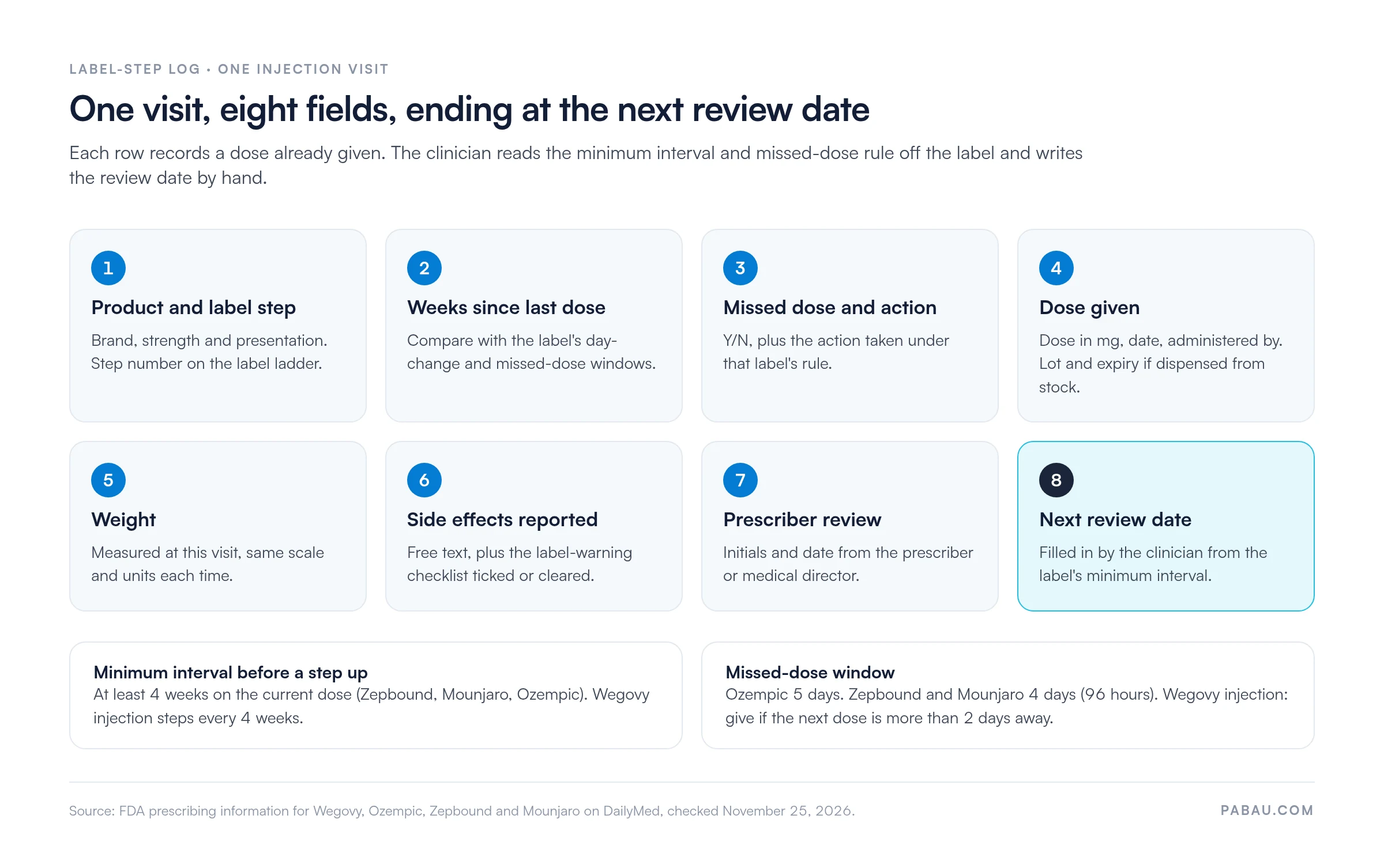
Pabau, a practice management platform, has a GLP-1 tab that practices can switch on as part of its software for weight-loss practices. The table maps each limit of a paper log to what Pabau does instead.
| Limit of a paper or PDF log | What Pabau does instead |
|---|---|
| The log goes stale between visits. | Patients complete weekly check-ins in the patient portal. |
| Dose history lives in rows you read one at a time. | The GLP-1 tab shows dose over time and the current dose. |
| The label ladder is retyped by hand onto every form. | The GLP-1 tab shows the licensed dose-step ladder. |
| Weight sits on a separate sheet. | Weight shows in the GLP-1 tab next to the dose history. |
| The form is chased, signed and filed by hand. | Forms go out before the visit, are signed digitally and are saved to the patient record. |
| Follow-up recalls depend on someone remembering. | Recall Workflows send SMS, email or WhatsApp messages and skip patients who already have a booking. |
For the wider picture of running a weight-loss program on one system, see this guide to EMR for weight-loss practices.
In Pabau, the titration log becomes the GLP-1 tab on the patient record. The tab shows dose over time, the current dose, the licensed dose-step ladder and weight. Patients add weekly check-ins through the portal, so the team sees between-visit entries before the next injection.
The GLP-1 tab records the doses given. It does not plan or schedule future dose steps, so the prescriber still decides each step. Where the practice dispenses from stock, Pabau records the lot against the patient and the appointment, with its batch number and expiry.
Intake and consent forms go out before the visit, get signed digitally and land in the patient record. Pabau GO, our iOS app, supports the care-pathway forms and consents too. Recall messages by SMS draw on usage-based credits.

Pabau’s GLP-1 tab shows each patient’s dose history, current dose, licensed dose-step ladder and weight in one place. Weekly portal check-ins and digitally signed forms land on the same record, so your team stops chasing paper rows.

A titration log earns its place when it answers the same two questions at every visit. Which label step is this patient on, and when is the next review due? Build the form around the label, and the team stops guessing at intervals and missed-dose windows.
Get the form reviewed by your medical director before the first patient row. Then re-date the label references whenever a label changes, because a log built on last year’s ladder records doses against the wrong rules.
Paper works for a handful of patients, but it cannot collect check-ins between visits. Book a demo to see how Pabau keeps each GLP-1 patient’s doses, weight and check-ins on one record.

Starting a patient on semaglutide? Semaglutide consent form covers the consent to collect before the first row of the log.
Starting a patient on tirzepatide? Tirzepatide informed consent template gives the consent wording for Mounjaro treatment.
Need the intake before the first dose? New patient weight loss intake form collects the history the prescriber reviews before starting treatment.
A dose-escalation log gives the practice one dated row per injection, with the dose, label step, weight, side effects reported and next review date. The prescriber can see where each patient sits on the label ladder without reading back through notes.
Add a row every time a dose is given or reviewed in the practice, and whenever a patient reports a missed dose. For a weekly injection that usually means one row per week, while Wegovy tablets get one row per review visit.
No. The log is a practice record of doses given, reviewed and initialed by the prescriber or medical director. It sits alongside the prescriber’s own clinical notes and orders, and the form should be reviewed with the medical director and legal counsel before use.
Each label sets its own window, checked on November 25, 2026. Ozempic allows a missed dose within 5 days, and Zepbound and Mounjaro within 4 days. Wegovy injection allows one if the next dose is more than 2 days away. The semaglutide titration schedule on the Wegovy label also restarts escalation at a lower dose after 2 or more missed doses in a row.
No. The GLP-1 tab records the doses given and shows the licensed dose-step ladder, but it does not plan future steps. A tirzepatide titration log kept in Pabau still relies on the prescriber to decide each step up.