Anja Dodevska

How to start a longevity clinic: The build order to finish before day one
How to start a longevity clinic comes down to five setups, finished in order bef...

Last Updated: Nov 20, 2026
Free PDF 4 pages, print-ready Clinician-reviewed
A peptide consent form records that a patient was told each peptide’s FDA and compounding status, its risks and the alternatives before the first dose. This free template covers a whole peptide menu on one form, with a block for each peptide and no dose fields.
You can use the form as it stands. Every FDA status line on it was checked on November 24, 2026, and names the FDA page it came from. Review it with your medical director and legal counsel before patients sign it.
A four-page, letter-size form in seven sections, from health questions to four initialed FDA and compounding disclosures. Sermorelin and BPC-157 come with dated FDA status lines, two blank peptide blocks follow, and the signatures include a legally authorized representative.
Start from scratch, or upload this PDF or any form you already use, and Pabau's AI Form rebuilds it with tick boxes, text fields and a signature. Attach it to the treatment once, and every patient gets it on time.
AI Form rebuilds the consent, history and aftercare forms you already use. You review each one, then publish.
Patients complete forms on their phone before they arrive, so the front desk stops retyping paper.
Every signed form is versioned and attached to the treatment record, ready when you need it.
Set how long a consent stays valid. Returning patients skip forms they have already signed.
Supports HIPAA and GDPR compliance AES-256 encryption 4.8 on G2 4.7 on Capterra Trusted by 4,000+ practices worldwide

The free download is a four-page peptide consent form with one block per peptide and no dose fields.
Compounded drugs are not FDA-approved, and the form says so in a disclosure the patient initials.
Off-label only describes an approved drug used for another purpose, so a peptide with no approved product is disclosed as not FDA-approved for any use.
On the FDA’s 503A list updated May 14, 2026, BPC-157, TB-500, CJC-1295, ipamorelin and sermorelin sit in no category. An October 30, 2026 HHS draft policy still lets pharmacies compound BPC-157 and TB-500 under conditions.
Patients sign again when a peptide or route is added, or when a peptide’s FDA status changes.
Pabau, a practice management platform, sends the form ahead of each peptide booking and saves the answers to the patient record.
This peptide therapy consent form has seven parts, from patient details to signatures, with a separate block for each peptide the patient may receive. Its disclosures start from the FDA’s statement that compounded drugs are not FDA-approved. The FDA does not verify their safety, effectiveness or quality before they are marketed.
The seven parts match the PDF page for page:
We read the peptide forms that rank for this search before writing ours. All three we checked call unapproved peptides “off-label”, and one live form pre-fills doses beside a product list. This form gives no dose, because doses belong in the prescription on the patient record.
The form also leaves out benefit claims. A consent form records what the patient was told about status, risk and alternatives, and a promised outcome undermines it. The form is step 4 of seven in our guide to starting a peptide practice, after the prescriber, regulatory status and compounding route are settled.
Most peptides marketed to practices are not FDA-approved for the uses promoted, and BPC-157, TB-500, CJC-1295 and ipamorelin sit in no 503A category.
Under section 503A, a pharmacy may compound only with certain bulk substances. Each must meet a USP or NF monograph, be a component of an FDA-approved drug, or appear on the 503A bulks list. Until a nominated substance is decided, the FDA sorts it into three interim categories.
The FDA does not intend to place substances nominated on or after January 7, 2025 into these categories. Several peptides, BPC-157 among them, left Category 2 when their nominators withdrew them. They now appear in no category at all.
Status can move like this, so every block on the form carries a Peptide Status Line. It is one dated, sourced sentence on that peptide’s FDA status. The table below is where each Peptide Status Line comes from.
Checked November 24, 2026. Recheck at fda.gov before each form version. A “No” in the second column means Drugs@FDA showed no application for that ingredient on that date.
Off-label use means an FDA-approved drug used for a purpose the FDA has not approved. A peptide with no approved product takes the “not FDA-approved for any use” disclosure instead.
The FDA’s own page defines off-label use as “unapproved use of an approved drug”. Providers generally may prescribe that way when they judge it medically appropriate for the patient.
Calling BPC-157 “off-label” therefore tells the patient an approved product exists, and none does. Each blank block on the form gives the provider three boxes. They read: FDA-approved drug used off-label, not FDA-approved for any use, or a named 503A category.
The compounded-status disclosure tells the patient that compounded drugs are not FDA-approved, so the FDA has not checked their safety, effectiveness or quality before sale.
The wording follows the FDA’s compounding Q&A, content current as of September 16, 2025. The patient initials it, along with three more disclosures: the off-label distinction, the dated status rule and the research-use-only refusal.
Below the disclosures sits a line for the compounding pharmacy’s name and license number. Filled in, it shows which pharmacy prepared the peptides this patient consented to.
The provider completes one block per peptide before the patient signs, writing the route, start date, purpose discussed and monitoring agreed, but never the dose.
Each block opens with its Peptide Status Line. The medical director rechecks that line at fda.gov, writes the new check date, and only then releases a new form version. Patient and provider initial every block, so one signature never covers a peptide nobody discussed.
Who may complete and sign the provider lines depends on state rules and the provider’s role. Our guide to who can prescribe peptides covers that scope by license type.
The sermorelin consent form section states that sermorelin was approved as GEREF, lost that approval in 2009, and sits in no 503A category.
GEREF was approved under two applications, on December 28, 1990 and September 26, 1997. The FDA withdrew both effective June 18, 2009. In a March 4, 2013 Federal Register notice, the FDA determined GEREF was not withdrawn for reasons of safety or effectiveness.
Drugs@FDA, with data updated November 20, 2026, lists both GEREF applications as discontinued and no other sermorelin application. Sermorelin is also absent from every category of the FDA’s 503A list updated May 14, 2026.
Neither tick-box fits a once-approved drug with no current product, so Peptide A carries this history as a written Peptide Status Line.
The BPC-157 consent form section states that BPC-157 is not FDA-approved for any use and that its nomination for 503A compounding was withdrawn.
The FDA’s safety risks page, current as of April 22, 2026, lists BPC-157 among peptides previously in Category 2 and withdrawn by their nominators. It says BPC-157 may pose a risk of immune reactions and may have impurity problems.
The same page says the FDA “lacks sufficient information to know whether the drug would cause harm when administered to humans.” For the July 23–24, 2026 advisory committee meeting, the FDA’s briefing document proposed that BPC-157 not be added to the 503A bulks list.
The committee went the other way. It voted 8–6, with one abstention, to recommend adding BPC-157 to the list, according to AJMC’s report of the vote. The vote is advisory, and only FDA rulemaking can add a substance to the list.
On October 30, 2026, HHS published a draft enforcement discretion policy in the Federal Register. HHS does not intend to act against state-licensed pharmacies that compound BPC-157, TB-500 and four other peptides under set conditions. The policy is not binding and applies while the 503A bulks list goes through rulemaking.
When we checked on November 24, 2026, BPC-157 was still not FDA-approved for any use and not on the 503A bulks list. Before this block reaches a patient, confirm with your medical director and legal counsel whether your practice offers BPC-157 and on what terms.
To add a peptide, the provider fills a blank block with its status type, check date and FDA source, all before the first injection.
Each new block works as its own peptide injection consent. The rest of the signed form still stands, so the patient doesn’t redo the health questions for one added peptide.
A patient signs the peptide consent form before the first dose, and again when a peptide or route is added or FDA status changes.
The PDF lists these triggers in section 6, so the patient agrees to them up front:
The form version and last-reviewed date on the signature page show which version a patient signed. A patient on an older version is the one to re-consent first.
Upload the PDF to Pabau and AI rebuilds it as a smart form that goes out before each peptide booking and files to the record.
Pabau’s patient intake software takes a PDF, Word file or photo of a form. Pabau’s AI turns it into a smart form, fields and signatures included. The flow below runs from that upload to a signed record.
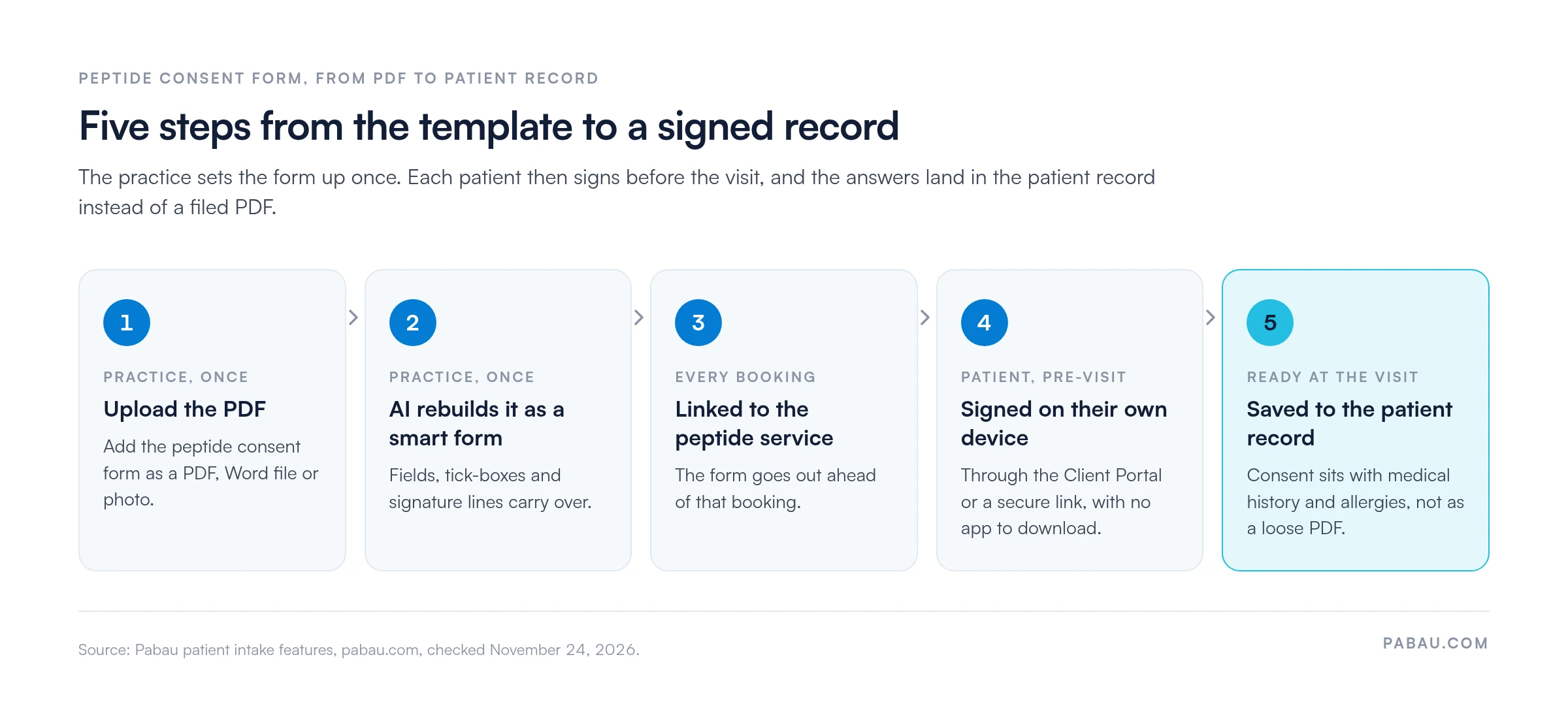
Practitioners on the move can work from Pabau GO, our iOS app for practitioners, which supports care-pathway forms and consents. Each time you re-date a Peptide Status Line, upload the new version so the next booking sends it.
A paper or PDF consent form can’t send itself before the right booking, or connect consent to the vial and the prescription.
Each limit below maps to what Pabau does instead:
If you’re choosing a system to run a peptide service, our comparison of software for peptide practices sets the options side by side. Where peptides sit inside a wider longevity menu, Pabau’s software for longevity practices keeps those services on the same patient record.
Want to see a peptide consent form go out, come back signed and land beside the lot number? Book a demo to see that flow run on a peptide booking.

Pabau sends your peptide consent form before each peptide booking and saves the signed answers to the patient record. Each vial’s batch number is recorded against the same patient.

A peptide consent form is only as defensible as its last status check. BPC-157 and TB-500 moved twice in 2026, with an advisory vote in July and a draft HHS policy in October. GHK-Cu goes back to its advisory committee by February 2027.
So recheck each Peptide Status Line at fda.gov before every form version, and write in the new date. Patients who signed the old version then re-consent on the new one. Book a demo to see how Pabau sends the current version of your peptide consent form before every booking.

Still setting up the service? How to open a peptide clinic lays out seven steps for licensed practices.
Who signs the provider line? Who can prescribe peptides sets out prescribing scope by role.
Offering injections beyond peptides? The vitamin D3 injection consent form is a ready-made consent for that service.
Building a wider longevity menu? How to start a longevity clinic covers clinical oversight, lab partners and the forms to have ready before day one.
Comparing platforms for the practice? Best longevity clinic software scores eight platforms on labs, memberships and booking.
This page has one to download free. The peptide therapy consent template is a four-page, letter-size PDF with dated FDA status lines, blank peptide blocks and signature lines.
Yes, as long as each peptide has its own block with a dated status line and both sets of initials. A peptide added later gets a new block before its first injection.
Yes. Review it with your medical director and legal counsel before first use, and again whenever a Peptide Status Line is re-dated.
No. In an August 24, 2026 warning letter, the FDA said products labeled “research use only” were still drugs intended for human use. It called them unapproved new drugs, and this form commits the practice to not supplying them.