Maja Popovska

Values exploration worksheet
Download your free values exploration worksheet A two-page printable form that o...

1
Last Updated: Nov 6, 2026
Free PDF 2 pages, print-ready Clinician-reviewed
This free low carb diet plan menu PDF is a two-page form for planning a patient's reduced-carbohydrate diet. The practitioner fills in the patient's purpose, medical history, baseline diet and a sample meal plan. Further sections cover lifestyle considerations, recommendations and dated progress tracking. Low-carb plans usually keep net carbs below 130g a day, with ketogenic versions at 20-50g. Patients on insulin, sulfonylureas or SGLT-2 inhibitors need a prescriber review before carbs drop. Many patients struggle to stick with a low-carb approach, so a written plan reviewed at each visit keeps the advice consistent.
A two-page low carb diabetic diet plan form with sections for medical history, baseline diet, a sample meal plan, lifestyle considerations, recommendations and progress tracking. The practitioner completes each section for the individual patient.
Start from scratch, or upload this PDF or any form you already use, and Pabau's AI Form rebuilds it with tick boxes, text fields and a signature. Attach it to the treatment once, and every patient gets it on time.
AI Form rebuilds the consent, history and aftercare forms you already use. You review each one, then publish.
Patients complete forms on their phone before they arrive, so the front desk stops retyping paper.
Every signed form is versioned and attached to the treatment record, ready when you need it.
Set how long a consent stays valid. Returning patients skip forms they have already signed.
Supports HIPAA and GDPR compliance AES-256 encryption 4.8 on G2 4.7 on Capterra Trusted by 4,000+ practices worldwide

A low carb diet plan usually keeps net carbs below 130g a day, and ketogenic versions restrict intake to 20-50g.
The PDF is a fillable two-page form, with a sample meal plan section the practitioner completes for each patient.
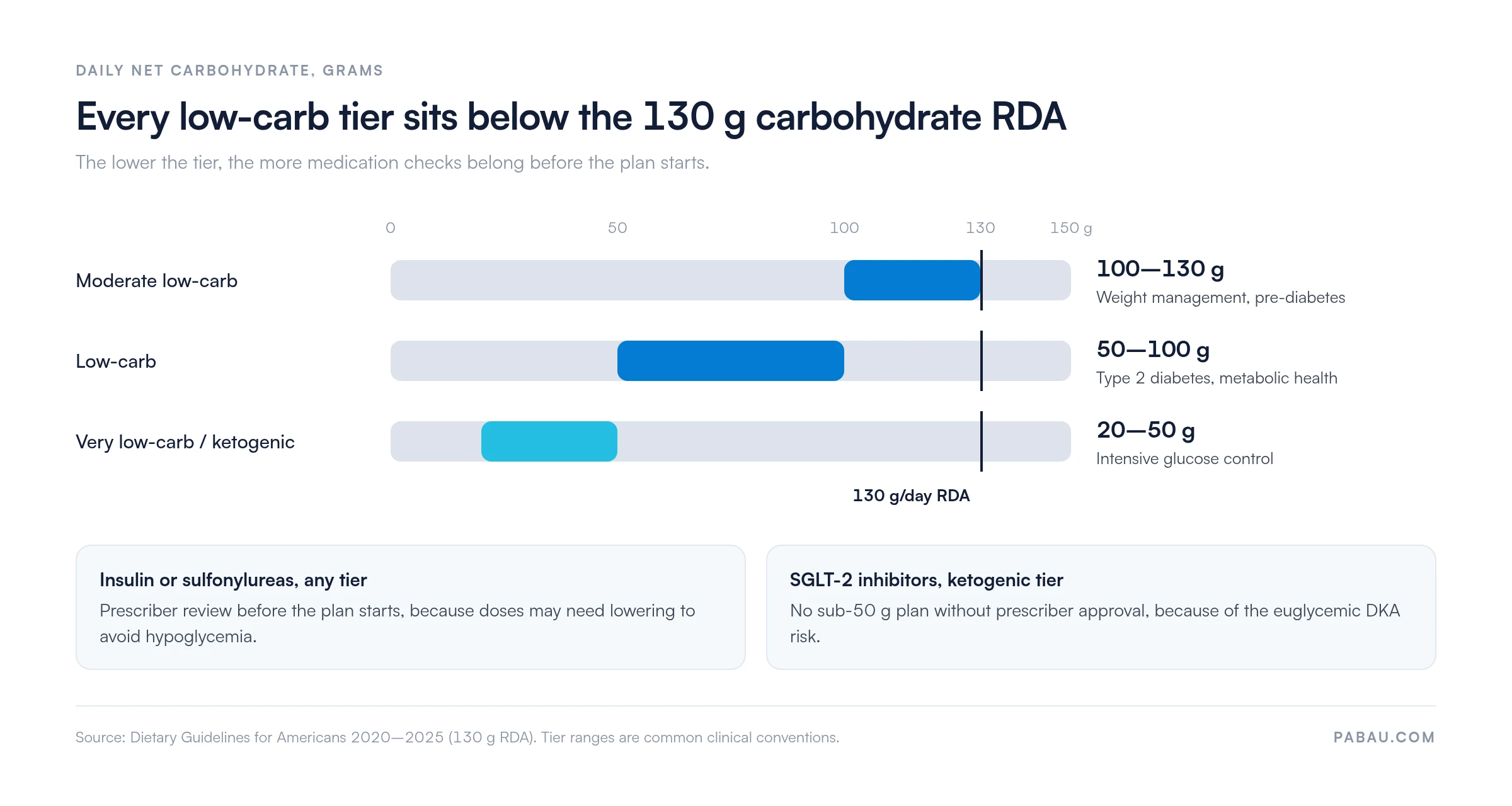
Patients on insulin or sulfonylureas must see a prescriber before starting a low-carb plan because of the hypoglycemia risk.
In Pabau’s practice software, weight loss practices can send the plan as a digital form and file the completed copy in the patient record.
A low carb diet plan limits daily carbohydrate intake to reduce blood glucose spikes, support weight loss and improve metabolic markers. The Dietary Guidelines for Americans cite a 130g/day RDA for carbohydrate, based on the brain’s glucose use. Clinicians commonly treat intake below 130g a day as low-carb.
Practitioners usually work with patients across three carb tiers.
Diabetes UK describes a low-carb diet as an option for people with type 2 diabetes, followed with professional support. It warns that patients on insulin or certain type 2 medications can have hypos without dose changes and regular blood testing.
The form is built for a practitioner-led consultation. These five steps take a patient from screening to the first review.
The form suits any practice where dietary change is part of the treatment plan. Weight loss practices can use it as a structured starting point for new patients, before or alongside medication-based programs.
A completed diet plan form saves consultation time. It also leaves a documented plan in the patient’s file that you can audit later.
Track patient measurements alongside the diet plan to show progress objectively. Pabau’s measurements tracking lets clinicians log weight, waist circumference and blood glucose at each review. The result is a longitudinal record that motivates patients and supports clinical decisions.
Carbohydrate restriction lowers blood glucose directly and quickly. For most patients that is the goal. For patients on certain medications, the speed of the drop is a safety issue to settle before the plan begins.
The American Diabetes Association Standards of Care 2024 support low-carbohydrate eating patterns for improving glycemic control in adults with type 2 diabetes. The ADA uses the term “remission” rather than “reversal” or “cure” for sustained normoglycemia after dietary change. Practitioners sharing this template should use the same language.
Check three clinical considerations before issuing the plan.
Those checks tighten as the carb target drops, and the chart below maps each tier against the 130g RDA.
Practices running metabolic health programs can use Pabau’s measurements tracking to log fasting glucose and HbA1c at each review. Those readings give objective data to guide medication changes alongside dietary progress.
A printed diet plan usually leaves with the patient, while review notes get written somewhere else. By the second follow-up, the paper copy and the clinical record rarely match.
In Pabau, the practice sends the plan as a digital form before or after the consultation. The completed copy is filed in the patient record. Weight, waist circumference and glucose readings go into measurements tracking at each review.
The result is one record per patient that shows the plan, the readings and every medication change. Follow-up appointments get booked with automated reminders, so reviews happen on schedule.

Pabau lets weight loss and metabolic health practices send diet plan forms, track patient measurements and automate follow-up appointments in one platform.

A low-carb plan is only as safe as the screening done before it starts. Check every patient’s medications first, and bring in the prescriber whenever insulin, sulfonylureas or SGLT-2 inhibitors are involved.
The form gives that screening, the sample meal plan and each review a fixed place. Completing it the same way each time lets you compare progress across patients and stand behind the advice you gave.
Book a demo to see how Pabau keeps diet plans, measurements and follow-ups in one patient record.

Need software built for weight loss practices? Weight loss clinic software from Pabau covers patient records, treatment plans and automated follow-ups in one platform.
Planning meals for patients with diabetes? 28-day diabetes meal plan gives four weeks of meals to hand patients once their carb target is set.
Need target ranges to read glucose logs against? Glucose reading chart sets out fasting and after-meal ranges for reviewing patient readings.
A low carb diet plan is a structured eating program that keeps daily carbohydrate intake below 130g. It aims to reduce blood glucose spikes, support weight loss and improve markers such as triglycerides and HDL cholesterol. Moderate low-carb sits at 100-130g a day, standard low-carb at 50-100g and ketogenic diets at 20-50g net carbs.
Most clinical low-carb protocols target 50-100g of net carbohydrates per day for general metabolic health and diabetes management. Ketogenic protocols restrict carbs further, to 20-50g net carbs. The Dietary Guidelines for Americans cite a 130g/day RDA for carbohydrate, and clinicians commonly treat intake below it as low-carb.
A low carb diet reduces carbohydrates to 50-130g per day, while a ketogenic diet restricts intake to 20-50g net carbs to induce nutritional ketosis. Keto is the strictest form of low-carb eating. Medical ketogenic therapy for epilepsy is a separate supervised protocol, distinct from dietary ketosis.
A low carb diet for a woman follows the same general thresholds as for men, with intake below 130g of carbohydrates per day. Some sources suggest women may benefit from a slightly higher carb floor for hormonal reasons. High-quality randomized trial evidence on sex-specific thresholds is limited, so individual targets are best set with a registered dietitian or clinician.
Low-carb snacks include hard-boiled eggs (under 1g carbs), cheese slices (0-1g), celery with almond butter (3-4g) and a small handful of mixed nuts (4-6g). Cucumber slices with hummus (5-6g) and plain Greek yogurt (5-8g per 100g serving) also work. Patients should check labels for total and net carbs, because sugar alcohols in packaged “low-carb” snacks affect blood glucose differently from person to person.