High protein grocery list: Free PDF with protein per serving
A high protein grocery list is a shopping guide that groups protein-rich foods b...

1
Last Updated: Oct 8, 2026
A free 28 day diabetes meal plan pdf is a four-week eating guide that holds blood sugar steady. It does that through portion control, carbohydrate counting, and a fixed rotation of diabetes-friendly foods. The file below covers 28 consecutive days in three calorie versions, with a carbohydrate target on every meal.
Meal planning is one of the most effective non-drug tools for stabilizing blood glucose, according to the CDC’s Division of Diabetes Translation. A fixed 28-day structure takes the daily decision away from the patient and replaces it with a plan to follow.
This guide walks through the plan’s structure, how to personalize it during a consultation, and what to review at each follow-up. It suits newly diagnosed type 2 diabetes, prediabetes management, and the opening document for dietitian-led nutrition therapy.
Twenty-eight consecutive days of breakfasts, lunches, dinners, and snacks, each carrying a carbohydrate target and a portion size.
Download template
The plan sets a carbohydrate target for every meal, not one daily allowance.
Three calorie versions of 1,200, 1,500, and 1,800 let you match the plan to weight, activity, and how the first two weeks go.
The plate method covers meals eaten away from home, where counting grams is not practical.
Each measure moves on its own schedule, so check fasting glucose at week 4 and HbA1c at week 8 or later.
Practice management software like Pabau keeps the plan on the client record and sends the weekly check-in reminders for you.
The plan runs 28 consecutive days on a rotation, so patients eat varied meals without deciding what to cook. Carbohydrate targets sit on each meal rather than on the day. On the 1,500-calorie version that means 38 to 45 grams at breakfast, and 45 to 50 grams at lunch and again at dinner. Optional snacks sit on top of those figures.
Those three meals total 128 to 145 grams a day. The American Diabetes Association figure of 45 to 60 grams is a per-meal target, not a daily allowance. Patients who read it as a daily cap end up under-eating carbohydrate from day one.
Start by picking the calorie version from weight, activity level, and weight-loss goal. The 1,500-calorie version suits most adults managing their weight. Move to 1,800 for people who train regularly or who stall at 1,500.
Print the plan or send it through the patient portal. Then mark the meals the patient likes and cross out the ones they will not eat. That takes five to ten minutes in the consultation. Patients who help choose their own meals are far more likely to still be following the plan in week two.
Keep a copy on the client record and open it at each follow-up. A written plan answers “what should I eat?” before the appointment starts, which shortens the visit and leaves room for the questions that matter.
A diabetes-friendly diet leans on non-starchy vegetables, lean protein at every meal, and low-glycemic carbohydrates portioned to the meal’s target. The plate method makes that visual. Fill half the plate with vegetables, one quarter with protein, and one quarter with a starch.
Capture food preferences, allergies, and restrictions on the intake form before the first consultation. A patient who eats no meat or no dairy needs a different starting document. A vegan diabetes meal plan covers that case without rebuilding the whole four weeks.
Some patients want the shopping rules without the day-by-day structure. A standing list of type 2 diabetes foods gives them that, and it doubles as a fridge reference once the four weeks are over.
Some foods raise blood sugar fast enough to undo a careful day. Explaining why helps patients make their own call when the plan does not cover the situation in front of them.
Teach substitution rather than elimination. A patient who wants chocolate can have a one-ounce square of 70% cacao with a few almonds instead of a full bar. Diets built on swaps outlast diets built on bans.
Carbohydrate counting tracks grams per meal, and it is the most direct lever a patient has on blood sugar. Carbohydrates move glucose within 15 to 30 minutes of eating. Total calories never predict that rise with the same accuracy.
The table below shows what each calorie version works out to across the three main meals.
For packaged food, read the “Total Carbohydrate” line on the label. For whole foods with no label, a nutrition app handles the lookup. Ask patients to write the grams down at every meal for one week, because the numbers on paper rarely match the estimate in their head.
Patients who want fewer carbohydrates than these figures allow are better served by a low-carb diabetic diet plan built for that target. Shaving portions off this one leaves the meals unbalanced.
The plate method drops the arithmetic. Patients divide the plate into halves and quarters by sight, which works the same at home, in a restaurant, or at someone else’s table.
Vegetables bring fiber and volume for very few calories, protein keeps people full, and a quarter-plate of starch caps how far blood sugar can rise. No measuring is involved. Teach it at the first visit and refer back to it at every follow-up.
Plans fail on execution more often than on content. A patient who means well but reaches Wednesday with an empty fridge orders takeout. Build the prep habit into the rollout rather than hoping it appears.
Pre-cooked protein and chopped vegetables cut weeknight assembly to under ten minutes. Send a prep reminder on Friday afternoon so the shopping actually happens. Software built for weight loss practices schedules that message once and sends it to every patient on the plan.
The plan carries 1,200, 1,500, and 1,800-calorie versions. The choice follows weight, activity level, and goal. Expect to move some patients up or down within the first two weeks, based on hunger and on blood glucose readings.
Review progress at week 2. Weight loss should average half a pound to two pounds a week, and a fast first week is usually water. Move a constantly hungry patient from 1,200 up to 1,500. Drop a patient who has plateaued for a month back to 1,200 for a short stretch.
Patients judge a meal plan by the number they can see, and that number is usually the scale. Telling them upfront which measure moves when stops a working plan from being written off in week three.
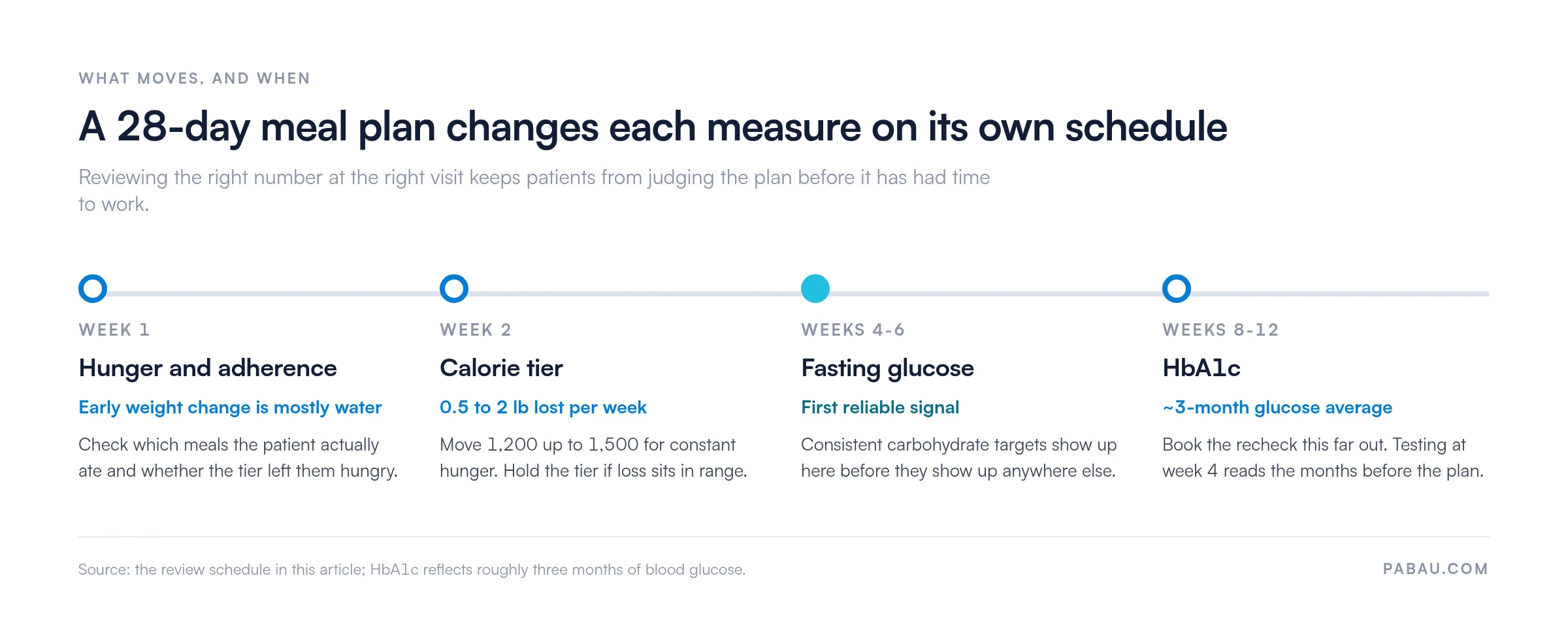
Fasting glucose is the first honest read on carbohydrate control, and four to six weeks is long enough to see it move. HbA1c averages roughly three months of blood glucose, so book that recheck at week 8 at the earliest. A blood glucose log handed out with the plan gives you the between-visit readings to work from.
Most practices hand the PDF over at diagnosis and hear nothing until the next appointment. The plan sits in the patient’s inbox and the calorie change lives in someone’s notebook. At the next visit the dietitian and the physician give different advice.
Pabau keeps the plan and its history on the client record. You attach the file to the patient’s record, log the calorie version you set, and note each adjustment against the date you made it. Whoever opens the record next sees the same plan and the same changes.
Reminders then go out on a schedule you set once. That covers the Friday prep prompt, the week 2 check-in, and the week 8 HbA1c booking, with nobody on the team needing to remember them. Weight, glucose readings, and the patient’s own comments record against the same file, so each follow-up starts from data rather than recall.
Every Pabau subscription includes the client records, digital intake forms, automated reminders, and reporting this workflow runs on. Practices that want structured care plans layered on top can add Care Plus, our additional patient care add-on.

Pabau stores the 28-day plan, the calorie version you set, and every adjustment on the patient’s record. Weekly reminders go out on their own, so check-ins happen without a staff member chasing them.

A 28-day plan earns its keep by removing the daily decision about what to cook. The patients who stay on it are the ones whose copy got marked up in the consultation. Their own likes and dislikes are on the page.
So download the file, personalize it at the first visit, and set the review points before the patient leaves the room. Check hunger at week 1, the calorie version at week 2, fasting glucose at week 4, and HbA1c no earlier than week 8.
The follow-up is where most of these plans are won or lost. Book a demo to see how Pabau keeps the plan, the adjustments, and the check-in reminders on one patient record.

Need the HbA1c target to review against? A1c goals by age chart sets out the thresholds to measure each recheck against.
Writing the diet into a nursing care plan? Diabetes nursing care plan gives you the goals, interventions, and evaluation wording to document alongside it.
Treating a patient with diabetes and heart disease? Cardiac diabetic diet food list narrows the food choices to the ones that suit both conditions.
Still at the prediabetes stage? Insulin resistance diet plan targets the earlier point, before a type 2 diagnosis is on the record.
Timing meals around medication? Diabetes medication list sets out the classes so you can line meals up with dosing.
Breakfast: two scrambled eggs, one slice of whole-grain toast, and half a cup of berries (30g carbohydrate). Lunch: 4 oz grilled chicken, a cup of broccoli, and a third of a cup of brown rice (40g). Dinner: 4 oz baked salmon, spinach salad, and a small sweet potato (35g). That day totals around 105g, which sits inside the 1,200-calorie version. The plan gives 28 days of options in the same range.
Yes. Consistent carbohydrate targets, protein at every meal, and a high fiber intake slow glucose absorption and flatten the spikes. Fasting glucose often improves within four to six weeks on a plan the patient actually follows. HbA1c takes longer, because it reflects roughly three months of blood glucose, so allow eight to twelve weeks before rechecking it.
No. This plan targets type 2 diabetes and prediabetes. Pregnant patients with gestational diabetes need a plan built with their obstetric and dietetic team, because carbohydrate and calorie needs shift during pregnancy. Check with an obstetrician before using this resource.
Read the “Total Carbohydrate” line on packaged food labels. For whole foods, use a nutrition app or the Academy of Nutrition and Dietetics database. Then hit the per-meal targets rather than one daily figure. Breakfast runs 30 to 50g, and lunch and dinner run 35 to 60g each, depending on the calorie version. That works out to 100 to 170g a day across the three versions.
Yes. The plan is built for type 2 diabetes and prediabetes alike. Structured meal planning, portion control, and carbohydrate awareness all have evidence behind them for delaying or preventing progression to type 2. Start on the 1,500-calorie version and adjust it with your healthcare provider.
Both improve blood glucose control. Low-carb generally means under 130g a day, while moderate-carb sits between 130 and 180g. This plan lands at 100 to 170g depending on the calorie version. It leans on low-glycemic sources such as brown rice, lentils, and sweet potato. Most patients stay on that approach longer than on strict carbohydrate avoidance.