HIPAA compliant texting: What you can send patients & how to communicate securely
HIPAA compliant texting is possible when a text holds no protected health inform...

Last Updated: Oct 16, 2026

The DS-3053 is the State Department form a legal parent or guardian uses to consent to a child’s passport without attending in person.
The non-appearing parent completes sections 1 to 3, then swears section 4 in front of a passport authorizing officer or notary.
There is no section 5, because the notarization block sits inside section 4 alongside the affiant’s signature and identification details.
Signed consent lasts 90 days, so file Form DS-11 inside that window or swear a fresh one.
Practice management software like Pabau sends, captures and stores signed consents against the client record, so your team sees what is outstanding.
A section-by-section worksheet for the current DS-3053, edition 10-2024. Draft the child’s details, the applying adult and relationship, the consent statement and contact blocks, and the identification details for the oath. Then copy them onto the official government form. Includes a pre-appointment checklist and a table of the situations where consent works differently.
Download templateThe DS-3053 statement of consent form lets a child get a US passport when one legal parent cannot attend the appointment. Both parents normally have to show up in person for a child under 16. This form carries the absent parent’s written consent instead.
One detail decides most of these applications. Consent expires 90 days after the officer or notary signs it. Sign too early, or sign before you reach the notary, and the form goes back in the printer.
Below is the current edition, section by section, plus the situations that call for different paperwork.
The DS-3053 is the US Department of State form that carries a parent’s consent to a child’s passport. You use it when that parent cannot attend the appointment.
The current edition is titled “Statement of Consent: U.S. Passport Issuance to a Child”, and the footer reads DS-3053 10-2024.
Why does written consent matter at all? Both legal parents or guardians normally have to appear in person with a child under 16. That two-parent rule comes from section 236 of Public Law 106-113. When one of them cannot be there, this form stands in for them.
The form calls the person who signs it the affiant, and that word runs through the instructions. It simply means the parent or guardian swearing the statement rather than standing at the counter.
A separate notarized statement carrying all the same details works too. Most families still prefer the printed form, because it prompts for every detail the acceptance facility expects.
You need a DS-3053 whenever a legal parent or guardian will not be at the counter.
Five situations cover almost every case:
Take a common case. Two parents share custody, the father works offshore, and the mother books the appointment for their nine-year-old.
He completes sections 1 to 3, swears section 4 in front of a notary on the Tuesday, and couriers the original home. She files it with the DS-11 that Friday, well inside the 90 days.
Consent may not be needed at all when one parent holds sole authority and can evidence it. That evidence comes up further down, under absent and deceased parents.
The signature has to come from the legal parent or guardian who is not attending. Nobody else will do, and a form signed by the wrong person gets refused at the counter.
Naming a third party in section 2 is a different matter. That adult files the application, while consent still comes from the legal parents or guardians.
If they are also looking after the child while you travel, a separate babysitter consent form covers medical treatment.
Section 4 has to be sworn in front of a passport authorizing officer or a notary public. No seal, no consent. Work through the appointment in this order:
Notarizing abroad works differently. Some countries will not accept a local notary for this form, so the affiant visits a US embassy or consulate instead.
The current edition runs to four sections on one signing page. The non-appearing parent drafts the first three at home, and the fourth waits for the appointment.
That split is worth getting straight before you print, so here it is at a glance.
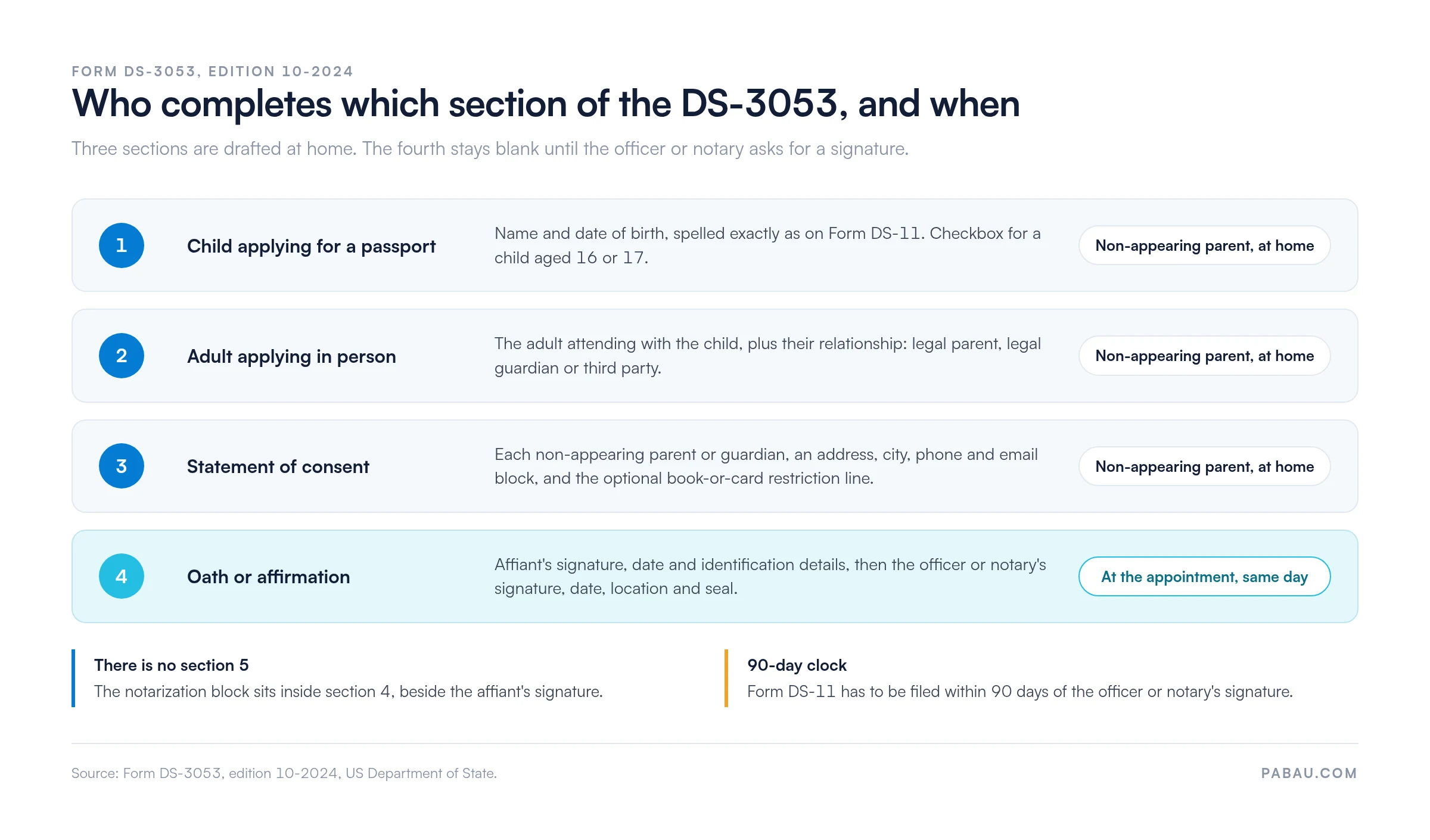
The form does not ask for the child’s passport number, their country of residence, or the affiant’s date of birth. Looking for those boxes means you are reading an old version, or another form entirely.
The official PDF is free from the State Department, and it is the only version an acceptance facility takes. Our worksheet above is a planning aid, so draft your answers there and copy them across.
Print it and leave it as it comes. Do not retype the form, redraw the boxes, or drop a section you think does not apply. Use black ink only. That instruction sits at the top of the signing page, next to the warning about correcting a mistake on the page.
Difficult family situations need different paperwork, not a stalled application. In several of them the DS-3053 is not the document the facility wants at all.
Contested custody and international abduction concerns are worth an attorney’s time before you apply. States differ on what a facility accepts as evidence of sole authority, so check locally rather than assume.
Most rejections come down to the same handful of avoidable errors. Walk this list on the morning of the appointment:
The 90-day clock deserves its own line here. It starts when the officer or notary signs, not when the appointment is booked. A consent sworn in January will not survive a May filing.
Several documents authorize something on a child’s behalf, and mixing them up delays passports, trips and treatment.
A medical consent form covers treatment while a parent is away, for instance, and it carries no weight at a passport counter.
The line worth remembering is a narrow one. The DS-3053 exists for passport issuance and no other purpose. A travel consent letter will not stand in for it, and neither will one of the medical forms your doctor’s office keeps on file.
A passport consent is a family matter, but the version-control problem behind it will look familiar to any practice. Forms go out as email attachments or printouts and come back signed on paper. They then sit in a drawer or an inbox until somebody needs them.
Practice management software like Pabau closes that loop. You build the consent or intake form once, send it to the right person before their appointment, and collect the signature digitally. Everyone works from the current version, because there is only one.
Each signed document then files itself against the client record with a timestamp. Your team can see at a glance who has signed and who has not. Chasing an outstanding form becomes an automated reminder rather than a phone call, and an audit stops being a filing-cabinet exercise.
Running paperless patient intake this way also keeps the right form attached to the right context, which is where most compliance errors start.

Pabau’s digital forms send the current version of a consent to the right person, capture the signature, and file it against their record automatically. Your team can see what has been signed without opening a filing cabinet.

The DS-3053 rewards preparation and punishes improvisation. Draft your answers first, then take photo identification and a photocopy of it to the appointment. Leave section 4 untouched until the officer or notary asks for your signature.
The timing is what usually costs families a second appointment. Swearing the consent early feels organized, but it can expire before the appointment comes around. Work backward from the DS-11 filing date, not from whenever the absent parent happens to be free.
If your practice handles consent forms of its own, the same discipline applies at a larger scale. Book a demo to see how Pabau sends, signs and stores every consent against the right client record.

Need consent for treatment rather than travel? Medical consent form for minors covers who may authorize care, the treatments allowed, and how long the authority lasts.
Treating a child whose parent is not in the room? Consent to treat a minor form records the guardian’s authority and the emergency contacts a practice needs on file.
Sending a child’s records to another provider? Medical release form for a minor sets out what may be shared, with whom, and for how long.
Releasing confidential information on request? Authorization for release of confidential information covers the purpose of disclosure, the recipient, and the expiration date.
Need a signature that satisfies HIPAA? HIPAA authorization form template shows the elements a valid authorization has to contain.
No. Only a legal parent or a court-appointed guardian may sign. A stepparent qualifies once they adopt the child or a court grants them guardianship, and the paperwork has to prove it.
Refusal cannot be worked around with paperwork. You need a court order granting you sole authority, or one that specifically allows the passport application. Bring the certified order to the appointment.
Yes. Section 1 names one child, so each child applying needs a form of their own. A single notary appointment can cover all of them.
A current government-issued photo ID, such as a driver’s license, state ID or passport. Exact rules vary by state. The officer records the type, number, place of issue and dates.
No. Children under 16 always reapply in person on Form DS-11. So a DS-3053 is needed again whenever one parent cannot attend that appointment.
The form itself is free. Notary fees are set by state law and vary widely. Many banks notarize free for account holders, and military legal offices do it free for servicemembers.