OSHA respirator medical evaluation questionnaire
The OSHA respirator medical evaluation questionnaire is the mandatory health for...

3
Last Updated: Oct 15, 2026

Dry socket, or alveolar osteitis, is a post-extraction complication where the blood clot is lost and bone is exposed.
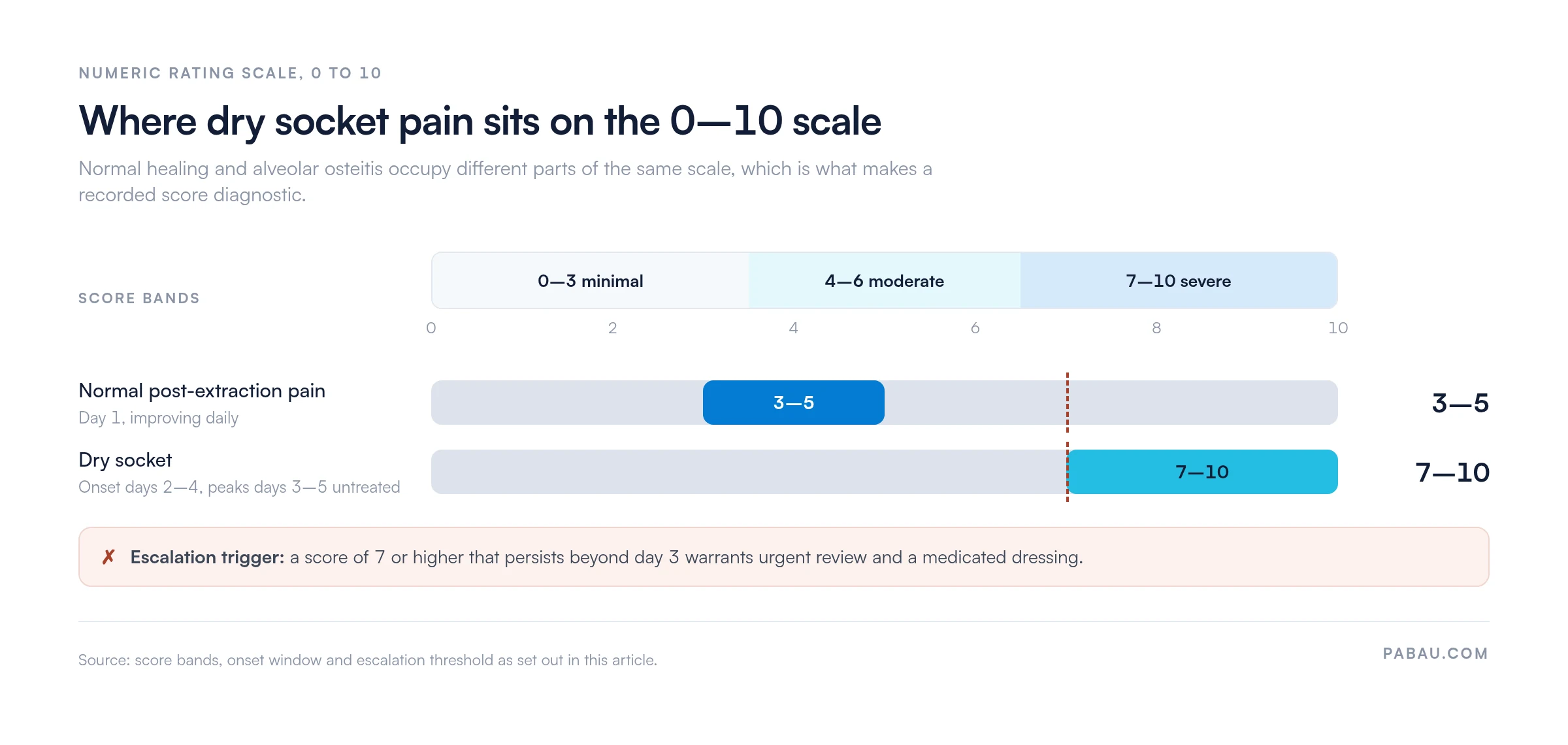
Pain ratings typically reach 7 to 10 on a 0-10 numeric scale, starting two to four days after extraction.
A recorded score separates dry socket from normal post-op discomfort, so your team escalates on evidence rather than instinct.
Practice management software like Pabau captures pain scores, schedules timely reviews, and coordinates patient messages during recovery.
A ready-to-use assessment sheet for dental teams. It carries the 0-10 rating scale, a symptom checklist, an onset-timing field, and the score thresholds that trigger treatment.
Download templateDry socket is one of the most painful complications a patient can walk back in with after a tooth extraction.
Telling it apart from ordinary healing pain is the hard part, and guessing costs the patient days of relief.
A recorded number solves that. This guide sets out the dry socket pain scale dentists use and the scores that should trigger treatment. It also shows how the downloadable template turns those scores into a follow-up routine your whole team can run.
Dry socket, clinically termed alveolar osteitis, occurs when the blood clot at an extraction site dislodges or dissolves in the first few days. That leaves bone and nerve endings exposed to the mouth, which is why the pain is so severe.
Dentists quantify that pain with a numeric rating scale, or NRS, running from 0 for no pain to 10 for the worst pain imaginable. Dry socket sits consistently at 7 to 10. Normal post-extraction discomfort sits at 3 to 5 on day one and eases by day three.
Those two ranges barely overlap, which is what makes a written score worth collecting.
Dry socket usually emerges two to four days after extraction. Pain escalates fast from there, so the day you catch it decides how long the patient suffers.
Early warning signs that map to the pain scale:
Ask for a number on every post-extraction check-in call, not a yes-or-no about pain. A score is comparable between calls and between staff. A description is not.
A systematic checklist speeds up diagnosis and keeps documentation consistent across your practice team.
Risk factors decide who needs closer monitoring after extraction, and they shape what you tell the patient before they leave the chair.
Third molars deserve their own protocol. Our wisdom teeth removal template covers the pre-op counseling and aftercare instructions that pair with this pain scale.
Treatment follows the score. Most cases settle with an in-office medicated dressing plus pain relief the patient manages at home.
The downloadable template carries a treatment decision tree tied to NRS thresholds, so clinical staff can triage and start first-line management without waiting.
Patients cope better when they know what to expect, and clear instructions improve how closely they follow aftercare.
Advice given at the chair does more for dry socket rates than any treatment given later. Put these points in writing and hand them over with the aftercare sheet.
Written instructions beat verbal ones every time. If your practice has not standardized them yet, our post-extraction aftercare guidelines give you a base to adapt.
Give patients a number to act on, not a feeling. Clear thresholds also tell your front desk when a call becomes a same-day appointment.
Record the score, the date, and who took the call. That log is what protects the practice if the patient later questions how quickly you responded.
Most cases resolve within 7 to 14 days once treatment starts. Telling patients that up front cuts the anxiety that drives repeat calls.
Say all of this while the patient is still in the chair. The template’s prognosis section gives you the wording, so every clinician gives the same answer.
Flag your highest-risk patients at the pre-op consultation. Smokers, wisdom tooth cases, and difficult extractions all qualify. Record the risk level in the patient’s chart so the day 2 to 3 follow-up call gets scheduled automatically rather than remembered.
The template bridges assessment and documentation. Adapt the fields to your own protocols first. Then attach it to your digital patient intake forms so scores get captured during the call, not typed up later.
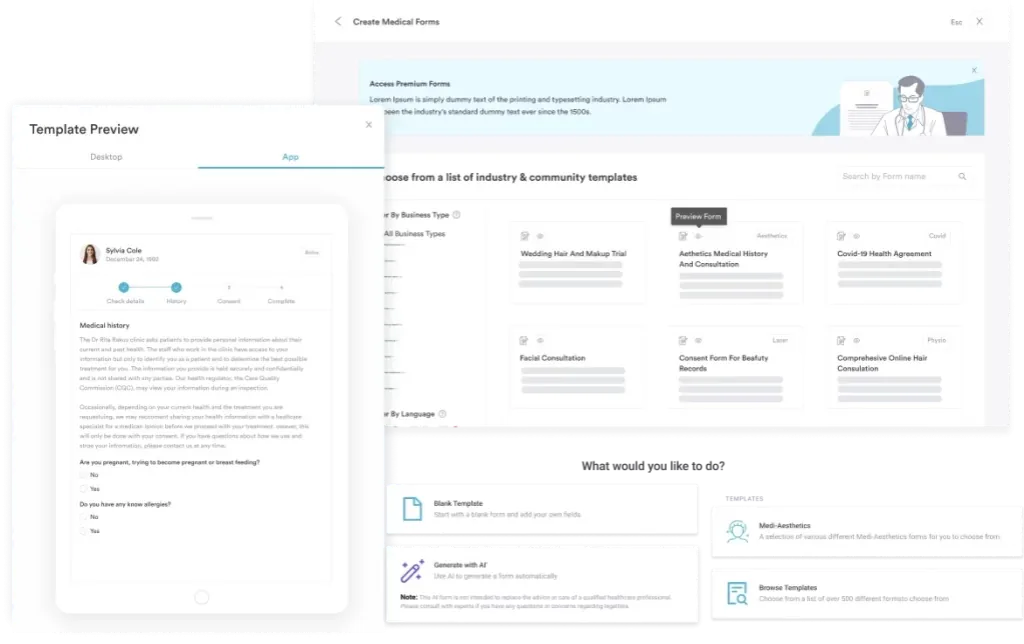
Use the structured fields to:
Kept in one system, those entries build a record you can defend at clinical review. Scattered across paper notes and a spreadsheet, they usually cannot be reconstructed.
Post-extraction complications are a common source of complaints and claims. Careful documentation protects the practice and shows you met the standard of care.
Consent is usually the thinnest part of an extraction record. A dental treatment consent form that names dry socket by risk factor fixes that before the procedure.
In most practices the day 2 call is a receptionist working from a printed list. The score gets written on paper, or not written at all, and the escalation depends on who took the call.
Practice management software like Pabau runs it differently. Every extraction fires an automated follow-up workflow that texts the patient on day 2 with the 0-10 scale attached.
The reply lands in the patient record, not an inbox. A score of 7 or more flags the chart and offers the next available slot, so the patient is booked before the pain peaks.
Your team gets a defensible audit trail as a by-product. Every score, every reminder, and every response is timestamped against the patient who gave it.

Pabau captures patient-reported pain scores through digital forms and triggers day 2 and day 7 check-ins automatically. Scores above your threshold flag the chart and open a same-day slot.

A pain scale earns its place through comparison. A score recorded on day 2 and compared on day 3 makes the escalation obvious to whoever reads the chart next.
Download the template, set your own thresholds, and decide who owns the day 2 call. That decision matters more than the form itself, because an unused scale changes no outcome.
Get the follow-up running on its own and dry socket stops depending on who remembers to call. Book a demo to see how Pabau schedules and scores post-extraction check-ins for dental practices.

Handling third molar cases? Wisdom teeth removal template covers the consent and aftercare steps for the extractions with the highest dry socket rate.
Standardizing your aftercare handout? Aftercare guidelines template gives you a base set of post-procedure instructions to adapt.
Need consent that names the risk? Dental treatment consent form documents what the patient was told before the extraction.
Recording the examination itself? Dental examination form structures the findings you take at every appointment.
Charting which tooth was treated? Tooth charts give you a consistent way to mark the extraction site in the record.
Dry socket pain typically rates 7-10 on a numeric pain scale, with most patients reporting 8-9. Normal post-extraction discomfort sits at 3-5 on day one and declines from there. Patients usually describe dry socket as throbbing and constant, radiating to the jaw, ear, or temple.
Normal post-extraction pain is localized, improves daily, and responds to over-the-counter pain relief. Dry socket pain is severe, persists or worsens after day 3, and radiates beyond the socket. Standard painkillers barely touch it until a medicated dressing is placed.
Call the practice immediately if pain of 7 or higher persists beyond day 3 after extraction. The same applies to visible bone in the socket, a foul odor, or a sudden jump in pain after a day of improvement.
With prompt medicated dressing treatment, dry socket pain typically improves within 24-48 hours and resolves within 7-14 days. Without treatment, pain can persist for weeks and increase infection risk.
Yes, some patients rate dry socket pain at 10/10, describing it as among the most severe pain they have ever experienced. That is why rapid diagnosis matters. Untreated dry socket wears the patient down and drives repeat calls to the practice.
Dentists use a numeric rating scale, or NRS, running from 0 for no pain to 10 for the worst imaginable. A score of 7 or more on days 2-4, with visible bone and a foul odor, confirms the diagnosis.