Waist-to-hip ratio chart: Risk bands for women & men (free PDF)
A waist-to-hip ratio chart sorts a patient’s waist-to-hip ratio (WHR) into...

3
Last Updated: Oct 14, 2026

Hashimoto’s thyroiditis is an autoimmune condition that needs lifelong medical management alongside anti-inflammatory nutrition.
A structured diet lowers inflammation, supports thyroid function, and may reduce thyroid antibody levels over time.
Selenium at 200 mcg a day, plus zinc, vitamin D, and omega-3 fatty acids, forms the nutritional foundation.
Diet cannot replace levothyroxine, and high-dose iodine can make Hashimoto’s worse rather than better.
Practice management software like Pabau lets you send this plan digitally, store it in the patient record, and track adherence.
A seven-day meal plan covering breakfast, lunch, dinner, and snacks for Hashimoto’s thyroiditis. It also carries the categorized shopping list, the daily micronutrient targets, and notes on spacing meals around a levothyroxine dose.
Download templateA diet plan for Hashimoto’s gives patients something concrete to act on between appointments.
Levothyroxine corrects the hormone deficiency. Nutrition works on the inflammation and the micronutrient shortfalls underneath it.
This page carries a seven-day meal plan, a categorized shopping list, and the daily nutrient targets that support thyroid function. It also compares the four dietary frameworks patients ask about most. Those are anti-inflammatory eating, the Mediterranean pattern, gluten-free eating, and the autoimmune protocol.
The downloadable template turns all of that into a form you can complete with a patient and file in their record. The sections below cover the mechanisms, the nutrients, the food lists, the plan itself, and how to run it in a practice.
Hashimoto’s disease is an autoimmune thyroid condition in which the immune system attacks the thyroid gland. The result is chronic inflammation and a progressive shortfall in thyroid hormone. Levothyroxine remains the cornerstone of treatment.
Diet sits alongside the medication rather than in place of it. An evidence-based eating pattern can lower systemic inflammation and support thyroid function. It also helps patients manage the symptoms they notice most, including fatigue, weight gain, and brain fog.
Hashimoto’s cannot be cured through diet alone. Clinical research does show that an anti-inflammatory, nutrient-dense diet improves symptom control. It may also lower thyroid peroxidase (TPO) antibody levels, which track ongoing autoimmune activity.
Nutrition reaches autoimmune thyroid disease through three connected pathways. Chronic inflammation accelerates thyroid antibody production and tissue damage. Gut health shapes immune tolerance, and dysbiosis (microbial imbalance) increases intestinal permeability. Bacterial lipopolysaccharides then cross the gut barrier and trigger a systemic immune response.
The third pathway is nutrient status. Shortfalls in selenium, zinc, and vitamin D impair regulatory T-cell function, the immune cells that hold autoimmune responses in check.
A nutrient-dense, anti-inflammatory diet addresses all three. Omega-3 fatty acids and polyphenols dampen inflammatory signaling. Fiber and fermented foods rebuild beneficial gut microbiota. Targeted micronutrient intake restores immune regulation. Patients then report steadier energy, stable weight, and clearer thinking.
Five micronutrients form the foundation of Hashimoto’s nutritional management. Each has clinical evidence behind its role in thyroid function and immune tolerance. The table below sets out daily targets, food sources, and safety notes.
Focus on whole, nutrient-dense foods that lower inflammation and support gut health. The same food groups anchor a general anti-inflammatory meal plan, so a patient already following one needs few changes. The categories below form the core of a Hashimoto’s-friendly diet.
Some foods drive inflammation, and others interfere with thyroid medication absorption. Patients who cut the items below often report faster symptom improvement.
Four evidence-informed frameworks are used in Hashimoto’s management. The right choice depends on symptom severity, patient preference, and tolerance. The table below compares them.
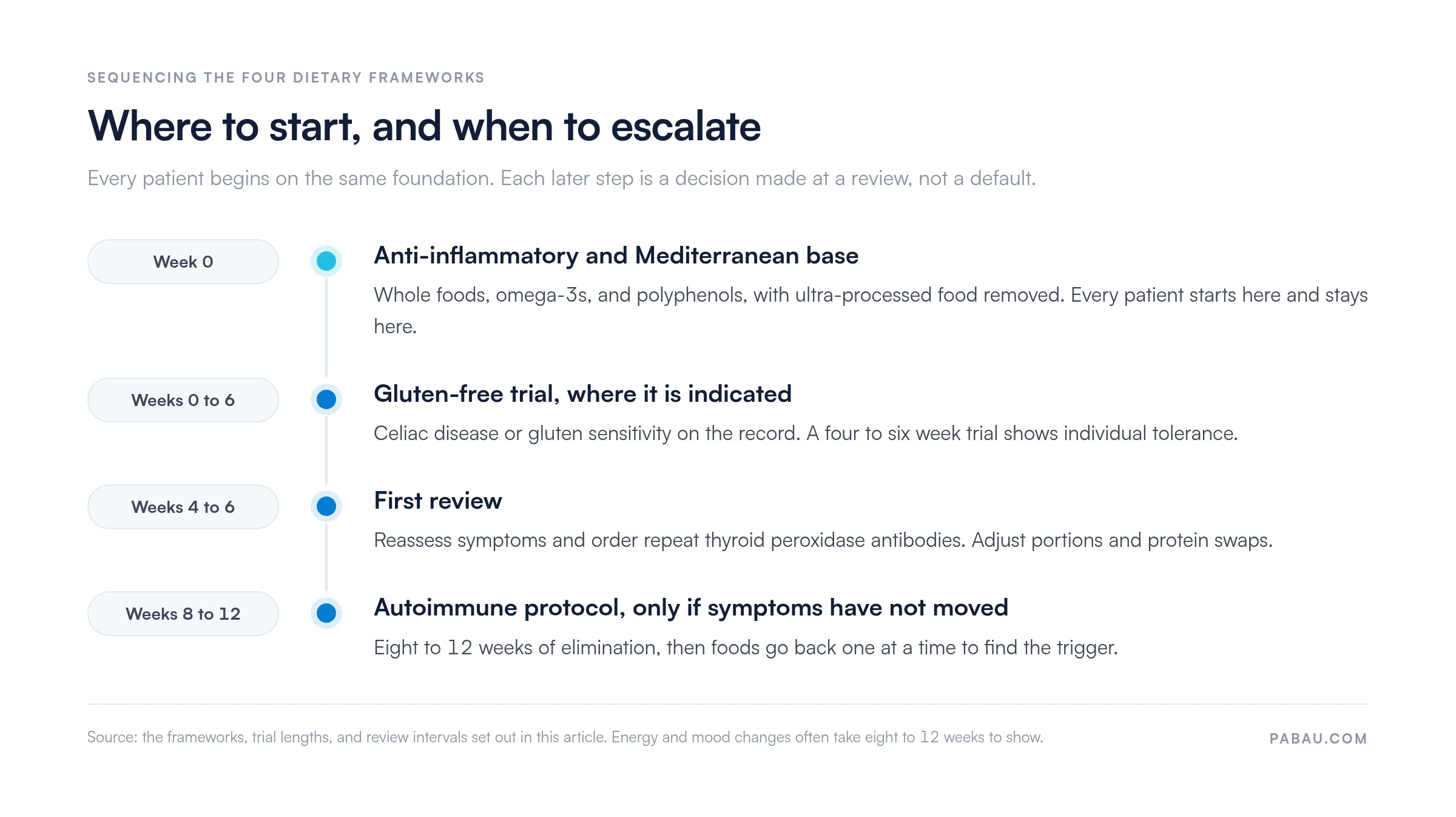
Sequence matters as much as choice. Start every patient on the anti-inflammatory and Mediterranean base, then add an elimination trial only where the history points to one. A structured gluten-free diet plan gives that trial a shape the patient can follow. The autoimmune protocol comes last, and only for patients whose symptoms have not moved.
The plan below follows the anti-inflammatory and Mediterranean frameworks. It prioritizes foods rich in selenium, zinc, vitamin D, and omega-3 fatty acids. Patients can adjust portions and swap proteins while keeping the nutrient density intact.
One detail decides whether the week works. Breakfast has to sit at least 30 to 60 minutes after the levothyroxine dose. The eggs, oats, and yogurt in this plan all carry fiber or calcium. Set the dose time first, then build the morning around it.
This categorized list helps patients build a Hashimoto’s-friendly pantry. Print it and share it at the first visit to cut decision fatigue at the store.
Share the plan during or just after the consultation, while the dietary counseling is still fresh. Record the patient’s food preferences, intolerances, and starting symptoms in the clinical note at the same time. That note becomes the baseline you measure the trial against.
Treat the plan as a starting reference rather than a prescription. Adjust it for individual tolerance, cultural food preferences, and any concurrent condition such as diabetes, renal disease, or cardiovascular disease.
Book a four to six week review, then reassess symptoms and order follow-up TPO antibody levels. Weight, symptom scores, and labs belong in one timeline, which is the job weight loss clinic software does for a metabolic caseload. Energy and mood changes often take eight to 12 weeks to become obvious, so set that expectation at the start.
Symptoms move when the pattern holds for weeks, and prep is what keeps it holding. Give patients a short routine they can repeat every week.
Today the plan usually leaves the room as a printout. It goes home in a bag, and by the second week nobody at the practice knows whether the patient ever opened it. The six-week review then starts from memory instead of a record.
Pabau is practice management software for healthcare and aesthetic practices. You attach this diet plan to a digital form and send it through our online booking and patient portal. The patient opens it on a phone and signs to confirm they have read it. The signed copy files itself against their record, which means the plan you gave is the plan you can look up later.
From there, automated reminders prompt the weekly check-in and the six-week antibody recheck without anyone chasing a list. You get a dated trail of what was recommended, what the patient acknowledged, and how symptoms moved. That lets you adjust the plan on evidence rather than recall.

Pabau’s digital forms and patient portal deliver this Hashimoto’s diet plan, file the signed copy in the patient record, and prompt the follow-up review. You spend less time chasing paperwork and more time on the consultation.

Diet does not put Hashimoto’s into remission, and no meal plan replaces a levothyroxine dose. Its value is narrower and still worth having. Patients get one lever they control between appointments, and the evidence says pulling it lowers inflammation.
The trade-off is effort. An elimination trial costs a patient six weeks of planning and label-reading, and the response varies from person to person. Start with the anti-inflammatory and Mediterranean pattern, which almost any patient can sustain. Hold the autoimmune protocol back for the patients whose symptoms have not moved.
Whichever pattern you choose, document it and set the review date before the patient leaves. Book a demo to see how Pabau sends this diet plan, files the signed copy, and prompts the six-week recheck.

Want the sustainable long-term pattern? Mediterranean diet plan breaks down the framework this meal plan borrows from, with its own patient template.
Managing blood sugar alongside the thyroid? Insulin resistance diet plan covers the metabolic side that often travels with Hashimoto’s.
Need to see what the patient actually ate? My food diary gives them a simple log to bring to the six-week review.
Writing up the counseling session? Nutrition SOAP note structures the note so the baseline is there to measure against.
Gluten can worsen Hashimoto’s in patients with celiac disease or non-celiac gluten sensitivity. Gluten and thyroid peroxidase share structural features, so molecular mimicry can amplify the autoimmune attack. A four to six week gluten-free trial reveals individual tolerance. Many patients report better energy and less brain fog afterwards.
A daily target of 200 mcg from food or supplementation has clinical evidence behind it. The safe upper limit is 400 mcg a day, and excess selenium can worsen thyroid inflammation. Advise patients to reach the target through food first, using Brazil nuts, fatty fish, and eggs.
No. Diet cannot cure Hashimoto’s, but it can lower inflammation, reduce thyroid antibody levels, and improve symptom control. Levothyroxine replacement stays the cornerstone of treatment. Dietary change is a complement to it, never an alternative.
The autoimmune protocol removes grains, legumes, nightshades, nuts, seeds, dairy, and eggs for eight to 12 weeks. Foods then go back one at a time so individual triggers show up. Observational data show benefit in patients who respond, though large randomized trials are lacking. Treat it as a short-term diagnostic tool rather than a permanent pattern.
Dietary iodine from iodized salt is safe. High-dose supplementation is not, and intakes above roughly 500 mcg a day from seaweed or supplements can trigger thyroid antibody production. Advise patients to skip iodine supplements unless an endocrinologist has asked for them.
Levothyroxine absorption drops when the dose sits near high-fiber foods, calcium, iron supplements, or soy. Patients should take it on an empty stomach, 30 to 60 minutes before breakfast, and keep those four items out of that window. Reinforce the timing during dietary counseling.