Tanja Lepcheska
Ethical consent form: free template and what to add
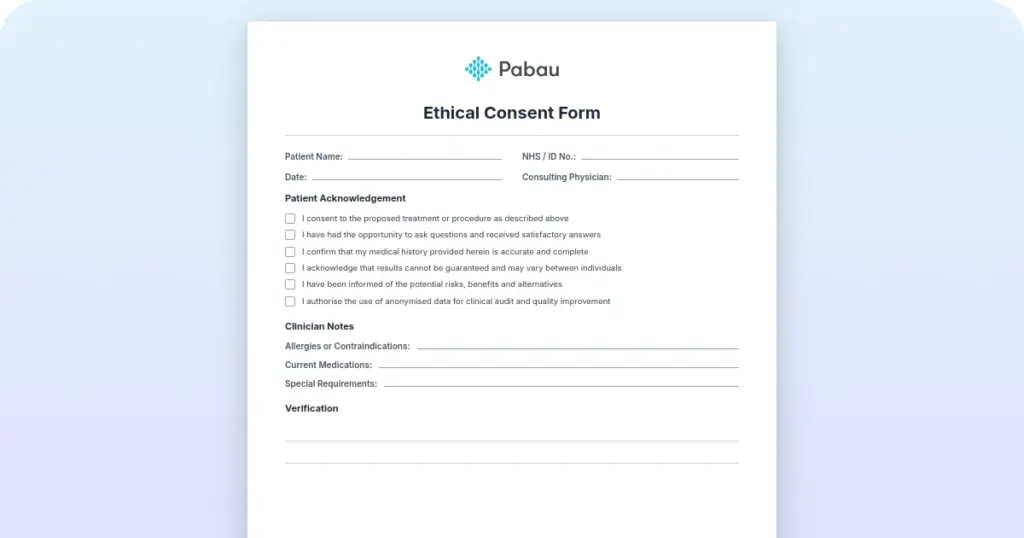
An ethical consent form is a written record that a patient or participant agreed...

2
Last Updated: Oct 26, 2026
Free PDF 1 page, print-ready Clinician-reviewed
A corrective action plan (CAP) is a formal document that names a performance or compliance problem and sets the steps to fix it.
Each step carries an owner and a deadline. Practices open one when informal feedback has not worked and the issue needs a written record.
This guide covers what belongs in the plan, how to write one in six steps, and where it fits in a healthcare practice. The free template above gives you the form to fill in.
A ready-to-use form with fields for the problem statement, root cause, action steps, owners, deadlines, and success metrics. Print it for the meeting or attach it to the staff record.
Upload this PDF, or any form you already use, and Pabau's AI Form rebuilds it with tick boxes, text fields and a signature. Attach it to the treatment once, and every patient gets it on time.
AI Form rebuilds the consent, history and aftercare forms you already use. You review each one, then publish.
Patients complete forms on their phone before they arrive, so the front desk stops retyping paper.
Every signed form is versioned and attached to the treatment record, ready when you need it.
Set how long a consent stays valid. Returning patients skip forms they have already signed.
Supports HIPAA and GDPR compliance AES-256 encryption 4.8 on G2 4.7 on Capterra Trusted by 4,000+ practices worldwide

A corrective action plan is a formal document that names a staff performance or compliance problem and the steps that will fix it.
Every plan needs a problem statement, a root cause, action steps, named owners, deadlines, and success metrics.
Corrective action plans are usually disciplinary and run 30 to 90 days, while performance improvement plans are developmental and run longer.
A signed plan and its meeting records are what an inspector looks for in a staff file after a complaint.
Practice management software like Pabau stores the plan, the training log, and the check-in notes with the staff record.
A corrective action plan is a formal, documented response to a performance problem, a policy violation, or a process failure. Informal feedback leaves no trace. A CAP creates a paper trail and sets explicit expectations for improvement.
Healthcare practices open CAPs for clinical documentation errors, missed HIPAA compliance requirements, staff conduct issues, or inconsistent care protocols. A written plan shows the employee and any outside inspector that the practice treats compliance seriously.
Every workable plan carries the same seven components. Use this checklist to confirm yours is complete and defensible during an audit or a dispute.
The two documents get confused because they look alike on the page. A CAP and a performance improvement plan (PIP) serve different purposes, and they signal different things to the person receiving one.
Follow this six-step process to build a plan that protects the practice and gives the employee a clear route back. The timeline below shows when each stage falls in a 90-day plan.
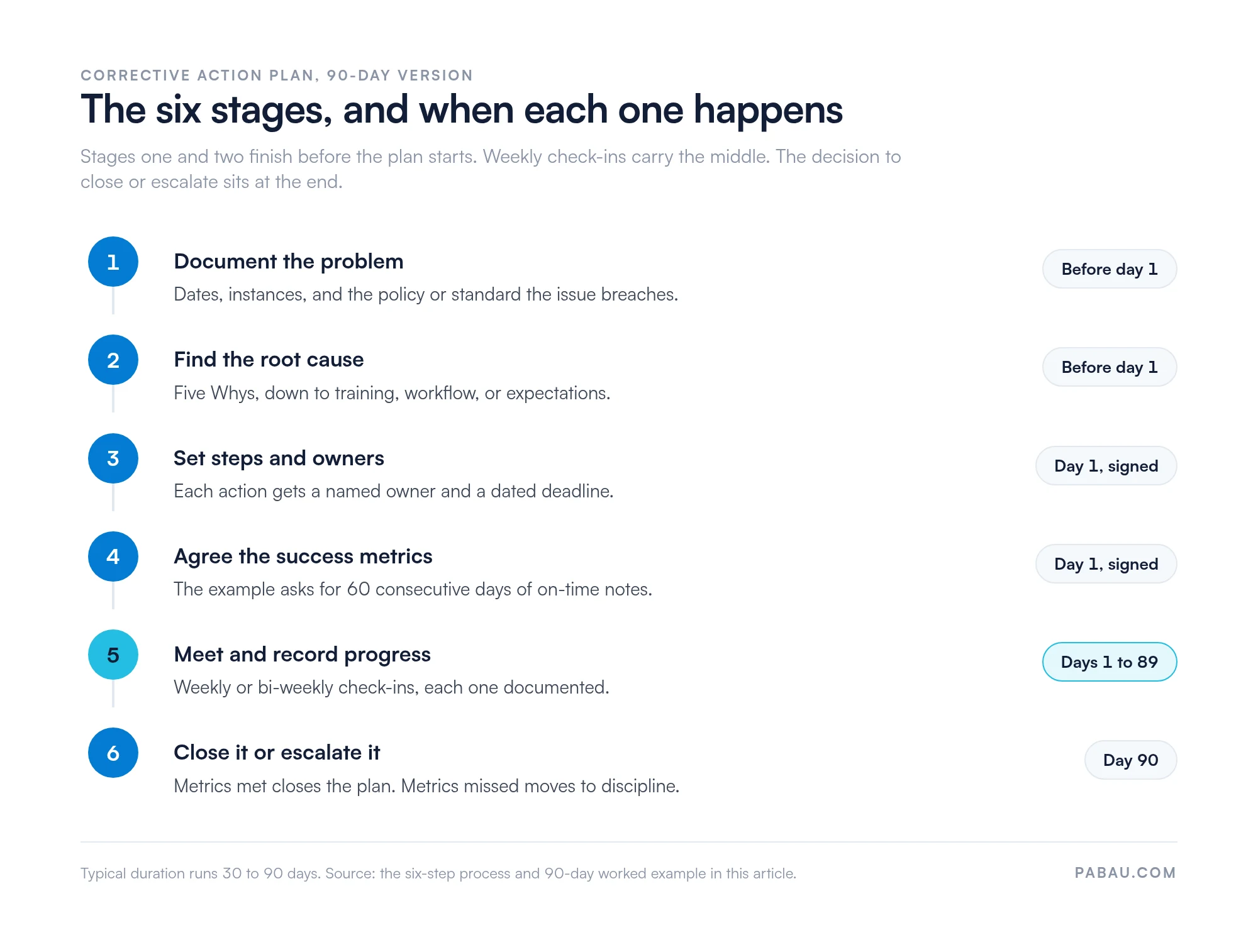
Start with facts, not opinions. Write down the specific issue with dates, times, and evidence someone else could check.
Understanding why the problem happened stops you writing the same plan again in six months. Common causes include thin training, unclear workflows, personal circumstances, and expectations nobody ever spelled out.
The Five Whys technique gets you there quickly. Why were the notes late? The staff member did not understand the new system. Why not? Training ran to 20 minutes because the EHR rollout was rushed.
That chain points at inadequate training, which is a fixable cause. It also changes what goes in step 3, because a training problem needs a training remedy rather than a warning.
Turn the root cause into concrete corrective steps. Each one should be specific, measurable, achievable, relevant, and time-bound. Give every step a named owner.
Team management tools let you assign each step and track it against the person’s schedule, so the deadline is visible to both of you.
Define what improvement looks like in numbers. Metrics remove the argument at the end, and give you objective grounds for either closing the plan or escalating it.
Do not set a plan and then disappear. Weekly or bi-weekly check-ins signal that the practice is serious, and they surface obstacles while there is still time to clear them. Write up each meeting.
Use compliance management software to hold the meeting notes, the progress against each metric, and any escalation trigger. That gives you one audit trail instead of three.
Hold a formal review at the end of the period. If the employee met the metrics, close the plan and document the closure in writing. If they did not, escalate according to your practice’s disciplinary policy.
The downloadable form above has a section for each element in the table. As you complete each field, check that it is:
One healthcare-specific point. Where the plan touches patient safety or clinical compliance, cite the standard it relates to. That might be HIPAA, a state licensure rule, or an accreditation requirement. That ties the corrective action to an outside standard rather than to a manager’s preference.
Healthcare raises the stakes on both sides. Staff performance feeds straight into patient outcomes, and a compliance breach carries regulatory and financial consequences on top of the clinical ones.
What usually triggers a plan:
A completed plan also shows an inspector that performance management happens here in writing. That matters to state licensing boards and accreditors in the US, and to the Care Quality Commission for practices in England. When an audit lands, staff files and training records are among the first documents requested.
Keep the plan alongside the staff record rather than in a separate folder. Software practice managers use day to day already holds schedules, training records, and reporting, so the evidence sits in one place.
These two documents get filed in the same drawer and should not be. A corrective action plan sits in one employee’s file and addresses one person’s conduct or performance. A plan of correction is the practice’s answer to a survey finding, submitted back to the regulator.
In the US, surveyors record deficiencies on form CMS-2567, and the facility responds in the plan-of-correction column of that same form. The audience is the regulator, not the employee, and no individual is named.
One incident can produce both. A surveyor who flags a missed follow-up may want a plan of correction from the practice. The person who missed it may still need a corrective action plan. Write them separately, and never file one in place of the other.
Here is what a completed plan looks like for a nurse in a busy practice.
Notice what the example does. It names a documented issue, traces it to a cause the practice created, then prescribes a remedy that matches that cause. The metrics are numbers rather than adjectives.
At the 90-day review, meeting those numbers closes the plan and the nurse goes back to ordinary performance management. Missing them moves the case to the practice’s disciplinary policy.
Four habits separate a plan that holds up from one that creates more problems than it solves.
Document as you go. Write the meeting notes on the day, not from memory at the end. A time-stamped trail of meetings, metrics, and decisions protects the employee as much as the practice.
Keep it confidential. Share the plan with the employee, their manager, HR, and leadership. Talk about someone’s plan beyond that circle and you invite a legal claim, and you damage the team’s trust either way.
Be consistent. Apply the same standard whatever the person’s seniority or tenure. If one nurse gets a 90-day plan for missed notes, the next one should too. Inconsistency is what gets challenged.
Offer support. Use the plan to help the employee succeed, not only to record a failure. Provide the training, the mentoring, or the reasonable accommodation the root cause points to.
Paper and email are still the default for this document. The signed form sits in a shared folder, the check-in notes live in a manager’s notebook, and the training record sits somewhere else again. When a complaint or a survey arrives, assembling the file takes an afternoon.
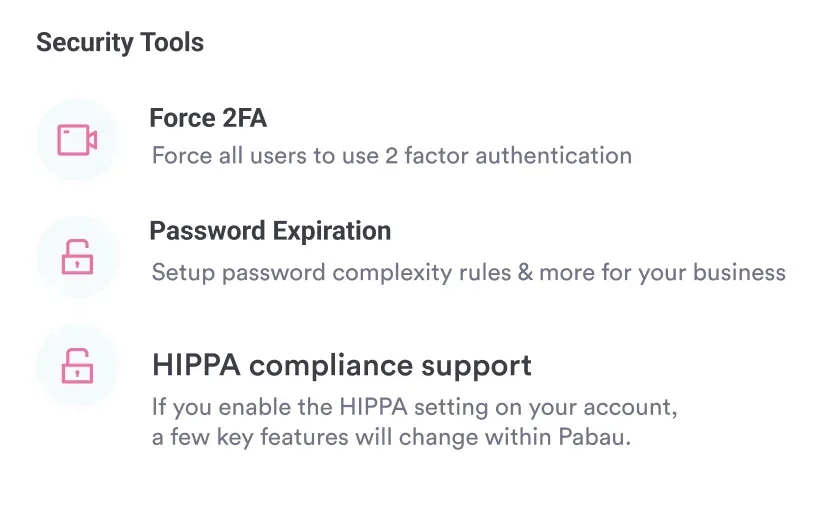
Practice management software like Pabau keeps those pieces together. Build the plan as a digital form and every version saves with a timestamp, so the dates are not open to dispute. Roles and permissions decide who can open it, and the account’s security tools keep it off the wider team’s screens.
Schedules, time-off records, and timesheets sit in the same system, which is where the evidence for a punctuality or coverage issue usually lives. Reporting then shows you whether the metric moved, instead of leaving you to count it by hand.
The outcome is a file you can produce on request rather than reconstruct from three places. Nobody hunts for the signed copy, and the record matches what the manager says happened.

Pabau stores the signed plan, the check-in notes, and the training record with the staff file. The evidence is ready when someone asks for it.

A corrective action plan earns its keep twice. It gives the employee a route back with dates attached. It also gives the practice a record that still stands up months later.
The trade-off worth remembering is follow-through. A plan you write and then ignore is worse than no plan, because it documents that the practice saw the problem and let it run. Only open one you will run for the full 30 to 90 days.
Download the template above, then decide where the file will live before the first meeting. Book a demo to see how Pabau keeps staff plans, training records, and check-in notes in one place.

Need a record of every check-in? Staff messaging for practice management covers where to keep those notes.
Is the problem skill rather than conduct? Performance improvement plan template gives you the developmental version of this document.
Documenting the conversation before it escalates? Employee counseling form records the informal warning that usually comes first.
Due a scheduled review instead? Annual review template covers the yearly conversation, with space for goals and ratings.
A disciplinary warning is typically a single formal notice, written or verbal, stating that a behavior is unacceptable. A corrective action plan goes further. It specifies what the employee must do to improve, and sets the timeline and the monitoring for it. A CAP often follows a warning and gives a formal chance to correct the behavior before escalation or termination.
Yes. A CAP is not a guarantee of job security. If the employee fails to meet the success metrics or breaches the plan terms, the practice can proceed to further discipline, including termination. A documented CAP does show that the practice gave a fair opportunity to improve, which protects against wrongful termination claims. Take legal advice before terminating an employee.
Most plans run 30 to 90 days, depending on how serious and how complex the issue is. A single-incident problem might resolve in 30 days. A pattern of missed work usually needs 90 days to show sustained improvement. Set the duration at the outset and hold to that timeline.
The practice can open a new plan, or move straight to further discipline, depending on your policy. Either way, keep managing performance after the plan closes. Improvement during a monitoring period is not a guarantee that it holds.
Yes. The signature acknowledges that the employee received the plan and understood it. If they refuse to sign, record that refusal in writing and have a witness present. A signed plan is stronger evidence in a legal proceeding than an unsigned one.