Maja Popovska

Healthcare dashboard examples: 6 real-world use cases
The most useful healthcare dashboard examples fall into six types: executive, cl...

Last Updated: Nov 11, 2026
Free PDF 3 pages, print-ready Clinician-reviewed
A consent for treatment of a minor form is a signed document in which a parent or legal guardian authorizes medical care for a child. The form records who gave permission, which services it covers, and how long consent lasts. Without one on file, a practice may struggle to show it had permission before treating a patient under 18. This guide covers what the form should contain, who can sign it, and where HIPAA and state law apply. The free PDF template is ready to adapt to your practice.
A five-section PDF covering the parent or guardian's legal authority, the scope of consent, and authorization for a non-parent adult. It also holds emergency contacts, consent duration, and signature lines for the parent, a witness, the minor and the clinician.
Start from scratch, or upload this PDF or any form you already use, and Pabau's AI Form rebuilds it with tick boxes, text fields and a signature. Attach it to the treatment once, and every patient gets it on time.
AI Form rebuilds the consent, history and aftercare forms you already use. You review each one, then publish.
Patients complete forms on their phone before they arrive, so the front desk stops retyping paper.
Every signed form is versioned and attached to the treatment record, ready when you need it.
Set how long a consent stays valid. Returning patients skip forms they have already signed.
Supports HIPAA and GDPR compliance AES-256 encryption 4.8 on G2 4.7 on Capterra Trusted by 4,000+ practices worldwide

The form records the permission a parent or legal guardian gives for a child’s medical care.
Who can sign depends on custody, guardianship, and your state’s rules.
An emergency can justify treatment under implied consent, while routine care waits for a signature.
HIPAA generally treats parents as a minor’s personal representative, with exceptions set by state law.
Pabau, the practice software we build, collects signed consent through digital forms and files it to the patient record.
A consent for treatment of a minor form usually names the child, the adult giving permission, the care being authorized, and the date. Many practices also add relevant medical history, risk disclosures, and an emergency contact. Staff can then act if the child needs care unexpectedly.
Vague wording causes most problems. A form that says “routine care” without describing the services invites disputes later, so list the treatments or service types the signer is authorizing.
Download the PDF and adapt it to your practice before the first family signs it. The template runs from a state-law check through to acknowledgment and signature, so you can work through it in order.
Any practice that treats patients under 18 needs a consent for treatment of a minor form. Pediatric and family medicine teams handle this most often, but urgent care, physical therapy, and dermatology teams also treat minors.
A parent or legal guardian usually signs the consent for treatment of a minor form, and the form should record which adult holds that authority. Several other situations come up in practice.
An emancipated minor can often consent to their own care, though the definition of emancipation differs by state. Some states also allow minors to consent to certain services on their own, such as reproductive, mental health, or substance use care. Check your state’s rules before you accept a minor’s own signature.
Front-desk staff meet these cases in a fixed order, so the decision path below puts the rules in the order you would apply them.
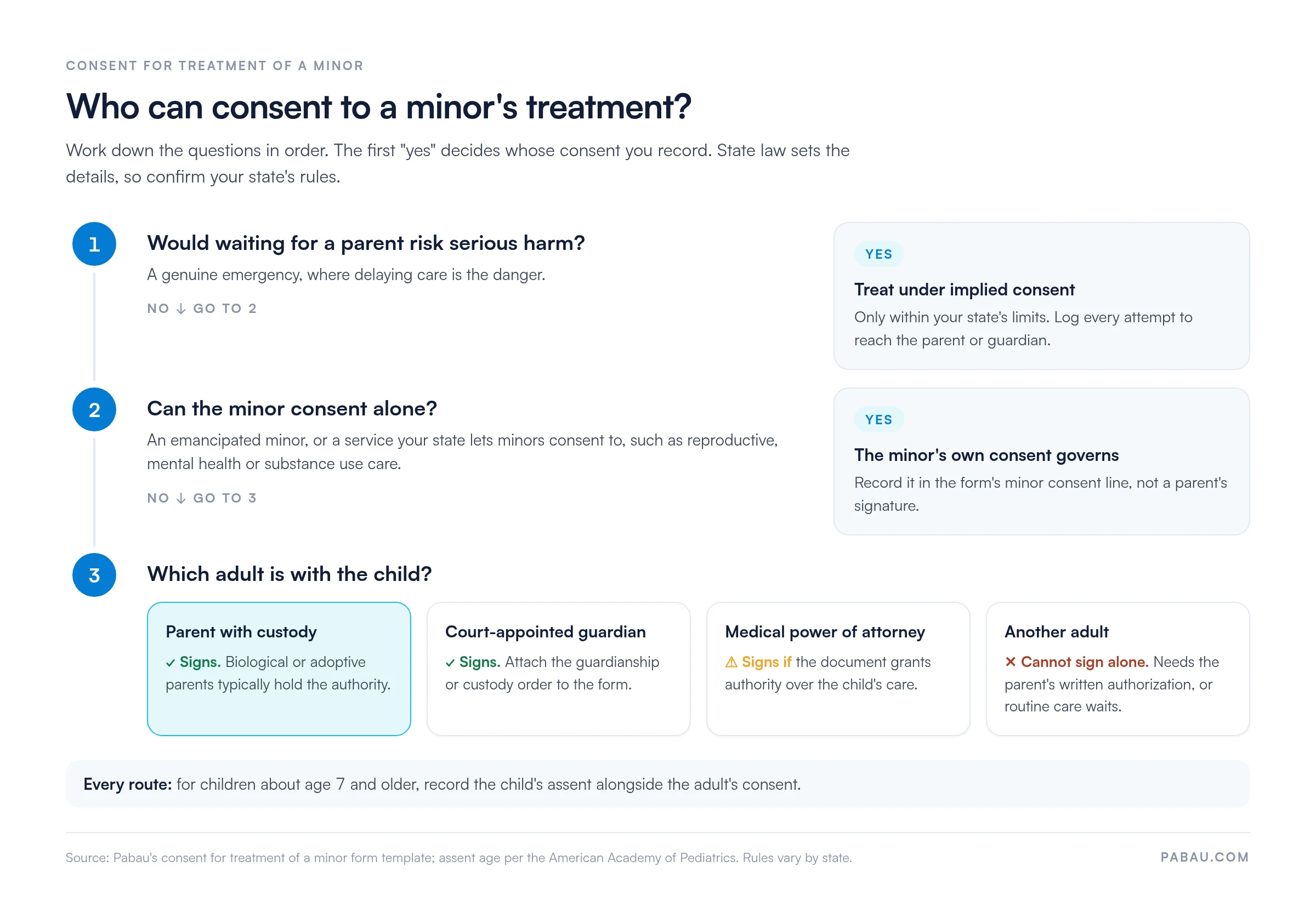
Clinicians may be able to provide emergency treatment under the implied consent doctrine when delay would risk serious harm, but state law sets the limits. Once the emergency passes, the standard consent process applies again.
For non-emergency care, a missing signer usually means the appointment waits. Document each attempt to reach the parent or guardian, and involve your compliance lead before making any exception to your standard process.
Consent is the permission a parent or guardian gives, while assent is a child’s own agreement to a plan of care. Both matter, and they do different jobs in the same visit.
The American Academy of Pediatrics recommends seeking assent from children approximately age 7 and older, in addition to parental permission. Assent does not replace parental consent. Explain the plan in age-appropriate language and record the child’s agreement alongside the signed form.
Under HIPAA, parents generally have access to a minor’s medical records as the minor’s personal representative. The HHS HIPAA privacy guidance lists exceptions, including situations where state law lets a minor control certain care.
A consent form does not automatically limit a parent’s access, so keep the consent workflow and the record access rules separate. To share a minor’s records outside the care team, the parent usually signs a HIPAA authorization form as the child’s personal representative.
Paper consent forms for minors tend to live in a binder at the front desk, away from the child’s chart. When a parent questions what they authorized, staff first have to find the right sheet. Pabau’s patient intake software sends the form before the visit, so the parent can sign it on their own phone.
Once signed, the form lands in the child’s record, where Pabau’s medical records management keeps it next to their history and treatment notes. Pabau Scribe, our AI medical scribe, can draft the visit note where you record the child’s assent.
Staff can open the signed consent at the next visit instead of searching paper files. Practices that also track policy reviews and audits can run them in Pabau’s compliance management software.

Pabau sends consent forms before the visit and captures the parent’s signature. The signed copy files to the child’s patient record, ready for your team at check-in.

Adapt the free template to your state’s rules, then make the signature a check-in step for every patient under 18. Done that way, the question of who authorized care is settled before the child reaches the treatment room.
The trade-off is a slower first visit for families who arrive without a guardian’s paperwork. That delay costs far less than defending care nobody can show was authorized. Book a demo to see how Pabau collects minor consent forms before families arrive.

Need a broader intake checklist? Medical forms at your healthcare practice covers the wider paperwork a practice handles alongside consent.
Want patients to know their HIPAA rights? HIPAA notice of privacy practices is a template that explains how patient records are used and shared.
Moving consent off paper? E-consent form shows how an electronic consent form is structured and signed.
A consent for treatment of a minor form is a signed document in which a parent or legal guardian authorizes medical care for a child. It records who gave permission, what care was authorized, and when. Practices keep it on file as evidence that permission was obtained before treatment started.
A signed form documents consent, but whether it is legally binding depends on state law and the type of care. Statutes set who may consent and in which situations, so have your legal counsel confirm the rules for your state.
Retention periods are set by state law, so no single number applies everywhere. Check your state’s medical records rule and set your schedule to meet the longest period that applies to your practice.
Often yes, because the federal ESIGN Act generally makes electronic signatures legally valid. Some states add healthcare-specific rules, so confirm your state’s requirements before relying on an e-signature.