Maja Popovska

DASES: Drug Avoidance Self-Efficacy Scale
DASES at a glance and what it measures DASES stands for Drug Avoidance Self-Effi...

1
Last Updated: Oct 29, 2026
Free PDF 3 pages, print-ready Clinician-reviewed
A client consent form is a signed document that confirms a patient understands a treatment, its risks and its alternatives, and agrees to go ahead. Med spas, skin practices and day spas use one before each procedure, and it protects both the practitioner and the patient. This free template is built for skin and aesthetic treatments, with a medical history checklist, a skin assessment and a treatment record card.
This guide explains what belongs on the form, how HIPAA and GDPR apply to it, and when a patient needs to sign again.
A printable 11-page client consent form with a medical history checklist, skin assessment, consent statements, signatures and a treatment record card.
Start from scratch, or upload this PDF or any form you already use, and Pabau's AI Form rebuilds it with tick boxes, text fields and a signature. Attach it to the treatment once, and every patient gets it on time.
AI Form rebuilds the consent, history and aftercare forms you already use. You review each one, then publish.
Patients complete forms on their phone before they arrive, so the front desk stops retyping paper.
Every signed form is versioned and attached to the treatment record, ready when you need it.
Set how long a consent stays valid. Returning patients skip forms they have already signed.
Supports HIPAA and GDPR compliance AES-256 encryption 4.8 on G2 4.7 on Capterra Trusted by 4,000+ practices worldwide

A client consent form records that the patient understood the treatment, its risks and the alternatives before agreeing to it.
This free template covers patient details, a medical history checklist, a skin assessment, consent statements, signatures and a treatment record card.
Its contraindication flags are written for microdermabrasion, so re-mark them for each treatment you offer.
Under HIPAA, treatment consent is optional, but using before-and-after photos to market your practice needs a signed authorization.
Pabau, the practice management platform we build, sends consent forms before the visit and files each signed copy to the patient record.
A client consent form is a written record that a patient has received enough information to make an informed decision about a treatment. It captures what the procedure involves, what could go wrong, and what the patient agreed to.
Informed consent is an ethical and legal requirement for medical and aesthetic treatment, as set out in the AMA Code of Medical Ethics. The form is the written record of a consultation. A practitioner still needs to explain the treatment in person, answer questions, and check for contraindications before the patient signs.
The signed form protects the practice too. If a patient later disputes a result, it shows what was explained and agreed. That only works when the form names the specific treatment and its risks.
The free PDF runs to 11 pages and is built for skin and aesthetic treatments. It has six parts, which you can use as printed or adapt to your services.
Four conditions in the medical history carry an asterisk. They are asthma or breathing difficulties, highly sensitive skin, semi-permanent makeup, and severe or active acne. A footnote marks them as contraindications specific to microdermabrasion.
Before you use the form for peels, laser or injectables, re-mark that list for the treatment in question. A form that flags the wrong conditions still collects a signature, but the patient was never warned about the risks that apply to them.
A usable client consent form covers seven core sections. Each one answers a question you may be asked later, whether by a patient, an insurer, or a regulator. The third column shows how far this template takes you, and what you add yourself.
Keep the language plain, so patients can spot the parts they don’t follow and ask about them before treatment. For the conversation that comes before the signature, our client consultation form gives you a structure to follow.
Work through the form with the patient at the consultation, or send it ahead and review it together before treatment. This order keeps each signature tied to a conversation.
If you collect a longer health history first, our client questionnaire captures it before the consent conversation starts.
Aesthetic practices need a form that names specific procedures, such as injectables, dermal fillers, laser, or chemical peels. A generic “I agree to treatment” line rarely covers the risks of each one. Build a separate section for each treatment type you offer.
Spas and massage practices usually need a lighter form. Focus on contraindications such as pregnancy, recent injury, and skin conditions, plus a liability acknowledgment where your local rules allow it.
Many skin treatments run as a course. This template already states that optimal results need multiple sessions, so one signature can cover the course. The treatment record card then logs each visit against that consent.
A patient needs to sign a new consent form when the treatment, their health, or your form changes. The same applies once their last signature passes the validity period you set. A parent’s signature also stops covering a patient once they become an adult. Run through these five checks before each visit.
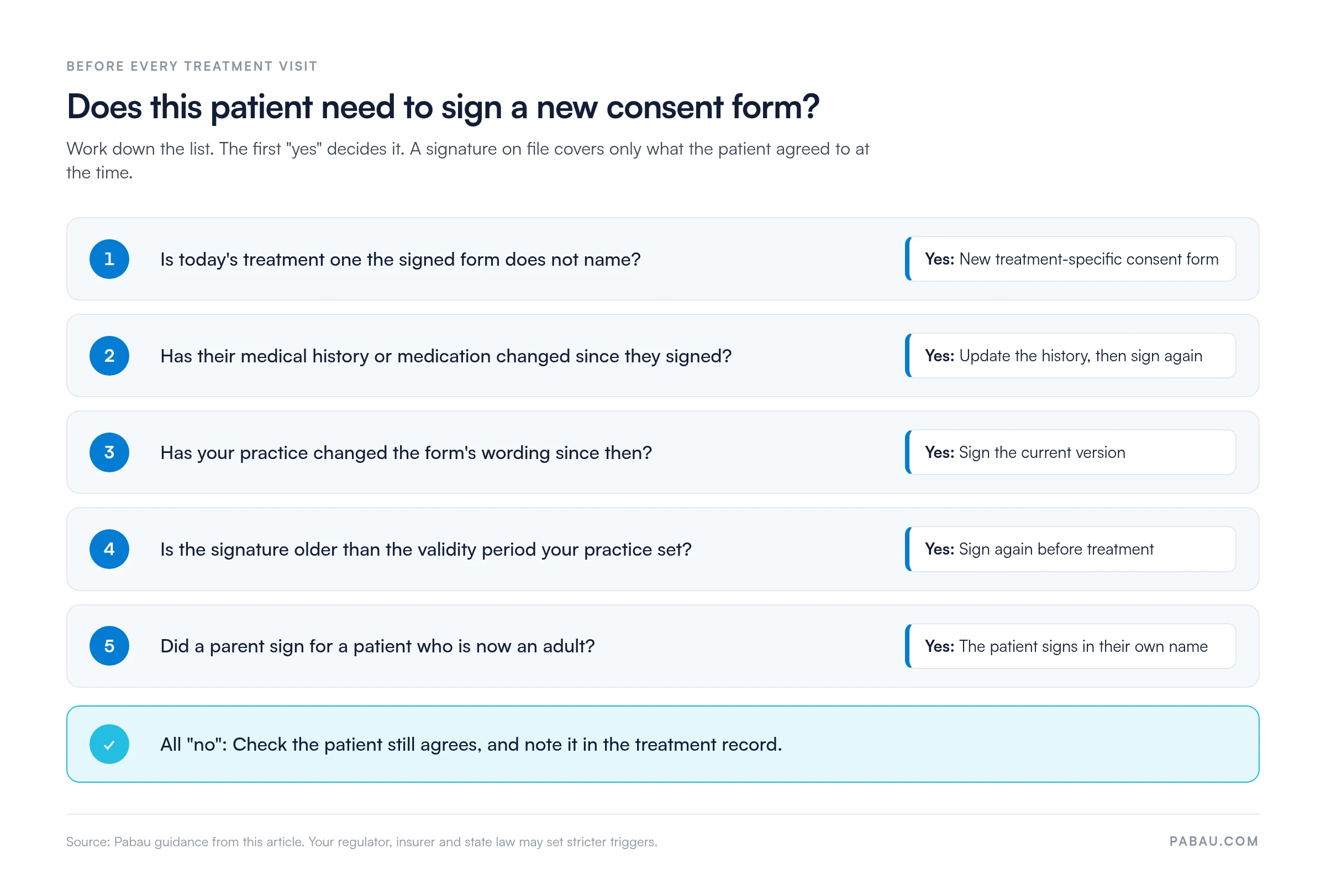
Consent is also ongoing. A patient can withdraw it at any point, including halfway through a course. Ask at each session whether they still want to go ahead, and record the answer in the treatment notes.
HIPAA does not require a signed consent form before you use health information for treatment, payment or healthcare operations. Under 45 CFR 164.506(b), a covered provider may obtain that consent, but it is optional. Your treatment consent form is a clinical and legal document, separate from HIPAA.
Uses outside those purposes need a signed HIPAA authorization under 45 CFR 164.508. Marketing is named explicitly. So posting a patient’s before-and-after photos on your website or social media needs their written authorization first. Our photo release form covers that permission.
Direct treatment providers must also make a good-faith effort to get written acknowledgment that the patient received your Notice of Privacy Practices. Many practices add that line to the same intake packet. HHS guidance on the HIPAA Privacy Rule sets out each requirement.
HIPAA has no certification program. Any software claim of being “HIPAA certified” is misleading. Describe a tool as HIPAA-compliant only where you can verify the specific safeguards.
Under GDPR, a patient’s agreement to treatment is separate from consent as a lawful basis for processing their data. The UK regulator, the Information Commissioner’s Office (ICO), says consent is rarely the most appropriate basis for a medical practice.
Health data is special category data, so you need an Article 6 lawful basis and an Article 9 condition. Healthcare providers usually rely on legitimate interests or public task, plus the health or social care condition. Consent can be withdrawn at any time, while clinical records still have to be kept.
Keep this template’s data tick box as a record that you explained how data is used. Then name the lawful basis you rely on in your privacy notice. Reserve GDPR consent for optional uses, such as marketing emails or sharing photos.
Paper forms are simple to start with, but they create filing and retrieval work. Digital forms can be sent before the appointment and signed on any device. The trade-off is that digital forms need secure storage and a clear audit trail.
The US ESIGN Act gives electronic signatures the same legal standing as handwritten ones in many transactions. Nearly every state has also adopted the Uniform Electronic Transactions Act. Whether a digital consent form is valid in your situation still depends on your state, country, and treatment type.
Practices treating patients under 18 usually need a parent or legal guardian to sign. In most US states the age of majority is 18, but the rules for minors vary by state and by treatment type. Check your local requirements before you treat a minor.
Some treatments are off limits whatever a parent signs. In England, the Botulinum Toxin and Cosmetic Fillers (Children) Act 2021 bans these injections for cosmetic purposes in under-18s. Our consent form template for parents covers treatments where a guardian’s signature is allowed.
Retention periods depend on where you practice. Under HIPAA, the 45 CFR 164.530(j) documentation rule requires six years from creation or last effective date for the related policies and documentation. State rules may set longer periods for medical records. Confirm your own retention schedule with a healthcare attorney.
Store the treatment record card with the consent form. Together they show what the patient agreed to and what was done at each session.
On paper, a consent form gets printed, signed at reception, scanned and filed. Each step is a chance for an old version or a missing signature to slip through.
Pabau moves that process online. Consent forms attach to a service, so each patient gets the right form automatically before the appointment. They sign on their own phone, and the signed copy files to their record.
See how Pabau’s digital forms handle consent from booking to signature.
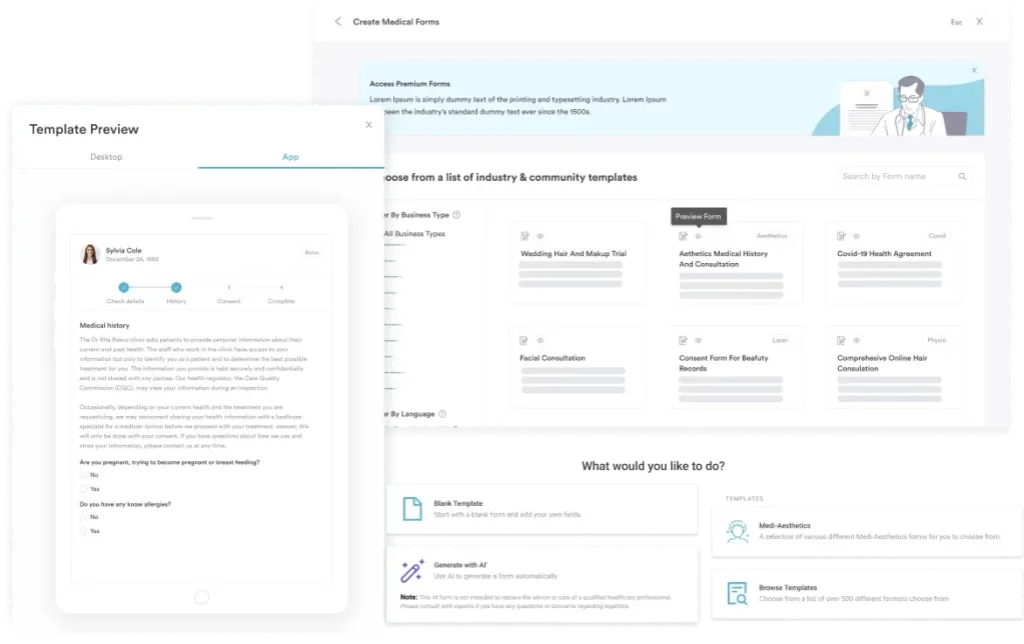

Pabau sends the right consent form for each treatment, captures the e-signature on the patient’s phone, and files it to their record. Your team stops chasing paperwork at check-in.

A downloaded template gives you the structure. The protection comes from what you add to it. That means your treatments, the right contraindications and a plain statement of how you use the patient’s data. Do that work once per treatment, and every later signature means something.
Keeping consent current is the harder job. Treatments change, medical histories change, and forms get revised. A paper file can’t tell you which signature has gone stale, so write your re-sign triggers into your process now.
Pabau asks returning patients to re-sign only when their consent has expired. Book a demo to see how it sends the right consent form before every visit.

Preparing for the consultation itself? Client consultation form gives you a structure for the conversation that comes before the consent signature.
Need a fuller health history first? Client questionnaire collects medical background and lifestyle details before treatment is planned.
Treating patients under 18? Consent form template for parents records a parent or guardian’s agreement on the patient’s behalf.
Want to share before-and-after photos? Photo release form captures the separate permission you need before a patient’s images appear in your marketing.
Comparing digital forms tools? Best healthcare forms software reviews the platforms practices use to send, sign and store patient forms.
A client consent form is a signed record confirming that a patient understood a treatment, its risks, and its alternatives before agreeing to it. It is signed at the end of the consultation, as the record of what was explained.
It can be, but enforceability depends on your jurisdiction, the treatment, and how the form was completed. A form signed without a proper explanation of the risks gives you little protection, so check local law.
In many cases, yes. The US ESIGN Act gives electronic signatures legal standing in many transactions. The e-signature and storage still have to meet the rules for your practice in your country or state.
Many practices use one general form plus a treatment-specific section, because risks differ between procedures. A course of the same treatment can sit under one signature if the form says so.
Include patient details, a description of the treatment, its risks and side effects, and the alternatives. Add contraindications, how you use the patient’s data, and dated signatures from both the patient and the practitioner.
No. Under 45 CFR 164.506(b), consent for treatment, payment and healthcare operations is optional. HIPAA does require a signed authorization for other uses, such as marketing with a patient’s photos.
There is no single legal expiry date. A new form is needed when the treatment, the patient’s health or your form changes. It is also needed once the signature passes the validity period your practice sets.
Usually not. In most US states a parent or legal guardian signs for a patient under 18. Some treatments are banned for minors outright, such as cosmetic botulinum toxin and fillers in England.
Yes. Clinical photos are part of the patient’s health record. Using them in marketing needs separate written permission, which is a HIPAA authorization for US covered providers.
HIPAA requires six years for its required documentation, and state rules may set longer periods for medical records. Keep the treatment record card alongside the form, and confirm your schedule with a healthcare attorney.