Free printable blood glucose log
A free printable blood glucose log is a paper form for recording each blood suga...

Last Updated: Oct 5, 2026

Phase 1 Induction caps net carbs at 20g a day, which is what moves the body into ketosis.
Foundation vegetables carry 12 to 15g of that allowance. Protein and fat carry none, so patients eat them freely.
Nuts and seeds wait until week 3. Sugar, grains, fruit, starchy vegetables and alcohol stay out for the whole phase.
The free PDF holds the food tables, the avoid list, a 7-day meal plan and a daily net carb tracker.
Practice management software like Pabau carries the intake forms, the monitoring schedule and the visit notes behind the intervention.
Five printable pages covering protein, foundation vegetables, dairy, fats, nuts and drinks, each with net carbs per serving. You also get the foods to avoid, a 7-day meal plan, a daily carb tracker and a week 0 to week 8 monitoring schedule.
Download templateThe Atkins Phase 1 food list PDF below gives you every food Induction allows, with the net carbs each serving costs. Phase 1 holds you to 20g of net carbs a day. Protein and fat carry none, so they stay unlimited. Foundation vegetables take 12 to 15g of that, and the rest of the plate should cost you none.
Below you get the printable list, the carb values, the foods to avoid, a 7-day plan, and the mistakes that catch people out.
Atkins Phase 1, called Induction, is the opening stage of the Atkins 20 program. It runs for a minimum of two weeks and holds net carbohydrates to 20g a day. That restriction moves the body into ketosis, a metabolic state where fat becomes the main fuel instead of glucose.
Induction works as a reset for insulin sensitivity and appetite. Sugars, grains, fruit and starchy vegetables come off the plate entirely. Teams at weight-loss practices report steadier blood sugar, fewer cravings and measurable fat loss in the first 7 to 10 days.
The download is a five-page document, built to be handed to a patient at the first appointment.
Net carbs are what Phase 1 counts, and the arithmetic is the same on every label. Subtract fiber and half of any sugar alcohol from the total carbohydrate. Fiber and most sugar alcohols pass through without raising blood glucose, which is why they come out of the count.
The formula: total carbohydrate − dietary fiber − (sugar alcohols ÷ 2) = net carbs
Meat, fish, eggs and cooking fats sit at zero. Build the meal around them and the only items left to count are vegetables, dairy and, later, nuts.
Every food below is permitted during Induction, grouped the same way the printable version groups them. Values are per standard serving and rounded to one decimal place.
All of these sit at 0g net carbs, so there is no daily cap on them. Oysters and mussels are the exception at roughly 4g per 3 oz, so those need counting.
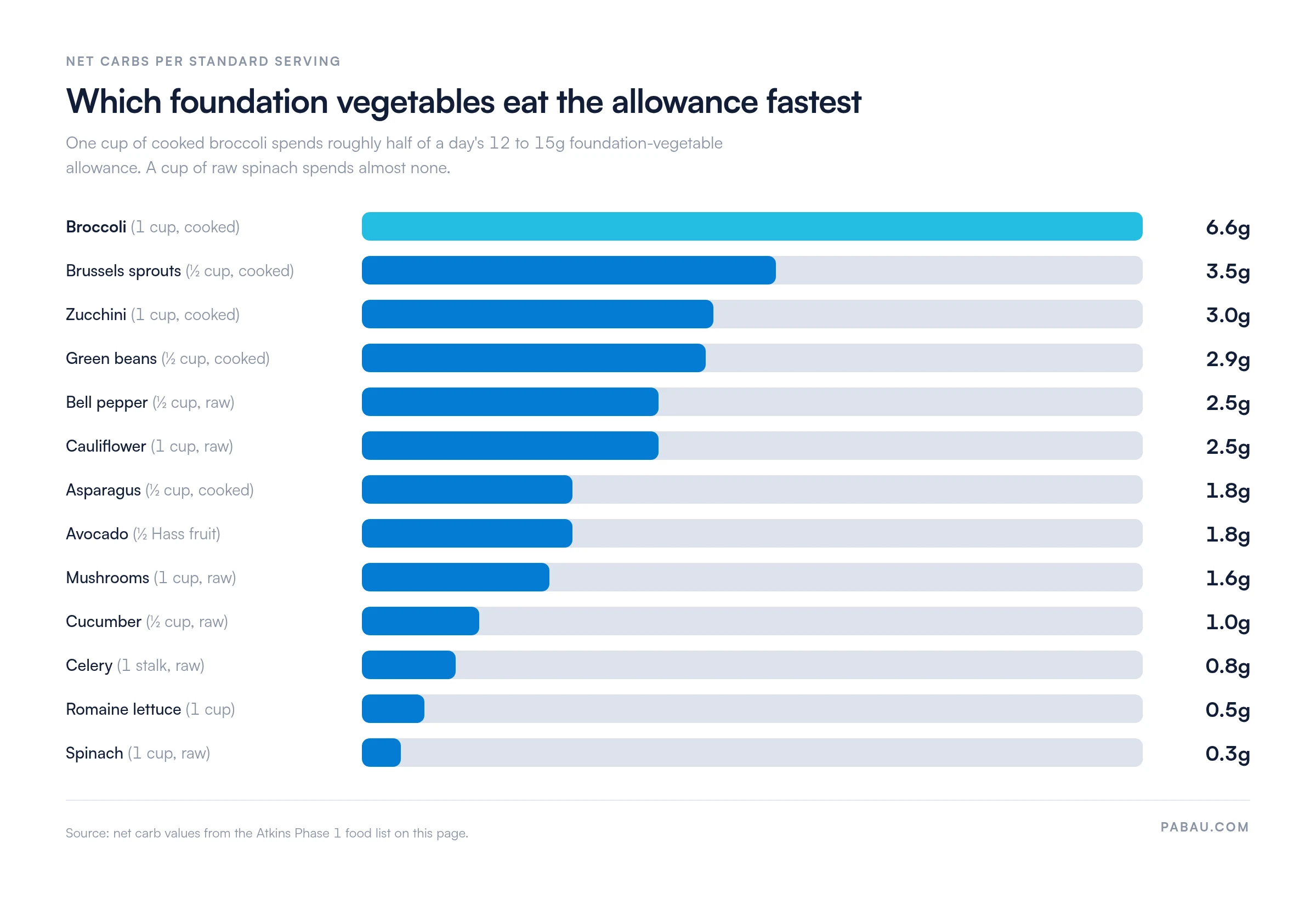
Foundation vegetables are the only carbohydrate Phase 1 permits. Spend the 12 to 15g allowance across the day rather than in one meal. The carb cost varies far more between them than the serving sizes suggest.
Milk and yogurt stay off the list during Induction. Both carry more sugar than a 20g allowance can absorb.
Every cooking fat is approved and every one sits at zero net carbs. Cook with them freely and eat until you are full, since fat is what makes a 20g day comfortable.
Nuts and seeds stay out for the first two weeks. If Induction runs longer than that, they can come in, counted against the same 20g ceiling.
The restricted list matters as much as the approved one. Each group below either blows the 20g allowance on its own or raises blood glucose enough to interrupt ketosis.
Phase 1 is an elimination phase, so the carb sources come out together rather than one at a time. Phase 2 brings some of them back in measured portions, which is where a structured clean eating meal plan takes over.
Much of what decides the first two weeks happens before a single meal is eaten. Work through this list at the appointment where the food list is handed over.
Then build the first shop straight from the approved tables above. A ready-made weight-loss grocery list saves the patient a second trip for what they forgot.
Five steps take a patient from the printed page to a logged first week.
Here is what a day near the limit looks like. Breakfast of three eggs and bacon costs 0g. A lunch salad of raw spinach with half an avocado costs about 2g. Dinner with a cup of cooked broccoli and a cup of raw cauliflower adds roughly 9g. Two tablespoons of cream in the coffee take the day near 12g, which leaves headroom for a bigger salad.
Use this week as a starting framework. Each day lands near 18 to 20g of net carbs when vegetable servings match the sizes in the table above.
Salt food to taste and drink to thirst. Sodium loss is normal in week 1, and it drives most of the fatigue patients report on days three to five.
Almost every stalled Induction traces back to one of the same five habits. None of them look like cheating, which is why they survive a whole fortnight unnoticed.
Phase 1 is a short, aggressive intervention, so the supervision around it has to be structured. Four things carry most of the outcome.
Patients forget spoken instructions within minutes, so the printed list does the work the consultation cannot. Capture dietary history, medication and weight goals on patient intake forms beforehand, then mark up the list against what that patient already eats.
Take weight, blood pressure, a lipid panel and fasting glucose before day one. Then repeat them on a fixed schedule, so week 0 and week 8 can be read side by side rather than hunted for.
Headache, fatigue and irritability are common as glycogen and sodium drop. Say so at the first appointment, because a patient who expects it rarely quits over it. Sodium, potassium and magnesium usually settle the symptoms, and they pass on their own.
Eating out is the other early sticking point. Rehearse two or three orders with the patient, such as a bunless burger, extra vegetables and an oil-based dressing.
Record the barrier and the fix in the chart so the whole team gives the same answer next visit. Pabau Scribe, our AI scribe, writes that note from the consultation itself.
Induction runs two to four weeks. Phase 2, called Balancing, raises the ceiling to 25g of net carbs a day. It also brings nuts, more dairy and small portions of berries back onto the plate, which is the reward most patients are counting down to.
Most practices run a Phase 1 program on paper and memory. The food list is a printout. Adherence lives in a notebook the patient forgets to bring, and the week-2 recall depends on somebody remembering to make the call. Baselines get taken, then sit in a scan nobody opens again.
Practice management software like Pabau puts the same program on one record. Digital intake forms collect dietary history, medication and weight goals before the patient arrives. Measurements hold weight, blood pressure and lab values against the schedule above, so week 0 and week 8 sit in one view.
Automations handle the follow-up. A week-2 recall books itself, and the Phase 2 education email sends on the date you set. Pabau Scribe turns each consultation into a note without the charting time. Your team sees the whole intervention on one timeline, so the plan agreed at visit one never has to be reconstructed.

Digital intake forms, measurement tracking and automated week-2 recalls keep an Atkins Phase 1 program on schedule. See how Pabau brings the whole intervention onto one patient timeline.

Phase 1 comes down to three numbers. Net carbs stay at 20g a day, 12 to 15g of them come from foundation vegetables, and the phase runs two weeks minimum. The list turns those numbers into a shopping trip and a week of meals, which is the part a patient can act on.
So download the PDF, hand it over on day one, and keep the tracker coming back with the patient. The two weeks are short enough that a missed follow-up costs you the whole intervention.
Book a demo to see how intake forms, measurements and week-2 recalls sit on one patient record.

Planning a low-carb week? The 7-day ketosis meal plan sets out macro targets and a blank weekly grid you can fill in alongside this food list.
Need the two weeks mapped out? The 2-week diet plan covers the same fortnight as Induction, with daily structure and a progress log.
Need a longer program? The 30-day meal plan for weight loss covers the four weeks after Induction, with grocery lists and calorie targets.
Moving patients off restriction? The clean eating meal plan gives Phase 2 and beyond a whole-food structure patients can stay on.
Most people lose 3 to 10 lbs in the first two weeks, and much of that is water rather than fat. Glycogen depletion accounts for the early drop. From week 2, fat loss usually settles at 1 to 2 lbs a week.
They overlap but they are not identical. Both hold net carbs near 20 to 25g a day, which is enough for ketosis. Keto also sets fat, protein and carb ratios. Phase 1 sets the carb ceiling only and leaves protein and fat open.
Yes, though keep it light for the first week. Strength work and walking are fine. Hard cardio often feels worse until the body adapts to burning fat, which usually takes 7 to 10 days. Drink to thirst and salt food, since sweat adds to the sodium loss.
No. Phase 1 counts net carbs only, and appetite usually falls on its own once ketosis starts. Calories still matter if weight loss stops after week 3. At that point, check portion sizes on fats and cheese first.
Urine ketone strips are the cheapest check, and they usually turn positive within the first few days. They get less reliable as the body adapts. Reduced hunger and steady energy are better signs by week 2.
Induction is not appropriate during pregnancy or breastfeeding, or for anyone with kidney disease, without specialist input. Patients on insulin, sulfonylureas, diuretics or blood-pressure medication need a dose review first, because carbohydrate restriction changes what those drugs do.