Despina Petrushevska
Nutrition intake form
A nutrition intake form is a structured questionnaire that records a patientR...

3
Last Updated: Oct 22, 2026
Free PDF 1 page, print-ready Clinician-reviewed
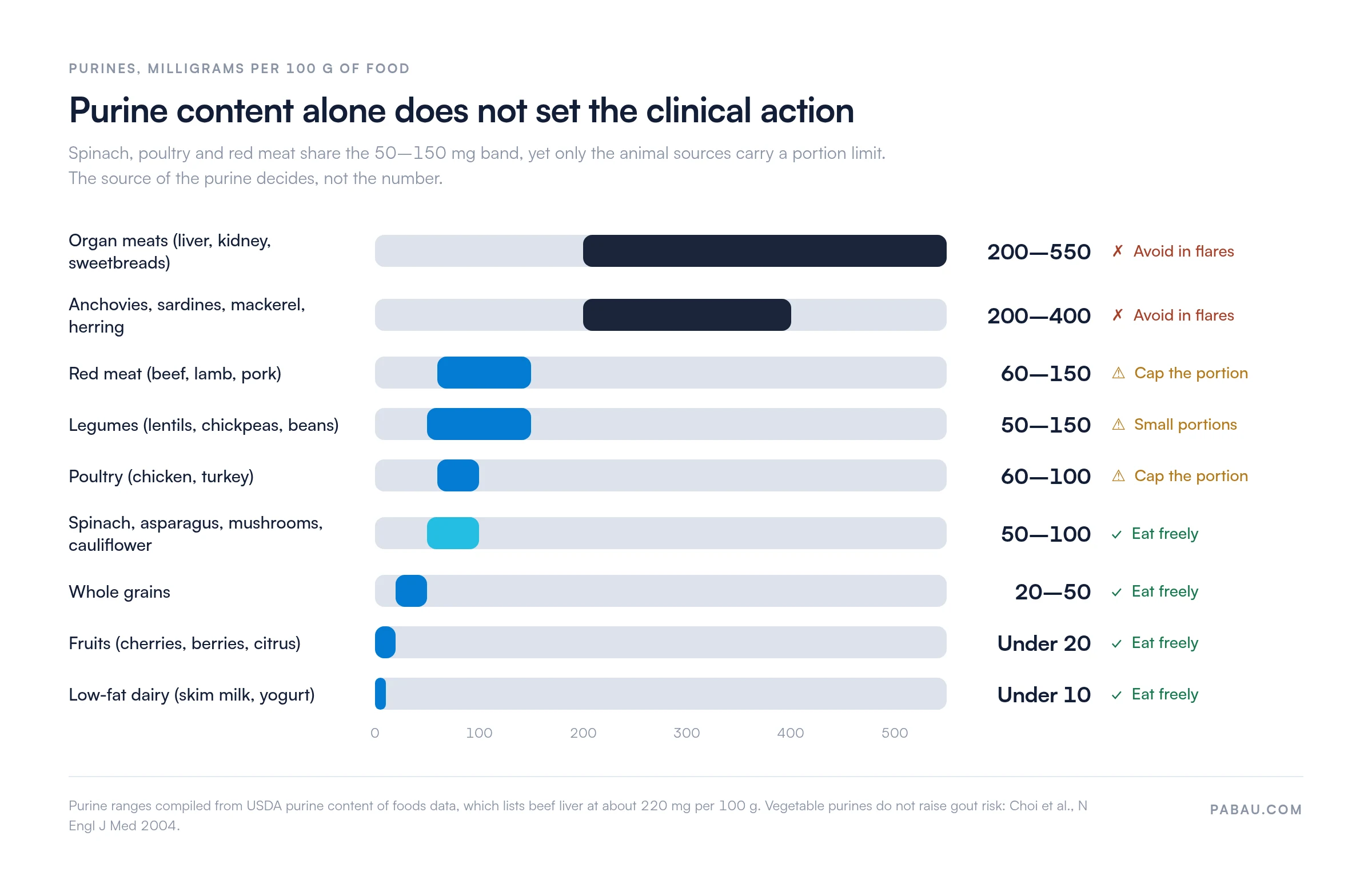
A high uric acid foods chart sorts foods by purine content. The tiers tell a patient what to avoid, what to cap and what to eat without limit. The reference table on this page gives the range for every major food group, measured in milligrams per 100 g.
Above 150 mg per 100 g, avoid or strictly limit. Between 50 and 150 mg, cap the portion. Below 50 mg, eat freely.
Organ meats sit at the top of that range, at roughly 200 to 550 mg per 100 g. Low-fat dairy and fruit sit at the bottom, under 20 mg. The printable handout below is the patient-facing version of this chart. It is a one-page checklist of foods to avoid or limit and foods to eat, with no milligram values.
When serum uric acid exceeds 6.8 mg/dL, monosodium urate crystals form in joints and soft tissues, which is what a gout flare feels like. Diet accounts for roughly 10-12% of total uric acid burden. That makes it a meaningful lever alongside urate-lowering medication.
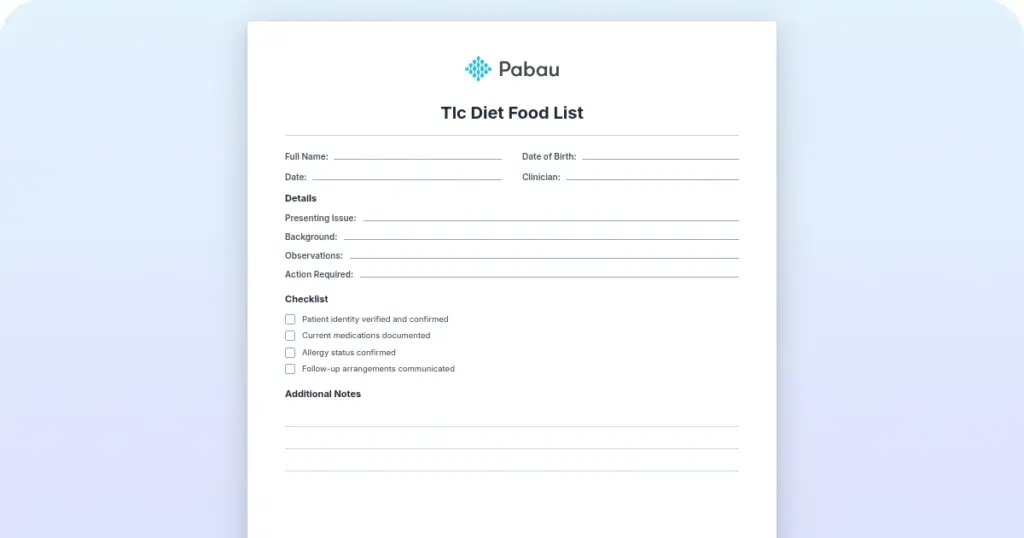
A printable one-page patient handout. It lists the foods to avoid or limit and the foods to eat. Patient details sit at the top, and a notes box at the bottom is for the dietitian. The purine values in milligrams stay in the reference table on this page.
Upload this PDF, or any form you already use, and Pabau's AI Form rebuilds it with tick boxes, text fields and a signature. Attach it to the treatment once, and every patient gets it on time.
AI Form rebuilds the consent, history and aftercare forms you already use. You review each one, then publish.
Patients complete forms on their phone before they arrive, so the front desk stops retyping paper.
Every signed form is versioned and attached to the treatment record, ready when you need it.
Set how long a consent stays valid. Returning patients skip forms they have already signed.
Supports HIPAA and GDPR compliance AES-256 encryption 4.8 on G2 4.7 on Capterra Trusted by 4,000+ practices worldwide

The reference table on this page sorts foods into three purine tiers, measured in milligrams per 100 g, so dietary advice carries a number.
High-purine foods above 150 mg per 100 g include organ meats and anchovies. Beer is low in purines, but its ethanol slows uric acid excretion, so it comes out too.
Vegetable purines do not raise gout risk, so spinach, asparagus and mushrooms need no restriction.
Daily targets run from under 200 mg during an acute flare to 400-500 mg in stable remission.
The downloadable handout is a qualitative avoid-or-limit and eat checklist with a notes box, so write the milligram ceiling into it yourself.
Pabau’s digital forms and client records let you track dietary adherence against each uric acid result.
Uric acid is the end product of purine breakdown. Dietary purines are metabolized to uric acid in the liver, and the kidneys excrete most of what is produced. When intake outruns excretion, serum uric acid climbs and crystals form.
Walking a patient through that sequence changes how the chart lands. Purines in food become uric acid in blood, and uric acid becomes crystals in a joint. A patient who follows the chemistry has a reason to watch portions, rather than a list of banned foods to resent.
The tiers carry specific purine values, so you can quantify the risk instead of estimating it. USDA’s purine content of foods data puts beef liver at about 220 mg per 100 g. A cup of cherries delivers under 20 mg. Repeated across a day of meals, that difference moves a patient from over 500 mg to under 300 mg.
High-purine foods drive most of the dietary rise in serum uric acid. These are the foods to name first when you educate a patient on flare prevention. The last two entries earn their place through metabolism rather than purine content.
Tell patients that this elimination is temporary. Once serum uric acid holds below 6 mg/dL, usually two to four weeks into medication, measured portions of high-purine foods can return. The message moves from a permanent ban to a portion the patient controls.
Moderate-purine foods are tolerated in small portions, and one group in this tier needs no limit at all. Vegetables such as spinach and asparagus contain measurable purines, which is why they still appear on older avoidance lists. Observational cohort data (Choi et al., N Engl J Med 2004) found vegetable purines do not increase gout risk, while animal purines do.
That distinction is worth stating out loud at the visit. It prevents needless restriction of nutrient-dense foods, and the numbers in this tier show why the rule is easy to get wrong.
Low-purine foods make up the base of a gout-protective diet. Several of them carry benefits beyond simply lowering purine intake.
Weight loss lowers serum uric acid on its own. For a patient carrying excess weight, a gradual 5-10% reduction cuts uric acid by 0.5-1.0 mg/dL. Vitamin C may offer a modest benefit, though the evidence is limited. The ACR 2020 guideline conditionally recommends against supplementing for gout, so present citrus, kiwi and bell peppers as food, not as a dose.
Some patients want a fuller framework than a single chart. An anti-inflammatory meal plan is built around most of the foods in this tier.
The tiers tell a patient which foods to choose. A daily ceiling in milligrams tells them how much, and it is the number to write into the plan.
Digital intake forms make the three-day food diary easy to collect, and the tiers turn that diary into an estimated purine load. Pair the estimate with uric acid labs every four to six weeks at first. Each result then tells the patient whether their portions worked.
Diet rarely carries a patient from 8 mg/dL to target on its own, and knowing when to escalate is a judgment call. Our guide to lifestyle versus pharmacologic interventions works through where that line usually sits.

The chart does its work in the conversation, not on the printout. Five steps make that conversation repeatable across a caseload.
The table below condenses the three tiers for quick reference during a consultation. It is the clinician’s version, and it stays on this page rather than on the handout.
Keep this table open during the consult, and send the printable checklist through the patient portal before the appointment.
The table above is the clinician’s reference. The download is the patient’s, and the two carry different levels of detail. The handout is a single page with patient details at the top and two facing lists.
Two caveats are worth saying out loud as you hand it over. The form lists spinach, asparagus and mushrooms among the foods to limit, which is stricter than the evidence supports. It also groups turkey with the red meats, though poultry sits in the middle tier of the table above.
Because the handout carries no milligram values, write the daily ceiling into the notes box yourself. A patient who leaves with 300 mg per day written on the page has a number to measure against.
The chart earns its keep once it lives in the record rather than a drawer. Reference it during the visit, log the dietary change in the client record, and the next lab result sits beside the change that drove it. Practices running metabolic care at volume keep it inside their weight loss practice software, next to the labs and recalls.
A purpose-built metabolic health EMR stores the handout as a shareable document. It also keeps the food diary on the same timeline as the uric acid results. The four-week review then opens on a record that is already complete.
Patients who track their own intake watch uric acid fall by 1-2 mg/dL over six to eight weeks. At that point the diet stops feeling like a punishment. That change in attitude is what sustains it past the first flare.
The American College of Rheumatology last updated its gout management guideline in 2020, replacing the 2012 edition. Its dietary recommendations are conditional and modest in scope. The panel found the evidence on dairy too low in certainty to issue a specific recommendation. Present low-fat dairy as a reasonable protein choice, not a proven intervention.
The National Kidney Foundation covers dietary guidance for patients with concurrent chronic kidney disease, where uric acid management runs tighter. Reading both keeps your patient education aligned across rheumatology and nephrology.
In most practices the handout goes out as a PDF and the follow-up runs on recall. The food diary arrives on paper and the dietary note lands in free text. Lining the two up against the last uric acid result means digging through separate systems.
Practice management software like Pabau closes that loop. You send the handout from the client record as a shareable document. A digital intake form collects the three-day food diary before the visit. Both attach to the same client file.
The dietary note then sits on one timeline with the uric acid results, the medication changes and the flare dates. At the four-week review you open a single record and read the sequence in order, so the conversation starts from data rather than recall.
Across a caseload that record becomes a cohort view. You can see which patients responded to diet alone, and which need their urate-lowering therapy escalated.

Pabau’s digital forms collect the food diary and store the chart with the patient’s file. Dietary notes then sit beside every uric acid result, so your four-week reviews start from data.

The purine number is what makes this chart usable. It turns avoid meat into a portion the patient can measure, and a daily ceiling they can check against their own labs.
The trade-off worth remembering is scale. Diet accounts for roughly 10-12% of the uric acid burden, so it supports urate-lowering therapy rather than replacing it. Overselling the diet leaves a patient blaming themselves when a flare arrives anyway.
Hand the checklist out at the next gout consult and write the daily ceiling on it from the patient’s current result. Book the four-week review before they leave. Book a demo to see how Pabau keeps the food diary, the chart and every uric acid result on one client record.

Managing gout alongside kidney disease? Renal diet meal plan sets the sodium, potassium and phosphorus limits that sit on top of the purine ceiling.
Want a fuller dietary framework? Anti-inflammatory meal plan gives a seven-day structure built around the same low-purine foods.
Is the patient also hypertensive? DASH diet food list covers the daily serving counts and the 2,300 mg sodium cap.
Deciding when diet is not enough? Lifestyle vs pharmacologic interventions works through when to escalate to medication.
Documenting the wider chemistry? Basic metabolic panel template structures the panel you order alongside a serum uric acid test.
Organ meats (liver, kidney, sweetbreads) contain roughly 200-550 mg purines per 100g, which makes them the highest-purine foods. USDA data puts beef liver at about 220 mg per 100g. Certain seafood (anchovies, sardines, mackerel) at 200-400 mg/100g rank second. Beer and spirits also elevate uric acid, mainly because ethanol slows renal excretion rather than through their purine content.
During acute flares, avoid organ meats, high-purine seafood (anchovies, sardines, mackerel, shellfish), red meat portions over 3 oz, beer, and sugar-sweetened beverages. During remission when uric acid is stable below 6 mg/dL, moderate portions of red meat (3-4 oz, 3-4x weekly) and lower-purine fish are usually acceptable.
Low-purine foods safe to eat freely include low-fat dairy, fruits such as cherries and berries, most vegetables, whole grains, eggs and nuts. Spinach and asparagus are safe too, despite their moderate purine content. Legumes are fine in small portions. Water, coffee, and herbal teas are unrestricted and support uric acid excretion.
Adequate hydration (2-3 liters daily) dilutes serum uric acid and increases renal excretion, producing modest reductions of 0.2-0.5 mg/dL. Water alone does not replace dietary changes or medication, but it amplifies their effects and is strongly recommended for all gout patients.