CPT Code 62284: Injection procedure for myelography
CPT Code 62284: official descriptor and procedure overview The American Medical ...

Last Updated: Oct 19, 2026
S5125 is the HCPCS Level II code for attendant care services; per 15 minutes. It covers non-medical help with daily living tasks, such as bathing, dressing and meal preparation, delivered at home under a care plan. Medicaid programs and some commercial payers accept it, but Medicare fee-for-service doesn't.
Most denials come down to missing EVV data, lapsed authorization, and misapplied units or the wrong code (S5125 vs T1019).
Let Pabau's smart automation suggest the right codes, reduce claim denials, and keep your practice compliant—effortlessly.
Automate repetitive tasks and focus on what matters most—your patients.
Reduce coding errors and ensure compliance with the latest regulations.
Clean claims, fewer denials, and faster reimbursements.
Powerful insights and reporting to help your practice thrive.
HIPAA compliant SOC 2 certified GDPR-compliant Trusted by 4,000+ clinics worldwide

HCPCS code S5125 covers non-medical attendant care billed per 15-minute unit, mainly through Medicaid and home and community-based services (HCBS) waiver programs.
Medicare fee-for-service doesn’t recognize S-codes, so an S5125 claim sent to Medicare is rejected outright.
Federal EVV requirements under the 21st Century Cures Act apply to all personal care services billed with S5125 to Medicaid.
Pabau, the practice management platform we build, checks claims for missing details before submission and tracks each one through to payment or denial.
HCPCS code S5125 bills attendant care services in 15-minute units.
It belongs to the S5100-S5199 home care services range within HCPCS Level II, and the official descriptor is “Attendant care services; per 15 minutes.” S-codes are assigned by the HCPCS National Panel for use by non-Medicare payers such as Medicaid programs and commercial insurers.
In practice, that means state Medicaid programs and some commercial plans pay S5125, while Medicare fee-for-service doesn’t. HCPCS Level II covers services, supplies and items that CPT codes don’t capture.
S5125 covers non-medical, custodial attendant care tasks that help a beneficiary stay in their home or community setting. These are activities of daily living (ADLs) and instrumental activities of daily living (IADLs). A personal care aide or home attendant performs them under a care plan.
S5125 doesn’t cover skilled nursing procedures, wound care, injections, physical therapy, or any service that needs a licensed clinical professional. Billing S5125 for a skilled service is a compliance risk, and it’s exactly the mismatch auditors look for.
Medicare fee-for-service doesn’t recognize S-series HCPCS codes. S-codes are assigned by the HCPCS National Panel for use by non-Medicare payers such as Medicaid programs and commercial insurers. Blue Cross Blue Shield plans are among the commercial payers that accept them. An S5125 claim sent to Medicare is rejected at intake, so the fix is resubmitting to the correct payer. There’s no appeal to file.
Use the code your state Medicaid manual or payer contract names. Most state Medicaid programs bill personal care with T1019, while S5125 appears where a program or commercial contract lists it. Both describe personal care aide services, so the scope barely differs.
T1019 covers personal care services per 15 minutes, delivered as part of an individualized plan of treatment. Its descriptor excludes inpatients and residents of a hospital, nursing facility, ICF/MR, or IMD. It also excludes services from a home health aide or certified nurse assistant.
S5125 shows up in states that publish a rate for it, such as Ohio, Utah, Louisiana, Arizona, and North Carolina. Commercial payers that accept S-codes may also list it in their contracts.
Practical rule: check your state Medicaid provider manual before choosing between S5125 and T1019. The wrong code for your state’s program typically results in denial, even when the service is authorized and documented correctly.
S5126 (“Attendant care services; per diem”) is the adjacent code in the S5100 range. The difference is the unit: S5125 bills by the 15-minute increment, while S5126 bills one flat daily rate. Some state Medicaid programs and HCBS waivers use S5126 for consumers who receive full-day attendant care.
Use S5125 for time-tracked hourly or partial-day services, and S5126 only when the payer explicitly authorizes a per-diem rate. If S5126 already covers the day, adding S5125 units on top is overlapping billing, and the payer will treat the extra units as a duplicate. The three checks below settle which code goes on the claim.
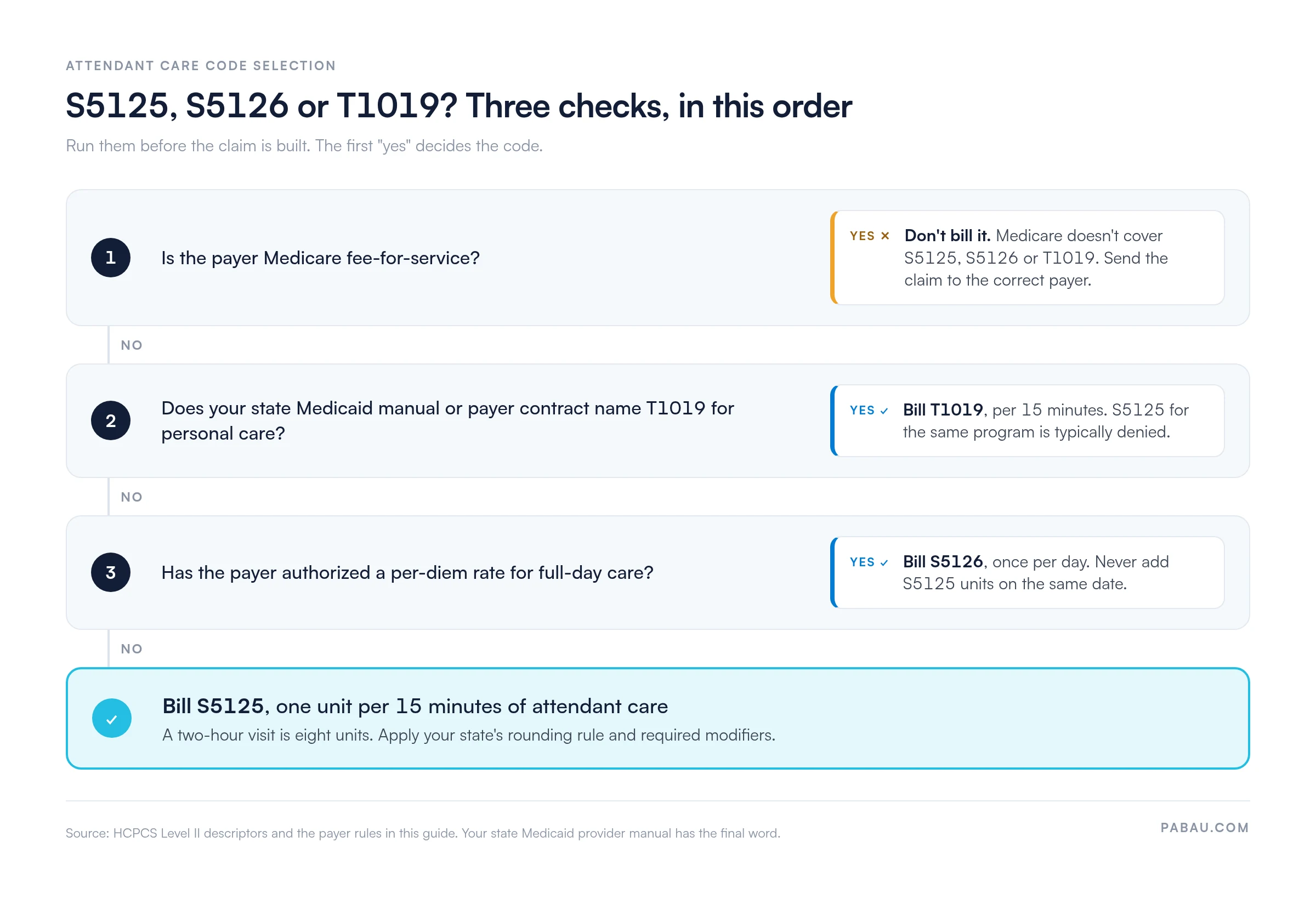
Accurate S5125 attendant care billing needs three things right: the unit calculation, the modifier stack, and the place of service code. An error in any one of them is a common denial cause. If you’re new to the revenue cycle, our guide to medical billing covers the basics.
Each unit of S5125 equals 15 minutes of direct attendant care, so a two-hour visit equals eight units. Most state Medicaid programs round to the nearest 15-minute increment, while some round down to the last complete unit. Check your state’s rounding policy to avoid overbilling.
Modifier requirements vary by state Medicaid plan and managed care organization. Verify with your payer before treating any modifier as universally required.
Place of service: Home (POS 12) is the most common. Community-based HCBS services may use POS 99 (Other Place of Service), depending on state guidance. Using POS 11 (Office) on an S5125 claim is likely to trip an edit in the state’s Medicaid claims system.
Section 12006 of the 21st Century Cures Act mandates electronic visit verification for all Medicaid personal care services. S5125 is a personal care service code, so EVV applies whenever a state Medicaid program pays for it. Staying on top of medical billing compliance depends on capturing the six EVV data elements before each claim goes out.
EVV systems must capture and transmit six data elements per visit:
States that have implemented EVV hold or pend claims when EVV data is missing or doesn’t match the submitted units. Bill eight units for a visit whose EVV record shows 90 minutes, and the claim hits a unit mismatch edit.
Run a pre-submission EVV reconciliation check each billing cycle. Compare the units on each S5125 claim against the EVV system’s recorded start and end times before submitting. A mismatch caught before submission costs a few minutes. Caught after a denial, it costs an appeals cycle and the attendant’s unpaid time.
Most state Medicaid programs and nearly all HCBS waiver programs require prior authorization (PA) for S5125. The authorization is tied to the consumer’s care plan, which must be approved before services begin. Billing without an active authorization is the fastest path to a bulk denial across every claim in a billing period.
Every S5125 claim needs a documentation package that can withstand a post-payment audit. Auditors look for four proofs: the service was authorized, it was delivered, the attendant was qualified, and the care plan justified the scope. A clean claim submission starts with these records in order before the claim goes out.
S5125 denials fall into seven predictable categories, each with its own correction path. The reason codes behind them are explained in our guide to medical billing denial codes. Proactive denial management workflows catch most of them before they hit the remittance.
Each state’s Medicaid agency sets its own S5125 rate, and rates vary by waiver program and contract year. The table below lists states that publish an S5125 rate. Two of the figures are more than a decade old, so treat them as historical reference.
Published rates change, so verify the current figure on your state Medicaid agency’s official fee schedule before billing. The Medicare Informatics HCPCS tables and the AAPC HCPCS code lookup help confirm the current descriptor and coverage status for S5125.
Subscribe to your state Medicaid agency’s fee schedule update notices by email or through the provider portal. Rates for attendant care codes often adjust in January and July. A missed rate change can mean months of billing at the wrong amount, followed by underpayment or an overpayment recoupment demand.
Many home care billing teams track authorizations in a spreadsheet, visits in the EVV system, and claims in a clearinghouse portal. When those three records disagree, the first sign is usually a denial on the remittance.
Pabau’s claims management software runs validation checks every time you send a claim. Missing details such as membership numbers and authorization codes are caught before submission. In the US, claims go straight to the Claim.MD clearinghouse, with real-time eligibility checks available before the visit.
Each claim then carries a status on one dashboard: pending, submitted, processing, paid, or error. You post electronic remittance advice (ERA) against it, so an unpaid S5125 line is visible the day the remittance lands. Keep your state’s EVV system as the record of visit times, and reconcile units against it before each cycle.
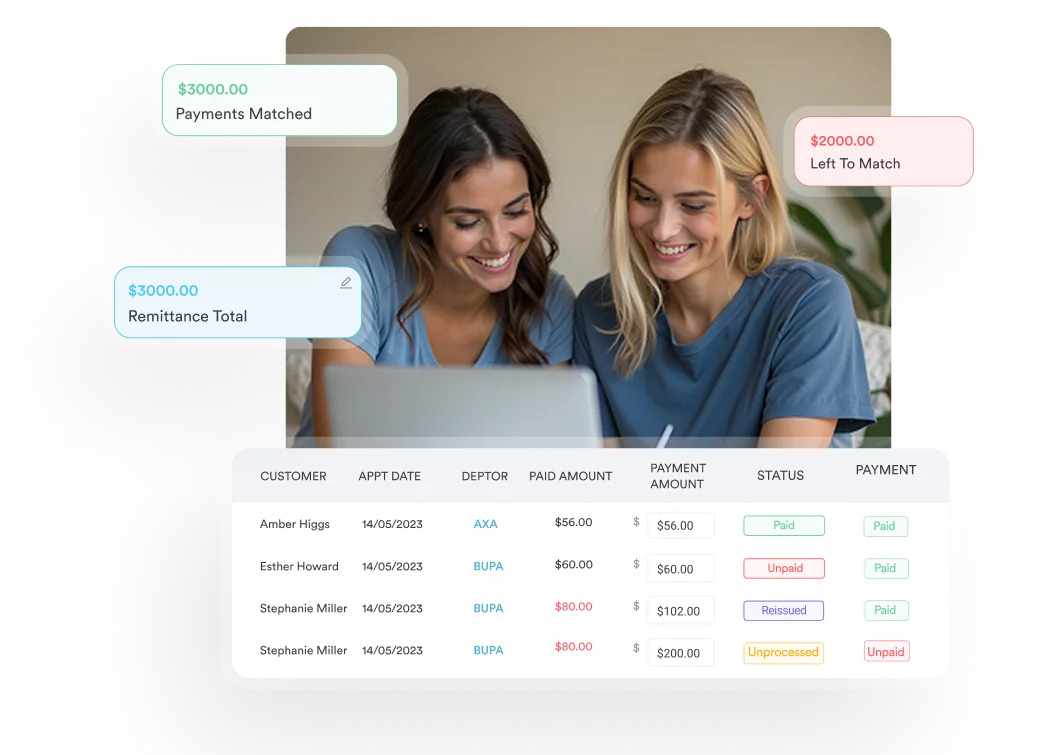
Catching a missing authorization or a unit mismatch before submission is far cheaper than appealing a denial weeks later.

Pabau checks each claim for missing details before submission and tracks it through to payment. Fewer attendant care claims come back denied.

Start with your state Medicaid provider manual before you touch the claim form. It settles whether you bill S5125, S5126 or T1019, which modifiers apply, and how units round. Settle those once per program, and the most common S5125 denials stop recurring.
The trade-off is discipline at the front end. Reconciling EVV records and checking authorizations every billing cycle takes a few hours. Skipping it costs appeals, recoupments and attendants’ unpaid time.
Book a demo to see how Pabau’s pre-submission checks and claim tracking help your team catch S5125 errors before they reach the payer.

Need to understand how clean claims are built? Clean claim submission guide walks through every field that Medicaid systems validate before processing payment.
Want to reduce billing denials across your practice? Denial management in healthcare covers the root-cause frameworks billing teams use to recover denied revenue.
Preparing for a billing audit? Medical billing compliance covers documentation standards, audit readiness, and payer-specific requirements.
Does your state bill personal care under T1019? HCPCS code T1019 explains the T-series personal care code most state Medicaid programs use.
HCPCS code S5125 covers attendant care services in 15-minute billing units. That includes help with activities of daily living (ADLs), instrumental activities of daily living (IADLs), supervision, and community escort. It’s used mainly for non-medical, custodial home care billed to Medicaid and participating private payers.
Both codes describe personal care aide services billed per 15 minutes. T1019 is a T-series code used by most state Medicaid programs, while S5125 is an S-series code accepted by commercial payers and select state programs. Your state Medicaid provider manual decides which one applies. The wrong code for your state’s program typically results in denial, however well the service is documented.
No. Medicare fee-for-service doesn’t recognize S-series HCPCS codes. The HCPCS National Panel assigns S-codes for use by non-Medicare payers. Submitting S5125 to Medicare results in an automatic rejection rather than a denial you can appeal.
Yes. Section 12006 of the 21st Century Cures Act requires EVV for all Medicaid personal care services, including attendant care billed under S5125. EVV must capture six data elements per visit: service type, recipient, provider, date, location, and start and end times. Claims without them can be held.
Most state Medicaid programs and nearly all HCBS waiver programs require prior authorization for S5125. Requirements vary by state and payer. Some require a functional assessment and physician order, while others need only a signed care plan. Billing without an active authorization is the single most common source of bulk claim denials for attendant care providers.
Published Medicaid rates for S5125 run from about $3.45 to $6.39 per 15-minute unit, depending on the state, program and task. Ohio pays $4.70 for personal care and $6.39 for nursing tasks, while Utah and Louisiana pay about $4.62 to $4.63. Verify the current rate on your state’s official fee schedule, since rates adjust periodically.