Pabau GO app

The new Pabau GO is heredownload on the App Store

Download on the App Store
Book a demo Book a demo
Billing Codes

HCPCS code J7604: Acetylcysteine nebulizer billing guide 2026

Key Takeaways

Key Takeaways

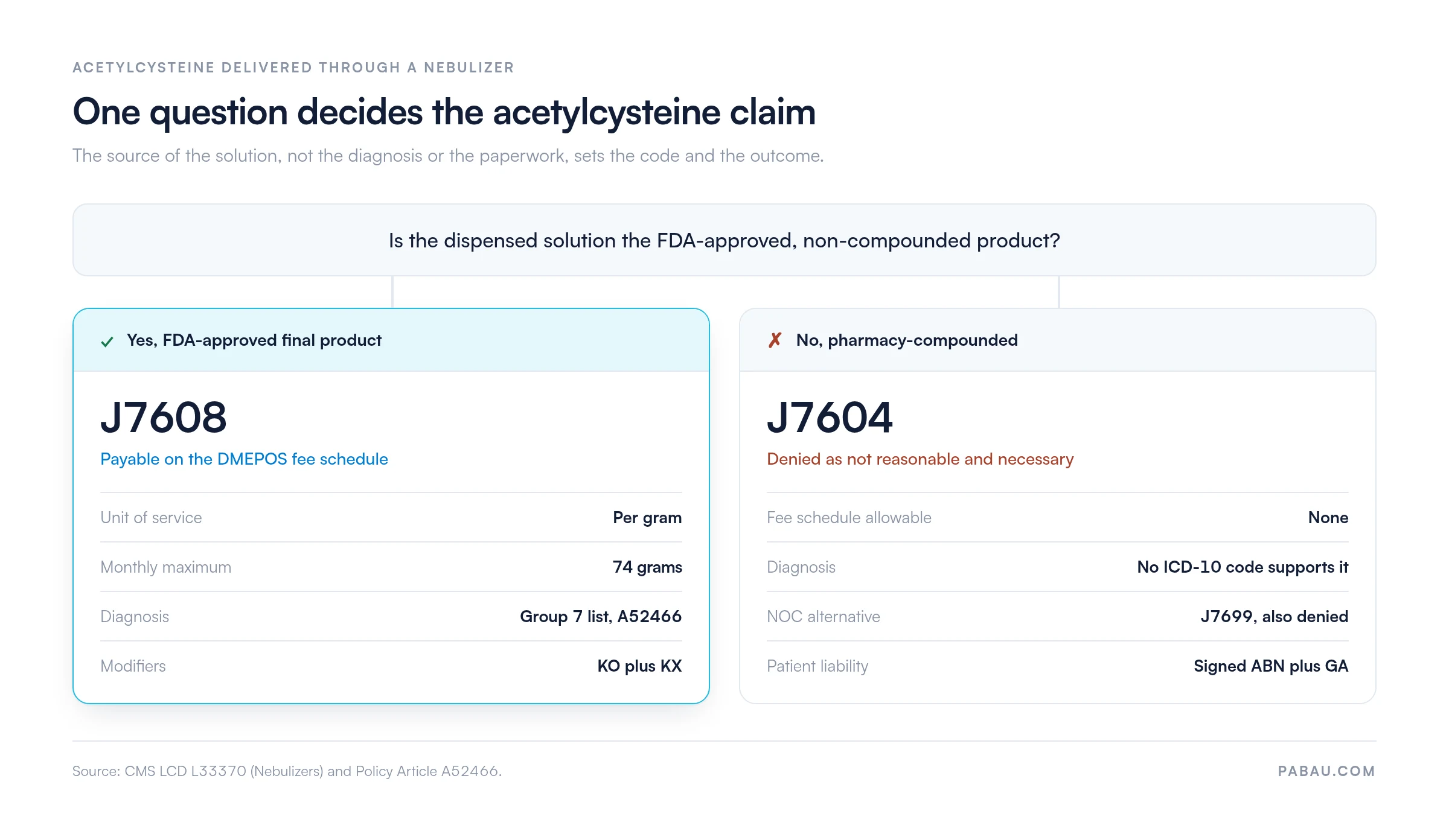
HCPCS code J7604 describes acetylcysteine inhalation solution, compounded product, administered through DME, unit dose form, per gram.

Medicare does not pay J7604. LCD L33370 names it among the compounded inhalation solutions that are denied as not reasonable and necessary, so there is no fee schedule allowable to look up.

It is not a documentation or modifier problem. Policy Article A52466 lists J7604 under “ICD-10-CM Codes that DO NOT Support Medical Necessity,” covering all ICD-10 codes.

J7608 is the only payable acetylcysteine nebulizer code. It covers the FDA-approved, non-compounded unit dose product for persistent thick or tenacious pulmonary secretions, capped at 74 grams per month.

J7609 is compounded albuterol, not acetylcysteine, so it does not belong in an acetylcysteine crosswalk.

If the patient still needs the compounded solution, expect the denial: get a signed ABN and append the GA modifier so the charge can be shifted to the patient.

HCPCS code J7604 looks like an ordinary durable medical equipment drug code, and billing it like one is why so many acetylcysteine claims come back at zero. Medicare denies J7604 outright. The nebulizer Local Coverage Determination names the code among the compounded inhalation solutions that are denied as not reasonable and necessary, and the companion policy article confirms that no diagnosis code will support it. No amount of documentation changes that answer. This guide explains what J7604 actually describes, why it is non-payable, and how to bill acetylcysteine correctly with J7608, the FDA-approved non-compounded code Medicare does cover. Getting this right is medical billing fundamentals applied to a code that reads more forgiving than it is.

Found our content helpful?

HCPCS code J7604: full descriptor and code attributes

The official HCPCS descriptor for J7604 is: Acetylcysteine, inhalation solution, compounded product, administered through DME, unit dose form, per gram. Two words in that descriptor decide everything. “Compounded” tells you the solution was mixed by a pharmacy rather than supplied as an FDA-approved final product, and that single attribute is what makes the code non-payable under Medicare.

Attribute Value Billing implication
Code J7604 HCPCS Level II J-code, inhalation drug range
Drug Acetylcysteine (N-acetylcysteine, NAC) Mucolytic agent for thick or tenacious pulmonary secretions
Formulation Compounded product Mixed by a pharmacy that is not an FDA-approved manufacturer
Delivery route Administered through DME (nebulizer) Falls under the DME MAC nebulizer policy, not the physician fee schedule
Dose form Unit dose form Pre-measured single-use vials, ready to nebulize without a separate diluent
Billing unit Per gram One unit of service equals one gram of acetylcysteine
Code status Active, but non-payable under Medicare The code exists in HCPCS; that is not the same as being reimbursable
Medicare payment status Denied as not reasonable and necessary Named in LCD L33370 among the compounded inhalation solutions that are denied

CMS defines a compounded inhalation solution as one that is not an FDA-approved preparation, produced by a pharmacy that is not an FDA-approved manufacturer, and involving the mixing, combining, or altering of ingredients for an individual beneficiary. That definition is broad. Even when one of the ingredients starts life as an FDA-approved product, mixing it with anything else makes the dispensed solution compounded. If the patient instead receives the FDA-approved, commercially manufactured acetylcysteine unit dose solution, the correct code is J7608, and that code is payable.

Medicare coverage: why J7604 is denied every time

CMS Local Coverage Determination L33370 (Nebulizers) settles the question in one sentence: “Compounded inhalation solutions (J7604, J7607, J7609, J7610, … and compounded solutions billed with J7699) will be denied as not reasonable and necessary.” J7604 is the first code on that list. CMS repeats the point in its own Medicare Learning Network compliance material on nebulizers and related drugs.

The companion CMS Nebulizers Policy Article A52466 closes the remaining door. J7604 appears in the section headed “ICD-10-CM Codes that DO NOT Support Medical Necessity,” in a group whose paragraph reads: “For HCPCS codes A7009, E0575, J7604, J7607, J7609, … all ICD-10 codes.” Every diagnosis in the code set fails. There is no covered indication to document toward and no modifier that unlocks payment.

That distinction matters because most denial guidance assumes the code is payable and the paperwork is at fault. Here the code itself is the problem. A denied J7604 line is a correct adjudication, not an error to appeal, so routing it into an appeals queue burns staff time for a result that will not change. Sound denial management workflows separate claims worth reworking from claims that were never payable.

There is one more trap. A52466 states that J7608 “may only be used for inhalation solutions which are FDA-approved,” and that if compounded versions are provided “they must be billed using code J7699 (NOC DRUGS, INHALATION SOLUTION ADMINISTERED THROUGH DME).” But LCD L33370 also denies compounded solutions billed with J7699. Follow the coding rule correctly and the claim still pays nothing. Under Medicare there is no payable route for a compounded acetylcysteine nebulizer solution, whichever code you reach for.

The denial can also spread past the drug line. LCD L33370 states that if none of the drugs used with a nebulizer are covered, the compressor, the nebulizer, and other related accessories and supplies are denied as not reasonable and necessary too. A practice dispensing only compounded acetylcysteine can therefore lose the equipment claim alongside the drug claim.

  • A pharmacy-compounded acetylcysteine solution has no payable Medicare code, so the choice is to switch to the FDA-approved product or to bill with a signed ABN.
  • Because a denial is expected, append the GA modifier when you hold a properly executed Advance Beneficiary Notice, or GZ when you do not.
  • GA transfers financial liability to the beneficiary. GZ does not, and it flags the line for review.
  • A line billed without KX, GA, or GZ is rejected as missing information before medical necessity is even assessed.
  • Dispensing fees (G0333, Q0513, Q0514) are payable only alongside a covered inhalation drug, so a denied compounded line earns no dispensing fee either.

J7604 payment status and the J7608 fee schedule

There is no 2026 rate to look up for J7604. Because the code is denied as not reasonable and necessary, Medicare publishes no DMEPOS fee schedule allowable for it, and a submitted line adjudicates at zero. Any third-party site quoting a national average for J7604 is reporting billed charges or a carrier placeholder, not a Medicare payment rate.

J7608 is the code with real money attached. It sits on the DMEPOS fee schedule, is priced per gram, and is adjusted by jurisdiction, so pull the current figure for your own MAC from the CMS DMEPOS fee schedule rather than relying on a published average. LCD L33370 caps acetylcysteine at 74 grams per month, and quantities beyond that cap are not reasonable and necessary regardless of the diagnosis.

Code Medicare payment status What to expect on the remittance
J7604 Non-payable. Denied as not reasonable and necessary Zero allowed. Patient liability only where a signed ABN supports a GA modifier
J7699 (compounded solution) Non-payable when the solution dispensed is compounded Denied under the same LCD L33370 provision as J7604
J7608 Payable under the DMEPOS fee schedule, priced per gram Paid up to 74 grams per month with a Group 7 diagnosis and a KX modifier
G0333, Q0513, Q0514 Dispensing fees, payable only with a covered inhalation drug No dispensing fee is payable on a denied compounded line
J7999 Invalid for nebulizer drugs Denied as incorrect coding; CMS prohibits J7999 for compounded nebulizer solutions

Reviewing payer rates quarterly is still good practice, but for this code family the review is short. Confirm the current J7608 allowable for your jurisdiction, confirm the 74 gram cap has not moved in the annual LCD update, and confirm nothing in your formulary is still routing compounded acetylcysteine to J7604. That is the whole exercise, and it belongs in the same calendar slot as the rest of your revenue cycle management housekeeping.

ICD-10 diagnosis codes: none support J7604, Group 7 supports J7608

Most code guides open this section with a list of covered diagnoses. For J7604 the list is empty by design. Policy Article A52466 places the code in its “ICD-10-CM Codes that DO NOT Support Medical Necessity” section and specifies “all ICD-10 codes.” Adding J44.1 or E84.0 to a J7604 claim does not rescue it, and searching for a better diagnosis is time spent on a code that cannot pay.

The diagnoses below matter for J7608, the payable code, where A52466 lists 141 ICD-10-CM codes in Group 7. The table is a representative sample of the respiratory diagnoses that come up most often in DME billing. Check the full Group 7 list in the policy article before you submit, because the sample is not the policy.

ICD-10-CM code Description Note
E84.0 Cystic fibrosis with pulmonary manifestations In Group 7. E84.9, cystic fibrosis unspecified, is not
J41.0 Simple chronic bronchitis In Group 7
J41.1 Mucopurulent chronic bronchitis In Group 7. Often the more accurate code where secretions are purulent
J42 Unspecified chronic bronchitis In Group 7. Use a more specific code where the record supports one
J43.9 Emphysema, unspecified In Group 7, along with the rest of the J43 subcategory
J44.0 COPD with (acute) lower respiratory infection In Group 7
J44.1 COPD with (acute) exacerbation In Group 7. Document exacerbation severity in the record
J44.81 Bronchiolitis obliterans and bronchiolitis obliterans syndrome In Group 7
J44.9 COPD, unspecified In Group 7
J45.909 Unspecified asthma, uncomplicated In Group 7, along with the wider J45 asthma range
J47.0 Bronchiectasis with acute lower respiratory infection In Group 7
J47.1 Bronchiectasis with (acute) exacerbation In Group 7
J47.9 Bronchiectasis, uncomplicated In Group 7. Document the ongoing mucolytic need
J69.0 Pneumonitis due to inhalation of food and vomit In Group 7, with the pneumonia and pneumonitis codes around it

The E84 pair is worth a second look, because it catches practices out. Group 7 includes E84.0, cystic fibrosis with pulmonary manifestations, but not E84.9, cystic fibrosis unspecified. A record that documents pulmonary involvement should be coded to E84.0, and coding to the unspecified option turns a supportable claim into a denial. The same logic runs through the list: the specific code is usually the covered one.

A diagnosis code describing the condition that necessitates nebulizer therapy has to appear on every claim for the equipment, the accessories, and the drugs. Checking that at the point of service, alongside insurance eligibility verification, is cheaper than discovering the gap on a remittance six weeks later.

Documentation requirements for acetylcysteine nebulizer claims

Documentation will not make J7604 payable, so the requirements below are what a J7608 claim needs. LCD L33370 is direct about the starting point: a Standard Written Order must reach the supplier before the claim is submitted, and billing without a completed SWO means the claim is denied as not reasonable and necessary. The LCD also restricts who may bill, stating that claims submitted by entities not licensed by the state to dispense drugs will be denied for lack of medical necessity.

Initial order requirements

  • Standard Written Order (SWO): beneficiary name, order date, a general description or brand name of the item, quantity where applicable, and the treating practitioner’s name, NPI, and signature
  • Drug detail: acetylcysteine identified by name, with concentration, dose, frequency, and route recorded in the order or the medical record
  • Product confirmation: written evidence that the solution dispensed is the FDA-approved, non-compounded unit dose product, because a compounded solution moves the claim outside coverage entirely
  • Supporting diagnosis: a Group 7 ICD-10-CM code in the medical record that matches the code on the claim
  • Clinical justification: practitioner documentation of persistent thick or tenacious pulmonary secretions, which is the covered indication in LCD L33370
  • Nebulizer coverage: evidence the beneficiary has a covered nebulizer and compressor in place under the same policy

Ongoing refill documentation

  • Dispensing records confirming the grams supplied per delivery, kept within the 74 grams per month maximum
  • Refill requests initiated no earlier than the interval the DME MAC allows, with evidence the beneficiary is nearly out of the previous supply
  • Proof of delivery for each shipment
  • Documentation of continued medical necessity and continued use
  • Records of any change in product, concentration, or frequency, including any switch between compounded and FDA-approved solutions

Keeping dispensing records aligned with the units on the claim is where suppliers most often lose money on this policy. J7608 is billed per gram, and an auditor comparing 30 billed grams against a 28 gram dispensing log has found an overpayment without needing a clinical opinion. The same standard behind superbill documentation applies: the file should let a reviewer reconstruct the episode from paperwork alone.

Pro Tip

Before anything is dispensed, confirm in writing whether the acetylcysteine is the FDA-approved unit dose product or a pharmacy-compounded solution. That single question decides whether the claim is a payable J7608 or a guaranteed J7604 denial, and it is far cheaper to ask the pharmacy than to discover the answer on a remittance.

How to bill acetylcysteine through DME: claim submission and modifiers

Acetylcysteine nebulizer solution is billed on a CMS-1500 claim form, or its electronic equivalent the 837P, by a supplier enrolled with the DME MAC. The practitioner who orders nebulizer therapy does not bill the drug; the supplier who dispenses it does. Pabau’s claims management software gives billing teams a single place to prepare, submit, and track those claims, and to see where each one stands after submission.

Pabau billing dashboard showing claims prepared and submitted from within the patient record
Claims are built from the same record that holds the order and the dispensing history, so nothing is rekeyed between the chart and the claim.

Step-by-step billing workflow

  1. Confirm the product first: establish whether the solution is the FDA-approved non-compounded unit dose product (J7608) or a pharmacy-compounded solution (J7604, which Medicare denies)
  2. Verify eligibility and the DME benefit: confirm active Medicare Part B coverage and that the beneficiary has a covered nebulizer and compressor under LCD L33370
  3. Confirm supplier enrollment and licensure: the billing NPI must be enrolled with the DME MAC, and the entity must be licensed by the state to dispense drugs
  4. Obtain the SWO before submission: the order must reach the supplier before the claim goes out, not afterwards
  5. Check the diagnosis against Group 7: confirm the ICD-10-CM code on the claim appears in the A52466 Group 7 list for J7608
  6. Calculate units in grams: total the grams of acetylcysteine dispensed and keep the monthly total within 74 grams
  7. Apply the right modifiers: KO for a single-drug unit dose container, plus KX, GA, or GZ depending on whether the LCD criteria are met
  8. Submit on the CMS-1500 or 837P: the code in field 24D, units in 24G, supporting diagnosis codes in 21A to 21L, and the supplier NPI in field 33
  9. Retain the file: keep the SWO, dispensing records, proof of delivery, and clinical documentation accessible for audit

Modifiers used with acetylcysteine nebulizer claims

Modifier Name How it applies
KO Single drug unit dose formulation Required on J7608 when one drug is in the unit dose container. A unit dose code billed without KO, KP, or KQ is denied as an invalid code
KP / KQ First / subsequent drug of a multiple drug unit dose formulation Not usable on J7608. A52466 lists J7608 among the FDA-approved unit dose codes that are rejected as invalid when billed with KP or KQ
KX Requirements specified in the medical policy have been met Added when every coverage criterion in LCD L33370 is met, with the supporting evidence held on file
GA Waiver of liability on file, signed ABN Used where a denial is expected and a properly executed ABN was obtained. This is the modifier for a compounded solution the patient still wants
GZ Expected to be denied, no ABN on file Used where a denial is expected but no valid ABN was obtained. Liability cannot be shifted to the beneficiary
JW / JZ Discarded drug amount / no discarded amount JW reports unused drug discarded from a single-dose container. JZ attests that none was discarded, and has been required since 1 July 2023
NU / RR New equipment / rental These belong on the nebulizer equipment code, never on the drug line

The KX, GA, and GZ family is not optional. A52466 states that claim lines billed without one of the three are rejected as missing information, so a technically perfect J7608 claim still fails if that modifier is absent. For reference on the wider J7600 to J7699 range, the AAPC HCPCS code reference is a reasonable second check, though the DME MAC policy is the authority.

Keep your nebulizer drug claims moving

Pabau’s claims management tools give billing teams one place to prepare, submit, and track claims, with the order, the patient record, and the claim history in the same system.

Pabau claims management dashboard

The acetylcysteine inhalation family is smaller than it looks. There are exactly two acetylcysteine nebulizer codes, one compounded and one not, plus the not-otherwise-classified codes that catch everything else. J7609 is often listed alongside them in third-party crosswalks, and that is simply wrong: J7609 is albuterol, inhalation solution, compounded product, administered through DME, unit dose, 1 mg. Different drug, different unit of service, no relationship to acetylcysteine at all. A clean claim starts with a crosswalk that reflects the code set rather than a copied table.

Code Descriptor Compounded? Form When it applies
J7604 Acetylcysteine, inhalation solution, compounded product, administered through DME, unit dose form, per gram Yes Unit dose Describes the compounded product, but Medicare denies it as not reasonable and necessary
J7608 Acetylcysteine, inhalation solution, FDA-approved final product, non-compounded, administered through DME, unit dose form, per gram No Unit dose The FDA-approved product is dispensed for persistent thick or tenacious secretions. This is the payable code
J7699 NOC drugs, inhalation solution administered through DME Either Various An inhalation drug has no valid specific code. A52466 routes compounded acetylcysteine here, but L33370 denies compounded solutions billed this way
J7999 Compounded drug, not otherwise classified Yes Various Never for nebulizer drugs. CMS denies compounded nebulizer claims billed with J7999 as incorrect coding
J7609 Albuterol, inhalation solution, compounded product, administered through DME, unit dose, 1 mg Yes Unit dose Not an acetylcysteine code. Listed here only because it is so often miscrosswalked to J7604

The practical rule is short. If the acetylcysteine is FDA-approved and non-compounded, bill J7608. If it is compounded, no Medicare code pays, and the decision moves from coding to whether the patient will accept liability under an ABN.

Common billing errors and how to avoid them

Acetylcysteine denials follow a short and predictable list. Most of them are decided before the claim is built, at the moment somebody chooses a code for the product in the box.

Error Why it causes a denial Correct action
Billing J7604 to Medicare at all The code is denied as not reasonable and necessary under LCD L33370, and no ICD-10 code supports it Switch to the FDA-approved product and bill J7608, or bill with a signed ABN and the GA modifier
Appealing a J7604 denial The denial is a correct application of policy, not a processing error Close the claim, correct the product or the liability paperwork, and stop the rework
Using J7608 for a compounded solution A52466 restricts J7608 to FDA-approved inhalation solutions Confirm the product source in writing before coding
Treating J7609 as an acetylcysteine code J7609 is compounded albuterol billed per 1 mg, so the drug and the unit of service are both wrong Use J7608 for FDA-approved acetylcysteine and keep J7609 out of the crosswalk
Unit dose code with no KO, KP, or KQ A unit dose form code without one of the three is denied as an invalid code Add KO for a single-drug unit dose container
KP or KQ appended to J7608 J7608 is on the list of FDA-approved unit dose codes rejected as invalid with KP or KQ J7608 takes KO only
No KX, GA, or GZ on the line Claim lines without one of the three are rejected as missing information Use KX when every LCD criterion is met, GA or GZ when they are not
Billing more than 74 grams a month LCD L33370 sets 74 grams per month as the reasonable and necessary maximum for acetylcysteine Track monthly totals across all shipments and pharmacies
No SWO before submission Billing before a completed SWO reaches the supplier is denied as not reasonable and necessary Hold the claim until the signed order is in hand

The denial codes in medical billing that land on these claims are worth reading closely, because they tell you which bucket the failure belongs to. CO-50, not deemed a medical necessity, is what a J7604 line returns and it means the claim was never payable. CO-4, the procedure code is inconsistent with the modifier used, points at the KO, KP, and KQ rules and is genuinely fixable.

Payer-specific considerations beyond Medicare

Medicare’s position on J7604 is settled, but it does not automatically bind every payer, and it would be misleading to claim that commercial plans routinely cover compounded inhalation solutions. What is reliable is the process for finding out, in writing, before anything is dispensed.

  • Medicare Advantage: Part C plans apply Medicare national and local coverage policy as their floor, so an LCD denial for compounded inhalation solutions carries across. Treat J7604 as non-payable unless the plan documents otherwise in writing.
  • Medicaid: coverage of compounded drugs is set state by state through the program’s own formulary and prior authorization rules. Ask the state program or the managed care organization directly, and get the answer in writing before dispensing.
  • Commercial payers: policies on compounded products vary by plan and are usually managed through prior authorization rather than a published code list. A pre-service determination naming the specific product is the only dependable answer.
  • Secondary payers: where Medicare is primary and denies the line, there is generally no Medicare allowable for a secondary plan to coordinate against. Check how the secondary plan treats a primary denial before you bill it.

The pattern worth building into the workflow is simple: for a compounded inhalation solution, no claim goes out without either a written coverage determination or a signed ABN. The right medical billing software keeps those determinations attached to the patient record where the billing team can see them, and a working grasp of HIPAA compliance for medical offices underpins the retention standards that keep that file defensible at audit.

Pro Tip

Build a one-page rule for your top payers covering compounded inhalation solutions: payable or not, prior authorization required or not, and which form the determination has to take. For Medicare the entry is already written, and it says no. Review it after each annual LCD update.

How Pabau supports nebulizer drug billing workflows

Most of the failures on this policy happen upstream of the claim. The product detail lives in a pharmacy record, the order lives in the chart, the dispensing history lives in a spreadsheet, and the claim gets built from whichever of the three the biller can find. By the time a CO-50 comes back, nobody can say quickly whether the solution was compounded or who signed the order.

Pabau keeps the clinical record and the billing work in one system, so the order, the documentation, and the claim history sit against the same patient rather than in separate tools. Claims are prepared and submitted from that record, and their status is visible in the same place afterwards, which shortens the time between a denial arriving and somebody understanding why.

That will not make a compounded acetylcysteine claim payable, and no software can. What it does is make the decision visible before dispensing, and give the billing team a complete file to work from when a payer asks questions about the ones that were.

Conclusion

J7604 is a real HCPCS code that Medicare will not pay. LCD L33370 denies compounded inhalation solutions as not reasonable and necessary, Policy Article A52466 confirms that no ICD-10 code supports the code, and there is no fee schedule allowable behind it. Recognising that early is worth more than any documentation improvement, because it redirects the work from appealing denials to choosing the right product in the first place.

Where the patient has persistent thick or tenacious pulmonary secretions and receives the FDA-approved, non-compounded unit dose solution, J7608 is the code, capped at 74 grams a month, supported by the Group 7 diagnosis list, and billed with KO plus KX. Where the product is compounded, the honest answer to the patient is an ABN rather than an appeal.

Pabau’s claims management tools keep the order, the patient record, and the claim in one system so billing teams can prepare, submit, and follow up on claims without switching between them. To see how it works in practice, book a demo with the Pabau team.

Continue your research

Continue your research

Need a primer on the broader HCPCS system? Medical billing fundamentals covers how HCPCS Level II codes fit into the overall claims process.

Want to reduce claim rejections across all payer types? Denial management in healthcare outlines a systematic approach to reducing repeat denials.

Building a compliant DME billing workflow from scratch? Medical billing compliance covers documentation standards, audit readiness, and payer rule management.

Frequently asked questions

What is HCPCS code J7604?

HCPCS code J7604 describes acetylcysteine, inhalation solution, compounded product, administered through DME, unit dose form, per gram. It identifies a pharmacy-compounded mucolytic solution delivered by nebulizer, billed in units of one gram. The code is active in HCPCS, but Medicare denies it as not reasonable and necessary, so it is a valid descriptor rather than a payable claim line.

Is J7604 covered under Medicare Part B?

No. CMS Local Coverage Determination L33370 states that compounded inhalation solutions, listing J7604 first, will be denied as not reasonable and necessary. Policy Article A52466 reinforces this by placing J7604 under “ICD-10-CM Codes that DO NOT Support Medical Necessity” for all ICD-10 codes. There is no fee schedule allowable and no diagnosis or documentation combination that makes the code payable. If the patient still wants the compounded product, obtain a signed ABN and append the GA modifier so the charge can be shifted to them.

Which acetylcysteine nebulizer code does Medicare actually pay?

J7608, described as acetylcysteine, inhalation solution, FDA-approved final product, non-compounded, administered through DME, unit dose form, per gram. LCD L33370 covers it for persistent thick or tenacious pulmonary secretions, caps it at 74 grams per month, and points to the Group 7 diagnosis list in Policy Article A52466 for supporting ICD-10 codes. Bill it with the KO modifier for a single-drug unit dose container, plus KX when all coverage criteria are met.

What is the difference between J7604 and J7608?

The difference is the source of the solution. J7604 covers a pharmacy-compounded acetylcysteine unit dose solution, and Medicare denies it. J7608 covers the FDA-approved, non-compounded acetylcysteine unit dose product, and Medicare pays it under the DMEPOS fee schedule. Both are unit dose codes billed per gram, so the descriptor “concentrated” does not apply to either. Confirming which product the pharmacy dispensed is the step that decides the claim.

Is J7609 related to J7604?

No, and treating it as an acetylcysteine code is a common crosswalk error. J7609 is albuterol, inhalation solution, compounded product, administered through DME, unit dose, 1 mg. It is a different drug with a different unit of service, and it should not appear in any J7604 or J7608 comparison. Like J7604, it is on the LCD L33370 list of compounded solutions denied as not reasonable and necessary.

Can J7604 be billed for patients with COPD?

It can be submitted, but it will be denied. COPD codes such as J44.0, J44.1, and J44.9 support medical necessity for J7608, not for J7604, because A52466 states that no ICD-10 code supports J7604. For a COPD patient with persistent thick or tenacious secretions, the correct approach is to dispense the FDA-approved non-compounded product and bill J7608 with the COPD diagnosis, within the 74 grams per month maximum.

What documentation is required to bill acetylcysteine through a nebulizer?

For J7608: a Standard Written Order communicated to the supplier before the claim is submitted, a Group 7 ICD-10-CM code in the medical record that matches the claim, practitioner documentation of persistent thick or tenacious pulmonary secretions, evidence of a covered nebulizer, dispensing records showing the grams supplied, proof of delivery, and refill documentation for repeat shipments. The supplier must also be enrolled with the DME MAC and licensed by the state to dispense drugs.

Do commercial payers cover compounded acetylcysteine?

It varies by plan and cannot be assumed either way. Medicare Advantage plans apply Medicare coverage policy as their floor, so an LCD denial generally carries across. Medicaid programs set compounded-drug coverage state by state, and commercial plans usually handle these products through prior authorization rather than a published code list. Get a written pre-service determination naming the specific product before dispensing.

Found our content helpful?
×