

CCSD code G5100: Bypass of duodenum billing guide
CCSD code G5100 bills a bypass that leaves the duodenum in place CCSD code G5100...

Last Updated: Oct 16, 2026
J2930 is the HCPCS Level II code for injection, methylprednisolone sodium succinate, up to 125 mg. CMS terminated it with effect from 31 March 2024, so it is no longer valid for claims after that date.
HCPCS code J2930 no longer exists. It covered injectable methylprednisolone sodium succinate, up to 125 mg, and CMS deleted it for dates of service from April 1, 2024. J2920 went on the same day. CMS replaced both with a single code, J2919, described as injection, methylprednisolone sodium succinate, 5 mg.
That 5 mg unit is what catches billers out. A 1,000 mg infusion now reports 200 units, where the old code took 8. Keep the old math and the practice underbills by thousands without ever seeing a denial.
Let Pabau's smart automation suggest the right codes, reduce claim denials, and keep your practice compliant—effortlessly.
Automate repetitive tasks and focus on what matters most—your patients.
Reduce coding errors and ensure compliance with the latest regulations.
Clean claims, fewer denials, and faster reimbursements.
Powerful insights and reporting to help your practice thrive.
HIPAA compliant SOC 2 certified GDPR-compliant Trusted by 4,000+ clinics worldwide

HCPCS code J2930 covered injectable methylprednisolone sodium succinate, up to 125 mg. CMS deleted it for dates of service from April 1, 2024.
J2920 described the same drug at up to 40 mg, and it went on the same date. One code replaced both.
J2919 reads injection, methylprednisolone sodium succinate, 5 mg. Divide the milligrams given by 5 to get the units.
A 1,000 mg infusion now reports 200 units. The old J2930 math would have billed the same dose as 8.
Every J2919 line needs modifier JW when drug was discarded from a single-dose vial, or JZ when none was.
Depo-Medrol is a different salt. Methylprednisolone acetate bills under J1010 at 1 mg per unit, not under J2919.
J2930 was a Level II J-code maintained by the Centers for Medicare and Medicaid Services (CMS). It reported injectable methylprednisolone sodium succinate on outpatient claims, and it was valid through March 31, 2024.
The table records the descriptor as it stood on its final valid day.
The drug itself has not changed. Methylprednisolone sodium succinate is a water-soluble corticosteroid, given for acute inflammatory conditions, autoimmune flares, and immunosuppressive regimens.
Because it is injected rather than swallowed, it sits in HCPCS Level II rather than under a CPT code. J-codes cover non-oral drugs and biologicals a patient cannot self-administer.
CMS removed J2930 and J2920 in the April 2024 HCPCS quarterly update and added J2919 the same day. Neither deleted code has a dose-specific successor to look up.
One code now covers the whole strength range, and the unit does the work the old tiers used to do.
Dates of service matter more than submission dates here. An infusion given on or before March 31, 2024 still belongs on J2930 or J2920, and that holds for late filings and reworked denials too. Any date of service from April 1, 2024 onward belongs on J2919.
Filing J2930 on a current date of service produces claim adjustment reason code 181: procedure code was invalid on the date of service.
The edit is automatic, so no clinical review or medical necessity argument is involved. Your remittance names the code as the problem, not the documentation.
The correction is a rebill rather than an appeal. Swap J2930 for J2919, recalculate the units at 5 mg each, then resubmit with the same NDC and administration record.
Telling the two routes apart starts with the reason code, and our guide to denial codes maps the ones a biller meets most often.
Deleted-code denials usually trace back to a stale charge master rather than a coder’s mistake. Three checks close the loop:
Off-cycle deletions like this one are easy to miss, because code file audits usually happen each January. This change landed in April. Checking the CMS quarterly HCPCS update every three months catches the next one sooner.
One unit of J2919 equals 5 mg of methylprednisolone sodium succinate. There is no “up to” language in the descriptor and no tier to choose. Take the milligrams documented as administered, divide by 5, then report that figure in the units field.
The right-hand column is there for one reason. A remittance showing 8 units paid on a 1,000 mg infusion means the claim went out on the old tiered logic.
The practice was paid for 40 mg of drug. Under-billing at that scale is invisible on a single claim and expensive across a pulse therapy course.
Round up to the next whole unit, and never round down to a tidier number. Most standard orders divide cleanly by 5, but weight-based pediatric doses often do not. A 62 mg dose works out to 12.4 units, so 13 units go on the claim.
Discarded drug bills separately from administered drug. When a single-dose vial leaves a remainder, report the wasted milligrams on their own line with modifier JW. Document the discarded amount in the record as well, and keep the administered milligrams on the primary line.
One of two modifiers belongs on every single-dose-vial line, and this has been mandatory since July 1, 2023. Use JW when drug was discarded, and JZ when none was. Since October 1, 2023, CMS returns single-dose-vial claims unprocessable when neither modifier is present.
Write the exact milligrams ordered and administered into the clinical record before anyone calculates units. Auditors compare the administered dose in the chart against the units on the claim line. With a 5 mg unit, a vague note turns into a large unit variance. A 1,000 mg infusion recorded only as one gram of Solu-Medrol leaves the coder without a figure to divide.
Methylprednisolone comes in two injectable salts, and each has its own HCPCS family. Mixing them is the oldest error on this drug, and the April 2024 update rewrote both families at once.
Two points are worth holding on to. J2920 was never the acetate code, despite how often it gets described that way. It carried the same sodium succinate descriptor as J2930, only at a lower milligram tier. The acetate codes have always run in the J10xx range, and CMS folded J1040 into J1010 on the same date.
The practical check is the vial, not the code book. A clear solution reconstituted from powder is sodium succinate and bills as J2919. The white suspension you shake before drawing up is acetate and bills as J1010. The unit basis differs too, at 5 mg for one and 1 mg for the other.
Medicare Part B covers outpatient drug injections a patient cannot self-administer. IV methylprednisolone sodium succinate given in a physician office or hospital outpatient department qualifies. Confirm the patient’s Part B benefit for that setting and diagnosis before the infusion date, not after it.
Payment runs on the Average Sales Price methodology. CMS publishes quarterly ASP files that set the office-setting allowance at ASP plus 6%, and hospital outpatient departments are paid under OPPS instead.
The per-unit rate is now expressed per 5 mg, so a payment limit that looks small on paper multiplies across a high unit count.
Medicaid coverage varies by state. Many state programs use the same J-codes, but allowed amounts and coverage criteria differ, and some states were slow to load J2919. Check the state fee schedule or the MAC portal before you assume Medicare rates apply.
Medicare and most commercial payers want the National Drug Code reported next to the HCPCS code on drug claims. The NDC is manufacturer-specific and names the exact product, package size, and labeler. Several manufacturers make methylprednisolone sodium succinate, and every one of those NDCs maps to J2919.
On an 837P electronic claim, the NDC goes in loop 2410 in the LIN segment, with the N4 qualifier ahead of the 11-digit number. The CTP segment in the same loop carries the drug quantity and unit of measure. Outside that loop, the SV1 segment holds the code, any modifier, and the unit count.
On the CMS-1500 paper form, the same information splits across box 24. The NDC goes in the shaded area of box 24A. Box 24D holds the procedure code and its modifier, and box 24G holds the unit count. Sending one of those to the wrong field is a rejection, not a denial.
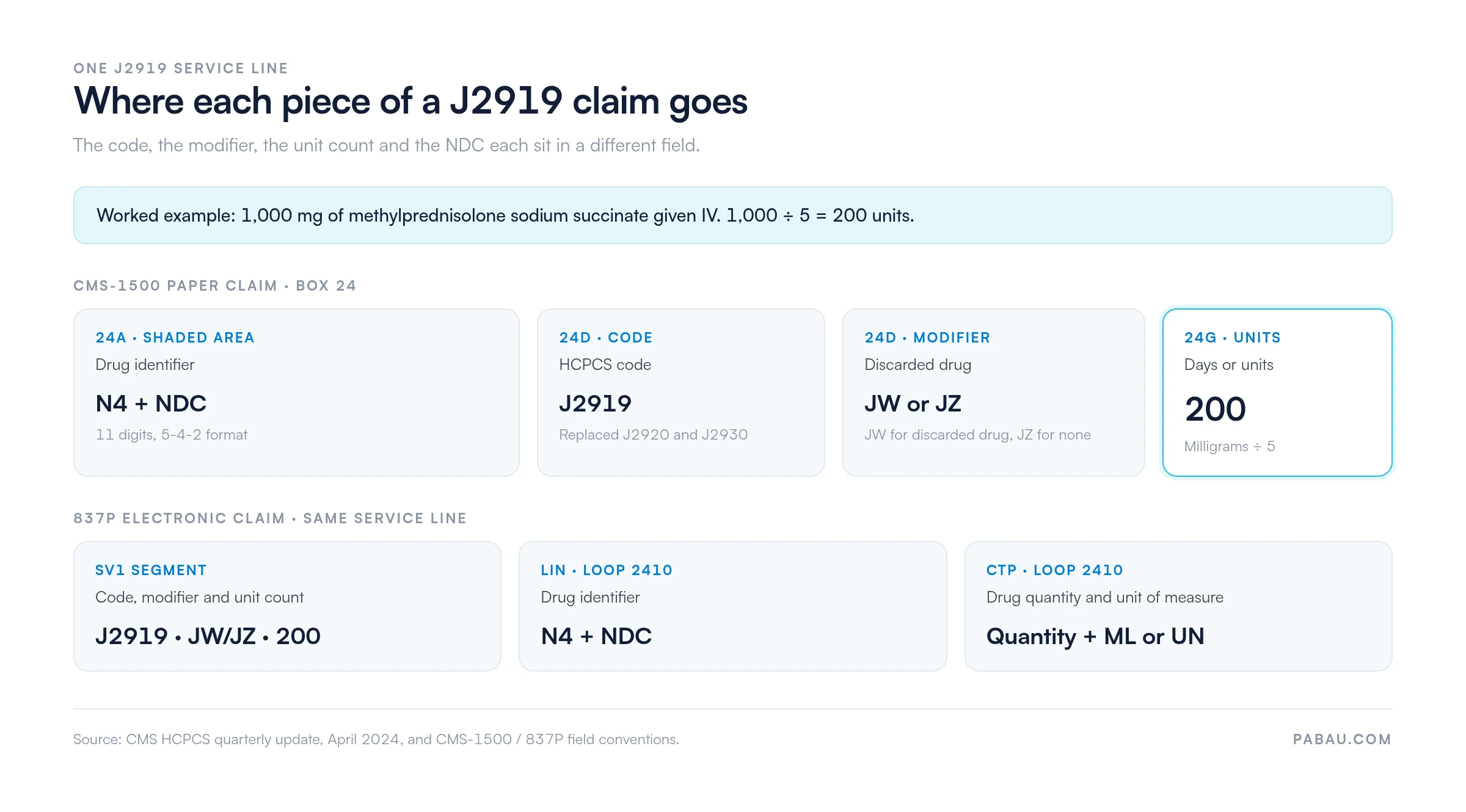
Payers pay J2919 on the strength of the administration record. The note has to show that the injection was clinically appropriate on that date of service, and it has to state the dose in milligrams.
A superbill for an injection practice should carry fields for dose, route, time, and the diagnosis that justifies the drug.
Record retention runs to seven years in most states, and payer contracts sometimes ask for longer. Store the administration record and the vial documentation together, because auditors read them as one exhibit.
Rheumatology and neurology run the highest unit counts, because pulse dosing is routine in both. The drug crosses plenty of other specialties too, and the billing context shifts with each one.
Local and national coverage determinations set out which ICD-10-CM codes support medical necessity for corticosteroid injections in each region. Read the applicable LCD before billing, especially for repeat pulse courses, which draw more scrutiny than a single dose.
Denials on this drug repeat in a narrow set of patterns. Knowing them lets a team build pre-submission checks instead of reworking the same rejection every month.
Track the denial rate on this drug month by month. A rate above 5% points at the code file or the unit conversion, rarely at one person’s typing.
Reconcile the paid units on your remittance against the milligrams in the chart once a quarter, on a sample of ten infusions. Under-billing never generates a denial, so it never lands in the work queue. A J2919 line paid at 8 units for a one gram infusion looks perfectly clean until somebody does that division.
You can catch most J2919 problems at the desk in under a minute. Run the line through this list before the batch is released.
A line that fails one of these gets fixed before submission, not after the remittance arrives.
In a lot of practices, drug claims live in two disconnected places. The dose sits in the clinical note, the code and units sit in a billing screen, and somebody retypes one into the other. That handoff is where a 125 mg entry becomes 1 unit instead of 25.
Practice management software like Pabau keeps the injection record and the claim in the same system. The dose, route, site, and indication recorded at the point of care stay on the client’s chart. Whoever prepares the claim reads the original note rather than a retyped copy.
Pabau’s claims management software then files the claim electronically through the clearinghouse for your region.
Before it goes, Pabau checks that the required claim fields are complete, including membership numbers and authorization codes. Incomplete claims stop at your desk instead of coming back weeks later as a rejection.

Practice management software like Pabau keeps dose, route, site, and indication on the client record. Claims then file electronically, with a check on the required fields before anything is sent.

Learning the new code takes a minute. Trusting it takes longer, because a 200-unit line looks wrong to anyone who billed the same infusion as 8. Coders who grew up on the “up to 125 mg” tiers will keep second-guessing that number. A claim held back for a second look is a claim that ages.
So fix it once in the charge master rather than case by case at the keyboard. Build the J2919 line so it calculates its own units from the documented milligrams. That takes the judgment out of the moment, and it protects the doses nobody flags. Under-billing never bounces back, which is exactly why it survives.
That fix only holds if the milligrams are written down clearly in the first place. Pabau keeps the injection record and the claim in one place, then checks the required fields before submission. Book a demo to see how that works for the drug claims your practice sends every week.

Need to understand how denials work across all billing codes? Denial management in healthcare covers the full appeal process, common payer denial patterns, and how to build a denial tracking workflow.
Looking for a structured approach to clean claim submission? Electronic remittance advice explains how to read ERA files, interpret adjustment reason codes, and reconcile payments against billed HCPCS units.
Billing another corticosteroid injection? HCPCS code J1040 walks through the parallel methylprednisolone acetate deletion and the single J1010 replacement code.
Yes. The drug and the service that delivers it bill separately. Report J2919 for the milligrams given, then the administration code, such as 96365 for an IV infusion or 96372 for an IM injection.
Yes, and pulse dosing can reach it. CMS publishes the per-day unit limit in its Medically Unlikely Edits table, which is refreshed quarterly. Check it before a high-dose claim goes out.
Revenue code 0636, drugs requiring detailed coding. Hospital outpatient claims report J2919 under that revenue code, with the unit count and the NDC on the same line.
Rarely under Medicare Part B, though commercial plans differ. Check the payer’s medical policy for corticosteroid infusions before scheduling, especially for a repeat pulse course.
Milligrams. One unit equals 5 mg of drug given, whatever the vial volume or the diluent used. The milliliter figure belongs in the NDC quantity field, not the units field.
In the diagnosis pointer, box 24E on the CMS-1500. Point the J2919 line at the ICD-10-CM code that justifies the corticosteroid, or the line risks a medical necessity denial.



