CPT Code 27425: Lateral retinacular release billing guide
CPT Code 27425: Official descriptor and procedure overview CPT code 27425 is def...

Last Updated: Nov 16, 2026
J2020 is the HCPCS Level II code for injection, linezolid, 200 mg. It reports intravenous linezolid, an antibiotic used against MRSA and vancomycin-resistant Enterococcus, at one unit per 200 mg administered.
A standard 600 mg adult dose bills as three units. Medicaid and many commercial payers also require the product's 11-digit NDC on the claim line. Hospira's linezolid has its own code, J2021, so the NDC decides which of the two applies.
Let Pabau's smart automation suggest the right codes, reduce claim denials, and keep your practice compliant—effortlessly.
Automate repetitive tasks and focus on what matters most—your patients.
Reduce coding errors and ensure compliance with the latest regulations.
Clean claims, fewer denials, and faster reimbursements.
Powerful insights and reporting to help your practice thrive.
HIPAA compliant SOC 2 certified GDPR-compliant Trusted by 4,000+ clinics worldwide

HCPCS code J2020 reports intravenous linezolid at 200 mg per unit, so a standard 600 mg adult dose bills as three units.
Bill the dose documented as administered, never the vial size, and put any discarded drug on its own line with modifier JW.
Medicare has required modifier JZ on single-dose container claims with no discarded drug since July 1, 2023.
Hospira’s linezolid has its own code, J2021, so check which code the product’s NDC maps to before billing.
Pabau records the infusion lot against the patient and tracks prior authorizations on the case, so the claim matches the chart.
HCPCS code J2020 is the Level II code for Injection, linezolid, 200 mg, billed at one unit per 200 mg administered. CMS’s HCPCS Table of Drugs lists linezolid 200 mg, given intravenously, under J2020.
Linezolid is an oxazolidinone antibiotic active against gram-positive organisms. They include vancomycin-resistant Enterococcus (VRE) and methicillin-resistant Staphylococcus aureus (MRSA).
Pfizer markets linezolid as Zyvox, and generic IV products are widely available. Most of them bill under J2020 whatever the manufacturer, provided the product is an FDA-approved injectable.
Hospira’s product is the exception, with its own code covered in the J2021 section. The table below summarizes the identifiers coders need before submitting a claim.
Medicare Part B covers drugs furnished incident to a physician’s service when they are not usually self-administered. The Medicare Benefit Policy Manual tells contractors to presume that intravenous drugs meet that test. That is why IV linezolid bills under Part B with a J-code, while the oral tablets do not.
J2020 sits in the J range of HCPCS Level II, the drugs administered other than by mouth. Our HCPCS procedure code guides cover the neighboring drug and supply codes.
J2020 covers FDA-approved IV linezolid in any strength, as long as the billed units match the administered dose in 200 mg increments. The list below sets out what falls inside the code and what falls outside it.
The oral exclusion trips up practices that transition a patient from IV to oral therapy mid-stay. Once the route changes to oral, J2020 must stop appearing on the claim. Submit only for days and doses where IV administration is documented in the medical record.
J2021 is a separate HCPCS code for linezolid made by Hospira (now Pfizer Injectables). Both codes cover injectable linezolid at 200 mg per unit, but CMS assigns them to different products. Billing the code that does not match the product’s NDC is a denial risk.
Before billing, look up the administered product’s NDC in the AAPC HCPCS code lookup or the CMS NDC-HCPCS crosswalk. Confirm which J-code that NDC maps to. When the NDC and J-code do not match, payers return the claim as unbillable.
Accurate billing for HCPCS code J2020 depends on three checks: the unit count, the NDC line, and the place-of-service code. An error in any one of them can produce a denial.
One unit of J2020 equals 200 mg of administered linezolid, so a standard 600 mg adult dose bills as 3 units. Bill only the dose documented as administered, not the full container. Any discarded remainder from a single-dose container goes on its own line with modifier JW, covered in the modifiers section.
Medicaid requires the NDC on physician-administered drug claims under the Deficit Reduction Act of 2005, so states can collect manufacturer rebates. Medicare Part B does not require an NDC on every J-code line, but many commercial payers do.
Reporting it on every J2020 claim is still good practice, because it shows which product was given. On the CMS-1500 claim form, the NDC goes in the shaded supplemental area of the J-code’s service line, in this format:
For Medicaid and any payer that requires the NDC, an incorrectly formatted NDC or a missing NDC line triggers an automatic claim rejection. Build a verification step into your billing workflow before submission. The claim below shows how the NDC, the drug line, the waste modifier and the infusion code sit together for a 600 mg dose.
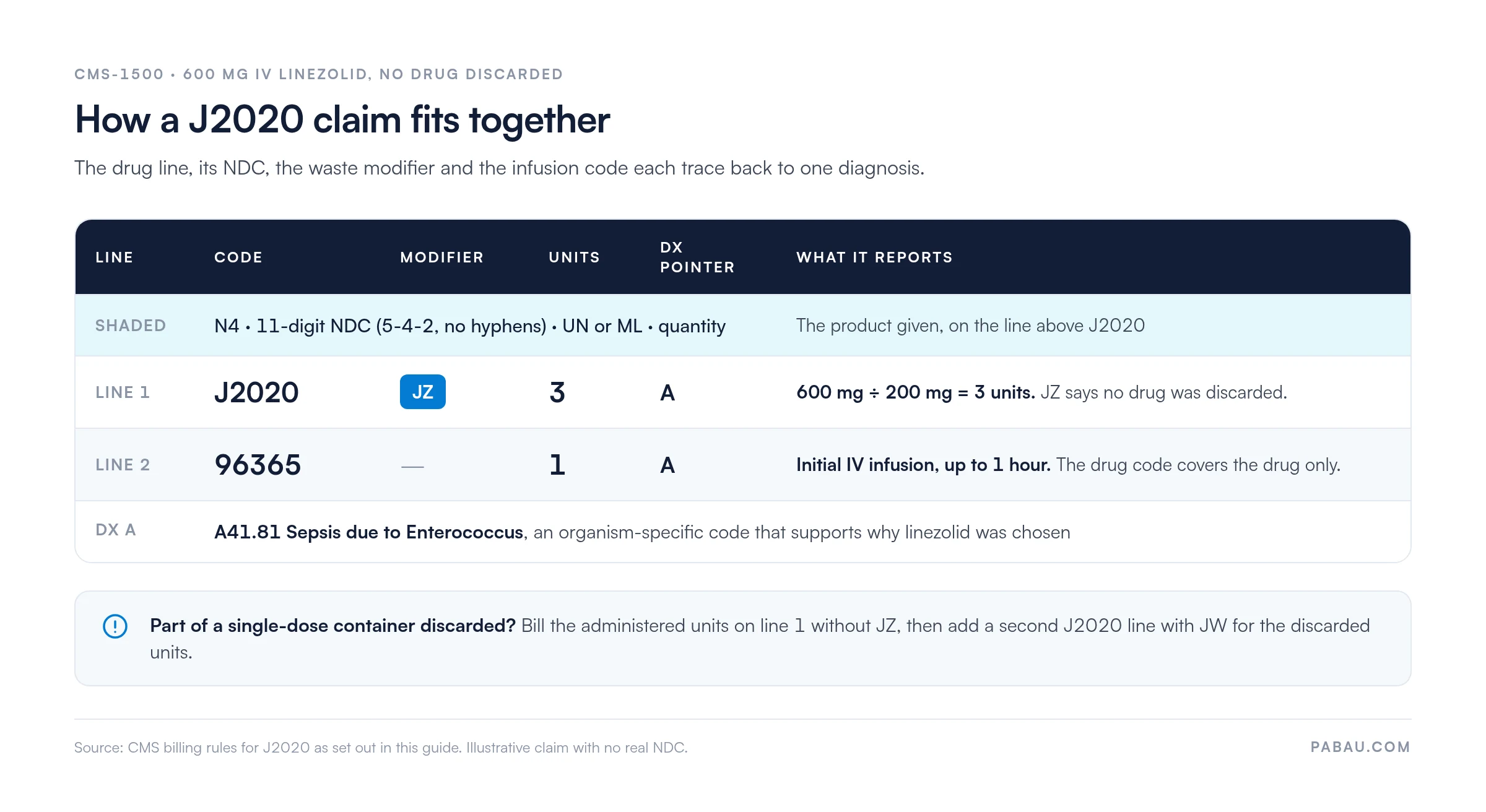
The diagram shows the no-waste case. When part of a single-dose container is discarded, the drug line drops JZ and a second J2020 line carries JW.
J2020 is billable across several settings. The place-of-service (POS) code on the claim affects the reimbursement rate and whether the administration CPT code bundles with the facility fee.
Three modifiers apply regularly to HCPCS Code J2020. Getting these wrong is a common source of audit risk and denied claims.
Before July 1, 2023, coders left the modifier field blank when no drug was discarded. CMS now requires JZ on every single-dose container claim with zero discarded drug. A missing JZ on an applicable claim creates an inconsistency that can flag the account for review.
J2020 covers only the drug cost. The infusion administration service needs a separate CPT code, billed on the same claim. For a first linezolid infusion of the day, that code is usually 96365. The correct code depends on infusion type and on whether it is the initial or a concurrent infusion on that date.
At POS 22 (hospital outpatient), the facility bills the administration separately under revenue code 0260/0261. The professional claim (CMS-1500) in that setting typically includes the drug J-code.
The administration CPT may be bundled into the facility fee, depending on MAC policy. Check with your Medicare Administrative Contractor before billing both on a professional claim from a hospital outpatient setting.
Medicare Part B pays HCPCS code J2020 at the Average Sales Price (ASP) plus 6 percent in physician office settings. CMS updates ASP payment limits quarterly, so the dollar amount changes each quarter. Pull the current rate from the quarterly Part B payment limit files rather than a figure from a prior quarter.
Payment differs by setting. In a hospital outpatient department (POS 22), CMS pays for the drug under the Outpatient Prospective Payment System (OPPS). That rate is not tied to ASP plus 6 percent and may differ from the physician office rate. For inpatient admissions (POS 21), linezolid is bundled into the Medicare Severity Diagnosis Related Group (MS-DRG) payment and is not separately payable.
Medicare Part B does not currently require prior authorization (PA) for J2020 at the federal level, but many Medicare Advantage plans and commercial payers do. PA criteria typically ask for three things:
Requirements vary by payer and plan year. Check the plan’s formulary tier and PA requirements before the first infusion, and run each request through a set prior authorization process.
Run insurance eligibility and benefit verification before scheduling a linezolid infusion. Document the PA reference number, authorized units, and authorization expiry date in the patient record. Including these details on the claim form reduces denial rates for payers that require prior authorization for J2020.
Every J2020 claim needs a supporting ICD-10 diagnosis code that establishes medical necessity for linezolid specifically. The diagnosis must reflect the FDA-approved indications: VRE infections, MRSA pneumonia, and complicated skin and soft tissue infections. Submitting a generic infection code without organism specificity is a leading trigger for medical necessity denials.
Pairing a primary infection ICD-10 code with an organism code (B95.2 for Enterococcus, B95.61 for MRSA) shows the payer why linezolid was necessary. Check your MAC’s local coverage determination (LCD) for anti-infective agents before finalizing the diagnosis codes.
Every figure on a J2020 claim has to trace back to the chart. If a payer audits the claim, these are the records it asks for, so keep each one for every linezolid infusion:
Check two mismatches before every submission: units billed from the vial size, and a JZ with no waste entry behind it. Both are fixed at the bedside, not in the billing office.
J2020 denial patterns are consistent across payers. The table below maps six common denial reasons to their root cause and the corrective action for each. For appeals and cross-payer workflows, see our guide to denial management strategies.
Each of these errors can be caught before submission rather than on a remittance advice. Knowing what makes a clean claim for drug codes gives your team the checklist to run.
Billing a linezolid infusion often means pulling the dose from the nursing record. The lot comes from a pharmacy log, and the authorization from an email thread. Each handoff is a chance for the units, NDC or modifier to drift from the chart.
Pabau, the practice management platform we build, keeps those records on the patient. Stock carries a batch number and expiry date, and IV sessions record the lot against the patient and the appointment. Prior authorization codes, dates, and sessions sit on the case, with a warning when one is missing.
Pabau’s claims management software then sends CMS-1500 claims through the Claim.MD clearinghouse. Eligibility checks and electronic remittances come back to the same record, so a rejected J2020 line surfaces the day it returns.

Pabau records the infusion lot against the patient, tracks prior authorizations on the case, and submits claims through Claim.MD. Your billing team works from the chart, not from re-keyed notes.

J2020 claims fail on details that live in the chart, not in the code book. When the administration record shows the dose given, the lot, and what was discarded, the units, NDC, and modifier follow from it. Build the claim from that record and the denial table above has little left to catch.
The trade-off is a few extra fields in the administration record at each infusion. That is less work than reworking a denied claim. Book a demo to see how Pabau keeps the infusion record and the J2020 claim in one place.

Need a broader grounding in medical billing fundamentals? Medical billing fundamentals for clinical practices covers the end-to-end claims process from encounter to payment posting.
HCPCS Code J2020 represents injectable linezolid at 200 mg per billed unit. Linezolid is an oxazolidinone-class antibiotic used intravenously to treat vancomycin-resistant Enterococcus (VRE) and methicillin-resistant Staphylococcus aureus (MRSA) infections. The brand name is Zyvox, manufactured by Pfizer, though FDA-approved generic IV formulations are also billable under J2020.
One unit of J2020 equals 200 mg of administered linezolid. A standard adult dose of 600 mg bills as 3 units. Bill only the documented administered dose, not the vial volume. Use modifier JZ when no drug is discarded, or modifier JW on a separate line for any wasted amount from a single-use vial.
No, traditional Medicare Part B does not currently require prior authorization for J2020. However, Medicare Advantage plans and many commercial payers do require PA, typically based on confirmed organism susceptibility and evidence of failed first-line therapy. Verify the individual plan’s requirements before each course of treatment.
Both J2020 and J2021 cover injectable linezolid at 200 mg per unit, but J2021 is specific to linezolid manufactured by Hospira (now Pfizer Injectables). The code you bill must match the NDC of the product administered. Using J2020 when the dispensed product’s NDC maps to J2021, or vice versa, results in a claim denial.
Report the NDC of the specific linezolid product given to that patient on that date. Medicaid requires it on physician-administered drug claims, and many commercial payers do too. Format the NDC as an 11-digit number (5-4-2 segment structure) with the N4 qualifier on the line directly below the J2020 on the CMS-1500. Hyphens are not used in electronic 837P claims. The NDC must correspond to the product lot dispensed, not a default stock NDC.
No. CMS does not reimburse compounded drug formulations under standard HCPCS J-codes. J2020 applies only to FDA-approved injectable linezolid products. Compounded linezolid does not meet the statutory requirements for Medicare Part B drug reimbursement under the J-code framework.