HCPCS Code G0163: Skilled nursing observation and assessment
What is HCPCS Code G0163? HCPCS Code G0163 is a deleted Level II code for skille...

Last Updated: Oct 15, 2026
J0840 is the HCPCS Level II code for injection, crotalidae polyvalent immune fab (ovine), up to 1 gram.
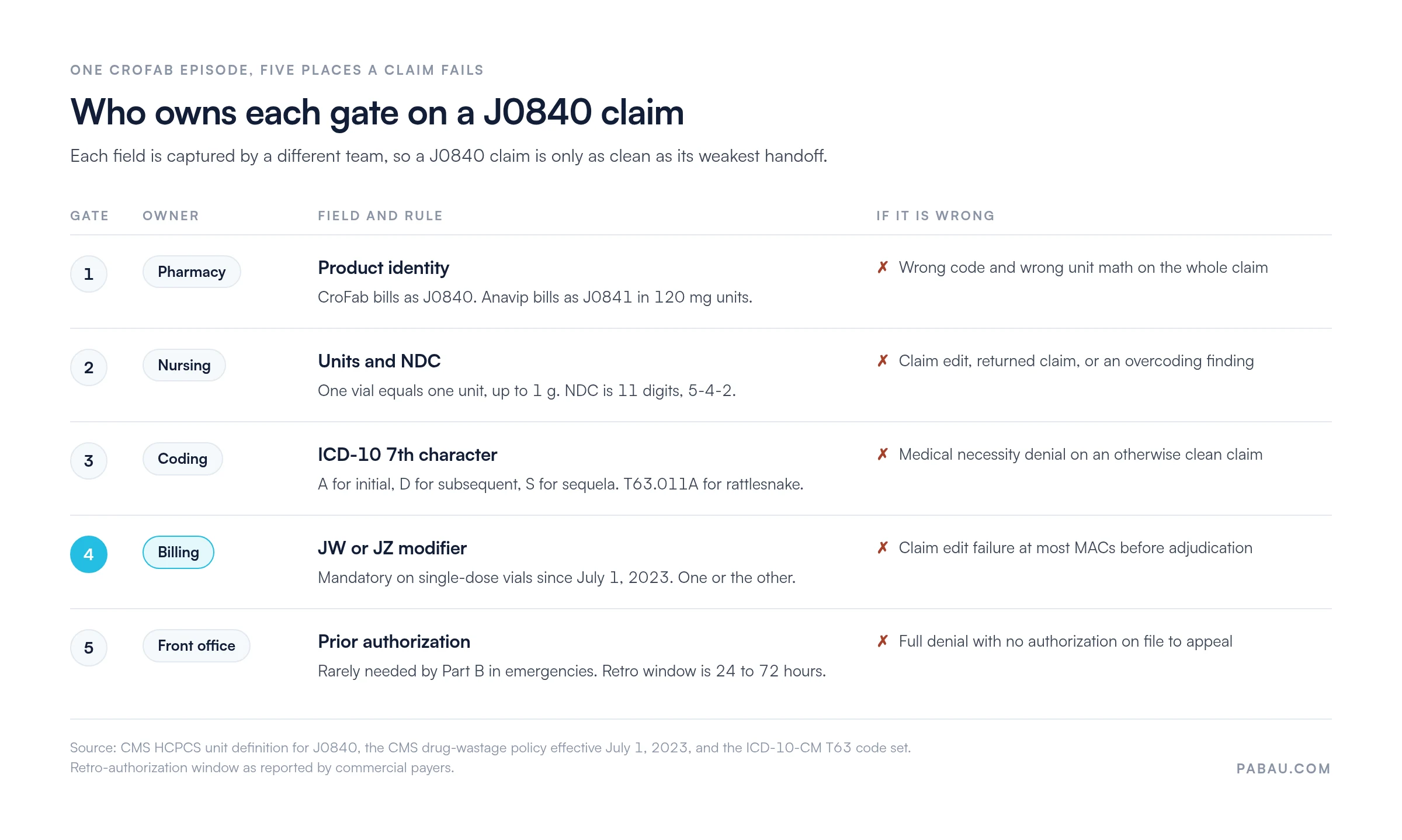
Each of those fields is captured by a different team, and the claim fails at whichever one gets it wrong.
Let Pabau's smart automation suggest the right codes, reduce claim denials, and keep your practice compliant—effortlessly.
Automate repetitive tasks and focus on what matters most—your patients.
Reduce coding errors and ensure compliance with the latest regulations.
Clean claims, fewer denials, and faster reimbursements.
Powerful insights and reporting to help your practice thrive.
HIPAA compliant SOC 2 certified GDPR-compliant Trusted by 4,000+ clinics worldwide

HCPCS Code J0840 describes injection, crotalidae polyvalent immune fab (ovine), up to 1 g, sold as CroFab for pit viper envenomation.
One billing unit equals up to 1 gram of CroFab, so bill one unit for each vial the administration record documents.
Medicare pays J0840 at ASP+6% under Part B, and the rate changes each quarter when CMS releases a new ASP pricing file.
Either JW or JZ must appear on every J0840 claim, a CMS requirement on single-dose vials since July 1, 2023.
Pabau’s claims management software submits J0840 claims, validates the required fields before submission, and tracks each claim through to payment.
HCPCS Code J0840 sits in Level II of the CMS Healthcare Common Procedure Coding System. Level II covers drugs, biologicals, and other supplies that CPT does not capture. The official descriptor is: Injection, crotalidae polyvalent immune fab (ovine), up to 1 g.
CroFab is the primary antivenom for North American pit viper envenomation, including rattlesnakes, cottonmouths, and copperheads. BTG International manufactures it from ovine (sheep-derived) immunoglobulin Fab fragments, which distinguishes it from equine-derived antivenoms. The FDA approved CroFab, and each vial’s National Drug Code is assigned through the FDA drug labeling process.
Billing units for HCPCS Code J0840 are defined by CMS as up to 1 gram of crotalidae polyvalent immune fab (ovine). One CroFab vial contains approximately 1 gram of lyophilized drug after reconstitution. This means each vial administered generally equates to one billing unit.
The CMS unit definition is the authoritative standard. Never bill more units than the number of grams administered, because billing units must match the quantity of drug given to the patient. Misreporting units, even inadvertently, counts as overcoding and creates audit exposure.
Avoiding it is a matter of procedure. Clinical staff record the vial count at the point of administration, and that count goes straight to billing without being re-derived.
Medicare reimburses HCPCS Code J0840 at ASP+6% under the Part B drug reimbursement methodology. ASP is the Average Sales Price that drug manufacturers report to CMS each quarter. The table below shows the rate structure. Verify current figures against the CMS ASP pricing files, which is where J-code payment limits are published.
Because CroFab is a high-cost drug, the ASP-based rate is substantial per unit. Pull the current quarter’s ASP pricing file from the CMS website rather than relying on a static rate sheet.
Facility and non-facility rates differ by MAC jurisdiction, so the same J0840 claim can pay differently depending on which MAC processes it. Reading the remittance advice against the expected rate is how you catch a jurisdiction-specific adjustment.
Modifiers signal to payers how, where, or under what circumstances J0840 was administered. Using the wrong modifier, or omitting one when required, is a leading cause of J0840 claim denials. The AAPC HCPCS code reference includes modifier guidance for J-code drug claims.
The JW and JZ modifiers became mandatory for single-dose vials under the CMS drug wastage reporting policy effective July 1, 2023. CMS began returning claims that carried neither modifier on October 1, 2023. Every J0840 claim must therefore include either JW (wastage occurred) or JZ (no wastage). Check local MAC bulletins, as modifier requirements for J0840 can vary by jurisdiction.
Every J0840 claim requires a supporting ICD-10 diagnosis code that establishes medical necessity. Snakebite codes carry a 7th-character extension for the encounter type. A marks an initial encounter, D a subsequent one, and S a sequela. Submitting the wrong extension is a frequent reason for J0840 denials, so the character gets set at intake rather than at the billing desk.
T63.011A is the most specific code for a confirmed rattlesnake bite treated with CroFab at the initial encounter. For cottonmouth or copperhead envenomation, use T63.061A. Coral snake codes are never paired with J0840, because CroFab does not work against coral snake venom.
Extension A applies to any visit where active treatment is being provided, and D to follow-up visits after that treatment has concluded. The 6th character carries intent. A bite whose circumstances the record never establishes takes the undetermined-intent variant, such as T63.064D at a follow-up visit.
National Drug Code (NDC) reporting is required on outpatient drug claims under CMS policy. For J0840, the NDC identifies the specific CroFab lot, labeler, and package size. Submitting the claim without an NDC, or with an incorrect NDC, triggers a claim edit and typically results in a denial or returned claim. The NDC must match the vial actually administered, not a stock number or product catalog reference.
NDC numbers for CroFab may change when BTG International updates packaging or lot configurations. Always verify the current NDC against the physical vial label at the time of administration, not from a reference sheet created in a prior year. The FDA drug database is the authoritative source for active NDC numbers, and CMS validates submitted NDCs against that registry during claim adjudication.
Where J0840 is administered directly affects the reimbursement rate and billing pathway. CroFab is most commonly administered in hospital emergency departments or hospital outpatient departments. Physician offices in areas with high snakebite incidence may also stock it and administer it under the buy-and-bill model.
Under the buy-and-bill model, the practice or hospital purchases CroFab from a distributor and administers it. It then bills the payer for both the drug and its administration. The margin between the acquisition cost and the Medicare rate of ASP+6% is the practice’s drug revenue.
Commercial payers may negotiate rates differently from Medicare. A drug this expensive also ties up cash for weeks between the purchase and the payment. For a small practice, that timing matters as much as the margin.
Track your CroFab acquisition costs against the ASP+6% reimbursement rate each quarter. When CMS updates the ASP file, the margin on J0840 can shift meaningfully. Build a quarterly rate review into your billing team’s calendar so you catch any net-negative reimbursement situations before they affect cash flow.
Medicare Part B does not generally require prior authorization for J0840 in emergency settings. Commercial payers frequently do require it for CroFab, particularly in a non-emergency outpatient setting or for additional doses after the initial treatment. Checking the patient’s coverage while the drug is still being administered tells the billing team which rule set applies.
When authorization cannot be obtained in advance, most payers allow a retrospective request within a set window, commonly 24 to 72 hours after administration. Document the clinical urgency in the medical record to support that request. Filing it inside the window is far cheaper than appealing the denial that follows if you miss it.
Incomplete records are the second-most common reason for J0840 denials, behind incorrect coding. A structured charge form for antivenom encounters captures each required element at the point of care, before anyone has to reconstruct it. The claim documentation package must contain the following items.
Claims management software that validates required fields before submission will catch a J0840 claim missing any of these elements. When something is missing at claim preparation, return the claim to clinical staff for completion rather than estimating the value. An estimated unit count with no vial administration record behind it can constitute a compliance violation.
J0840 and J0841 are both crotalidae antivenom HCPCS codes, but they cover different drug formulations. Billing one when the other was administered puts the wrong code on the claim. The two products are not interchangeable, clinically or for billing.
The unit definition is where the two codes diverge. J0840 bills in grams, up to 1 g per unit, while J0841 bills in 120 mg increments. A facility that switches from CroFab to Anavip has to rebuild the unit math on every claim, not just change the code.
Confirm with the pharmacy which product was dispensed before you pick the HCPCS code. Where the wrong pick keeps slipping through, the denial codes on the remittance will show the pattern.
This walkthrough runs from drug acquisition through payment reconciliation, pulling data from the pharmacy, the clinical team, and the payer’s authorization records, in that order.
Four errors account for most J0840 rejections.
Each error comes from a different team, and prior authorization adds a fifth handoff, which is why pre-submission review works better as a handoff check than a billing check.
Build a J0840 claim template in your billing system with the most common modifiers (JA, JZ) pre-populated. Leave the unit count, NDC, and ICD-10 extension as required fields that clinical staff must complete before the claim can be submitted. This prevents the most common submission errors without adding review time.
Most billing teams assemble a J0840 claim by hand. The vial count comes off a nursing note, the NDC off a photo of a label, and the authorization number out of an email thread. Every one of those handoffs can deliver a blank field.
Pabau is an all-in-one practice management system, so the encounter, the treatment note, and the claim sit in one patient record. Its claims management validates the required fields before a claim is submitted. A J0840 submission missing a value gets stopped at your desk instead of the payer’s.
From there you can track each submitted claim through to payment. A J0840 claim that stalls in adjudication shows up as a status you can act on. It does not surface as a line on next quarter’s aging report.

Pabau’s claims management software validates the required fields before a claim is submitted, then tracks each outpatient drug claim through to payment. See how it fits your billing workflow.

A J0840 claim rarely fails on one large mistake. It fails on a single blank or wrong field, and that field usually belongs to someone who never sees the claim.
So the work sits upstream of billing. Capture the vial count at the bedside and the NDC off the label, and the submission becomes routine. Leave both to the billing desk and you are reconstructing an emergency encounter from memory, days later.
Book a demo to see how Pabau validates the required fields on an outpatient drug claim before it reaches the payer.

Need to understand how clearinghouses process J-code drug claims? Pabau’s Claim.MD clearinghouse guide explains how electronic drug claims move from submission to payment.
Want to reduce denials on high-cost drug claims? Revenue cycle management fundamentals covers the workflows that keep high-dollar claims from aging into write-offs.
Looking for guidance on building clean claims for outpatient drugs? How to build an accurate superbill walks through the data elements required for complete outpatient drug claim documentation.
HCPCS Code J0840 bills the administration of crotalidae polyvalent immune fab (ovine), up to 1 gram per unit. The drug is sold as CroFab. It is the HCPCS Level II code for this rattlesnake and pit viper antivenom under Medicare Part B and most commercial payers.
CroFab, manufactured by BTG International, is the drug billed under J0840. Its generic name is crotalidae polyvalent immune fab (ovine), an ovine-derived Fab fragment antivenom. It treats North American pit viper envenomation, including rattlesnakes, cottonmouths, and copperheads.
J0840 covers CroFab, an ovine-derived antivenom billed in units of up to 1 gram. J0841 covers Anavip, an equine-derived F(ab’)2 antivenom billed in units of 120 mg. Both treat North American pit viper envenomation, but they are different products with different unit definitions. Bill whichever code matches the drug actually administered.
The NDC for CroFab is assigned by the FDA and may change when BTG International updates packaging or lot configurations. Always pull the NDC directly from the vial label administered to the patient and verify it against the FDA NDC Directory. Do not use a static reference sheet NDC from a prior year without confirming it is still current.