HCPCS code J3471: Hyaluronidase ovine injection billing guide
HCPCS code J3471: Descriptor, code type, and quick-reference data HCPCS code J34...

Last Updated: Oct 14, 2026
J0570 is the HCPCS Level II code for buprenorphine implant, 74.2 mg.
It was the first FDA-approved implantable formulation for opioid use disorder (OUD) maintenance treatment. Unlike daily sublingual films or tablets, Probuphine releases a steady, low dose of buprenorphine over six months. The patient never handles the medication.
The code itself has an unusual recent history. CMS discontinued J0570 effective January 1, 2025, then reactivated it on October 1, 2025. The product changed hands during that period. CMS now records ReacX Pharmaceuticals, Inc. as the company that acquired Probuphine from Titan Pharmaceuticals.
Availability is the first question to settle. The FDA listed Probuphine as discontinued in October 2020, and no current marketed label appears in FDA data. Confirm sourcing with ReacX Pharmaceuticals or a specialty distributor before you plan a buy-and-bill workflow.
Let Pabau's smart automation suggest the right codes, reduce claim denials, and keep your practice compliant—effortlessly.
Automate repetitive tasks and focus on what matters most—your patients.
Reduce coding errors and ensure compliance with the latest regulations.
Clean claims, fewer denials, and faster reimbursements.
Powerful insights and reporting to help your practice thrive.
HIPAA compliant SOC 2 certified GDPR-compliant Trusted by 4,000+ clinics worldwide

HCPCS Code J0570 covers one 74.2 mg buprenorphine implant rod (Probuphine), billed per rod alongside CPT 11981, 11982, or 11983.
CMS discontinued J0570 effective January 1, 2025 and reactivated it on October 1, 2025, so check the date of service first.
CMS records ReacX Pharmaceuticals, Inc. as the manufacturer of record, not Braeburn, so confirm availability before planning buy-and-bill.
Probuphine has no active FDA-listed NDC and both historical NDCs were deleted, so ask the payer in writing what to report.
Medicare Part B reimburses J0570 at ASP+6%, and rates update quarterly against the current CMS ASP payment file.
Prescribers must hold active Probuphine REMS certification before administering and billing J0570, and missing REMS documentation is a leading denial cause.
Practice management software like Pabau supports structured J-code documentation and NDC reporting for buy-and-bill drug billing workflows.
HCPCS Code J0570 describes buprenorphine implant, 74.2 mg. It belongs to the J-code category within HCPCS Level II, which covers drugs administered by routes other than oral.
One unit of J0570 represents one 74.2 mg buprenorphine implant rod. A full Probuphine treatment consists of four rods inserted subdermally in the upper arm. A complete initial insertion therefore requires four units of J0570, billed alongside the appropriate CPT procedure code.
CMS established J0570 effective January 1, 2017. The FDA had approved Probuphine in May 2016, and the CMS HCPCS Level II code set was updated to carry it. Ownership of the product has moved since then. Titan Pharmaceuticals and Braeburn ended their Probuphine license agreement, and Titan divested the ProNeura implant assets in 2023.
The CMS Q2 2025 HCPCS application summary names ReacX Pharmaceuticals, Inc. as having acquired Probuphine from Titan. ReacX is therefore the manufacturer of record for coding purposes. Any payer policy, drug file entry, or internal fee schedule still naming Braeburn is out of date.
Contact ReacX Pharmaceuticals or an authorized specialty distributor to confirm whether the product can currently be acquired. Buy-and-bill only applies once the practice can purchase and stock the implant.
J0570’s history is broken in the middle. CMS discontinued the code effective January 1, 2025, then reactivated it in the October 2025 HCPCS Level II update. For nine months of 2025 the code was not valid for new claims. The timeline below tracks the code against what happened to the product itself.
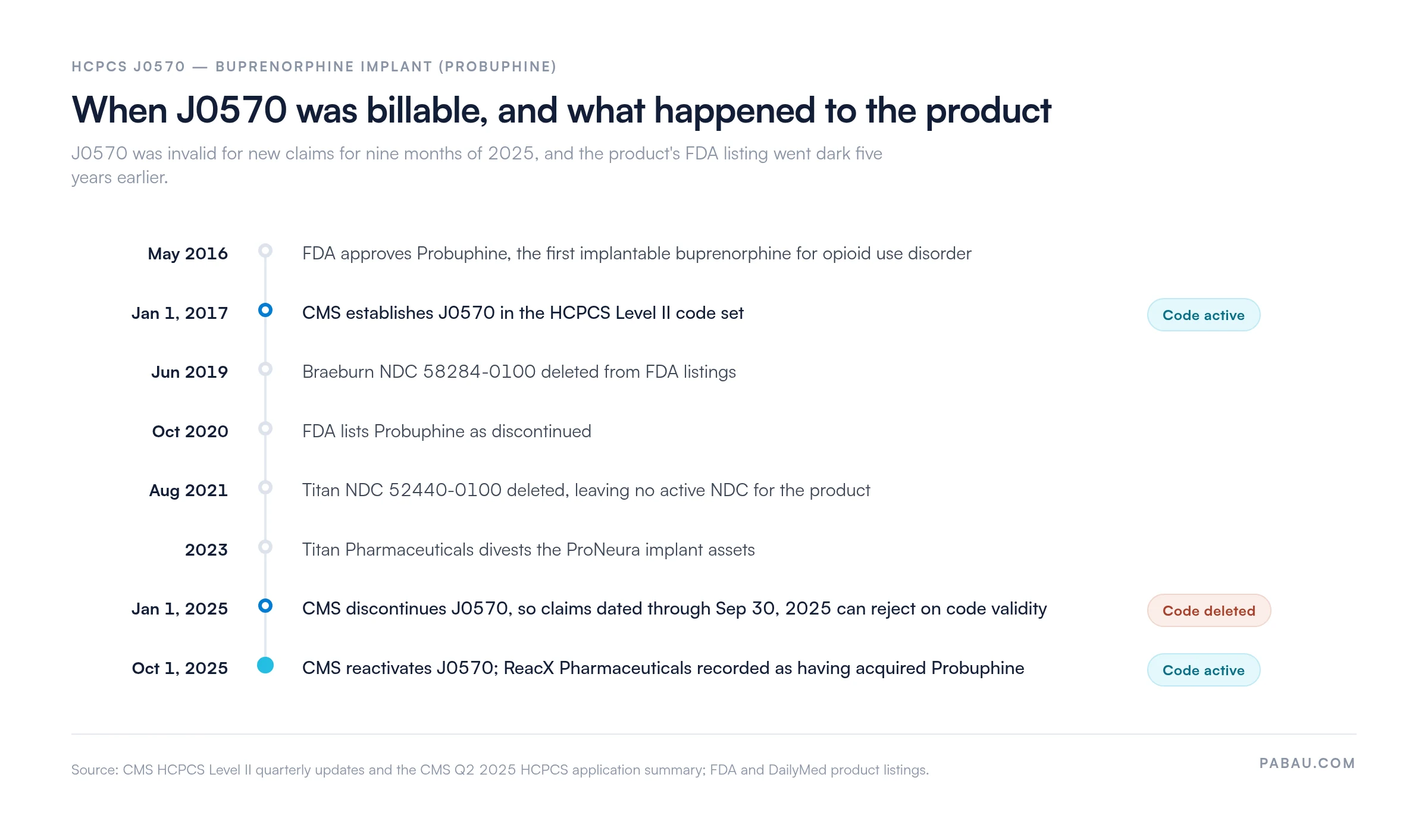
That history matters in two places. Claims with a date of service between January 1 and September 30, 2025 may reject on code validity alone, whatever the documentation shows. Payer drug files and clearinghouse edits updated during the deletion window may still carry J0570 as invalid.
The reactivation was also tied to a stated relaunch intent in the CMS filings, not to confirmed commercial availability. Before you bill, check the date of service against the active windows. Then ask the payer how it wants services from the deletion window reported, and get that answer in writing.
Medicare Part B reimburses J0570 under the Average Sales Price (ASP) methodology at ASP plus 6%. The 6% add-on is intended to cover acquisition and handling costs for buy-and-bill drugs. Because ASP is recalculated from manufacturer-reported data each quarter, the payment rate for J0570 changes four times per year.
Verify the current rate using the CMS Physician Fee Schedule lookup or the quarterly ASP payment file before submitting claims. A static fee schedule drifts out of date within a few months, which leaves the practice either under-collecting or overbilling.
Reconcile each remittance against the quarter’s published ASP rate rather than an expected amount carried over from last year. The remittance shows the rate that was applied, the patient coinsurance, and any secondary payer coordination.
Medicaid coverage for J0570 varies significantly by state. Most state Medicaid programs cover buprenorphine implants as part of their opioid use disorder treatment benefits. Coverage criteria, reimbursement rates, and prior authorization requirements still differ between them.
Some states reimburse at or near the Medicaid drug rebate-adjusted rate. Others have carved OUD drugs into managed behavioral health plans with separate formularies. Contact your state Medicaid agency or MAC for the applicable fee schedule before billing.
Many payers, including Medicare Part B and most state Medicaid programs, require the National Drug Code (NDC) on the claim line alongside J0570. Probuphine has no active NDC in FDA data as of the last verification for this guide. Neither openFDA nor FDA DailyMed returns a current listing for the product.
Two NDCs existed historically, and both are now dead. The Braeburn listing, 58284-0100, was deleted in June 2019. The Titan listing, 52440-0100, was deleted in August 2021. They are recorded here for reconciling old claims or an archived drug file, and neither belongs on a claim submitted today.
Verify current NDC status directly with ReacX Pharmaceuticals or against FDA DailyMed before billing. If no active NDC is published for the product you hold, get written direction from the payer on what to report in the NDC field. Do not substitute a deleted NDC or one belonging to another buprenorphine product, which is a common shortcut and an avoidable compliance problem.
When an active NDC is available, report it on a CMS-1500 or 837P claim in the 11-digit format in the shaded portion of Box 24. The qualifier for J0570 is UN (unit), and the quantity equals the number of implant rods billed.
Leaving the NDC field blank is a common denial trigger for buy-and-bill drugs. Payers use the NDC to confirm that the billed code matches the drug the practice purchased. With no published NDC for Probuphine, that field is where a J0570 claim is most likely to stop. Get payer direction before the insertion date, not after the rejection.
J0570 billing follows a buy-and-bill workflow. The provider acquires Probuphine from the manufacturer of record or an authorized specialty distributor. The practice then administers the implant and bills the payer for both the drug and the procedure. Sourcing is the step to settle first, because current availability of the product is not confirmed.
J0570 covers only the drug cost. A separate CPT code must always be billed to report the surgical procedure of inserting or removing the implant. Omitting the procedure code — or billing it without J0570 — results in an incomplete claim.
Every J0570 claim requires a covered OUD diagnosis code to establish medical necessity. The primary covered diagnoses are in the F11 series (opioid-related disorders) from ICD-10-CM. MAC local coverage determinations and published payer policies commonly accept the codes below. Individual payer policies still differ, so verify the covered diagnosis list before claim submission.
The clinical record must substantiate the chosen diagnosis with documented substance use history, severity, and treatment rationale. Maintenance treatment claims most often carry F11.20, so check that the note supports dependence rather than abuse before the claim goes out.
Prior authorization requirements for J0570 vary across payer types. Medicare Part B does not currently require PA for J0570 as a standard national policy. Individual MAC jurisdictions and Medicare Advantage plans frequently impose their own requirements. Most commercial payers and state Medicaid programs require PA before the procedure date.
The submission typically needs an OUD diagnosis, treatment history, and proof of prescriber REMS certification. It also needs a clinical justification for the implant over sublingual buprenorphine formulations. Confirming eligibility and PA status before the procedure is scheduled avoids the most common denial pattern for this code.
Prescribers cannot administer or bill J0570 without completing the Probuphine REMS program, a Risk Evaluation and Mitigation Strategy mandated by the FDA. The program requires training on patient selection criteria and on the insertion and removal procedure before a clinician can order or administer Probuphine.
A claim from a prescriber without active certification will deny, and the denial reason code rarely names REMS as the cause. Billing staff can spend days chasing the wrong problem before anyone checks the certificate.
Keep a record of REMS certification for each prescriber who bills J0570, and include it in the documentation package for any payer audit. The FDA oversees the program. Current requirements are published in the FDA REMS database and on the Probuphine REMS program website, now administered under ReacX Pharmaceuticals. A lapse in enrollment can produce a denial and compliance exposure even where the prescriber was certified previously.
Build a REMS certification tracker into your credentialing file for every clinician who administers Probuphine. Set a calendar reminder 30 days before any REMS renewal deadline. Verify active enrollment status in the FDA database before the first J0570 claim of each calendar year.
J0570 is a high-cost, physician-administered drug billed under a controlled substance REMS program. That combination draws post-payment review more often than a routine office procedure. The documentation below should be retrievable for any claim, ideally from the patient record rather than a separate folder.
Capturing these at the point of care is far cheaper than reconstructing them during an audit. A structured template forces rod count, lot numbers, and the REMS check at documentation time. That removes the omissions that most often surface months later.
J0570 is one of four buprenorphine-related HCPCS codes. Coders often confuse J0570 with the sublingual formulation codes J0571, J0572, and J0573. The drug names are similar and the products treat the same indication, which makes the wrong-code denial a frequent one. The distinction turns on the dosage form: J0570 is the subdermal implant only, and the other three cover oral transmucosal formulations at different dose strengths.
The clinical setting also differs. J0570 is reported for a physician-administered subdermal procedure in an office or outpatient setting. J0571 through J0573 typically apply to dispensed oral medications in opioid treatment programs (OTPs) or similar settings. Always confirm the correct code based on the product administered, not the ICD-10 diagnosis code alone.
Verify current HCPCS Level II definitions against the CMS list of CPT/HCPCS codes each year. Our reference library of HCPCS codes carries the same unit and documentation detail for the rest of the J-code range.
J0570 denials tend to cluster around a small number of preventable errors. A single four-rod Probuphine claim carries meaningful revenue exposure, so each one is worth catching before submission rather than after. Below are the most common billing mistakes and how to avoid them.
Compliance for J0570 also means keeping the evidence retrievable for a retrospective audit. Four records carry that weight. They are the OUD diagnosis, the REMS certification, the drug acquisition invoice, and the procedure note. Payers that cover high-cost implant drugs typically subject them to post-payment review.
Where one of those four records cannot be produced, the practice can owe a refund even though the service itself was appropriate. Check that your charge-capture template for J0570 records every required field at the point of service.
Run a quarterly audit of all J0570 claims submitted in the prior three months. Check units billed against the rod count documented in each procedure note. Verify NDC entries against current FDA listings and the payer direction on file. Confirm PA was in place for every commercial and Medicaid claim. Catching these patterns before a payer audit prevents recoupment.
In many practices, J0570 runs across three disconnected systems. The clinical note lives in the chart. The REMS certificate and the acquisition invoice live in a shared drive. The claim is keyed separately from both. The three records only come together when a payer asks for all of them at once.
Practice management software like Pabau keeps the drug claim and its evidence in one record. Procedure templates capture rod count, lot numbers, and anatomical site as structured fields, so a four-rod insertion cannot be documented as one unit. Prescriber credentials, including REMS certification and its renewal date, sit against the clinician record and are visible before the appointment is booked.
On the billing side, claims are validated against the required fields before submission rather than after a rejection. Remittance data then posts back against the expected ASP rate. Both steps leave an audit trail. With a nine-month deletion window and unresolved NDC status behind this code, payer questions do come up. That trail lets a biller answer one in minutes instead of days.

Pabau helps OUD treatment practices structure their buy-and-bill workflows, capture NDC data at the point of care, and submit cleaner claims. See how it works for your practice.

HCPCS Code J0570 sits where controlled substance prescribing, buy-and-bill drug billing, and REMS compliance meet. Its denials are rarely as simple as a missing modifier, and two checks now come before all the familiar ones. Confirm the date of service falls inside an active code window, and confirm with ReacX Pharmaceuticals that the product can be sourced.
After that, four checks prevent most denials. They are unit count, NDC direction from the payer, REMS certification, and prior authorization confirmed before the procedure date. None of them is difficult on its own. They fail because each one lives in a different system, and nobody checks all four before the claim is keyed.
Practices that administer Probuphine regularly do better with billing workflows that enforce these checks at the point of care rather than at claim submission. To see how Pabau handles J-code documentation, NDC capture, and claim validation, book a demo with the team.

Billing the sublingual formulation instead? HCPCS Code J0571 covers oral buprenorphine, billed per 1 mg rather than per implant rod.
Need the combination product code? HCPCS Code J0572 covers buprenorphine/naloxone up to 3 mg buprenorphine, with its own unit and coverage rules.
Want to decode the rejection you already have? Denial codes in medical billing explains what each remittance code means and how to work it.
Cleaning up your buy-and-bill documentation? What is medical billing walks through the end-to-end billing cycle from charge capture to payment posting.
HCPCS Code J0570 bills a buprenorphine subdermal implant, 74.2 mg (Probuphine). A physician administers it as maintenance treatment for opioid use disorder. One unit covers one 74.2 mg implant rod. A standard four-rod insertion requires billing four units of J0570 alongside the companion CPT procedure code.
Medicare Part B reimburses J0570 at ASP plus 6%, where ASP (Average Sales Price) is updated quarterly. The specific dollar amount changes each quarter. Verify the current rate in the CMS quarterly ASP payment file or the CMS Physician Fee Schedule lookup tool before submitting claims.
There is no active, currently marketed NDC for Probuphine in FDA data as of the last verification for this guide. Two historical NDCs existed and both were deleted: 58284-0100 under Braeburn in 2019, and 52440-0100 under Titan in 2021. Neither should be submitted on a claim. Verify current NDC status with ReacX Pharmaceuticals or FDA DailyMed. If no active NDC is published, ask the payer in writing what to report in that field.
Yes, for most commercial payers and state Medicaid programs prior authorization is required before administering Probuphine. Traditional Medicare Part B does not have a universal national PA requirement for J0570, but Medicare Advantage plans and individual MAC jurisdictions often impose one. Confirm PA status with the specific payer before scheduling the procedure.
J0570 covers the buprenorphine subdermal implant, Probuphine, at 74.2 mg per rod. J0571 covers oral buprenorphine, billed per 1 mg. J0572 covers oral buprenorphine/naloxone at doses up to 3 mg buprenorphine. The distinction is the dosage form. J0570 is the implant only. J0571 and J0572 are sublingual or buccal products, usually dispensed in opioid treatment programs rather than in a physician office.
The primary ICD-10-CM diagnosis codes that support J0570 claims are F11.10 (opioid abuse, uncomplicated), F11.20 (opioid dependence, uncomplicated), and F11.21 (opioid dependence, in remission). Individual payer coverage policies may accept additional F11 series codes, so confirm with the specific MAC or commercial plan before submission.
Treat availability as unconfirmed until you check with the manufacturer. The FDA listed Probuphine as discontinued in October 2020, and no current marketed label appears in FDA data. Titan divested the implant assets in 2023, and the CMS Q2 2025 HCPCS application summary names ReacX Pharmaceuticals, Inc. as having acquired Probuphine. CMS reactivated J0570 on October 1, 2025 in connection with a stated relaunch, which is an intent rather than a confirmation of supply. Contact ReacX or a specialty distributor before you build a buy-and-bill workflow around this code.