

CCSD code G5100: Bypass of duodenum billing guide
CCSD code G5100 bills a bypass that leaves the duodenum in place CCSD code G5100...

Last Updated: Oct 16, 2026
H2037 is the HCPCS Level II code for developmental delay prevention activities, dependent child of client, per 15 minutes. It reports prevention work for the child of a patient in behavioral health or substance use treatment, billed in 15-minute units.
The code sits in the H-code section for alcohol, drug and rehabilitative services. Medicare does not pay for it, so practices bill state Medicaid programs or other payers that recognize it.
Let Pabau's smart automation suggest the right codes, reduce claim denials, and keep your practice compliant—effortlessly.
Automate repetitive tasks and focus on what matters most—your patients.
Reduce coding errors and ensure compliance with the latest regulations.
Clean claims, fewer denials, and faster reimbursements.
Powerful insights and reporting to help your practice thrive.
HIPAA compliant SOC 2 certified GDPR-compliant Trusted by 4,000+ clinics worldwide

HCPCS code H2037 reports developmental delay prevention activities for a patient’s dependent child, billed per 15 minutes.
Wraparound services bill under H2021 (per 15 minutes) or H2022 (per diem), so they never belong on an H2037 claim.
Medicare does not pay for H2037 (coverage code I), so claims go to state Medicaid programs or other payers that recognize the code.
Modifiers, diagnosis codes, unit caps and prior authorization rules come from your state or payer, so confirm them before the first claim.
Pabau, the practice management platform we build, keeps the appointment, treatment note and invoice in one record, so billed units match documented time.
HCPCS code H2037 is the Level II code for “developmental delay prevention activities, dependent child of client, per 15 minutes.” The Centers for Medicare and Medicaid Services (CMS) maintains it in the H-code section, which covers alcohol, drug and rehabilitative services.
The code reports prevention work aimed at a patient’s child. The patient’s own treatment is billed under other codes. Each unit equals 15 minutes of service. H2037 has been active since April 1, 2003.
Medicare assigns H2037 coverage code I, which means Medicare does not pay for it. Practices bill it to state Medicaid programs or other payers whose manuals list the code.
The descriptor has three parts, and each one shapes the claim. Read them together before you decide the code fits a service.
CMS publishes the descriptor but not a list of qualifying activities. Each payer that covers H2037 defines that list in its own manual. Before you bill, confirm these points with the payer:
If the payer manual does not list H2037, ask provider relations which code it expects instead. Billing a code the payer does not recognize produces a denial, however complete the note is.
H2037 sits among H-codes with very different meanings, including the two wraparound codes. The table below sets out the codes most often mixed up with it.
The test is who receives the service and what it is for. Use H2037 only when the activity aims to prevent developmental delay in a patient’s dependent child. Coordinated wraparound care belongs under H2021 or H2022, depending on the unit your payer uses.
One unit of H2037 equals 15 minutes of service. Count units from the start and end times in the note, never from the scheduled appointment length.
Payers set their own rule for partial units, so check how yours rounds a session that runs 20 or 40 minutes. Daily and annual unit caps are payer-specific too. Units billed beyond an authorized cap are denied even when the time was spent with the family.
No national coverage policy governs H2037, because Medicare does not pay for it. Each state Medicaid program or payer sets its own coverage, rates, prior authorization and claim format. The same service can therefore bill differently from one state to the next.
Some payers ask for HCPCS modifiers that describe the program behind the service. The modifiers below are standard HCPCS modifiers, but whether a payer requires any of them on H2037 is its own decision. Treat them as examples to check, never as defaults.
Diagnosis requirements vary in the same way. Some payers want the parent’s diagnosis on the claim, while others bill under the child’s own Medicaid ID. ICD-10-CM codes such as Z63.72 (alcoholism and drug addiction in family) or R62.0 (delayed milestone in childhood) may appear. They belong on the claim only where the payer accepts them, so take the diagnosis rule from the payer manual.
Ask the payer two questions before the first H2037 claim: whose Medicaid ID goes on the claim, and whose diagnosis supports it. Both answers vary by state, and a wrong guess on either one denies every claim that follows.
Each H2037 note has to show that a prevention activity took place for the right child, for the time billed. Unless your payer asks for more, every note should record:
Most payers also expect a current, signed plan of care that names the prevention goals. A note that cannot be traced back to that plan is hard to defend on audit. Structured note templates help staff capture each field at the point of care.
Most H2037 denials trace back to the code’s unusual scope or to payer-specific rules. The table covers the patterns to check first.
Systematic denial management workflows that sort H2037 rejections by reason code show patterns quickly. When one denial reason keeps repeating, the cause usually sits in a single step of the billing workflow.
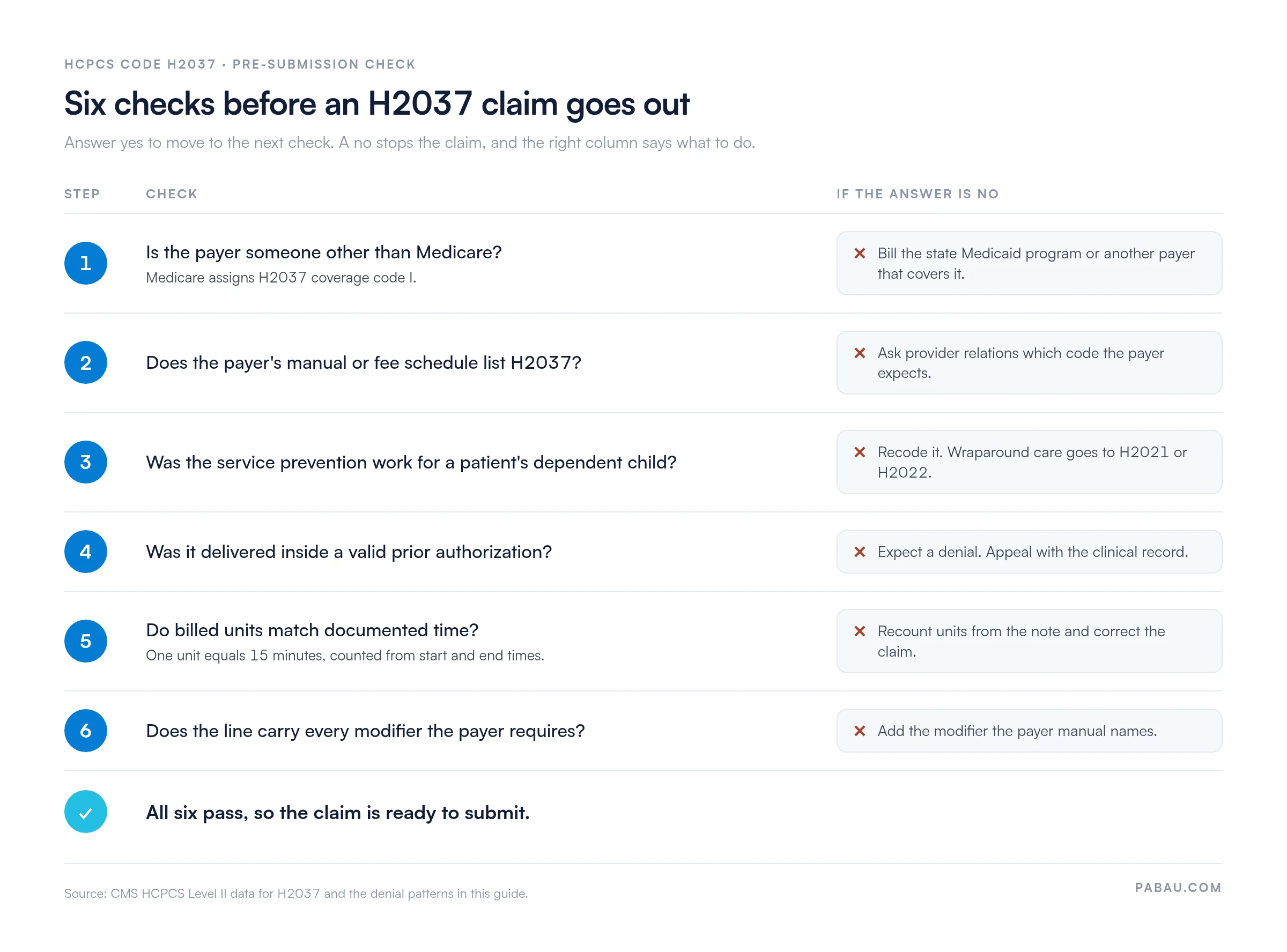
Run each claim through the six checks below, in order, and the denials in the table are caught before the payer sees them.
H2037 has no federal payment rate. Each state Medicaid program publishes its own rate, and managed care plans may pay differently under their contracts. To find the rate that applies to you:
H2037 claims depend on three records agreeing: the appointment, the clinical note and the claim. When those sit in separate systems, staff copy times and units by hand, and mismatches reach the payer.
In Pabau, all three live in the same patient record. You can build an H2037 note template that asks for start and end times, the dependent child and the activities performed. Billing staff can then check units against the note before the claim leaves.
Pabau’s claims management software matches payer remittances to each appointment and flags unpaid or reissued lines. Paired with billing compliance documentation standards, that keeps H2037 rework to a minimum.
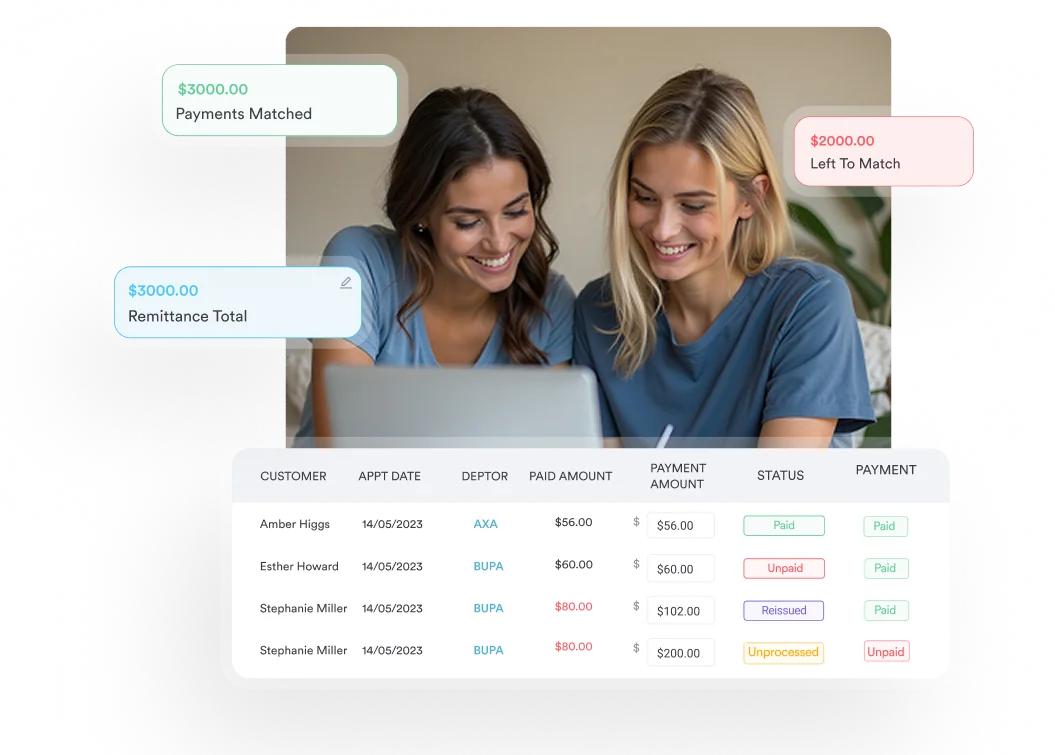

Pabau links each appointment, clinical note and claim in one patient record. Your team can check H2037 units against documented time before the claim goes out.

H2037 pays only when the service, the payer and the note line up. Keep it for prevention work aimed at a patient’s dependent child, and send coordinated wraparound care to H2021 or H2022.
Open the payer manual before the first claim goes out. It decides whether H2037 is covered, how partial units round and whose ID and diagnosis go on the claim.
Build those answers into your note template, and every H2037 claim starts from the same rules. A clear view of your wider medical billing workflow shows where each rule should live. Book a demo to see how Pabau keeps H2037 notes, units and claims in step.

Billing wraparound care instead? HCPCS code H2021 covers community-based wraparound services billed in 15-minute units.
Treating the parent in a day program? HCPCS code H2036 explains per diem billing for alcohol and/or other drug treatment programs.
Seeing H2037 claims come back denied? Denial codes in medical billing breaks down the top 20 CARC codes and how to fix each one.
Want to reduce claim rejections across all payer types? Claims management software explains how automated claims tools catch errors before submission and track denial patterns over time.
HCPCS code H2037 means developmental delay prevention activities, dependent child of client, per 15 minutes. It reports prevention work for the child of a patient a program serves. Each unit equals 15 minutes.
No. Community-based wraparound services use H2021 (per 15 minutes) or H2022 (per diem). H2037 covers developmental delay prevention activities for a patient’s dependent child.
No. Medicare assigns H2037 coverage code I, which means it is not payable by Medicare. Practices bill it to state Medicaid programs or other payers that list the code.
Each 15 minutes of documented service equals one unit, so a 60-minute session bills as four units. Rounding rules for partial units and daily caps vary by payer, so check your payer manual.
That depends on the payer. Some ask for program modifiers such as HA, HD or HF, and some use state-defined U modifiers. The payer manual also sets whose diagnosis and Medicaid ID go on the claim.
H2036 is an alcohol and/or other drug treatment program billed per diem. H2038 is skills training and development, also per diem. H2037 is developmental delay prevention for a patient’s dependent child, billed per 15 minutes.
Each note should record the date, place, start and end times, the patient and dependent child, the rendering provider and the activities performed. It should also tie the service to a current, signed plan of care.



