HCPCS code G0206: Diagnostic mammography, unilateral
HCPCS code G0206: Definition and code status HCPCS code G0206 was the Level II c...

Last Updated: Oct 21, 2026
G0245 is the HCPCS Level II code for the initial physician evaluation of a diabetic patient with loss of protective sensation (LOPS). The LOPS must result from diabetic sensory neuropathy, and the service must include the LOPS diagnosis, a patient history, a foot examination and patient education.
Most G0245 claim denials trace back to three avoidable mistakes. They are a missing or incorrect ICD-10 code, incomplete records of the four mandatory components, and billing too soon after a G0245 or G0246.
Let Pabau's smart automation suggest the right codes, reduce claim denials, and keep your practice compliant—effortlessly.
Automate repetitive tasks and focus on what matters most—your patients.
Reduce coding errors and ensure compliance with the latest regulations.
Clean claims, fewer denials, and faster reimbursements.
Powerful insights and reporting to help your practice thrive.
HIPAA compliant SOC 2 certified GDPR-compliant Trusted by 4,000+ clinics worldwide

HCPCS code G0245 covers the initial evaluation of a diabetic patient with confirmed loss of protective sensation (LOPS) under Medicare Part B.
The service must document four components: LOPS diagnosis, patient history, physical examination, and patient education.
Medicare pays for G0245 or G0246 no more than once every six months per beneficiary. G0246 is the follow-up code for later visits.
Accepted ICD-10 codes must confirm both diabetes and diabetic neuropathy. Common choices include E11.40, E11.42, E11.49 and E10.42.
Claims management software such as Pabau supports structured HCPCS billing workflows, including diagnosis code linking and claim validation before submission.
HCPCS code G0245 is a Level II G-code for the initial evaluation and management of a diabetic patient with loss of protective sensation (LOPS). The LOPS must result from diabetic sensory neuropathy. Medicare covers the service under National Coverage Determination (NCD) 70.2.1, which addresses the diagnosis and treatment of that condition.
The Centers for Medicare & Medicaid Services (CMS) maintains the code in the HCPCS Level II G-series. That series covers professional services that CPT codes don’t describe.
The official CMS descriptor says the service must include four components:
The physical examination consists of at least these elements:
All four components are mandatory. If one is missing from the medical record, the claim is open to audit or denial. The neurological assessment within the physical examination typically includes a monofilament test, vibratory sensation evaluation, and assessment of ankle reflexes. Document each element by name in the encounter note, not as a grouped reference to “diabetic foot exam.”
Medicare covers G0245 under Part B as an evaluation and management benefit, under NCD 70.2.1. A patient qualifies when two conditions are met: A confirmed diabetes diagnosis (Type 1 or Type 2), and LOPS caused by diabetic sensory neuropathy. G0245 doesn’t cover routine foot care or cosmetic foot procedures, so the LOPS finding has to be documented in the record.
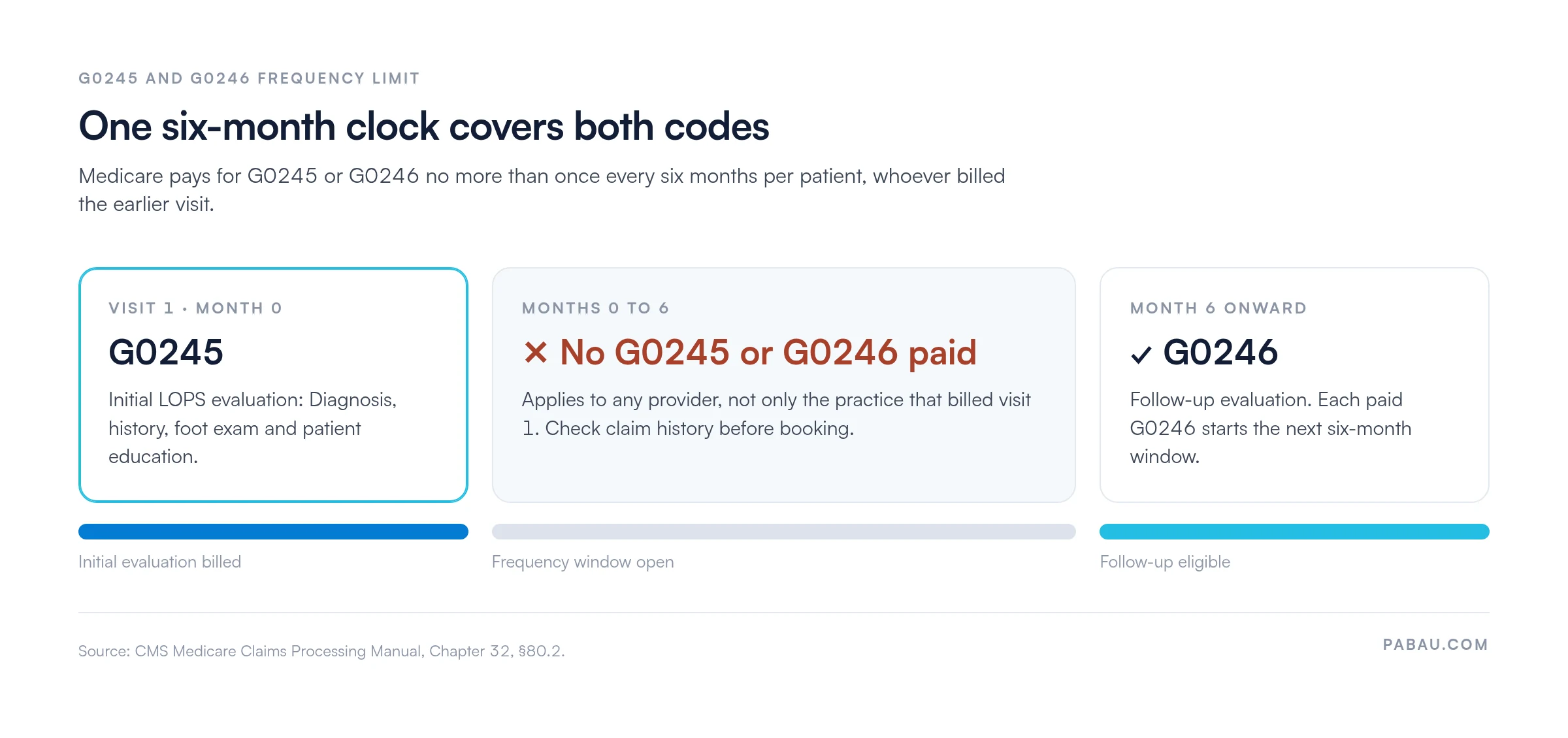
Medicare pays for G0245 or G0246 no more than once every six months per beneficiary. The limit applies to the two codes combined, whichever provider furnished the earlier service. G0245 is the initial evaluation, so it isn’t repeated within a year. Later visits use G0246.
Before scheduling the visit, run an eligibility verification process. Confirm the patient hasn’t had a G0245 or G0246 from any provider in the past six months. A claim filed inside an open frequency window is one of the most common denial triggers for this code, as the timeline below shows.
Medicare Advantage plans must cover the same benefits as traditional Medicare, but coverage terms and prior authorization requirements vary by plan. Always verify Advantage plan specifics before the visit when the patient is enrolled in a Medicare Advantage product rather than original Medicare.
The CMS sources we reviewed list physicians and podiatrists (doctors of podiatric medicine, or DPMs) as the providers who bill G0245. In practice, podiatrists and primary care physicians managing diabetic patients with peripheral neuropathy bill it most often.
Those sources don’t confirm whether nurse practitioners and physician assistants can bill G0245. Verify it with your Medicare Administrative Contractor (MAC) before an NP or PA bills the code, and check your state’s scope-of-practice rules. Eligibility can also differ under Medicare Advantage plans, so check the specific plan policy too.
The examining provider must be enrolled and active in Medicare. Billing under a supervising physician’s NPI when the code requires the physician’s own evaluation is a compliance risk. Check CMS guidance if your practice uses a split or shared visit model for these encounters.
The ICD-10-CM code on the G0245 claim must confirm two things at once: Diabetes, and diabetic peripheral neuropathy or LOPS. A code for diabetes alone, or neuropathy alone without a diabetic cause, won’t support G0245 coverage. Check accepted codes against the current ICD-10-CM code files and your MAC’s Local Coverage Determination (LCD) each fiscal year.
E11.40, E11.42 and E11.49 are frequent choices alongside G0245, because Type 2 diabetes accounts for most patients seen for LOPS evaluations. For Type 1 diabetes, E10.42 is the polyneuropathy equivalent. Always sequence the diabetes code as the principal or first-listed diagnosis when G0245 is the reason for the visit. A neuropathy-only code without a diabetes parent will generate a coverage denial under Medicare’s medical necessity edits.
G0245 and G0246 form a pair. G0245 covers the initial evaluation, and G0246 covers each follow-up visit for the same patient. Because G0245 opens the LOPS evaluation, it’s normally billed once per patient.
A common sequencing error occurs when a practice bills G0246 for a new patient before G0245 has ever been filed. G0246 is the follow-up to an initial G0245, so a G0246 with no prior G0245 invites review. Check the patient’s claim history before you choose the code.
Incomplete documentation is a frequent trigger for G0245 audits and post-payment recoupment requests. The medical record must contain each of the four mandatory components in enough detail to withstand a Medicare audit without supplementation after the fact.
Consider building a structured G0245 encounter template in your practice management system that prompts providers to complete each element before signing the note. Superbill documentation tied directly to the encounter record reduces the risk of incomplete submissions at the billing stage.
Build a G0245-specific encounter template that lists all five physical examination sub-elements as required fields. When a provider signs a note with any element blank, the system flags it before the claim reaches the biller. This single workflow change typically cuts G0245 documentation-related denials by eliminating incomplete submissions before they ever leave the practice.
HCPCS code G0245 is billed under Medicare Part B on a CMS-1500 claim form, or its electronic equivalent, the 837P transaction. Use the claims management software workflow to link the correct ICD-10 diagnosis code to G0245 before transmission. The code is not subject to prior authorization under traditional Medicare, though Medicare Advantage plans may impose their own requirements.
Accepted places of service include the physician’s office (POS 11), outpatient hospital (POS 22), and other outpatient settings recognized by the patient’s MAC. Facility vs non-facility setting affects the reimbursement rate: Non-facility (office) rates are higher because the practice bears overhead costs. Billing G0245 with a facility POS code when the service was rendered in an office setting will reduce reimbursement to the facility rate.
For clean claim submission, review clean claim requirements before filing. Position G0245 on line 24D of the CMS-1500. Confirm the rendering provider NPI in box 24J matches the enrolled Medicare provider who performed the examination. A mismatch between the NPI and the enrolled provider type triggers an eligibility-based denial.
No modifier is routinely required for G0245 on a standalone claim. When you bill G0245 on the same date as a separately identifiable E/M service, append modifier -25 to the E/M code. The modifier shows the E/M was significant and separate from the LOPS evaluation and management service. Don’t append modifier -25 to G0245 itself.
The same-day E/M edit varies by payer and MAC, and bundling edits change from year to year. Verify current CMS Claims Processing Manual Chapter 12 guidance and your MAC’s edits before applying this combination.
The distinction between the two codes matters on audit. G0245 covers the LOPS evaluation and management service, while an E/M code covers a separately identifiable, problem-oriented visit in the same encounter.
Under the 2026 Medicare Physician Fee Schedule (MPFS), G0245 pays approximately $70 non-facility and $35 facility (national, before GPCI). GPCI stands for Geographic Practice Cost Index, which adjusts each rate by locality. A practice in a high-cost metro area may receive noticeably more than a rural practice for the same code. The facility rate is lower because Medicare assumes the facility absorbs overhead costs.
Always confirm the current-year rate using the CMS Physician Fee Schedule lookup tool rather than relying on a prior-year figure. Rates change with each annual MPFS update. A stale rate in your revenue forecast creates budget variance that compounds in a high-volume diabetic foot practice.
Medicare Advantage plans negotiate their own fee schedules with providers, which may be higher or lower than the MPFS national average. Never apply the MPFS rate to an Advantage claim without confirming the contracted rate separately. The AAPC’s HCPCS code lookup provides additional reference data on code-level billing rules and coverage notes.
G0245 claims are denial-prone because the coverage criteria are specific, and payers apply automated edits that catch mismatches before manual review. Knowing the failure points reduces rework and speeds up cash collection.
Review denial management workflows to set up automated tracking by denial reason code. Group G0245 denials by Claim Adjustment Reason Code (CARC) to see which failure point shows up most in your practice. You can then target training at that one step. For a reference on the codes themselves, see these medical billing denial codes.
An Advance Beneficiary Notice of Noncoverage (ABN) is required when a provider expects Medicare may not cover the service. It lets the provider bill the patient if coverage is denied. For G0245, issue the ABN before the service in two situations:
The ABN applies to Original Medicare only. For a Medicare Advantage patient, use the plan’s own pre-service determination process instead.
Issuing an ABN after the fact is not permitted and does not protect the practice’s ability to collect from the patient. The form must be completed, explained to the patient, and signed before the examination begins. Retain the signed ABN for five years from the date of service, consistent with CMS requirements, or longer if state law requires it.
When an ABN is in place and Medicare denies the claim, the patient becomes financially responsible for the service. Document the conversation you had when presenting the ABN, including the option the patient chose.
Consult your compliance officer or MAC before you set up an ABN workflow for G0245. Improper ABN issuance can lead to financial penalties and refund obligations.
Track G0245 ABN issuance separately from your main claims workflow. When a patient approaches the six-month frequency window, flag the account for ABN review before scheduling the next evaluation. Catching the frequency issue at scheduling avoids a surprise ABN conversation on the day. It also avoids a denied claim that needs retroactive patient billing.
Many G0245 denials start before the claim is built. A provider signs a note without the footwear recommendation, or the biller picks E11.9 instead of a neuropathy code. Nobody spots it until the remittance comes back.
Pabau, the practice management platform we build, keeps the encounter note, the diagnosis code and the claim in one patient record. You can build the G0245 exam as a custom form, with each of the five exam elements as its own field. Its claims management tools then link the ICD-10 code to G0245 and validate the claim before submission.
Your billers stop chasing providers for missing exam findings. Fewer claims come back for medical necessity or documentation, and the six-month follow-up is booked at checkout.

Pabau’s claims management tools help podiatry and primary care practices link diagnosis codes, validate claims before submission, and track reimbursement across Medicare encounters.

Treat G0245 as a once-per-patient opening visit and build your workflow around it. Check claim history for any G0245 or G0246 in the past six months before you book. Then pick a combination code that names the neuropathy, such as E11.42.
The trade-off is a few extra minutes of documentation at each initial visit. That costs far less than a recoupment letter that takes the full payment back months later.
Book a demo to see how Pabau keeps G0245 exam notes, diagnosis codes and claims together, so each one is complete before it reaches Medicare.

Need a framework for tracking Medicare claim denials by reason code? Denial management in healthcare walks through how to categorize CARC codes and build a structured appeals workflow.
Preparing to submit HCPCS claims electronically? Electronic 837 claim file guide explains the 837P transaction structure and what coders need to include for Medicare G-code submissions.
Want to verify a patient’s Medicare eligibility before the appointment? Insurance eligibility verification covers real-time eligibility checks and how to confirm G0245 frequency limits before scheduling.
Providing routine foot care for patients with LOPS? HCPCS code G0247 covers the routine foot care that often follows a G0245 or G0246 evaluation.
HCPCS code G0245 covers the initial physician evaluation and management of a diabetic patient with loss of protective sensation (LOPS). The LOPS must result from diabetic sensory neuropathy, and Medicare Part B covers the service. It must include four documented components: Diagnosis of LOPS, a patient history, a physical examination with five sub-elements, and patient education.
Medicare pays for G0245 or G0246 no more than once every six months per beneficiary, whichever provider furnished the earlier service. G0245 is the initial evaluation, so later visits use G0246, the follow-up code. A claim within six months of a prior G0245 or G0246 is a frequency-limit denial.
G0245 is the initial diabetic foot evaluation code for a patient newly confirmed to have LOPS. G0246 is the follow-up code for later visits once the initial evaluation is done. G0246 is the follow-up to an initial G0245, so a G0246 with no prior G0245 invites review.
The ICD-10-CM code must confirm both diabetes and diabetic peripheral neuropathy or LOPS. Commonly used codes include E11.40, E11.42 and E11.49 for Type 2 diabetes, and E10.40, E10.42 and E10.49 for Type 1. A diabetes code without a neuropathy component (such as E11.9 alone) doesn’t support G0245 under Medicare medical necessity edits.
Yes, in certain circumstances. When the provider performs a separately identifiable E/M service on the same date as the G0245 exam, append modifier -25 to the E/M code. It never goes on G0245. The E/M must be documented as distinct from the LOPS evaluation and management service. Verify current CMS Claims Processing Manual Chapter 12 guidance and your MAC’s bundling edits before applying this combination.
Issue an ABN before the service when the patient may not meet Medicare’s coverage criteria for G0245. That covers a patient without confirmed LOPS, or one who already had a G0245 or G0246 paid in the past six months. The ABN must be signed before the exam begins, because one issued afterward doesn’t protect your right to collect. ABNs apply to Original Medicare only, not Medicare Advantage plans.